The Department of Land Reform and Rural Development tabled an ambitious Budget Vote for 2026/27, supported by legislation, investment and a clear vision for equitable land access and prosperity for all. South Africa stands at a defining moment. Decades after the advent of democracy, the wounds of dispossession and rural neglect remain visible across the landscape evidenced by overcrowded communal areas, in farms without title deeds, and in rural communities where opportunities are scarce. Minister Mzwanele Nyhontso and Deputy Minister Stan Mathabatha delivered the Budget Vote and Policy speeches in Parliament which signalled not merely spending plans, but a determined national commitment to change.

A budget to support
For the 2026/27 financial year, the Department of Land Reform and Rural Development has been allocated R10.336 billion. This allocation represents hectares of land restored, families given security of tenure, and young people given pathways out of poverty and underdevelopment.
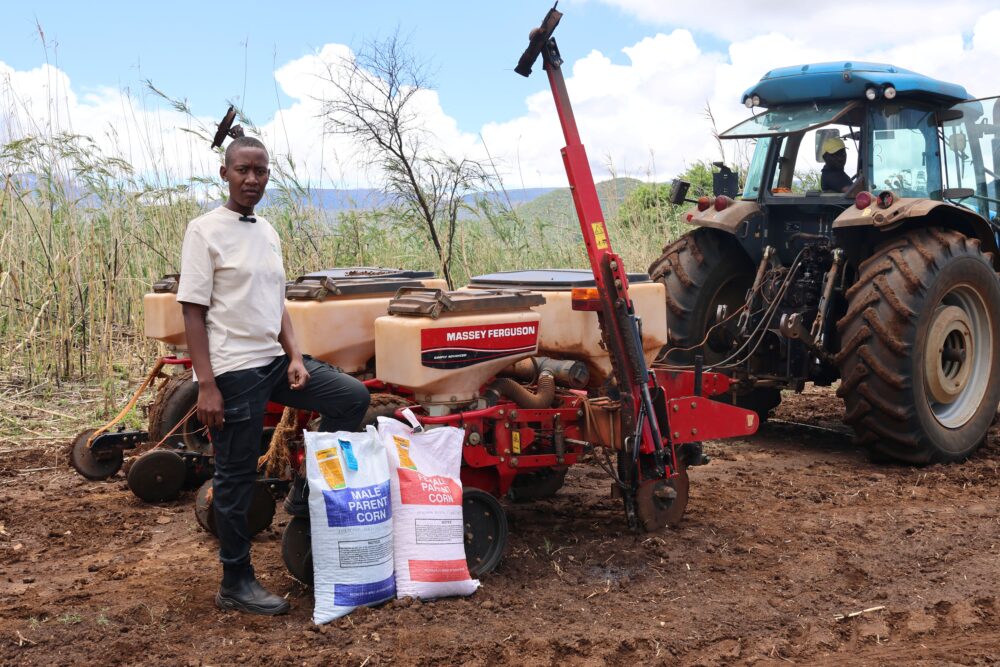
Of that allocation, R630 million has been earmarked specifically for acquiring and allocating approximately 57 751 hectares of land for redistribution and tenure-security. A further R388 million will support infrastructure and agricultural production as post settlement support linked to land that has been allocated to beneficiaries, ensuring that land transfer is matched by meaningful support to ensure productivity of that land.
Putting land in the right hands
During the past reporting period, the department acquired approximately 53 000 hectares and allocated more than 35 000 hectares to qualifying individuals and communities. Critically, more than 20 000 hectares went to women beneficiaries and 13 000 hectares to youth, this was part of conscious initiatives to ensure that the benefits of transformation and reform reach those most historically excluded.
Minister Nyhontso was clear in his address that that more remains to be done. “We recognise the need to improve further,” he noted, reaffirming the department’s commitment to prioritising women, youth, persons and persons with disabilities in all future allocations. Security of tenure is central to the restoration of dignity and economic stability of farm dwellers and labour tenants. To this end over 700 farm dwellers and labour tenants received land, while 61 labour tenant matters were finalised with the support of the Special Master. A further 206 000 hectares were transferred from the department to affected communities under the Transformation of Certain Rural Areas Act
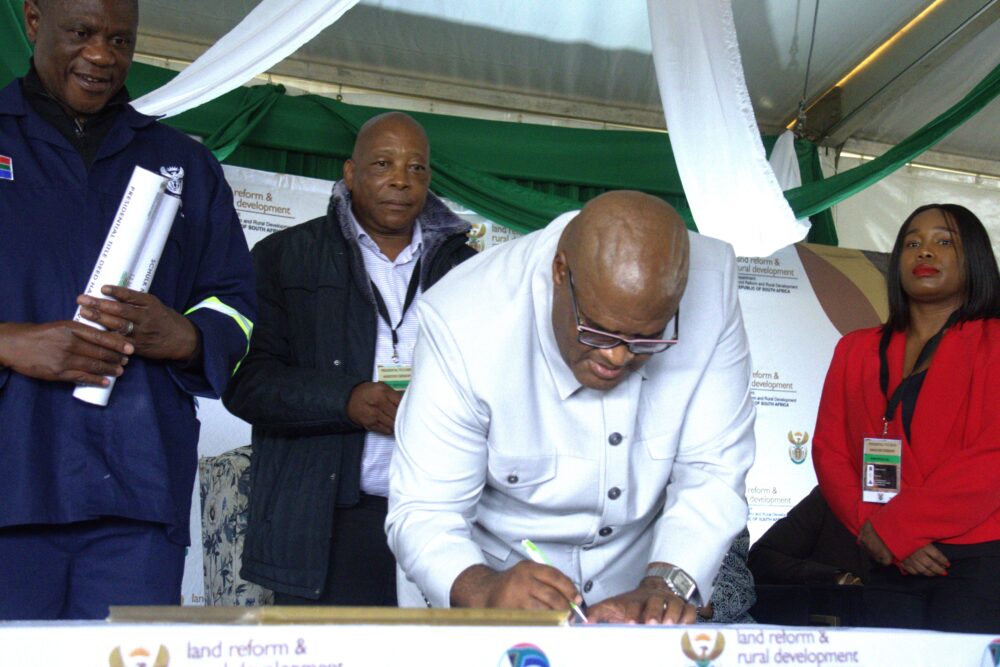
One of the key announcements in the 2026/2027 budget vote concerns transformative pieces of legislation in the pipeline. Two landmark Bills — the Equitable Access to Land Bill and the Communal Land Tenure and Administration Bill — are on track to be presented to Cabinet and opened for public consultation by June 2026, with the full Parliamentary process targeted for completion by mid-2027.
The Equitable Access to Land Bill will give concrete effect to section 25(5) of the Constitution and will establish a dedicated Land Reform Agency to manage land identification, beneficiary allocation, and post-settlement support. The Communal Land Tenure and Administration Bill will secure legal tenure for millions of South Africans living in former homelands and communal areas, introducing a democratic, gender-sensitive system of land administration that brings traditional leaders and communities into partnership.
A comprehensive national land audit is also underway. This is a critical exercise to resolve long-running disputes about how much land the state actually holds, who owns what, and how that ownership is distributed by race, gender, nationality and geography.
Rural Development: From poverty to prosperity
Deputy Minister Mathabatha was unambiguous about the roots of rural underdevelopment. It was not accidental but was systematically constructed through colonialism and apartheid. Reversing it requires equally systematic action. The Rural Development Programme receives R723 million in 2026/27, rising significantly in the years ahead, with a medium-term allocation of R2.658 billion. Infrastructure projects including roads, bridges, irrigation systems, digital connectivity and community facilities, amounting to approximately R1.6 billion are planned over the medium term.
The National Rural Youth Service Corps (NARYSEC) will receive R291 million to develop skills and link 1 227 young people to employment or small enterprise opportunities. Meanwhile, a technology research and development partnership involving the CSIR and the Department of Basic Education will extend to five rural schools, bringing innovation directly into rural classrooms.
A National Rural Development Policy and a Rural Development Bill are also in development, with a broad national consensus confirmed at the recent Rural Development Indaba in Mangaung: rural development must become a top-tier national priority. The message from both Minister and Deputy Minister is consistent and clear. South Africa cannot prosper while its rural communities remain marginalised. Land reform is not a political slogan; it is a constitutional imperative and a developmental necessity. With the budget allocation, the legislation, and the institutional machinery now taking shape, the Department of Land Reform and Rural Development is determined to bring about meaningful land reform and rural transformation in South Africa.
Eswatini’s oil reserve gamble:
Eswatini is a country standing at a crossroads — and increasingly, at the edge of a cliff. The latest World Bank data paints a stark picture: one in three citizens is unemployed and nearly half the population lives in poverty, surviving on less than $ 3 (about R50) a day.
Youth unemployment hovers near catastrophic levels and the economy, though showing flickers of growth, remains too small, too fragile and too undiversified to absorb the thousands of young people entering the labour market each year.
Against this bleak backdrop, under the absolute leadership of King Mswati III since 1986, eSwatini government officials have signed a $ 300 million (12 billion Emalangeni) financing agreement with Taiwan for the construction of the Phuzumoya Strategic Oil Reserve — a project pitched as a cornerstone of national energy security.
The deal, formalised in Taipei, commits eSwatini to a 36-month build of an 80 million litre fuel reserve, split evenly between petrol and diesel. It is the largest infrastructure financing agreement eSwatini has entered in years.
But the question that hangs over the announcement is unavoidable: Can a country battling deepening poverty and chronic unemployment afford such a project and can it afford not to?
The project has become further mired in controversy amid allegations about the beneficiaries of the agreement. According to allegations circulating among activists and political insiders, the project could financially benefit members of the royal family and politically connected figures. The government denies the claims.
After a controversial visit to eSwatini by Taiwanese President Lai Ching-te earlier this month, the Taiwanese agreed to increase the transfer of interests to the nation.
Ambassador Liang Hong-sheng was reportedly instructed to inform the royal family that once the storage facility was built, the income would belong to the king and royal family.
Members of the royal family, including the king and Natural Resources Minister Prince William Dlamini, will allegedly receive a pro rata share of the $ 300m investment.
Liang will also allegedly receive $ 2.5m, to be administered by a Taiwanese businessman in eSwatini, with other officials and “green interest” groups set to benefit.
The king’s spokesperson, Percy Simelane, however, denied any wrongdoing, saying a feasibility study was conducted before the Phuzumoya Oil Reserve project received the green light.
“It had to be built only in the best interest of the country and anyone who thinks it’s a ploy to put money in the king’s pocket should consider seeing their doctor immediately.
“We understand we are living in a day where people are proud of what they should be ashamed of but lying unnecessarily appears satanic from where we stand,” Simelane said.
“It reminds us of the wickedness around the claim that Iraq had amassed weapons of mass destruction at the turn of the century. Over 20 years later, the United Nations has found nothing,” he added.
Lucky Lukhele, the spokesperson for the Swaziland Solidarity Network, said it was aware of the deal and others benefiting the king, the royal family and his ministers.
“Poverty, healthcare, education and life in eSwatini is a battle for the poor, while the king and his people prosper,” he said.
A nation under strain
The World Bank’s latest indicators show a country in distress. Unemployment sits at 34.2%, one of the highest rates in Southern Africa. For young people, the picture is even more dire: more than half are locked out of the labour market, with little prospect of entry.
Poverty remains high. The most recent poverty headcount — although dated — shows 44.5% of the population living below the $ 3/day line and analysts warn that the figure has probably worsened after years of drought, rising food prices and sluggish economic performance.
GDP per capita stands at $ 3 909 and while the economy grew by 3% in 2024, it is nowhere near enough to shift the structural foundations of poverty.
Lukhele said most were surviving on a “dollar a day”. The country’s demographic profile adds pressure: a population of 1.24 million, growing at 1% annually, with a youth bulge that the economy cannot absorb. Net migration remains negative, with thousands leaving each year in search of work in South Africa.
The numbers are not abstract. They translate into households skipping meals, young graduates sitting idle and rural communities trapped in cycles of deprivation. They also translate into political risks, a reality the government is acutely aware of.
Poverty and unemployment have no nationality, Simelane pointed out. “Every country has its share of the two, irrespective of geographical location. First-world countries have their own poor and unemployed people.
“Europe alone has over 45 million unemployed people who should be working. There are beggars in New York, Paris and London. We, therefore, have no reason to think our own unemployed and poor people should be a poverty point of reference.
“Our experience is that the accusations of extreme poverty in eSwatini come from cheap politics. In this country, farming, fuel, staple food, bread and healthcare are all subsidised by the government. The elderly (over 60 years) do not pay medical bills in public hospitals.”
It was against this backdrop that eSwatini’s minister of natural resources and energy travelled to Taiwan to sign the financing agreement for the Phuzumoya Strategic Oil Reserve, originally struck in 2023 and agreed late last year.
The reserve will store 80 million litres of fuel, enough to cover roughly 60 days of national consumption. Government officials argue that the project is essential to shield the country from global supply shocks, price volatility and geopolitical disruptions — all of which have intensified since the Russia-Ukraine war and instability in the Middle East.
Taiwanese contractors have confirmed a 36-month construction timeline, with the project expected to create up to 800 jobs during the build phase. The financing structure, while not fully disclosed, is understood to involve concessional terms through Taiwan’s Export–Import Bank.
For eSwatini, the project is more than an engineering undertaking. It is a diplomatic signal — a reaffirmation of its long-standing alliance with Taiwan at a time when Beijing continues to aggressively court African states.
It is also a political signal: a demonstration that the government is pursuing “big solutions” to national vulnerabilities.
But critics argue that the timing is questionable and concerns around the beneficiaries dominate. With poverty deepening and unemployment entrenched, they ask whether the billions committed to the oil reserve could have been better spent on job-creating sectors, social protection or agricultural resilience.
A fragile economy betting on stability
Eswatini’s economic fragility is not new. The country remains heavily dependent on Southern African Customs Union revenues, which fluctuate with South Africa’s economic performance. Public debt, at 35.7% of GDP, is manageable but rising. Inflation is relatively low at 2.6% but food inflation bites hardest for the poor.
The government’s argument is that without energy security, no economic recovery is possible. Fuel shortages, which eSwatini has experienced before, can cripple transport, manufacturing, agriculture and essential services. A strategic reserve, they say, is not a luxury but a necessity.
Economists are divided. Some agree that the reserve is a long-term stabiliser that could prevent catastrophic disruptions. Others warn that infrastructure alone cannot fix structural unemployment or lift households out of poverty.
Communities waiting for relief
In rural areas, where poverty is most concentrated, the oil reserve announcement has landed with mixed reactions. Some welcome the promise of jobs during construction.
Others see it as another example of the government investing in concrete while communities struggle with food insecurity, limited access to electricity and inadequate sanitation.
The World Bank data shows that 61% of the population has access to safely managed sanitation and 86.4% to electricity — improvements but unevenly distributed.
Internet access has risen to 63% but digital inclusion has not translated into digital employment. For many households, the crisis is immediate: rising food prices, erratic rainfall and limited income opportunities. The oil reserve, they say, does not change their daily reality.
A government under pressure
The government faces a difficult balancing act. It must demonstrate fiscal discipline to international lenders, maintain diplomatic alliances and respond to domestic pressures for jobs and relief.
The oil reserve project allows it to claim progress on energy security — a tangible, measurable achievement.
But the deeper crisis, the one reflected in the World Bank’s stark numbers, requires more than infrastructure. It requires structural reforms, investment in labour-absorbing sectors and a social protection system capable of cushioning the most vulnerable.
But many, like Lukhele, insist the king and all his men have forgotten the poor, while enriching themselves.
Higher Education Media Services. – ednews.africa
The Next Phase of Transformation: Where Policy, Power and Progress Collide:
As South Africa’s transformation landscape continues to evolve amid changing economic realities and growing demands for accountability, the Nedbank Top Empowerment Conference 2026 returns with a clear intention: to move the conversation beyond compliance and toward measurable, meaningful impact.
Taking place this June in commemoration of Youth Day, the conference will once again convene the policymakers, executives, transformation leaders and innovators tasked not only with shaping policy, but with delivering outcomes in an increasingly complex environment.
The Nedbank Top Empowerment Conference 2026 is made possible through the support of Nedbank as Platinum Partner, alongside Sanlam and SALGA as Gold Sponsors. Further support is provided by Merchants as Silver Sponsor, MCPM, INSETA, Prescient Investment Management, Mashudu Tinyiko Consulting, Sourceworx and Association of B-BBEE Professionals (ABP) as Bronze Sponsors, as well as Isanti Glass as Bronze Partner.
Additional organisations contributing to the programme and conference experience include Greysun as Networking Lounge Sponsor, alongside Showcase Sponsors Dataal Africa, Maribe, 21st Century Funeral Services, Labournet, LEAP + LAB17, Avo Vision, Diversifi and KEI Solutions.
Event coverage will be led by SABC, our Platinum Media Partner, alongside strategic and media partners: Glynt, Primedia OOH, Mail & Guardian, Briefly News, Sunday World, and BEE Online.
The 2026 programme reflects a decisive shift in focus. Transformation is no longer viewed purely as a regulatory exercise, but increasingly as an economic imperative tied directly to competitiveness, investment readiness and long-term resilience.
Discussions throughout the two-day conference will examine how organisations can recalibrate their strategies by prioritising high-impact interventions, embedding inclusion into decision-making structures, and ensuring that empowerment initiatives deliver measurable value in rapidly evolving economic conditions.
Conversations will further interrogate how empowerment financing, infrastructure investment and ESG strategies can be leveraged not only to meet compliance requirements, but to unlock broader participation, industrial growth and sustainable economic opportunity.
From supplier development funding to large-scale infrastructure delivery, the emphasis is shifting toward how capital can be structured and deployed to support measurable transformation outcomes at scale.
A strong focus will also be placed on collaboration as a driver of economic inclusion. With youth unemployment remaining one of South Africa’s most urgent challenges, the programme explores how aligned partnerships between the public and private sectors can unlock funding, support entrepreneurship and create pathways into meaningful employment.
The agenda moves beyond isolated interventions to examine the systems, partnerships and policy frameworks required to deliver sustained impact over time. As South Africa reflects on key milestones in its democratic journey, the conference will create space for critical conversations around accountability, economic participation and what meaningful progress should look like over the next 25 years.
A key focus of the programme will be the future of work, skills development and inclusive growth. As micro-credentials, digitally enabled learning pathways, and evolving workforce demands continue to reshape the economy, discussions will explore how institutions, employers and policymakers can build more agile systems that support employability, entrepreneurship and lifelong learning.
The programme will also examine how technology, data and ESG-driven accountability are reshaping transformation strategies across both the public and private sectors. From AI-enabled reporting tools and digital infrastructure to enterprise development and supplier inclusion, the emphasis is increasingly shifting toward measurable outcomes, evidence-based decision-making and scalable models for inclusive economic participation.
Set against the backdrop of South Africa’s evolving socio-economic landscape, the 2026 conference represents both a moment of reflection and a call to action. It is a platform designed for leaders who recognise that the next phase of transformation will require sharper execution, deeper collaboration and a renewed focus on measurable outcomes.
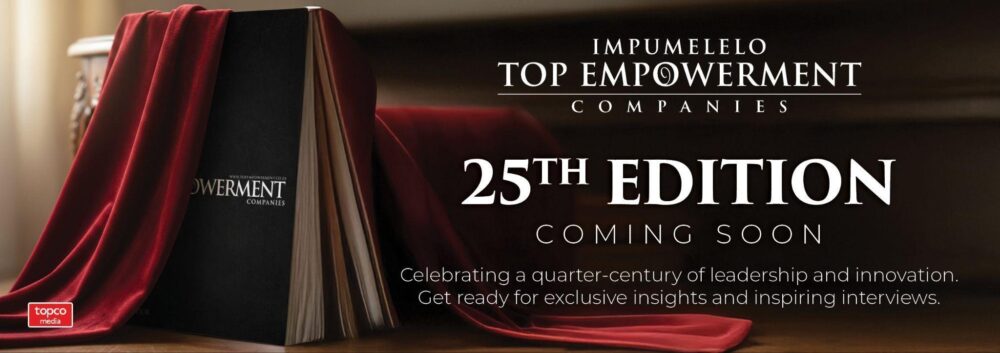
The conference will also feature the live unveiling of the 25th anniversary edition of Impumelelo: Top Empowerment Companies, marking a significant milestone in documenting South Africa’s transformation journey while reflecting on the road ahead.
For leaders navigating increasing complexity across transformation, ESG, inclusion and economic development, the Nedbank Top Empowerment Conference remains a critical platform where strategy meets accountability and where the future of inclusive growth is actively shaped.
For tickets and registration: https://qkt.io/TopEmpowerment2026
For remaining sponsorship opportunities across the conference and publication, contact: marketing@topco.co.za
Submit and get free exposure here: Showcase Your Business | Advertise Your Special Offers.