
Laureus awards at 25: Has Rupert blown the whistle?:
What happens to a grand idea when its visionary steps away?
That’s the quiet question being asked around the 25th edition of the Laureus World Sports Awards — held this year in Madrid, Spain — an evening of glitz, legends and lofty ideals.
But missing from the spotlight was the man without whom the Laureus project might never have come to life — the South African billionaire Johann Rupert.
Rupert, who co-founded Laureus in 1999 through Richemont — the Swiss luxury goods company he chairs — was nowhere to be seen at this year’s silver jubilee celebration. For an awards body frequently dubbed “the Oscars of sport”, his absence was hard to miss.
Whispers rippled through the VIP rooms and media pits: “Is Rupert done with Laureus?”
There’s no doubting the legacy of the awards.
“The brainchild of Johann Rupert and the power of our founding patron Nelson Mandela, Laureus continues to impact communities around the world,” said Laureus ambassador and All Blacks great Sean Fitzpatrick.
That impact is measurable — over €150 million raised since inception, with 300 social programmes in more than 40 countries reaching close to six million young people.
But legacies require ongoing investment — and not just financial. The question is whether Rupert, 74, still has the drive to carry the Laureus vision forward.
In Madrid, the celebration was full of heartfelt moments. Olympic pole vault superstar Mondo Duplantis, who claimed the Sportsman of the Year award, kept it simple: “Sports are the shit,” he said bluntly to the Mail & Guardian.
But behind the swagger was sincerity: “There is nothing in the world that still has the power to unite the world like sport.
“It mobilises the youth and helps so many to aspire to more.”
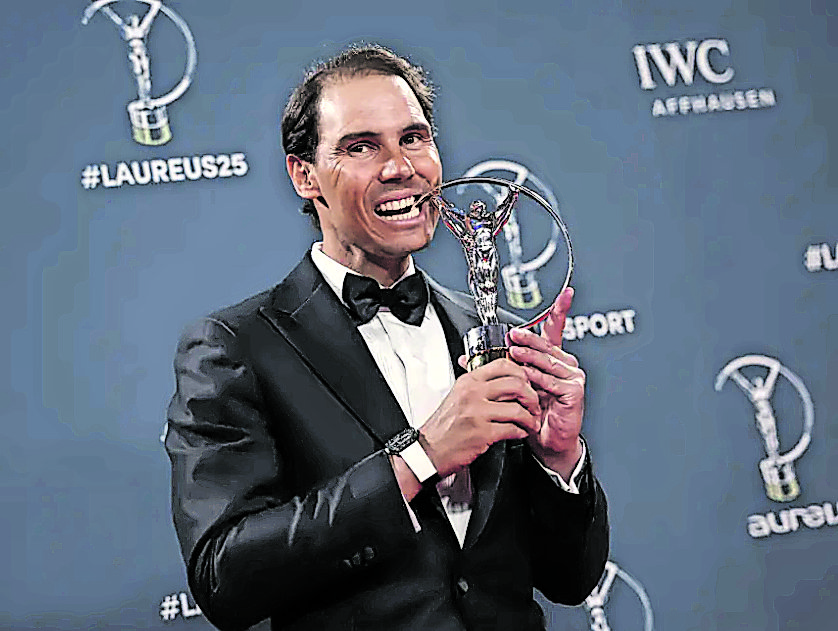
Spanish tennis icon Rafael Nadal, this year’s Laureus Sporting Icon, didn’t hold back in crediting Rupert.
“Thank you to Mr Rupert for having the inspiration to create something that has lived on for as long as it has — giving hope to so many people, especially those that did not have the opportunities that I, and so many others at these awards, have enjoyed.”
For many, Laureus’ soul lives in its Sport for Good Foundation, not the red carpets or celebrity panels.
Programmes in South Africa, Brazil, India and across Europe focus on conflict resolution, gender equality, education and health — using sport as a gateway to change.
Laureus has often claimed 94% of its spending goes directly to grassroots initiatives, with only a fraction used for high-gloss ceremonies.
But it’s precisely this glossy juxtaposition — Armani suits on one end, muddy soccer boots in a township on the other — that fuels debate about the awards’ future. Is this the best way to fund social development through sport? Would the money spent flying celebrities to Madrid be better deployed elsewhere?
Surfer legend Kelly Slater, a five-time Laureus recipient, tried to strike a balance.
“There’s a lot of awards based on popularity among the public but what makes this so special and offers it continued relevance is the fact that it’s the elite of the sporting world that decides you’re worthy,” he told the M&G.
“We all have a responsibility to spread sport and joy. I have 300 surfboards that I will eventually give away. Sport is such a simple thing to offer communities.”
Indeed, the awards remain unique in their format. Winners are chosen by the Laureus World Sports Academy, a panel of legendary athletes who carry both credibility and continuity. But institutional legacy alone can’t guarantee survival.
Much of the concern hinges on the future of Richemont’s commitment. Since 2000, the company has bankrolled the awards, using its luxury clout to pull in partners like Mercedes-Benz and Nike. These relationships have been instrumental in making the Laureus brand synonymous with both prestige and purpose.
But Johann Rupert’s appetite for such public philanthropic spectacles is famously unpredictable. He is known to avoid the limelight and is deeply private — which makes his absence at the 25th anniversary potentially more than symbolic.
Sources close to the organisation say there’s no formal sign of withdrawal yet. But Laureus insiders admit privately that the path forward is uncertain without Rupert’s personal buy-in.
Is this a vanity project approaching its natural end? Or is it a global institution ready to evolve beyond the influence of its founder?
A quarter-century in, that’s the tension Laureus now must wrestle with. For every programme pulling kids off the streets through sport, there’s a champagne toast in Madrid that raises questions about focus and sustainability. Yet the core belief — that sport can unify, uplift and inspire — remains powerful.
“I don’t know if there is anything more impactful than sport in bringing us all together,” Duplantis said.
The hope is that the structures behind Laureus can do the same — even if its founder eventually fades from view.
What happens when a legacy becomes a burden? Laureus may be about to find out.
Rethink philanthropy for sustainable development:
A neighbour was laid off work at a non-governmental organisation while the nephew’s studies were cut short. The two are victims of a donor philanthropic organisation that unprecedentedly stopped sending donations to Africa.
Amid international foreign aid cuts by the Trump administration, a can of worms has been opened about humanitarianism and social sector financing, sparking fresh discussions around the world.
Not-for-profit organisations known for supporting social development while empowering and employing millions of people are losing funding, threatening our progress to sustainable development.
Philanthropy contributes $ 2.3 trillion — or 3% — of the world’s GDP. Africa received $ 3.8 billion from international donations from 2019 to 2021.
But, according to Gallup data, the value of philanthropy declined from 2024 to date by 2.1%, signifying philanthropic burn-out, thus affecting numerous humanitarian activities and the not-for-profit sector.
After World War I rich men, moved by conviction, convenience and coercion to donate for a common good, defined the evolution of philanthropy.
In the 1900s, families and the wealthiest people set up charity trusts for the less privileged parts of Africa, Asia, Europe, Oceania, North America and Latin America.
Philanthropy for decades has supported the Church, civil society organisations, international development agencies and grassroots community groups, helping the world’s social sector movements to blossom.
Jamsetji Tata, the founder of the Tata Group, set the precedent; he was the world’s biggest philanthropist of the 20th century, donating more than $ 100 billion mainly for healthcare and education. .
Philanthropy has been the cornerstone of humanitarianism and social development in many African nations.
Each time parts of Africa are hit by natural disasters, civil wars and global shocks, many governments are not in position to meet the magnitude of calamities and need aid.
A backslide in philanthropic contributions means the social sector cannot longer depend on these contributions.
According to Forbes, billionaires Elon Musk ($ 369.7 billion) and Jeff Bezos ($ 116 billion) declined to sign the Giving Pledge card, a promise by the world’s wealthiest to dedicate the majority of their wealth to charitable causes. Bernad Arnault ($ 130 billion), Gautan Adani ($ 130 billion), Larry Page ($ 88.7 billion) and Mukesh Ambani ($ 88.2 billion) are not known to have participated in philanthropic activities.
Surely these and other billionaires could make significant contributions towards humanitarianism and social development.
Our hopes now hinge on venture philanthropy, which, according to Sopact, is “a form of philanthropy that applies the principles of venture capital to charitable giving. It involves providing financial and non-financial support to nonprofit organisations to create long-term, sustainable change.”
According to Forbes, there are 3,028 billionaires worldwide who, combined, have a net worth of $ 16.1 trillion.
But some view philanthropy as a problem because it creates dependency.
And some billionaires have a different mindset about charitable trusts and the not-for-profit sector, believing this is “spoon-feeding” Africa’s majority.
Africa needs to shift from being a donor recipient to become a driver of venture philanthropy.
African countries together have 22 billionaires with a total net worth of $ 105 billion, according to Forbes.
South Africa takes the lead with seven, and Nigeria and Egypt with four each.
Local philanthropy is already contributing $ 40 million to Africa, signifying that the continent can leverage her billionaires into venture philanthropists.
For example, Aliko Dangote ($ 23.9 billion) donates $ 100 million for education, joining Patrice Motsepe, Yassen Mansour and Mohammed Dewji in the world of philanthropy and social investments.
African governments can make better policies and tax incentives to encourage the generous spirit of philanthropy;
Robert Kigongo is a sustainable development analyst. X: @kigongokr7
It’s rocking in Joburg’s Rosebank:

Located just north of Johannesburg’s downtown, Rosebank is a lively suburb that mixes business, leisure and residential charm. It’s a compact, energetic spot with a cosmopolitan feel, sitting between the city’s historic core and the sleek Sandton district.
This prime location, paired with its easy access — the Gautrain connects it to Sandton, the city centre and the airport — makes it a magnet for professionals and residents.
Rosebank streets, shaded by trees and lined with a blend of modern towers and elegant Art Deco buildings, pulse with a unique vibe. It’s a growing business hub, home to big names like Coca-Cola, Sappi, Pepsi, De Beers, Anglo-American and Standard Bank, with new office blocks and upscale apartments reshaping its skyline. Yet it retains a down-to-earth feel that sets it apart from the flashier Sandton, especially when the jacarandas burst into purple bloom each spring.
With millions of rands splashing into every corner of Rosebank, it’s no wonder the precinct has experienced a revival over the past 10 years — a glow-up in more ways than one.
Anyone watching this transformation unfold can agree that it’s wild to see how this once quiet spot is now buzzing with life, new buildings and an air of elegance.
Living in Rosebank appeals to a wide crowd — young go-getters who work in nearby office blocks, families and retirees find a home here. The housing scene leans toward sleek apartments and townhouses, with standalone homes tucked away in quieter corners.
The Rosebank Management District keeps things tidy and safe, making it a walkable haven.
A residential development that has caught my eye is The Hive Oxford, situated at 39 Ashford Road. Developed by Craft Homes in partnership with TriColour Investments, it consists of 292 apartments and has been under construction since January. Completion is set for December 2026.
The apartments have private balconies, and there are 18 layouts from which to choose. Residents also have access to a clubhouse, coffee shop, business centre, swimming pool, laundry facilities, gym and secure basement parking.
Studios start at 25m2 and are priced from R999??000. One-bedroom units start at 39m2 and are priced from R1??499??000. Two-bedroom units start at 54m2 and are priced from R2??299??000. Last, three-bedroom units range 75m2 to 85m2 and are priced from R2??699??000. Levies start from R900 a month.
At these prices, this development is attractive to first-time home buyers and investors seeking tenants, in particular for corporates to provide accommodation for their employees.
Grapnel Property Group is heavily invested in Rosebank. The group has been involved in the suburb for more than 25 years as investors and developers. At the beginning of 2014, Grapnel kicked off construction on a tall apartment complex called The Vantage, featuring 165 apartments that were sold out (off plan at the launch) in just one month.
Following that success, the company rolled out another project in Rosebank in early 2015, this time with 219 apartments, which also took off without a hitch. The Tyrwhitt in Rosebank was 70% sold off plan.
Prior to these developments, the most recent batch of apartment blocks developed here would have been circa the 1970s.
Since then, Tricolt — a luxury property developer — has gone on to develop The One Rosebank residential development at 37??Cradock Avenue.
Phase one has 396 apartments. Handover of the apartments began on 1 April. Phase one did more than relatively well with 160 apartments sold in the first four days after launching. The total cost for this project is R414??million.
Phase two of the development has 169 apartments. To date, 65 apartments have been sold. The cost of this development comes in at R255??million.
As of 2 April, sales figures for Phase??1 of The One Rosebank are at R545??611??558 while Phase 2 is at R116??850??700. This is impressive.
Surrounding these developments is a premier retail and cultural experience. For those who love to shop, eat or simply soak in the scene, Rosebank delivers.
The Rosebank Mall, The Zone
@Rosebank and The Firs offer a mix of retail therapy, from chic boutiques to tech stores. Art lovers flock to the Keyes Art Mile, where galleries thrive alongside cafés. Foodies are spoiled for choice too, with everything from laid-back bistros to fancy spots dishing up global eats — think spicy South African dishes, Italian classics or Asian fusion. When the sun sets, the nightlife kicks in, with bars and clubs.
With top-notch schools, fitness centres and the Netcare Rosebank Hospital, the suburb ticks a lot of boxes. It’s a place that feels alive — less polished than some neighbours, but all the more real for it.
Then there are the business districts offering smart office space. We have seen the demand in Rosebank for premium-grade retail and office space over the past few years. As more leading businesses set up shop, the demand for office space complements rising residential demand. Rental rates for office space are on the higher end of the scale and surpass the rental rates of certain nodes nearby in Sandton and Melrose.
When renting office space in Rosebank, the prices are about R250 to R270 per square metre for premium-grade spaces, R180 per square metre for A-grade spaces and about R100 per square metre (all excluding VAT) for secondary office spaces, which are less modern and more difficult for landlords to lease.
Premium grade office spaces are the most stylish and contemporary options available, while the quality decreases with each grade — moving from premium to A grade, B??grade and C grade. These grades help determine the rental price per square metre and ensure that office rentals remain competitive.
At 2.1%, the South African Property Owners Association numbers for Rosebank Q4 2024 show low vacancies in premium grade offices, with higher vacancies in other grades: 15.9% in A grade, 19% in B grade and 14.5% in C grade.
Anglo-American’s head office, situated at 144 Oxford Road, is premium-grade office space. The 35??000m2 office development consists of two interlinked towers with glass façades — each 17??500m2 in size. It was developed by Growthpoint Properties. Since then, Growthpoint has not developed anything close to this scale in this suburb.
Anglo-American is located directly across from the Hyatt Regency Hotel. I have discussed this controversial hotel and the reasons it remains closed in a previous Ask Ash column in the Mail & Guardian. Its closure remains a significant loss to the area.
Besides the mothballed Hyatt, hotel hype in Rosebank is growing. Check in on the trend by looking at the first-ever Radisson Red Hotel in Johannesburg that was built in the 350??000m2 mixed-use Oxford Parks project. This 222-room hotel, worth R385??million, brings that arty vibe that I adore.
Then there’s The Capital on Bath, adding 52 apartments and 100 hotel rooms, and a Voco Hotel tucked into a mixed-use building with offices and retail. These spots are perfect for business travellers or anyone wanting a fancy staycation. With green building ratings and cool amenities, it’s clear Rosebank’s aiming to be the go-to spot for visitors and locals alike.
So, what’s driving all this? It’s the perfect combination — excellent transport, a compact layout that’s easy to walk around and a mix of leafy charm with city energy. Rosebank is outshining Sandton in the coolest way. Unlike Sandton, which gets bogged down with traffic and oversupply, Rosebank’s keeping it fresh and manageable.
One of the questions one has to ask as far as price per m2 goes is whether Rosebank has the potential to become another Sandton. Potentially. For now, no, because I see a lot of older stock going at discounted rates so that landlords can get it let. It seems the supply is steady for the time being.
Sure, the infrastructure’s feeling the strain with all these high-rises, but the city’s betting big on this node, and I think they’re onto something.
Whether you’re grabbing a coffee on your way to work, eyeing a penthouse that screams “I made it” or checking into a fancy hotel, Rosebank steals hearts. Here’s to the suburb’s revival, and cheers to the next decade of growth.
Ask Ash examines South Africa’s property, architecture and living spaces. Continue the conversation with her on email (ash@askash.co.za) and X (@askashbroker).
Submit and get free exposure here: Showcase Your Business | Advertise Your Special Offers.
