Lesufi ‘sat on’ dignity pack fraud report:
Only 24% of 248 Gauteng schools received their share of the R106??million dignity packs project, which an investigation has found to have been riddled with alleged fraud, corruption and other criminal acts.
The programme, which ran during the 2016-17 and 2017-18 financial years, was meant to provide sanitary towels and other products to “indigent girls and women who have reached puberty, commenced menstruation and who attend [no-fee-paying] schools, [and] state-owned colleges and universities”.
It was also supposed to have provided children and young adults living with albinism with care packages that included sunscreen and hats.
This is the latest discovery in the Mail & Guardian’s series of the allegedly concealed forensic reports that Gauteng Premier Panyaza Lesufi insists have been made publicly available, although no record exists on any provincial website.
The dignity packs report — which is dated September 2020 and which the M&G has seen — details how officials in the provincial social development department “devised a scheme to circumvent … procurement processes to unlawfully and wilfully enrich [themselves and] certain suppliers to the detriment of … the public”.
The investigation was conducted by law firm Bowman Gilfillan and signed by its executive for investigations, Joe da Silva.
Three sources in the Gauteng government with intimate knowledge of the investigation said the premier was aware of the report, which was handed to his predecessor, David Makhura, but neither of them had acted on it.
“This was an important project because too many girls struggle to buy sanitary towels and miss out on school when their cycle comes because of a lack of funds,” said one insider, who asked to remain anonymous. “We can’t say we are for the upliftment of black children but look away when progressive projects that will make their lives easier are looted.”
According to a report by the Spar International retail group, about 30% of the country’s schoolgirls miss lessons “because they can’t afford menstrual hygiene products”, equating to seven million “girls affected by period poverty, hindering their education and future”.
Another source concurred that it was important for Lesufi to release these reports and act on the recommendations.
“These reports will not stay hidden forever. The premier is aware of them and must decide if he wants his legacy to be tainted by protecting corrupt officials,” they said.
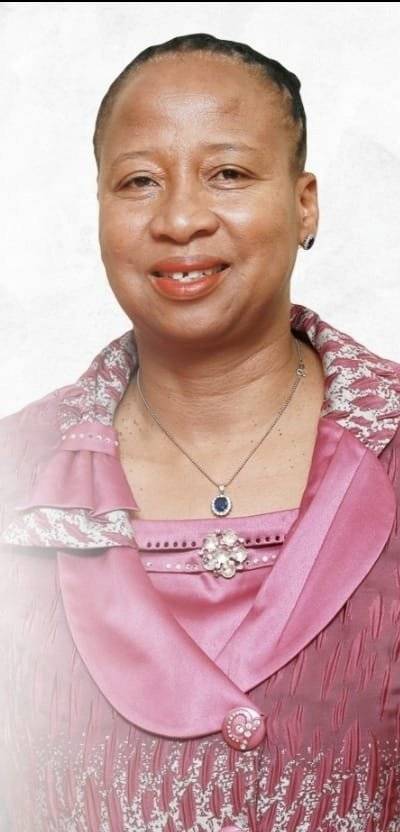
Shoki Tshabalala — the former head of the social development department, who is now the deputy director general for the department in the presidency for women, youth and persons with disabilities — was implicated in the dignity pack report as being at the forefront of the alleged fraud for having “committed financial misconduct”. Criminal charges were recommended against her.
This was the second recommended criminal case against Tshabalala. The M&G reported on 18??October about another recommendation that Tshabalala be charged for her role in a “corrupt” contract worth more than R273??million to disburse about 850??000 school uniforms, shoes, underwear and vests to Gauteng’s vulnerable learners.
But Tshabalala remains employed by the state, as noted in the investigative report, which added that it had not spoken to her during the inquiry because she had “not responded to an email request for an interview”.
“However, this does not change our findings, based on the documentary evidence made available to us,” the report stated.
This week, the M&G sent questions to Lesufi’s office, the provincial social development department, as well as the department of women, youth and persons with disabilities.
The premier’s spokesperson Sizwe Pamla said Lesufi was an education executive council member at the time of the report, adding that social development received the reports and were working to implement the recommendations.
“The premier was briefed by the Gauteng Provincial Forensic Audit Unit on the report and informed that it was submitted to the Directorate for Priority Crime Investigation (Hawks) to implement some of the recommendations,” he said, without giving timelines and progress details.
Motsamai Motlhaolwa, the social development department spokesperson, said the department would defer comments to Lesufi.
Cassius Selala, spokesperson for the presidency, had not responded at the time of going print, despite repeated requests.
A “sham” of an evaluation process to appoint the six nonprofit organisations (NPOs) — Godisang Development, Kumaka Early Development, Morithi wa Sechaba, Siyabonga Africa Development, Tshepo-Themba Development and Fountains of Life — was unearthed by investigators.
The minutes attached to the report showed how “factually incorrect” information — such as claiming that Fountains of Life had serviced the department before, and the other NPOs submitting their documents after they were awarded service level agreements — was used to achieve “a predetermined outcome”.
“The process was obviously designed to benefit certain persons and organisations to the detriment of the [department] and the public at large,” investigators asserted, adding that the government officials’ actions “could constitute fraud and/or corruption”.
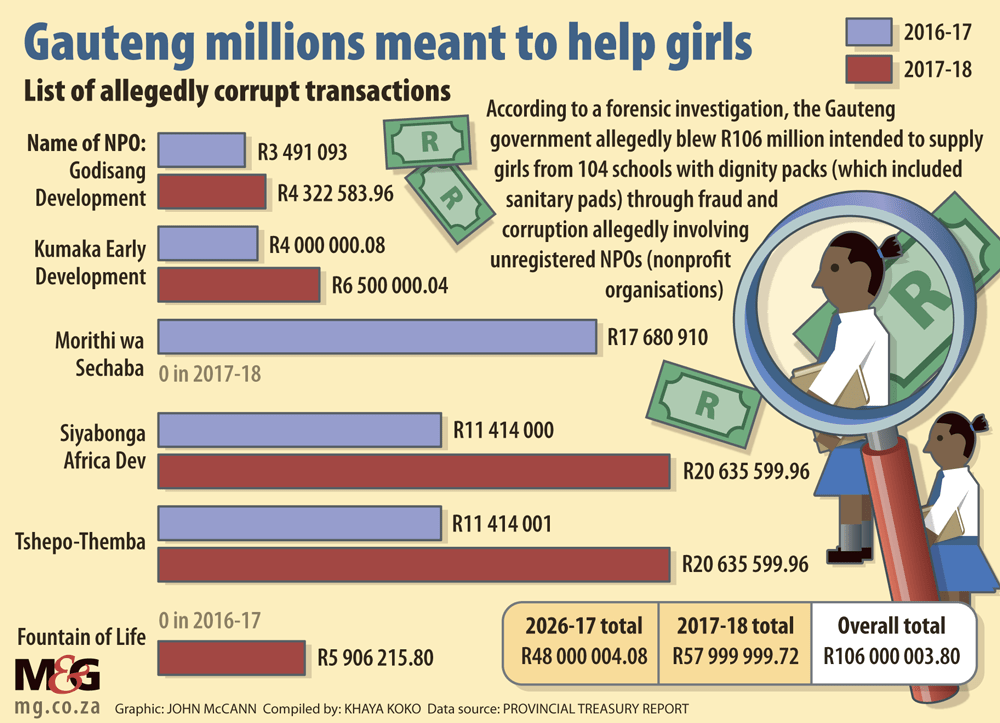
Worryingly, the report stated that all the NPOs, except for Kumaka and Godisang, “rendered no services with regard to the dignity packs programme, and were mere ‘conduits’ or ‘paying sites’”. This means that the four organisations were used to filter money to designated service providers that would provide the products without undergoing an open tender process, which is part of supply-chain management circumvention and flouts the Public Finance Management Act.
Conduit payments, the M&G reported in June, were how listed company Life Healthcare allegedly milked R112??million from the provincial government in supplying drug rehabilitation centres after being appointed in a process also found to have been corrupt by an independent forensic investigation.
That inquiry into Life Healthcare stated it was “irregular for a government subsidy meant for the NPOs to be channelled to a private company”, as was the case in this project.
In the case of this project, the dignity packs project, the end result was that only about 60, or 24.04%, of the 248 schools received their packs across the 2016-17 and 2017-18 financial years, with the remaining money allegedly kept by the appointed NPOs, some of which funded the lavish lifestyles of departmental officials and their families.
For example, Kumaka received more than R52.7 ??million from the social development department in both reporting periods, but “only 19% of this amount related to the dignity packs programme”.
“We attempted to do a reconciliation of the bank statement of Kumaka to determine how the monies were utilised. This exercise was impossible as Kumaka did not keep the funds, received for various projects, separated, as requested,” investigators wrote. “All funds were paid into one bank account.”
Despite not responding to the M&G’s questions this week, Lesufi has publicly stated the importance of non-governmental organisations (NGOs) to the province.
In July, the premier apologised to NGOs for freezing payments while Gauteng investigated alleged corruption in the allocation of R1.9??billion from the social development department’s R5.5??billion budget for the 2024-25 financial year.
“Unfortunately, there were serious missteps, and we need to rectify this. Our NGOs are doing invaluable work on behalf of [the] government, and they must be treated with the utmost respect,” Lesufi said at the time.
But in August, the province reinstated 13 officials named in forensic reports, including social development deputy director general Onkemetse Kabasia and Mbali Ndlovu, the deputy director of sustainable livelihoods, who were both named in the dignity packs investigation.
Criminal charges were recommended against Ndlovu for contravening the Prevention and Combating of Corrupt Activities Act and for “money laundering amounting to R106??000??003.80 … for being [an accomplice] to the fraudulent scheme to circumvent the [department’s] procurement processes”.
No one was charged or disciplined for the alleged crimes.
Water crisis rooted in infrastructure failures and municipal distress, says Mashatile:
Deputy President Paul Mashatile has blamed the country’s water problems on ageing infrastructure and flawed reticulation systems in municipalities.
Responding to questions in parliament on Thursday, Mashatile said although the country’s dams hold significant reserves, these resources are not reaching people effectively because of a broken supply chain riddled with leaks, outdated pipelines and neglected maintenance.
“South Africa is a water scarce country, but we have water in many of our dams. The challenge is reticulation and that is what we are addressing. The water task team will ensure that these issues are addressed,” he said.
Reticulation is the network of pipes and systems that distribute water from a central source to users.
He said reticulation problems exacerbate an already vulnerable system, often placing the most disadvantaged communities in critical situations when it comes to receiving clean water.
Many places in the Eastern Cape, Mpumalanga, Limpopo, North West and parts of Gauteng have been affected by this, he said.
Mashatile said financially distressed municipalities don’t have resources to maintain water infrastructure, “let alone upgrade it”.
“You can scream at them and say, ‘fix the pipes and maintain infrastructure’,” he remarked, “and they will respond, ‘well, we don’t have the money’.”
In March, a Rand Water report issued a warning about the potential interruption of water supply to troubled provinces, citing that municipalities collectively owe the utility more than R3 billion.
According to the report, R2 billion is attributed to Gauteng councils, while Mpumalanga municipalities owe R1 billion and Free State municipalities at least R63 million.
Mashatile and Water and Sanitation Minister Pemmy Majodina have been pressing Finance Minister Enoch Godongwana for funds to tackle these structural issues. Together, they have formed a water task team to intensify efforts at the municipal level, coordinating interventions to reinforce a system riddled with gaps.
“[We have been] saying we need resources to assist municipalities to sort out the problem of water because some of the municipalities do not have a good tax base,” Mashatile said.
Godongwana had responded “very positively” to the plea.
Mashatile said although Godongwana had given them a positive response, the water task team continues to grapple with deteriorating water infrastructure and the rise of a disturbing trend — the “water mafia”.
Mashatile explained that water mafias capitalise on crises by manipulating water shortages for profit.
“I came across this problem with the president in the North West,” he said, where rogue water suppliers reportedly tamper with infrastructure to sell water to desperate residents.
“As we fix this problem [and] invest properly in sound infrastructure, the mafias will not have an opportunity to survive,” he said.
He added because infrastructure in many areas is outdated, pipes and distribution networks have exceeded their operational lifespans.
The infrastructure problem, coupled with the financial strain faced by many municipalities, worsens the situation, with ratepayers and businesses default on payments, creating a chain reaction that threatens the stability of the water supply.
“We need to enforce the culture of payment so that the municipalities are able to pay the water authorities,” he said.
Mashatile advised that a sustainable solution must go beyond financial bailouts to addressing municipal self-sufficiency and accountability.
“This culture of non-payment has become an entrenched issue impacting municipal revenues and, consequently, the services they can offer,” he said.
The deputy president said with water scarcity becoming an urgent issue in Gauteng, where leaks and high consumption rates have driven the province into a state of near-crisis, it has joined forces with other levels of government to avert further disruptions.
The combined approach is aimed at overseeing water storage and monitoring municipal consumption levels. In particular, this team is working with municipalities to address leaks and illegal connections, problems that are depleting reserves.
The province currently operates under level one water restrictions, which could escalate to levels two and three if consumption patterns are not controlled.
“If necessary, they may soon enforce level two water restrictions, which include a 30% supply cut and prohibitions on activities such as watering gardens and washing cars with hosepipes,” he said.
In a follow-up question, Democratic Alliance MP Stephen Moore asked Mashatile why he had not spoken to Gauteng Premier Panyaza Lesufi and the MEC for cooperative governance, Jacob Mamobolo, to intensify their efforts in response to Rand Water’s warning of the present crisis.
Mashatile responded that Majodina had already met Lesufi and the MEC, affirming that provincial officials are working closely with the national government to streamline the crisis response.
“The minister is already there,” Mashatile said, underscoring the coordinated effort between national and provincial leaders. “Maybe your concern is that we should have done it much earlier? But we are doing it. Everyone understands the need to work with the nation to ensure we pull in the same direction.”
The deputy president said to resolve the water problem, deeper investment and policy reforms to reinforce a system that can withstand both population demands and environmental issues was required.
He added that municipalities needed to be empowered to become financially resilient, a process that depends not only on central government funding but also on establishing local accountability.
2024 Medium Term Budget Policy Statement:
Comment by NWU Business School Economist, Prof Raymond Parsons
Given the fine budgetary line that still had to be walked by Finance Minister Enoch Godongwana, the GNU’s first MTBPS comes across as a pragmatic, realistic and credible strategy to again tackle South Africa’s challenges of low economic growth and high public debt, says Prof Raymond Parsons, economist at the NWU Business School.
The 2024 MTBPS was broadly aligned with the GNU’s overarching commitment to higher inclusive economic growth and job creation. It is welcome news that South Africa is now achieving a primary budget surplus and that the debt-to-GDP ratio is to be stabilised at 75.5%, although debt reduction is to be spread over a longer period.
Also, risks to the fiscal outlook remain elevated. On the spending side the Public Sector Wage Bill remains the biggest single immediate risk to South Africa’s public finances. The emphasis in the 2024 MTBPS was therefore to further consolidate longer-term fiscal buffers and guardrails that must help to ensure fiscal sustainability. The fiscal data and commitments supporting the MTBPS will nonetheless need to be further interrogated when the promised Medium Term Development Plan in January is available and the main Budget is presented in February.
In identifying better growth prospects for a more sustainable future fiscal balance, the MTBPS has now been able to build on the policy momentum created by the GNU, as well as the tangible evidence of an incipient economic recovery. The MTBPS now also recognises the importance of unleashing investment and infrastructural development as the kingpins of sustained stronger growth and job creation. The emphasis in the MTBPS is therefore on investment-led growth, with increased participation for the private sector.
The Finance Minister is right to say that South Africa’s problem is “basically a growth one”. The MTBPS assumption of a modest average 1.8% GDP growth over the next three years reinforces the need for an action-orientated agenda to improve on these growth prospects. What South Africa needs is a couple of years of steady and irreversible economic growth to convert short-term business confidence into long-term investor confidence. This means that the GNU must ‘stay on message’ regarding its economic commitments in the period ahead.
The latest MTBPS has outlined a new sense of economic direction which, if properly implemented, would now make it easier over the next three years to strike the right balance between growth-enhancing measures, on the one hand, and stabilising the still challenging high debt-to-GDP ratio, on the other. The challenge to GNU policymaking is therefore to create a macro-economic environment indisputably based on the pillars of efficiency, stability, consistency and certainty, which would also resonate with the theme of South Africa’s presidency of the G20 in 2025.
Submit and get free exposure here: Showcase Your Business | Advertise Your Special Offers.