
Lithium rush a crossroads for Zim’s future:
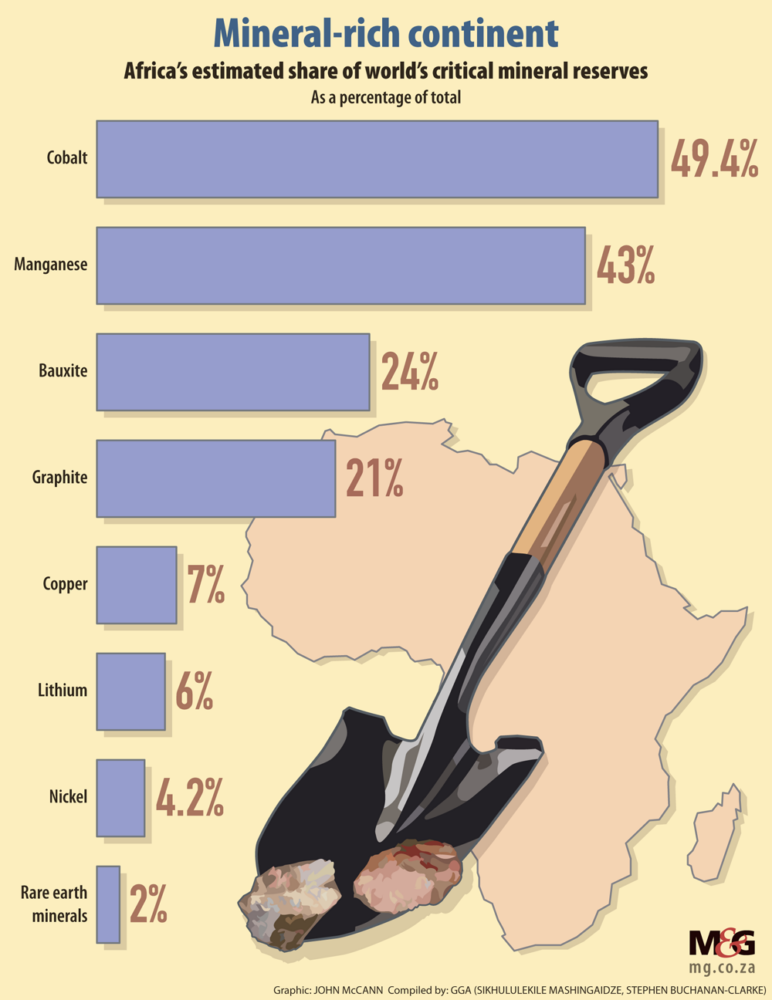
Africa, which holds significant estimated shares of the world’s total reserves of bauxite (24%), cobalt (49.4%), copper (7%), graphite (21%), lithium (6%), manganese (43%), nickel (4.2%) and rare earth minerals (2%), is at the centre of a global race for critical minerals required in the clean energy transition.
Exploitation of these resources should help to boost trade, industrialisation and development, but Africa’s track record is littered with examples to the contrary. Resource booms become drivers of corruption, conflict and ecological destruction and weaken governance institutions.
Given the continent’s economic problems, rapidly expanding population and mounting environmental pressures, there is a closing window of opportunity to ensure this new wave of mineral extraction breaks from historical patterns to become a catalyst for inclusive economic growth and long-term sustainability.
Zimbabwe’s lithium sector exemplifies both the opportunities and dangers inherent in the global race for critical minerals — a subject explored at a May 2025 conference hosted by the Centre for Natural Resource Governance (CNRG) titled Ensuring Equitable Distribution of Costs and Benefits in Critical Minerals Development.
Lithium, used in consumer electronics (including batteries), electric vehicles and renewable energy systems, has become an essential mineral to many of the modern industries driving economic prosperity and the global transition to clean energy. As drone warfare continues to revolutionise modern warfare, access to lithium-ion and lithium-polymer batteries has also become an important national defence issue from Washington to Beijing.
Zimbabwe is endowed with substantial lithium reserves. Since 2021, the sector has attracted more than $ 1.2??billion in foreign direct investment, with exports surging 800%, from $ 7 million in 2021 to $ 600??million by 2024. Investment in the sector has been dominated by Chinese companies including Rwizi Rukuru, Shengxiang Investments, Sinomine Resource Group, Chengxin Lithium, Zhejiang Huayou Cobalt and Yahua Group. This investment in the sector has been highlighted by Mines and Mining Development Minister Winston Chitando as crucial to the government’s wider national development strategy.
But, as shown in previous research by Good Governance Africa and the CNRG, Zimbabwe’s mining sector often fails to translate into broad-based economic prosperity. Several mining operations have also been associated with incidents of human rights abuses, corruption and environmental degradation, with local residents disproportionately suffering the adverse consequences.
The surging demand for Zimbabwe’s critical minerals presents a defining choice for both government and mining investors: they can either leverage this opportunity to empower local people and foster inclusive development or fall back into familiar patterns of exploitation. During conference proceedings, several measures were highlighted as necessary to maximise Zimbabwe’s chances of seeing the former option.
First, Zimbabwe’s mining sector requires comprehensive legal and governance reforms to unlock its potential for inclusive development. The current system, which vests mineral rights in the president and is administered through the mines and mining development ministry, creates opacity and excludes key stakeholders from decision-making processes. Transferring these rights to an independent regulatory body subject to parliamentary oversight and accountability would enhance transparency and ensure broader participation in mining agreements.
Simultaneously, fast-tracking the implementation of a comprehensive mining cadastre system is essential for providing real-time, accurate records of mining claims and licenses. This technological infrastructure would serve as a foundation for reducing corruption, limiting discretionary decision-making and aligning Zimbabwe’s mining sector with international standards.
Second, prioritising beneficiation to stimulate industrial development and local job creation is essential. In this respect, Zimbabwe passed the Base Minerals Export Control (2022), which includes a ban on raw lithium exports by 2026 to encourage investment in local processing facilities.
On 10 June 2025, the minister also announced a ban on the export of lithium concentrates by January 2027. Although these measures were designed to maximise benefit through localised processing of lithium, a CNRG press statement in response to the minister’s pronouncement noted with concern that “this urgent reform is being delayed into irrelevance”.
This, as CNRG further highlighted, “should be with immediate effect to prevent further natural capital depletion from unchecked lithium exploitation, which has devastating socio-economic and environmental implications. Zimbabwe’s lithium wealth risks being squandered, as unchecked exports, weak regulation and opaque deals undermine its potential for industrial transformation”. Local minerals beneficiation does not always make economic sense. But, where the opportunity for value addition is clear, it must be taken and supported through coherent industrialisation policies.
Further to this, China monopolising the sector could undermine these efforts, with Chinese companies already leveraging their position to undermine local beneficiation initiatives. Diversifying investment in the sector by addressing governance issues (currently deterring many Western investors) and leveraging opportunities such as the European Union’s Critical Raw Materials Act and the US Minerals Security Partnership (aimed at securing critical mineral supply chains) would help to strengthen Zimbabwe’s negotiating position.
A good step in this direction was the first European Union-Zimbabwe Business Forum held from 20 to 22 May, focused on renewable energy and mining investments, among other aspects.
Beyond diversifying investment partnerships, realising the intentions of the Base Minerals Export Control will also require concerted investment in the infrastructure required for local beneficiation projects to operate effectively, a consistent regulatory environment, and decisive action against corruption.
Third, strategic resource management should balance national sovereignty with economic pragmatism to maximise benefits from Zimbabwe’s mineral wealth. Moving away from disadvantageous long-term trade agreements while avoiding excessive nationalisation will help Zimbabwe capture fair value during price fluctuations without deterring necessary investment. Central to this approach is the need for long-term planning that addresses resource depletion through economic diversification strategies and sovereign wealth mechanisms, on condition that these be well governed.
Fourth, community empowerment and rights protection regarding land and water should be prioritised to ensure that local populations benefit from, and participate in, decisions affecting their areas. There is a need for ongoing, comprehensive government and civil society-driven capacity building programmes to educate people about critical minerals, associated opportunities and potential risks, enabling informed participation in mining-related decisions. Community involvement is a principle provided for by the Constitution on national development, and in the Environmental Management Actt. But the implementation of these provisions remains a problem.
In this respect, international best practice frameworks such as the Voluntary Principles on Security and Human Rights provide useful guidelines on how mining companies, civil society and government can play a role in advancing these goals. But creating the conditions under which these can be effectively implemented will require the Zimbabwean government to address long-run governance and human rights issues, as well as creating an enabling environment for civil society to operate.
Finally, environmental sustainability and social responsibility must guide Zimbabwe’s approach to critical mineral extraction, ensuring that the pursuit of economic benefits does not compromise long-term environmental and social well-being, particularly for the mining communities. Mining operations should be required to adopt cleaner technologies and implement robust mitigation measures, including cleaner coal technologies, where fossil fuels remain necessary for processing.
Humanising the broader energy transition can be achieved through gradual, community-sensitive steps rather than disruptive changes that harm rural livelihoods.
Upgrading Zimbabwe’s obsolete energy infrastructure is essential for supporting both mining operations and broader economic development while improving national energy security. By embedding environmental and social considerations into mining policies from the outset, Zimbabwe can position itself as a responsible supplier of critical minerals while building a sustainable foundation for long-term development that benefits all citizens rather than perpetuating historical patterns of exploitation and exclusion.
Sikhululekile Mashingaidze is the lead researcher in Good Governance Africa’s Peace and Security Programme and Stephen Buchanan-Clarke is the head of the programme.
International Atomic Energy Agency resolution was weaponised against Iran:
The perversion of multilateral institutions using seemingly benign resolutions as quasi-declarations continues. Consequently, the multilateral system is slowly collapsing. The election of Donald Trump as United States president has further complicated the situation.
Trump has pulled the US out of a number of multilateral agreements, including the Paris Accord on climate change. The International Criminal Court (ICC) is accused of selective justice when it comes to the prosecution of those charged with crimes against humanity — of only targeting African leaders and ignoring Western leaders who are accused of similar crimes. The ICC ignored calls to charge former British prime minister Tony Blair and former US president George Bush for crimes against humanity when they falsely asserted that Iraq’s Saddam Hussein had stockpiles of weapons of mass destruction.
The International Atomic Energy Agency (IAEA) resolution that Iran was in breach of its proliferation obligations for the first time in 20 years was a precursor to Israel’s attack on Iran.
The resolution was adopted by the IAEA’s board of governors on 10 June; three days later Israel attacked Iran. The resolution was passed by 19 votes in favour, three against and 11 abstentions.
The timing of the report and the speed with which Israel’s prime minister, Benjamin Netanyahu, acted on it has raised questions. When did he know about the resolution? How did he manage to prepare Israel’s attacks on Iran in such a short space of time? Was he given prior knowledge about the content of the resolution?
Netanyahu, who has always scorned talks with Iran, took advantage of the resolution and the changes in the Middle East since the start of the war in Gaza in October 2023. Israel has always claimed that Iran poses an existential threat to it.
This follows a statement made by Iran’s former president, Mahmoud Ahmadinejad, in 2012 at the United Nations. Ahmadinejad said Israel has no roots in the Middle East and would be “eliminated”. He was criticised for uttering an inflammatory statement and ignoring a UN’s warning to avoid incendiary rhetoric ahead of the annual General Assembly session. Netanyahu has been beating the war drum against Iran ever since, arguing that “Iran has to be stopped on its tracks before it is too late”.
There are 191 countries that are parties to the Treaty on the Non-Proliferation of Nuclear Weapons (NPT), making it one of the most widely adhered-to arms control agreements. But four nuclear weapons states — India, Pakistan, Israel and North Korea — are not signatories to the treaty.
The treaty’s objective is to prevent the spread of nuclear weapons and weapons technology, promote cooperation in the peaceful uses of nuclear energy and to achieve nuclear disarmament. The IAEA, an agency of the UN, is responsible for monitoring nuclear activities and obligations of countries party to the treaty.
South Africa has a nuclear power station generating 5% of the country’s electricity. The country ratified the Treaty on the Prohibition of Nuclear Weapons in February 2019 and was the first country to have disarmed its nuclear weapons. Fearing that these could end up in the wrong hands, South Africa ended its nuclear weapons programme, which began during the 1970s, in 1989. The decision was executed just months before negotiations on ending apartheid between the National Party (NP) and the ANC started.
It was an important decision which facilitated a smooth political transition in South Africa. Otherwise, global powers could have delayed or derailed the political transition. According to Ali Mazrui, a Kenyan intellectual, the NP was under pressure from various quarters to prevent what he referred to as the “Black Bomb” from being transferred to an unknown black political leadership.

Back to the Middle East. Who is presenting an existential threat to other nations in the Middle East? Who possesses nuclear weapons in the region? There is a wide belief that Israel has nuclear weapons. The estimates are that it has nuclear stockpiles of between 90 and 400 nuclear warheads. According to political analyst Msano Zive, it is Israel that poses an existential threat in the region.
The manner in which Israel has continued with the genocide in Gaza, its willingness to starve and suffocate civilians in Gaza and its disproportionate response to the attacks on 7 October 2023 has never been experienced in modern times.
Israel is intent on committing the same atrocities in Iran. The destruction of property in Gaza and the number of deaths, including those still lying under the rubble, resemble a country that was struck by an atomic bomb, Zive argues.
Israel has not ratified the non-proliferation treaty, meaning that the IAEA’s monitors have no access to its nuclear programme. The world should be concerned. Israel has continually violated national sovereignty and security of its neighbours. Other than continuing to commit genocide in Gaza, it is relentlessly bombing Lebanon, Syria, Yemen and now Iran. Netanyahu’s political survival and avoiding jail time is dependent largely on the continuation of the war in the region. Israel’s failure to destroy Hamas in Gaza has led to Netanyahu to search for new targets. Iran has been the low-hanging fruit for a long time, given the national sentiments on Iran in Israel.
The IAEA has to ensure a nuclear weapon-free and responsible world. Importantly, it also has to ensure that those who possess nuclear weapons and run nuclear related programmes act responsibly and adhere to the basic rules and regulations of the treaty. Importantly, the role of the IAEA of encouraging a nuclear weapons-free world has to be promoted. It is important therefore how the IAEA deals with Iran; it has to be seen to be fair.
Iran ratified the non-proliferation treaty voluntarily. Why is it then harassed by a country known to possess nuclear weapons that refuses to ratify the treaty and scrutiny by the IAEA? The continuation of these double standards is likely to encourage other countries in the world who intend to produce nuclear weapons from being open about their plans.
Thembisa Fakude is a senior research fellow at Africa Asia Dialogues and a director at the Mail & Guardian.
We need a values-based, not an ‘out of sight out-of mind’ leadership in South Africa:
Our political leadership could learn a lot about embodied, empathetic and compassionate leadership from a vlog by the dynamic young musician, Zintle Kwaaiman. In it, Kwaaiman cries, deeply moved by witnessing the plight of people affected by abject poverty in a place she had just visited.
Her tears were born of compassion for the people and of frustration that the leaders who have the power to change that situation were not doing enough, fast enough.
What she described in her vlog was what Hennie Swanepoel and Frik de Beer, in their book Community Development: Breaking the Cycle of Poverty, refer to as “the deprivation trap”. This is characterised by five realities:
- Powerlessness: Lack of social and economic influence. It’s also the ease with which people can be exploited.
- Isolation: Exclusion from systems and structures that can change their lives.
- Poverty: Lack of productive assets such as land, money and income-generating skills.
- Physical weakness: Malaise, lack of physical strength and exposure to chronic illnesses.
- Vulnerability: Lack of reserves and choices, which drives the ease with which the poor can be coerced.
As I watched Kwaaiman lamenting her powerlessness to effect the change needed at the scale and speed necessary, I wondered whether our political leadership, who have the power and the resources to change the situation, have any compassion for the plight of the poor.
Do they ever allow themselves to feel the pain of the pangs of hunger, the fear of crime and the hopelessness of lack of income? I wondered if the leadership cared about people’s lives. Or do they just simply go through the motions, talking about “our people”, yet do not care deeply. This is what I call “out of sight, out of mind” leadership.
According to Human Rights Watch’s World Report 2023, “South Africa struggled to realise economic and social rights because of increasing inequality and unemployment, exacerbated by the Covid-19 pandemic and corruption. The country also failed to take concrete steps to address environmental pollution and the dangers posed by toxic waste to people living close to abandoned mines and dams.
“Between 2021 and mid-2022, 400 000 to 500 000 children dropped out of school in South Africa, bringing the total number of out-of-school children to 750 000, according to the United Nations Children’s Fund. Teenage pregnancy was identified as one of the reasons why children drop out of school in the country. Over half a million children with disabilities are excluded from education,” the report noted.
To remedy the above, to muster the level of decisive action needed to transform the economy, improve service delivery, create conducive conditions for income generation, lift people out of poverty and combat corruption, South Africa requires a new leadership framework. It needs an embodied and compassionate leadership which is able to feel deeply for the people, because at the centre of the human being is the “heart” or the “inner being”.
It informs our cognition, affections and volition. What the heart loves, it will pursue. If it loves self, it will abandon empathy for the poor. If it loves others, it will think, act and feel in a way that truly serves the least of these.
It is a leadership firmly undergirded by ethics, good governance, compassion and care. We need a shift toward embracing embodied, empathetic and compassionate leadership.
It is for this reason that Good Governance Africa (GGA) is partnering with Values 20 South Africa, a global community of values experts and practitioners seeking to actively work with the G20, providing it with evidence-based, human-centred policy solutions that contribute to overcoming global problems. Its focus is on how we, as global citizens, can collectively and consciously apply values to the benefit of the planet and the people who inhabit it.
GGA shares this vision and is continually striving to embed effective democratic processes — in which the voices of citizens are really heard and responded to — across Africa through its programmes and projects. So, this synergy with Values 20 is a natural one and we hope that, together, we can have more impact in the relevant policy spheres.
In his book The Art of Somatic Coaching: Embodying Skilful Action, Wisdom and Compassion, Richard Strozzi-Heckler tells the story of a Mr Duffy who lived a short distance from his body. He says Mr Duffy was a one-dimensional bureaucrat who lived a bland, colourless life. “He is the postmodern everyman — cut off from his feelings, defined by rules and protocols, drifting aimlessly without purpose or meaningful connections.”
In the article Embodied Leadership: A Cure For What Ails Us?, which appeared in Forbes, Ginny Whitelaw states that “without the inner work of embodiment, leadership can’t fully do its outer work”. Embodied leadership is about feeling deeply, being present and observant, “using the wisdom of your body alongside your mind to lead yourself and others in a way that’s authentic, aligned and impactful”. This practice is about integrating our heads and our hearts.
Whitelaw is correct when she says, “At a time of deep divisions and discontent, the dissociations of head from heart, of talk from walk, of action from a felt sense of its consequences, are wholly inadequate for dealing with the wicked issues we face.”
When leaders are distanced from themselves, like Mr Duffy, they lose the embodied feelings for others necessary for effective leadership. This prevents them from feeling the pain of the majority and undermines their resolve to take the actions necessary to implement change.
Sadly, we seem to have an abundance of such leaders, from the local to provincial and national levels, travelling from meeting to meeting and making speech after speech. They are good at raising points of order and pontificating in legislative chambers, yet the resources at their disposal with which to effect material changes in people’s lives continue to be embezzled without consequences. Hence, we need to embed the value of embodied leadership in our body politic.
Claire Yorke and Maria Sklodowska make a compelling argument in their essay, Is Empathy a Strategic Imperative? about the strategic importance of empathy in offering solutions to policy failures. They argue that, when empathy is used wisely, it engenders the value of what we in South Africa call batho pele (putting people first) and creates new approaches to dealing with intractable governance problems in new ways.
They state that, “If strategy is about achieving certain desired ends and meeting core objectives — whether in warfare, politics or policy — then empathy is critical to understanding the contours of the human landscape in which such aims are to be achieved.” It is for this reason that empathy should “sit at the heart of government, built into how the government approaches its strategic vision and aiding the longer-term pursuit of its national objectives and international standing”.
Without the value of empathy built into our governance systems, the future of society is doomed. But, with empathy at the core of our leaders’ way of being and their decision-making, humanity’s future is bright.
According to Laura Segovia-Nieto and Andres Ramirez-Velandia, in their paper, titled Do We Need Empathy or Compassion in Our Political Leaders? A Case of Colombian Political Leaders, leaders need to embrace the value of compassion, not only empathy. They state that, “Empathy as the core of social engagement allows us to share others’ psychological experiences, but it does not entail necessarily the need to act toward specific community well-being. Compassion, on the other hand, drives action to relieve the discomfort of others.
“Due to the importance of the target in the definition of compassion, political leaders must choose which sector of their nation deserves their compassionate actions, even though empathy lets him or her understand other national actors’ situations.”
Unlike Kwaaiman, our political leaders appear to be numb and indifferent to the plight of the sectors of society who live in squalor and poverty.
For leaders to embrace the value of compassion, they need more proximity to the people. I am not talking about the occasional dropping in to electioneer and cutting ribbons. I am talking about an embeddedness in the human struggles of the poor that opens the leader’s eyes and ears to see and hear them. It is in this connectivity that compassion will take root. If leaders do not expose themselves to the conditions and experiences of people, they will never identify with them and they will never have the impetus to make changes.
The problems South Africa is facing will not be addressed successfully with mechanistic, legalistic and formulaic solutions. We cannot construct genuinely pro-poor policy that will generate broad-based development without compassion and empathy. Policy built in a way that is congruent with ubuntu is likely to be the most implementable too.
To burst open the deprivation trap and release the poor from its clutches, we need a values-based — not an out of sight, out of mind — form of leadership in South Africa. An out of sight, out of mind form of leadership is careless, clueless and indifferent. We need embodied, empathetic and compassionate leaders to lift us out of the quagmire we are stuck in.
Patrick Kulati is the chief executive of Good Governance Africa’s Southern African regional office.
Submit and get free exposure here: Showcase Your Business | Advertise Your Special Offers.
