Living in the darkness of a broken city – Johannesburg:
The electricity cable to my house has broken. I know this because four weeks after the power switched off in the last week of April, a truck visited and assessed the cable. They came on the day that my partner called a radio station to complain about living in prolonged darkness. We were told that the cable had broken at the base of the street pole. Fortunately for everyone, they would not need to dig up the road even as they warned that the cable to the house is old and will need to be replaced at some point.
They repaired the break in the cable, but the lights stayed off because there was something wrong with the meter. They temporarily bypassed the meter and left us with a caution; the power was now on the neutral cable and posed some risk. Instead of darkness, we chose the power we were given. It lasted a week. I write this piece five days into the darkness, on the coldest week of the year so far.
Another call was logged with City Power. Over the past six weeks many calls have been made. The call centre agents eventually respond by picking up the phone and then ignoring us while they continue their conversations. On their system, they count the number of calls received but to them, this is a game. In a landscape of so much unemployment, for them, work is a plaything. When we eventually escalate to a supervisor, promises are made.
But we languish in the dark. Our municipal account has arrived. It is just over R11??000. While the bill has arrived, the power has not. Before the power switched off in the week of Freedom Day, for several weeks, the electricity voltage had been low and only some appliances and lights worked. Touching some taps and shower knobs sent a jolt of shock through the body. And then everything went dark.
We are firmly middle class in my household. We have it better than most residents of this city. We shower at the gym, we cook on a gas plate stove, and we charge our computers and devices at work. We live. But the middle-class trappings and security systems that we need to protect ourselves from the inequality of this city are gone. We cannot use the electrical security system, the gate battery has died, and there are no outside perimeter lights. In the darkness of this broken city, we are sitting ducks.
We are black and we are not suffering from a native nostalgia for the apartheid city of the past. But it was not always like this. We would know because we have lived in our house for 15 years. Like everyone, we experienced the blackouts of load-shedding. Then, our suffering was shared. Now, as the lone house without power, no one knows our fate.
We cannot log it with EskomSePush or the city’s X account. Without the pressure of an entire neighbourhood, our calls can be ignored. The City Power trucks that drive by the neighbourhood know us. We sometimes stop them and direct them to the house. We are prepared to entertain their requests for cold drinks — code to compensate them for their paid work. Corruption is in the marrow of this city.
In previous years, when technicians have come for repairs on the problematic electric pole, they have asked us for money to buy electrical parts because these have supposedly run out at the warehouse. Waiting for stock means there may be delays which could take weeks or months. So, we give them what they ask for. They buy the parts and fix the problem. But because this is generally only patchwork, the problem often reemerges. The next person criticises the work of the previous technician. We pay again.
This is the illicit economy of a failing city of ageing infrastructure and city officials that have lost their hold over the city they supposedly manage. As residents that know nothing about electrical parts, we are at the mercy of officials who may or may not be corrupt. One thing is apparent though; the city’s residents are rendered vulnerable by a city that pretends to know what it is doing but is failing spectacularly.
When I call my mother in Lusikisiki, she is empathetic. We share notes about when to cook all the meat in the fridge before it spoils. She often has no electricity because the wind is sometimes too strong for the lightweight Eskom infrastructure in the village. Or a donkey might have rubbed itself against the electric pole. In the villages, power outages can take weeks to resolve. We wrongly expect this because we have come to accept that rural life is cheap and unimportant.
But it is jarring when this becomes the norm in the economic heart of the country where we pay inflated municipal rates.
The collapse of Johannesburg is in full swing. The ruin of the central business district has been self-evident for a while now. The gas explosion of Lilian Ngoyi Street might be read as the final confirmation of a known truth. The lethargic repairs tell us all we need to know about the city’s capabilities. Townships have been held in place by the sheer ingenuity of their residents. They navigate sink holes and sewage leaks. They no longer bother with City Power. They climb the poles and connect themselves. To fix a common problem, they conduct a collection and pay the cold drink fee of a rogue city employee.
The middle-class suburbs have been the last line of defence to a decent life. But in the tree-lined streets, the ominous signs of decay are here too. Potholes poke holes into the middle-class bubble. If residents do not fix pavements, kerbs and street walks, they degenerate because the city will not repair anything now. All this at our own cost. I know this from firsthand experience. When flood waters washed away the pavement outside my yard, I repaired it at the cost of R20??000 after a year of reporting it to the councillor.
Long lines periodically emerge when water runs out of many areas of the city. At the same time, water and sewage pipe bursts release water and faecal matter which run down Louis Botha Avenue unchecked. Shit splatters in the wake of the roaring traffic. Breathe in the droplets at your risk, dear resident.
The story is the same: ageing city infrastructure, but there is no end date given for when it will be changed. Water tanks poke over people’s walls as residents take on the role of municipalities. Those who can’t afford private water wait for water tankers. Solar panels are everywhere. The cost of living here has ballooned in the last decade.
The city is not just fraying at the edges. It is broken.
What is to be done? Our mayoral office has been a revolving door of failures. I don’t believe a change in those who don mayoral chains is the solution. The recycling of a former mayor of Cape Town with colonial longings does not excite me. Sitting in this dark place, I don’t know what is to be done. There are people that are paid to vision and implement plans. Chief executive officers, city managers and committees with dizzying salaries.
My immediate need is simpler than a vision or solution. All I really want is reliable electricity. I pay the bills, now could I have some power please?
Hugo ka Canham is a writer and professor at Unisa and the author of Riotous Deathscapes. He writes in his personal capacity.
Labour department denies racial quotas in Employment Equity Amendment Act:
The department of employment and labour has rejected claims by the Democratic Alliance (DA) that the Employment Equity Amendment Act, which came into effect in January 2025, has sectoral racial quotas.
In April, the DA said it had filed an application in the Pretoria high court challenging the employment equity quotas in the Act which it says are merely “racial exclusion under a new name”.
But labour department spokesperson Pertunia Lessing, told the Mail & Guardian that the Act “does not have quotas”.
The DA, whose challenge will be heard in the coming weeks, says the new amendments will “make employers self-implement sectoral racial quotas”, which give employers the right to identify and record an employee’s race if the employee chooses not to disclose it voluntarily.
In a written reply to a DA question in parliament, Employment and Labour Minister Nomakhosazana Meth said the amendment was meant to ensure “reliable, existing historical data”. This would mean that an employee would either need to disclose their family history, which is considered personal information, or have their race assumed.
DA spokesperson on labour Michael Bagraim said Meth’s “generic” definitions of persons of colour cannot stand in a democratic South Africa.
“This is a preposterous suggestion and appears to expect employers to conduct race inspections to tick a box, in order to avoid being fined,” he said.
According to the Employment Equity Act, “black people” is a generic term that includes African, coloured and Indian people. This definition in the Act has not been amended since 1998.
According to the 2025 amendments, employers with 50 or more workers are required to ask each worker to fill out a form to declare their occupational level in terms of race,
gender and disability status information.
If an employee refuses to fill out the form or gives incorrect details, the employer is allowed to use reliable past or current information to determine the person’s race, gender or disability status. This process must be done at the workplace and is the employer’s legal duty.
The DA accused the minister of not conducting a formal investigation based on evidence to establish the employment equity regulations, saying this would push the country’s already high unemployment rate — officially at 32.9% — even higher.
“South Africa continues to be one of the most unequal nations on Earth, with more than eight million South Africans unemployed and a small elite enriched, making the evidence against employment equity regulations undeniable,” Bagraim said.
The Act as amended further sets hiring quotas for 18 economic sectors, from mining and transport to construction and agriculture, in a bid to increase employment opportunities for “designated groups” including black people, women and people living with disabilities.
The DA noted that South Africa no longer uses the Population Registration Act, an apartheid era law that required every citizen to be classified by race.
“It cannot stand that employers become racial classification agents,” Bagraim said.
Ford Territory a worthy contender in a crowded SUV segment:
The local SUV segment has become crowded but South Africans are not complaining.
Our less-than-perfect roads have led to many of us looking for vehicles with higher ground clearance and, luckily, all the manufacturers are giving us their own little twist on SUVs.
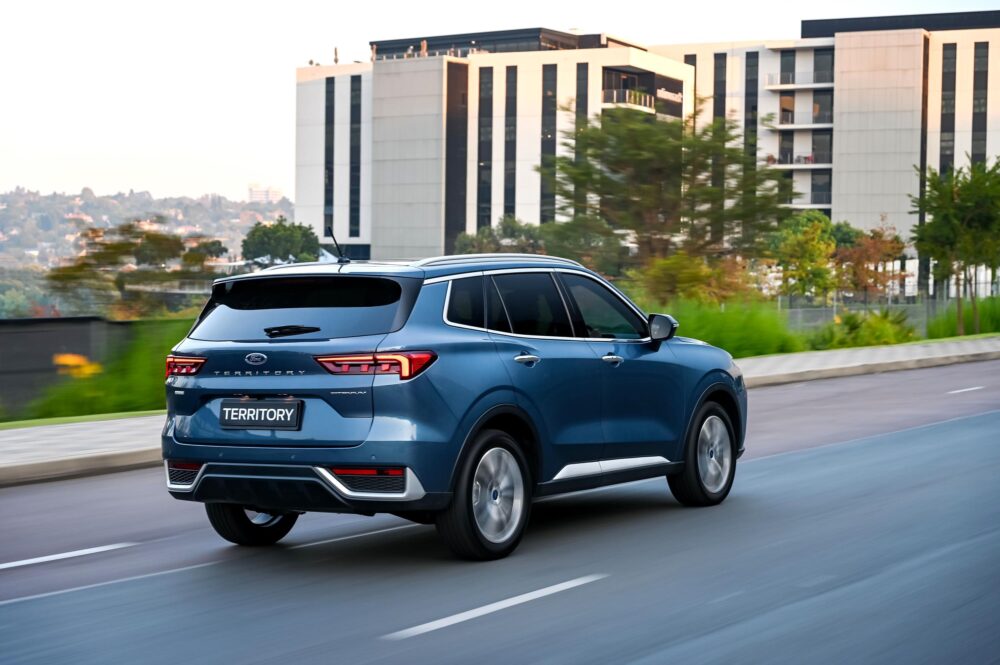
Ford reintroduced the Territory as its answer to the growing middle-sized SUV market. It is built in China and the thin, curved headlights resemble a few of the Chinese vehicles we see on the market.
It doesn’t necessarily have the characteristics of a Ford on the exterior. While it misses the mark of the traditional rugged look that the brand is known for, its aim was to release an SUV that looked commanding, agile and responsive.
The Territory’s front end is framed coast-to-coast by an integrated grille and LED daytime running lights, creating a signature light effect.
The back of the vehicle has tail lights that are also curved but separated by the branding in the middle.
Altogether, the exterior has a more energetic and unique feel than the average Ford.
The interior
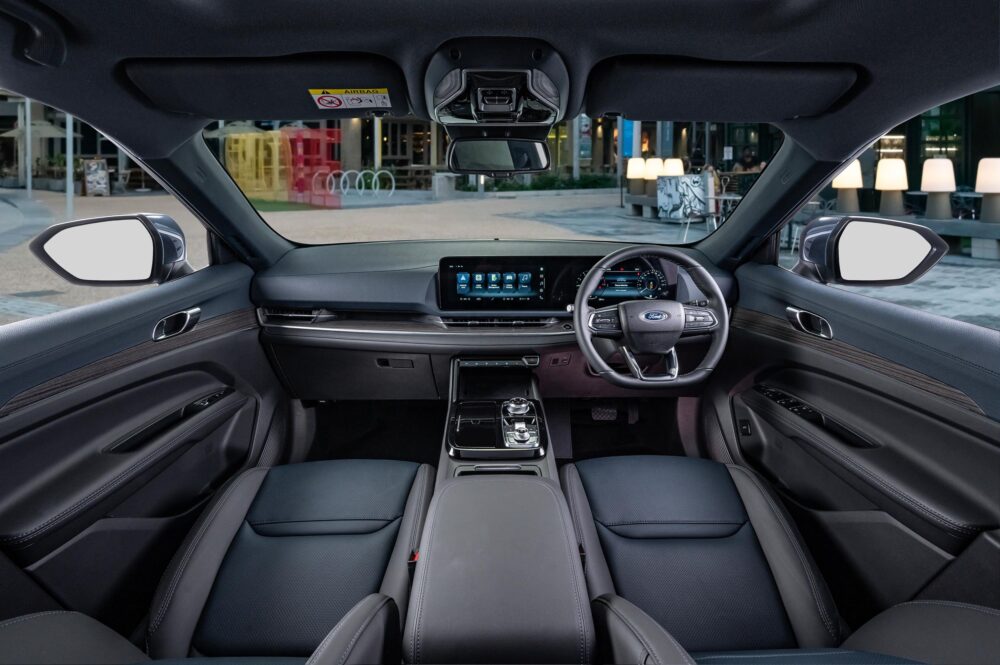
I feel this is where the Territory does its best work.
It continues to divert away from the extreme rugged nature of Ford SUVs, but it feels refreshing.
The wooden finish underneath the very nice materials on the dashboard gives the interior an upmarket and modern feel.
At the centre of the new Territory experience is a panoramic display that integrates a 12.3-inch high-definition digital instrument cluster paired to a 12.3-inch landscape infotainment touchscreen.
This caps off the luxurious nature of the interior and brings it all together exceptionally well.
The Titanium variant comes standard with a huge panoramic moonroof that flows all the way to the back of the vehicle.
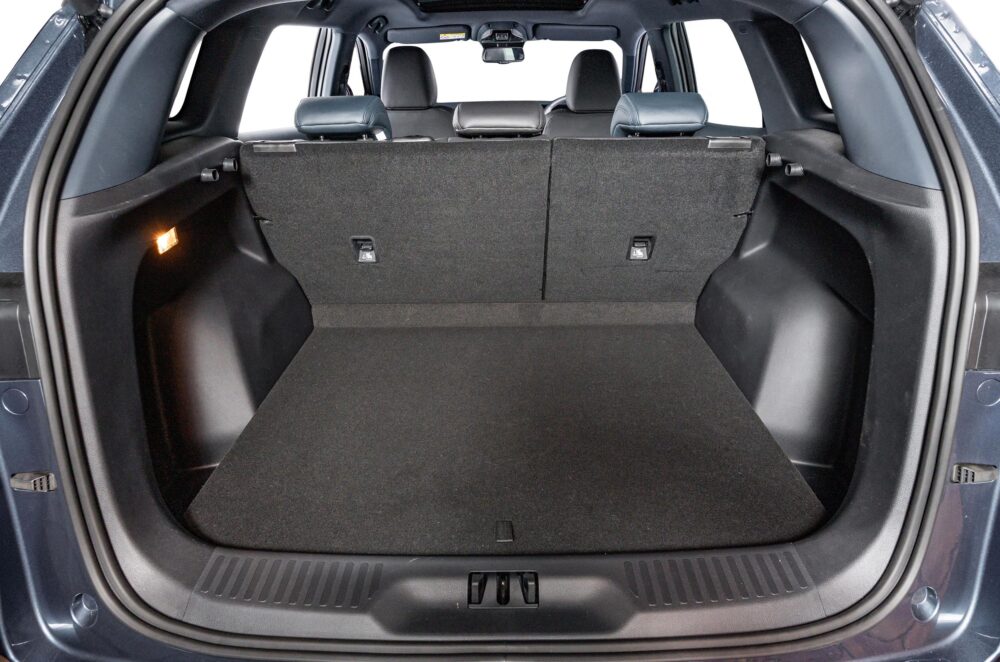
While the aesthetics blend together well, the best part of the Ford Territory is the practicality of the interior.
The front passengers are treated to very large and comfortable seats and the back is as spacious as mid-sized SUVs come.
This was the feedback I received from anyone who sat at the back of the vehicle — they were impressed at the amount of headroom and legroom that was offered.
The drive
The Ford Territory has a 1.8 litre EcoBoost engine that delivers 138kW of power and 318Nm of torque.
That is more than sufficient for easy overtakes on the highway.
It also provides a smooth drive. The engine is refined and there’s not much wind noise in the cabin. The handling and suspension also felt sturdy and solid, making navigating up steep hills effortless.
The Territory felt comfortable to drive — until I hit traffic on the N3. That’s when I started noticing the sensitive calibration of the brakes and throttle. The jerk I felt every time I applied the brakes became annoying.
You will get used to it, but it is certainly not ideal, and it detracts from what is otherwise a splendid driving experience.
Ford has claimed 7 litres/100km on the Territory but I could only manage 8.3 litres/100km when I had the vehicle on test.
Safety
On the safety front, all Territory models are equipped with electronic stability control with traction control; emergency brake assist and electronic brakeforce distribution; hill launch assist; hill descent control and a tyre pressure monitoring system. Six airbags — dual front, side and curtain — are provided.
The Titanium gains Ford’s advanced driver assistance package which includes adaptive cruise control with stop and go; automatic emergency braking; blind spot information system; rear cross-traffic alert; forward collision warning with pedestrian detection; lane keep assist; lane departure warning and lane change assist.
It seems that Ford has benefited greatly from its partnership with Jiangling Motors Corporation to include all of these safety features in the Territory.
Pricing and verdict
The Ford Territory comes in three variants: the Ambiente priced from R576 000, the Trend priced from R632 600 and the top-of-the-range Titanium priced at R707 000.
The Territory is very uncharacteristic of Ford SUVs and it brings the fresh and more modern feeling that consumers have become accustomed to in this segment.
The technology, along with the incredible amount of space that the Territory offers, makes it well worth the price.
However, it must be noted that, with the rise of Chinese cars in South Africa, the Territory enters a segment that is packed, but it is certainly a worthy contender.
Submit and get free exposure here: Showcase Your Business | Advertise Your Special Offers.