
Mali army air strikes blamed for civilian deaths in rebel-held town:

Mali’s army said on Tuesday it carried out air strikes on “terrorist targets” in the rebel stronghold of Kidal where witnesses and separatists said civilians, including children, died in the attack.
The armed forces said on social media that the strikes “neutralised several terrorist pick-up trucks” at a military camp evacuated by United Nations peacekeepers last week in the strategic northern town.
The army appealed to people “not to give in to the terrorists’ propaganda intended to tarnish the reputation of the Malian armed forces”.
The Permanent Strategic Framework (CSP), an alliance of predominantly Tuareg armed groups, said 14 people had died, including eight children gathered in front of a school.
It said they were killed by Turkish-made drones belonging to Mali’s army.
Residents and witnesses, speaking mostly on condition of anonymity out of safety concerns, said six to nine people had died.
“Six people, including children, were killed by air strikes by the Malian army,” said one health worker. “In the hospital, we have injured people.”
Last Saturday, the army said on social media that it had “neutralised” a certain number of targets a day earlier using air power. The targets were operating inside the camp near Kidal that the UN’s stabilisation mission vacated last week, it said.
Tuesday’s incident marked the first killings in Kidal since the Tuareg-dominated rebel groups resumed hostilities in August.
Fears of a confrontation in the town — long a centre of defiance and launching point for independence rebellions — have been building for some time.
The insubordination of the town and of the Kidal region, where the army suffered humiliating defeats from 2012 to 2014, poses a major sovereignty issue for the junta-led government.
Since seizing power in 2020, Mali’s military rulers have made the restoration of sovereignty their mantra. But Kidal is controlled by the separatist rebel groups. They launched an insurgency in 2012 and agreed to a ceasefire in 2014 and a peace deal in 2015, before taking up arms again in August.
The independence uprising in 2012 coincided with insurgencies by radical Islamist groups.
Unlike the rebels, the jihadists have never stopped fighting the state, plunging Mali into a political, security and humanitarian crisis that has spread to neighbouring Burkina Faso and Niger.
Violence has escalated in the north since August, with the military, rebels and jihadists vying for control as the UN mission evacuates its camps, triggering a race to seize territory.
The rebels do not want the peacekeepers to hand their camps back to the Malian army, saying it would contravene the ceasefire and peace deals struck with the government in 2014 and 2015.
The army on 2 October dispatched a large convoy towards Kidal in anticipation of the UN’s departure.
But UN forces, citing the “deteriorating security situation” and threats to its peacekeepers, accelerated their pull-out, upsetting the ruling junta, which wanted the departure to coincide with the army’s arrival.
Instead, when the mission left the Kidal camp last week, the rebels immediately seized control.
While the peacekeepers said they had been forced to destroy some of their equipment, they also left some behind.
A resident who worked for the mission before its pull-out said that some of Tuesday’s victims were residents who had gathered in front of the camp to collect equipment.
The CSP alliance of rebel groups said a drone strike had hit a group of children in front of a school near the camp.
The alliance said it was asking Türkiye to “review” its policy of selling drones to the junta and to the Russian paramilitary group Wagner, with which it says the junta is working.
Established in 2013, the UN’s mission had for the past decade maintained about 15??000 soldiers and police officers in Mali. About 180 members have been killed in hostile acts.
Since July, it has withdrawn nearly 6??000 civilian and uniformed personnel, after the ruling junta demanded the mission depart from Mali. The deadline for withdrawal, set by the UN Security Council, is 31??December. — AFP
The post Mali army air strikes blamed for civilian deaths in rebel-held town appeared first on The Mail & Guardian.

A slight genetic tweak millions of years ago eventually gave rise to humans and changed the trajectory of our planet.
All living organisms contain DNA, a molecular blueprint that children inherit from their parents. Sometimes genetic information changes slightly as it is passed on. Often these mutations mean nothing — a tiny blip in the complex, long code of life — but over time and in successive generations, the changes can accumulate and set plants and animals on a different evolutionary path from their ancestors.
As time passes and juveniles grow into adults that have offspring of their own, a species can change permanently, developing into a different sub-species or even — over multiple generations — a new species altogether.
Salamanders which fell into a cave in Slovenia many years ago lost their skin colour and sight, and their snouts got longer. Today, we know these populations as the European olm. Meanwhile, on the Galapagos Islands, finches developed differently shaped beaks, depending on the food they could access. These small, superficial changes help animals adapt to altered environments.
But over the course of millennia, evolutionary modifications can transform one species into another.
Human evolution studies tend to focus on the evolutionary fork in the road, between five and nine million years ago, when humans and chimps parted ways. But in reality, the slow accumulation of changes had been taking place long before then. Many key genetic events had been set in motion millennia prior to our hominin ancestors walking upright.
The traits that make humans, well, human — our short thumbs adapted to grasping, hip sockets that sit firmly in our pelvis and allow us to put one foot in front of the other, and giant brains capable of introspection and music and art — had been millions of years in the making.
Today, if you were to lie chimp and human skeletons side by side, it would be easy to spot the differences. For one (important) thing, you would most likely have two complete skeletons, something palaeoanthropologists dream of and seldom have.
The physical contrasts are significant. But between nine and five million years ago, the differences between members of the chimp and hominin lineages would have been subtle. Our early hominin ancestors would have only had a few of the attributes we recognise as characteristic of hominins (as opposed to the full suite of attributes). This makes separating early hominins from early chimpanzees quite difficult.
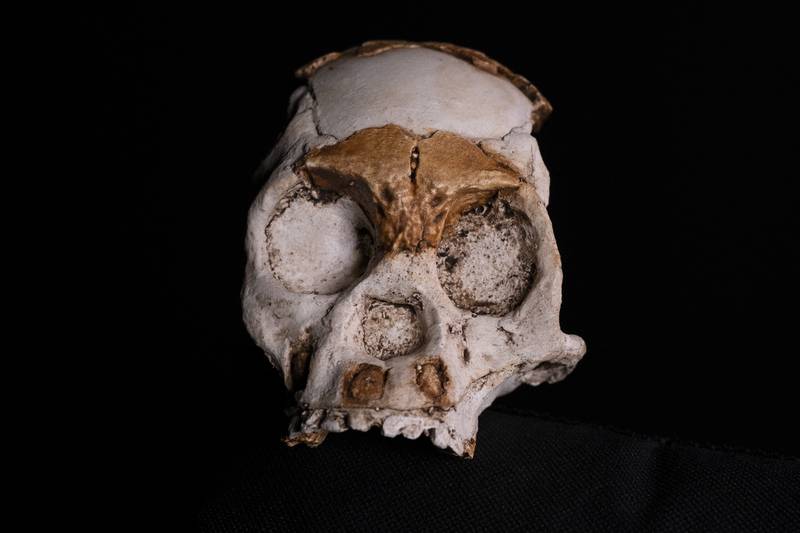
Millions of years ago, the landscape looked very different to how it does today. Throughout Earth’s history, its polar ice caps have frozen, thawed and frozen again. They have trapped millions of cubic kilometres of fresh water in their icy depths, and when the climate heated again, this water flooded the oceans. Innumerable forests have risen up from saplings, rotted into mulch and given way to grasslands. The continents themselves have shifted, raising mountains and buckling landscapes, while volcanoes have covered the land with boiling, mineral-rich lava and ash.
The changeable landscape has very important implications for fossil-hunting. When creatures begin the long process of fossilisation, they mostly become trapped in a sediment layer (although there are notable exceptions, such as creatures that fall into bogs and become naturally mummified). Layers of soil, ash and mud cover their bodies, and the chemical composition of these layers can make them easier to find and date.
There are two major regions for early hominin fossil-hunting — South Africa and eastern Africa —and this is mainly due to their fortunate geology.
In South Africa, about 50 kilometres north-west of Johannesburg, there is a treasure trove of hominin fossil sites. Collectively referred to as the ‘Cradle of Humankind’ by the government, the area, with its green rolling hills, was listed as a Unesco World Heritage Site in 1999. It only covers about 10 kilometres by 15 kilometres — a tenth of the size of London — but it is one of the richest hominin sites in the world. Palaeoanthropologists have found numerous early hominin skeletons (which are in fact remarkably rare globally), artefacts and animal remains at the sites, which have contributed greatly to our understanding of human evolution.
About 2.3 billion years ago, that area was a large, warm inland sea, home to a burgeoning community of coral reefs. The calcium and magnesium in the ocean and marine life laid the foundations for the dolomitic rock that forms part of the Cradle’s geology, and is what has made it such a wellspring of discovered fossils.
There are two reasons for this. One, limestone (which is calcium carbonate) is often found with dolomite, and in the nineteenth century, lime (calcium oxide, a derivative of limestone) was a much-traded commodity in South Africa, where rapidly developing colonial communities used it as a mortar to stick bricks together in buildings. Limestone mining was big business, and in fact some key hominin fossils, such as the Taung Child (Australopithecus africanus) and Little Foot, were discovered because miners blasted dolomite with dynamite in search of limestone.
The second reason for the Cradle’s wealth of uncovered fossils is that water can dissolve limestone. This erosion forms cavities and caves within the rock. For many unfortunate creatures, a wrongly placed foot meant a fall into vertical shafts that water had gnawed into the rock underfoot, and a plummet into inescapable subterranean caverns below. For example, at Malapa, a rocky site populated by the odd tree and surrounded by the Cradle’s grassy hills, there is a cave which contains hominin and animal fossils, none of which have the telltale signs of a carnivore’s teeth. There are more than twenty-five species represented among Malapa’s remarkable hoard, and these creatures most likely fell to their death through treacherous chasms millions of years ago.

We use fossils as signposts in the story of human evolution, and in the last few decades palaeoanthropologists have become increasingly aware of the bias in the fossil record, as well as their own bias, and are now trying to correct this.
There are physical realities that distort our understanding of the human narrative. For one thing, we seldom find whole skeletons. Some parts of a hominin skeleton are simply more durable than others, so we find more enamel-encased teeth than fingers. Hands and feet are more likely to be scavenged or washed away than, say, a skull. A muscle-clad thighbone may also be tastier to a predator than a bony skull. What this means is that certain parts of the skeleton are better represented in the fossil record, and so we place more emphasis on their evolution because we understand them better.
Some environments are also more conducive to the preservation of fossils. The fortuitous geology of eastern and South Africa has preserved skeletons and artefacts for millions of years, but there were hominins or possible last common ancestors in other places in Africa too.
Another important possible bias was introduced by Charles Darwin in his 1871 book, The Descent of Man, and Selection in Relation to Sex. In that work, he noted that modern humans more closely resembled African apes than their Asian counterpart, the orangutan. Thus, Darwin theorised, humans most likely evolved in Africa. This supposition has guided palaeoanthropology’s focus on Africa as the birthplace of humans. So far, the fossil record backs up Darwin’s speculation, but it is possible that the human story is more complex than we currently think it to be.
Sarah Wild is an award-winning science journalist. Human Origins is her fourth full-length science book and is published by Michael O’Mara.
The post Making no bones of science appeared first on The Mail & Guardian.
Tiny planthoppers reduce invasive water hyacinth on Hartbeespoort Dam to 5%:

It’s a warm October morning and Ian Hendrikse is scanning the expanse of Hartbeespoort Dam’s polluted waters for signs of his adversaries — invasive water hyacinth — floating on the surface.
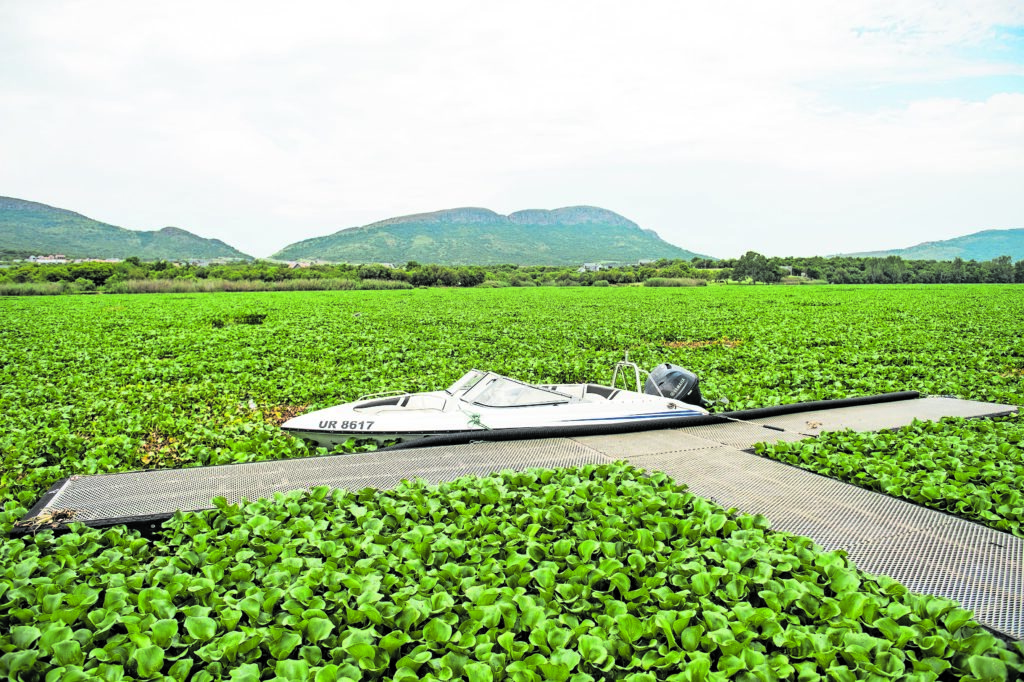
A few clumps of the fast-growing superweed drift in on a gentle breeze. “The dam is looking much, much better now,” said Hendrikse, who manages the Hartbeespoort Boat Club on the banks of the dam. “Everybody predicted that by the end of October we would be closed completely [by water hyacinth] and we’re standing at just 5% coverage. It’s amazing.”
The credit, he said, must go to the insect army that has been deployed onto the dam by the Centre for Biological Control (CBC) at Rhodes University to tackle the dam’s decades-long infestation, in a biological control programme managed by the department of forestry, fisheries and the environment.
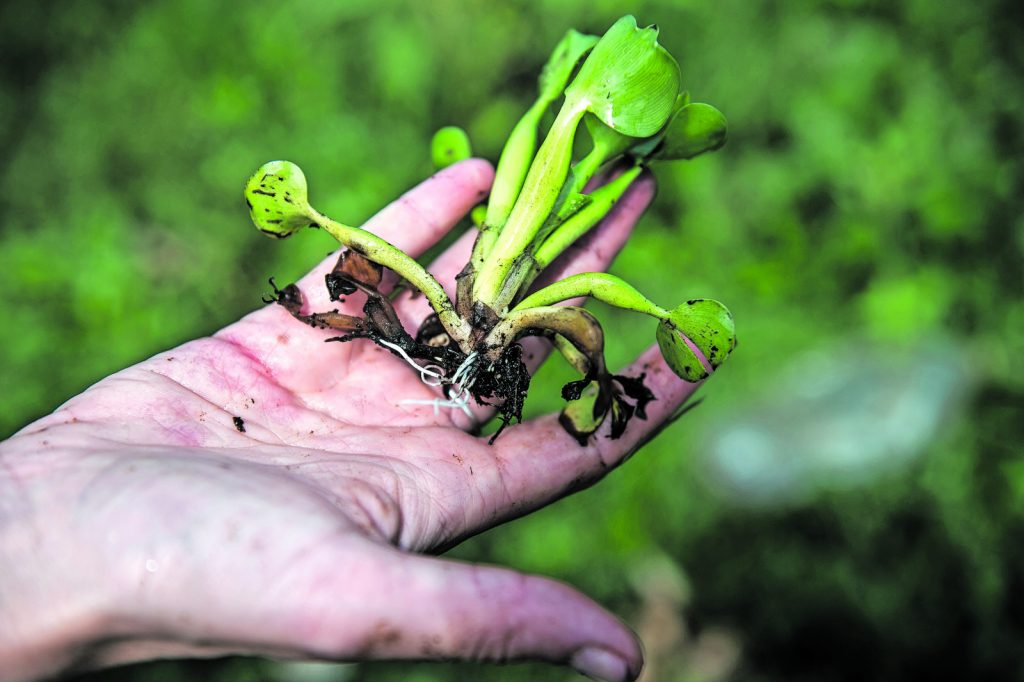
The inconspicuous biocontrol agent, Megamelus scutellaris planthoppers, are natural enemies of water hyacinth, and are host-specific. The planthopper responds well to mass rearing, reproduces rapidly, and recovers faster after periods of cooler temperatures than some of the other biocontrol agent species, according to the CBC. Importantly, they can be “exceptionally damaging” to water hyacinth.
“These are very powerful goggas; you can’t believe what they’re doing. People laugh at us because they come here and say, ‘How are you cleaning the dam?’, and we say ‘a little bug that high,” Hendrikse said, referring to the miniscule 3mm adults.
“But it’s working so well. If you saw last year how quickly the hyacinth died with the bugs and you check what’s actually happening on the plants, you can’t believe it. It kills that plant chop-chop and then it sinks.”
Effective weapon
Water hyacinth, native to South America, is described as the world’s worst aquatic weed. It thrives in nutrient-enriched waters like Hartbeespoort Dam, forming dense impenetrable mats that affect boating, fishing and water sport activities, harms aquatic biodiversity.
But the sap-sucking insects are an effective weapon. According to the CBC, the feeding damage they inflict pierces the plant’s tissue, damaging cells.
This harms the petiole, which connects the leaf blade to the stem. This results in water logging, which reduces plant buoyancy and causes the tissue to rot. It can be seen once the leaves start to turn brown and a sooty mould develops on the leaves.
“And because it’s under so much stress, the plant stops putting energy out to producing flowers, which means less seeds, so that’s also another benefit of biocontrol is you’re reducing the seed banks,” explained Kelby English, a postdoctoral fellow at the CBC.
Each flower can produce thousands of seeds, which can last up to 25 years in the sediment.
Raising an army
The CBC’s latest annual report describes how for the third year in a row, water hyacinth was reduced to less than 5% cover at Hartbeespoort Dam through biological control alone. In 2022, it released nearly 400 000 Megamelus scutellaris from its Waainek mass-rearing facility for water hyacinth control around South Africa, while satellite rearing stations run by citizen scientists have released thousands more onto infested waterways.
At Hartbeespoort Dam, five satellite rearing stations were set up in March, bringing the total to nine. Hendrikse and petrol attendant Takalani “Happy” Mamathato run one at the boat club, and recently released an estimated 90 000 bugs in a single operation.
“We’ve got a magic breeding formula. The tunnels are full again and they’re breeding like mad … We’re at the frontline. We’re actually fighting a war here and these are the little soldiers that are working for us.”
Within a few weeks, the 90 000 planthoppers will have doubled in number, English said. “It’s a slow process because it’s a natural process; it’s not instant gratification but it does work. It keeps that hyacinth peak a bit lower and we get to that 5% coverage.”

Huge toll
At the end of last year, water hyacinth exploded on Hartbeespoort Dam, covering more than half its surface. “You couldn’t see water, it was green on this side and green on that side,” Hendrikse said. “We’re running a resort so people come in a boat. When we’re full of hyacinth, we don’t get the income. We’ve got a petrol station and we don’t get boats coming to fill up so it hit us hard.
“Now with the dam looking like this, there’s three weeks coming up where we’re fully booked — in December, we didn’t have a single caravan. People didn’t want to come here. They come here for the dam, not to look at hyacinth.”
Moments later, Mamathato waded into the dam, carrying a bucket filled with dying water hyacinth, crowded with adults and nymphs. “These are my babies,” he crooned, as he gingerly released them. “I’ve opened my heart to these bugs. In winter, I put on the heaters for them; I put fresh water and everything for them to thrive for them and to live. They’re working so hard for us.”
The volunteers who run the satellite rearing stations are “our champions around the dam”, English said. “Word is getting around that biocontrol is a really good option and I think that everyone’s really hopeful.
“We’ve got the scientific data to prove that it’s done really good work in previous years and now we’ve added five extra stations so the more the better … We were sitting at 1% [coverage] for May, June and July. By August, it started growing slowly, but now by October it is still only 5%.”
Biocontrol attack
The CBC said its new approach to biological control of water hyacinth through “frequent inundative releases”, from both its Waainek facility and the satellite rearing stations, has changed the prospects for control of water hyacinth in the country.
“Feeding damage inflicted by the planthopper, Megamelus scutellaris, is reducing water hyacinth cover around South Africa at sites where we have historically faced difficulty in getting agents established.”
Adopting an augmentative approach, whereby the planthoppers are released often and in high numbers to “inundate and overwhelm” the water hyacinth, is most likely to lead to success. These augmentative releases can significantly reduce water hyacinth infestations over the summer growing season as the control agent populations continue to increase.
“However, the management of these programmes at key points of the invasion must be implemented timeously, with emphasis on releases during springtime to reduce the lag time between plant and control agent population build-up, as significant reductions in the populations of M scutellaris can be expected over winter or after floods.” For this strategy to work, insect mass-rearing plays a pivotal role.

Notching up wins
Julie Coetzee, the aquatic weeds programme manager at the CBC, added: “For some people, zero water hyacinth on the dam is a success, for others no water hyacinth over December is a success.
“With biocontrol we’re getting more success than we’ve ever had, following this inundative release, where the water hyacinth is dying far faster and it’s not persisting over winter, which is what it’s always done in the past. So for us, that is a success. We keep having to adjust the plan and to adjust our measure of success.”
English added that although biocontrol is an ecologically-friendly method of controlling water hyacinth, it is only fixing the symptom of a major problem — poorly-treated wastewater from Johannesburg and Pretoria that delivers a liquid fertiliser of nitrates and phosphates to the dam, enabling water hyacinth to flourish.
“If the sewage spills and the treatment works aren’t fixed, then this will continue. All the nutrients in the water [nitrates and phosphates] make Hartbeespoort Dam perfect for water hyacinth and we’ll just continue to treat the symptom.”
Remediation plan
In May, the department of water and sanitation officially appointed Magalies Water for a 36-month period, to implement a remediation plan focused on improving raw water quality in the Crocodile West catchment upstream, including Hartbeespoort Dam.
Its spokesperson, David Magae, said a “synergistic approach” has been enacted through a holistic intervention plan where mechanical and manual removal of water hyacinth is supplemented by biological control. “Biological control is part of the programme and will be considered.”
Its service providers for the removal of debris and floating plants “are on the ground working”, he said. Water quality is monitored on a monthly basis using the state-of-the-art and SANAS 17025 accredited laboratory, owned by Magalies Water. “The main quest is to check improvement in quality and there is notable improvement.”
Hya-Matla Organics are removing the floating plants and debris using a hybrid approach of mechanical and manual harvesting while Blue Planet South Africa is “boosting the dam using nano-bubblers”.
“Nanobubbles boost the oxygen levels in the dam and animate dead zones in the dam. Most importantly, it depletes the nutrients, which are catalysts to hyacinth hence restoring the intrinsic values of the dam and its pristine conditions, through the restoration of native biogeochemical processes and destress the impoundment.”
The installation of the nets in two critical ingression points, the Crocodile River and Magalies River, is underway to trap debris and confine the operations in the dam. “The intervention is yielding positive results. The technology suppresses the growth of aquatic plants, ie, hyacinth and algae, and fosters the flourishing of aquatic life such as fish.”
‘Curbing nutrients at source’
The core focus is to harvest the hyacinth for the production of fertilisers/compost and “not recycling the problem” by letting them sink to the bottom “where a devastating effect ensues when they deplete the water dissolved oxygen through their aerobic decomposition”.
“Our premier approach comprises the removal of nutrients, main ingredients/catalysts, through a de-ammonification process and phosphate sequestration. The plants will suffocate and their growth will be retarded.
“This will enable our removal efficacy to outperform their prolific growth and this plan will curtail the problem … Upstream intervention is also our fundamental intervention plan since the dam is the symptom of the upstream catchment activities,” Magae added.
The post Tiny planthoppers reduce invasive water hyacinth on Hartbeespoort Dam to 5% appeared first on The Mail & Guardian.
Submit and get free exposure here: Showcase Your Business | Advertise Your Special Offers.
