Maria McCloy made Johannesburg feel possible:
In true Maria McCloy style, to get to her send-off meant tracing the city she loved so fiercely. Johannesburg did not simply mourn her; it moved for her.
Cars lined up outside The Parktonian Hotel before people made the familiar walk toward the Joburg Theatre. No one needed directions. You simply followed the procession of style. The women in sculptural jewellery. The below the knee skirts. The leather jackets. The knitwear. The famous Mother & Child T-shirts McCloy made iconic.
Even in death, Maria had styled the room.
But inside the theatre, beneath all the texture and glamour, the mood shifted. Johannesburg — usually loud and restless, was quiet. Friends held onto each other. People cried before the programme even began. The city that Maria documented, stitched together and amplified suddenly felt smaller without her in it.
I walked in as journalist and longtime friend Niren Tolsi approached the podium. He immediately captured what so many had struggled to articulate since her death: how impossible it felt to write or speak about Maria McCloy in the past tense.
“It’s been eight days since Maria died,” he said, pausing often to gather himself. “And like all of us gathered here, I still do not know how we manage to face each day without her.”
Tolsi described the everyday intimacy of their friendship: the WhatsApp voice notes, the gossip delivered with razor-sharp political analysis, the messages about celebrity culture and corruption, the side-eyes and laughter that became their own language.
“How will I survive without our conversations?” he asked. “Without that McCloy side-eye snort and giggle signalling I was being suitably scandalous?”
The theatre laughed softly through tears because everyone there knew exactly what he meant. McCloy’s friendships were immersive. She was not halfway with people. She was entirely there.
Tolsi spoke of how McCloy loved Johannesburg with a rare and radical attentiveness. “She walked through Joburg layering observations and documentation,” he said.
“She understood and re-stitched the fabric of this city through politics, aesthetics and a love for culture, cloth and accessories.”
It was perhaps the clearest description of what McCloy represented to post-apartheid urban culture. She was not merely adjacent to culture; she helped shape the lens through which Black South Africans saw themselves after 1994.
Tolsi recalled meeting McCloy at Rhodes University. They were among only a handful of Black students in their journalism classes, navigating an institution still deeply colonial in character.
“We formed hard exoskeletons to preserve our Blackness,” he said.
Even then, Maria’s politics was already formed. She challenged rape culture, advocated for survivors and spoke openly against abusive men long before it became socially acceptable to do so in creative circles. She was also speaking about decolonisation decades before movements like #RhodesMustFall emerged nationally.
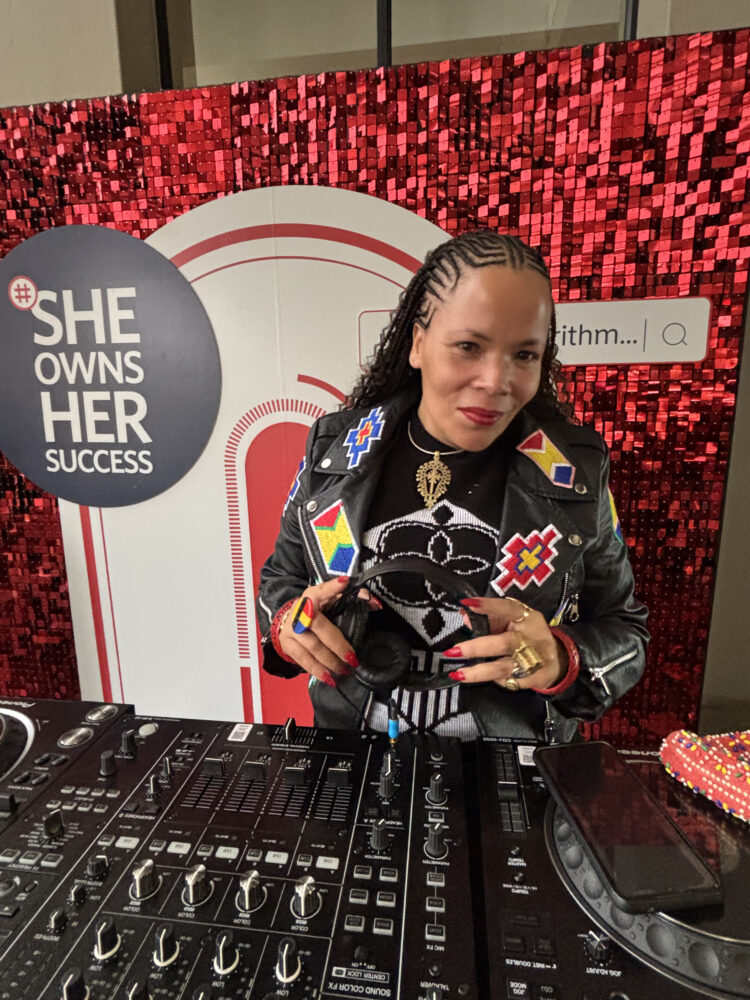
“She was never porous in her principles,” Tolsi said. “If she knew someone had been violent towards women, she made it clear where she stood.”
Their friendship stretched from student politics to Johannesburg’s cultural boom years in Yeoville during the late 1990s. Tolsi remembered parties at Westminster Mansions where artists, musicians, journalists and future cultural leaders gathered around McCloy’s orbit.
“At some point I walked downstairs and found Brenda Fassie shouting into the intercom trying to get into the building,” he laughed. “Maria is the coolest person I know, I thought to myself.’”
That coolness would become part of her mythology but Tolsi resisted reducing her to aesthetics alone. “People talk about her fashion and DJing and publicity work,” he said.
“But what I want to underline is that she shaped post-apartheid South Africa. She reshaped how we understood ourselves, how we danced, how we dressed, how we played.”
Writer and filmmaker Milisuthando Bongela followed with a tribute that was both devastating and funny, much like the friendship she described.
Bongela spoke about meeting McCloy in 2008 after moving to Johannesburg broke, uncertain and searching for direction.
“One day she saw me at a party and said, ‘What’s going on with you? You’ve lost your light’,” Bongela recalled.
When Bongela admitted she needed work, McCloy casually told her to come to the office in January. “I don’t even think they had a position for me,” she laughed. “I feel like they made one up on the spot.”
That was McCloy’s way. She made plans for people. She connected them. She held them up. Bongela also painted a vivid portrait of life at Westminster Mansions in Yeoville, where McCloy’s apartment became the emotional centre of an entire community.
“Her home was the literal middle centre of the building,” she said. “The beautiful beating heart of our community.”
Westminster was more than an apartment block; it was an ecosystem of artists, journalists, musicians and wanderers.
McCloy knew everybody. She introduced neighbours to each other. She hosted legendary January parties where one could encounter an ex-lover, a future employer, a famous poet, a sangoma or a lifelong friend all in the same night, Bongela said.
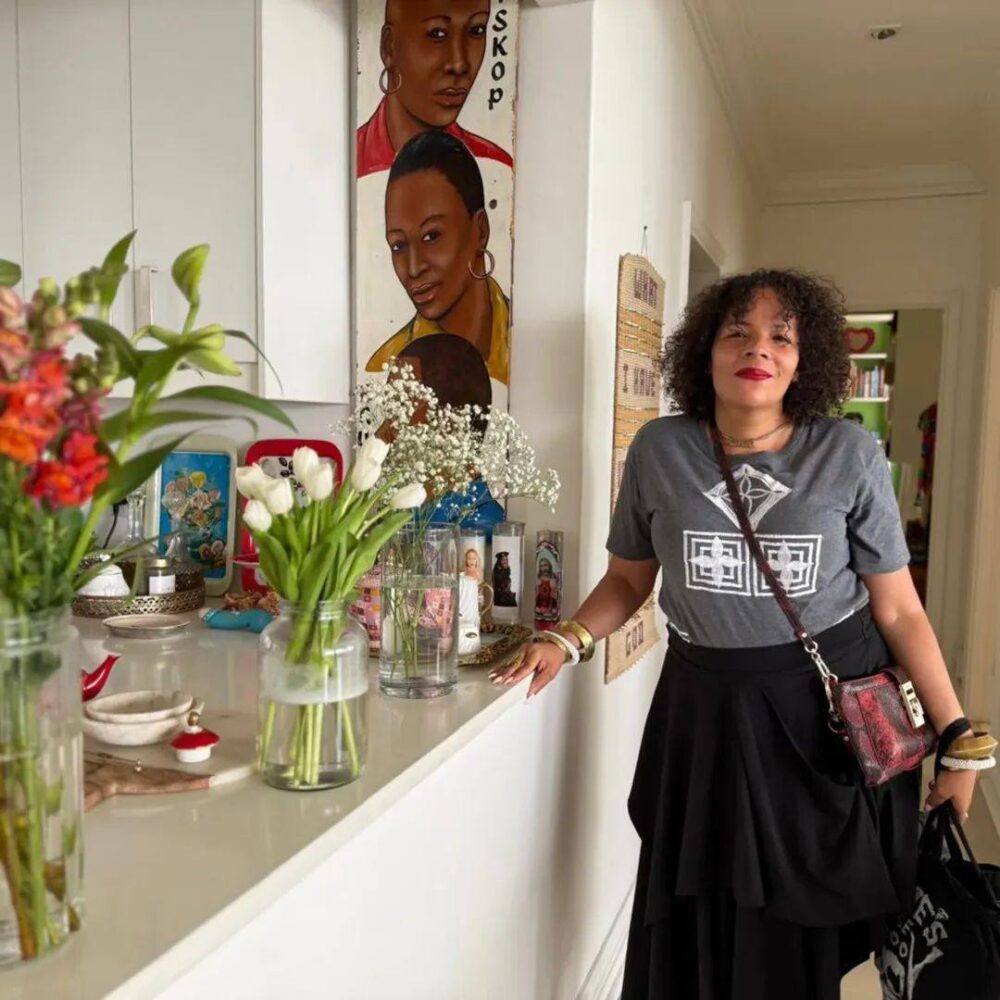
“Everything somehow passed through this butterfly,” Bongela said. “Because Maria was the nosiest person I ever met.”
Again, the theatre burst into laughter.
Bongela remembered how Maria never cooked, how her apartment smelled of incense instead of onions, how takeaway biryani and bottles of wine often stood in for domesticity. Yet somehow her home still radiated warmth.
“She gave people time,” Bongela said. “She gave us herself.”
The most striking part of Bongela’s tribute was her reflection on McCloy’s emotional generosity. Even after arguments, even after distance, she remained present.
“Ten years ago we stopped speaking for a few months,” she admitted. “Then in the middle of a feud she asked me for a lift home. I thought, ‘But we’re fighting.’ But I couldn’t say no. That was the end of the dispute. Never to be discussed again.”
Then came Dzino, co-founder of Black Rage Productions alongside McCloy and Kutloano Skosana. Through tears, Dzino spoke about the ambition they shared as young Black creatives in the 1990s.
“We wanted to create something like Drum magazine for our generation,” he said. “There was no media covering Black urban culture properly.”
Out of that vision came Black Rage Productions, which helped redefine South African television, publishing and music journalism in the democratic era. “Maria was at the centre of that universe for us,” he said. “She was the energy, the style, the taste, the instinct.”
He laughed remembering how she refused to fully digitise her business despite growing international demand for her accessories.
“I told her to set up a website,” he said. “But now I understand why she didn’t listen to me. Maria loved talking to customers. She wanted connection.”
It became a recurring theme throughout the memorial: McCloy as connector. McCloy as archivist of people. McCloy as emotional infrastructure.
And then, finally, there was Thandiswa Mazwai. She did not give a speech. She simply stood before the audience and sang Throw It Away by Abbey Lincoln.
The room broke open.
Mazwai’s voice carried what language no longer could. By then, everyone understood that this memorial was not merely about mourning a public figure.
It was about mourning someone who made Johannesburg feel possible. Someone who gathered people across class, art, music, fashion and politics and convinced them that beauty, style and radical care belonged together.
Outside, the city continued moving. Taxis hooted. Traffic thickened. Street vendors packed up for the evening. Johannesburg remained itself.
But for a few hours inside the Joburg Theatre, the city stopped to honour one of its greatest architects.
Kingsmead Book Fair returns with conversations SA needs right now:
The 14th annual Kingsmead Book Fair returns on Saturday, 23 May 2026, in association with Standard Bank, bringing with it the kind of energy Johannesburg rarely slows down long enough to hold onto anymore.
For one day, readers, writers, thinkers and the merely curious gather around stories. Not simply to buy books but to sit in conversation with ideas, memory, discomfort and possibility.
Tickets range from R60 to R115 on Webtickets but what the fair offers has never really been transactional. It remains one of the few cultural spaces that believes in slowness.
In sitting down. In listening carefully. In turning pages instead of endlessly refreshing timelines.
In a world where stories move through TikTok reviews, podcasts, newsletters, audiobooks and streaming adaptations, the Kingsmead Book Fair remains committed to the physical and emotional experience of reading.
Alex Bouche, the director of the fair, says that while the event has adapted to changing media habits, its central mission remains intact.
“We focus mainly on traditional literature because we think that literacy and reading is just so important,” Bouche says.
“While we have invited people who have podcasts onto panels and people who have done adaptations from books into plays and we have included them on the programme, our focus is always going to be on traditional literacy and promoting the love of the book.”
That commitment feels almost radical. Not because digital culture is inherently bad but because attention itself has become fragmented. Reading asks something different of people. It asks for time, concentration and imagination. It asks people to sit with complexity instead of skimming past it.
The Kingsmead Book Fair understands this deeply and over the years, has managed to preserve a sense of intimacy despite its growing scale.
This year’s programme feels especially compelling because of how sharply it reflects the emotional and political realities of South Africa right now.
More than 160 authors will take part in more than 80 sessions across children’s, teen and adult programming. Yet despite the size of the offering, the curation feels intentional rather than overwhelming.
“We have over 80 sessions happening throughout the day on our children, teen and adult programmes, which is very exciting,” Bouche says. “One of the things that we’re talking about is Joburg in particular.”
Johannesburg itself becomes one of the central characters of the fair this year.
“We have invited Tara Roos, who is a journalist. She will be in discussion with Jeff Wicks,” Bouche explains.
“And we’ve also invited Helen Zille because we feel that she has a broad knowledge of what’s happening in the city, following everything that she’s done and all the visits she’s made to different areas.”
The session asks a question many residents have quietly carried for years now: Can Joburg be saved?
“And I think that she can give us input on the status of the city and where to from here in terms of saving Joburg,” Bouche says.
It is difficult to think about Johannesburg without emotion. The city exists in constant contradiction. It exhausts people while simultaneously making them fiercely protective of it. Decay and beauty live on the same street.
Infrastructure collapses while creativity somehow continues to thrive under the pressure.
The fair’s willingness to centre the conversations is part of what has kept it culturally relevant. It refuses to treat literature as something detached from society. Here, books become entry points into larger conversations about politics, economics, identity and survival.
“We’re also obviously looking at mental health and making it through,” Bouche says. “So there we have Rachel Kolisi and Proverb. They are both speaking about difficult times and lessons they’ve learnt along the way.”
The programme also revisits South Africa’s historical wounds through discussions around apartheid’s legacy.
“With the anniversary of the Soweto Uprising, we’ve got a session on unpacking the legacy of apartheid, which I think will be hugely interesting,” Bouche says.
“With Yunus Carrim and Lebo Diseko.” The conversations matter because South Africa lives inside the consequences of its history daily.
The geography of cities, economic disparity, access to education and emotional inheritance continue to reflect apartheid’s architecture decades later. Literary spaces become necessary because they create opportunities for reflection beyond outrage or performance.
For younger attendees, the programme reflects how literacy intersects with digital culture as well.
When asked what she hopes attendees leave with this year, Bouche’s answer feels less like an event objective and more like a wish.
“I hope that they feel that they have been enriched by the authors,” she says. “That they have attended meaningful sessions that have included them in the sense of rich debate and dialogue and that they can’t wait for next year to join us again.”
Maybe that is ultimately what the Kingsmead Book Fair continues to offer in an age of endless distraction: the increasingly rare opportunity to be fully present.
Bongeziwe Mabandla is ready to be fully present:
The lights go down at Emperors Palace in Johannesburg and three silhouettes appear in separate pools of light.
One behind a drum kit, one behind a keyboard and one standing centre stage, directly in front of a microphone. The audience, drenched in darkness, falls silent.
Then Bongeziwe Mabandla’s distinctive voice cuts through that silence and the room erupts.
It’s the first South African stop of his world tour and from that opening moment, the evening belongs entirely to him.
Flanking Bongeziwe on either side are two Mozambican multi-instrumentalists whose contributions to his sound are anything but incidental. To his left stands Tiago Correia-Paulo — long-time musical director, principal producer and the architect of much of Bongeziwe’s distinctive electronic-infused Afro-folk sound, best known before this for his work with 340ml and Tumi and the Volume.
To his right is the younger Bruno Saranga, who also operates under the artistic moniker PizzawPineapples, a remarkably versatile musician, producer, sound engineer and visual artist. Together the three of them form something tighter than a band.
They move like a single musical organism.
Over the course of the evening, Bongeziwe pulls from across his discography, weaving familiar songs in and out of new material from his forthcoming album Ndingubani, due for release on 11 June.
The first time I saw him perform was back in 2022 at Constitution Hill, just before fellow Eastern Cape-born singer-songwriter Nakhane. I remember being struck then by the way he picked up his acoustic guitar and stepped off the stage mid-performance to walk among the audience, playing without missing a beat. The same guitar is with him again tonight at Emperors Palace, picked up and put down between songs depending on what the music requires.
He starts the evening in a black suit, elegant and composed. By the end, he has stripped down to a white vest, shorts and suspenders, dancing and jumping on stage with the joyful physicality of an artist who understands in his body what music is for. At one point, not long into the show, he calls on the seated audience to come forward and gather in front of the stage and they do, without hesitation, rising to meet him.
Before the show, I caught Bongeziwe on the phone from Maputo, Mozambique, where the African leg of his tour had begun. The tour has taken him through the Netherlands, Germany, Denmark, the UK, Belgium and France. After Joburg it will take him to East London for the Umtiza Arts Festival, then Gqeberha, Durban, Stellenbosch, Cape Town and ultimately Réunion Island for both the Indian Ocean Music Market and the Sakifo Reunion Music Festival, before returning to Emperors Palace for the final show.
His international footprint is staggering. He has performed across Europe, the US, Mexico and Australia, as well as in Africa — in eSwatini at the iconic Bushfire Festival, Zambia and Cape Verde. Ghana, Nigeria and Cameroon are in his sights. And not just for performances.
“I’m putting a Cameroonian artist on my album,” he tells me, with the quiet satisfaction of a man who has thought carefully about what it means to make African music that reaches across borders. All this touring, it should be said, has been done without the backing of a major label.
Bongeziwe works through his management company Black Major, with distribution handled independently through Platoon. When I ask him about the mechanics of making all this happen, he opens up about a reality that rarely makes it onto the Instagram highlight reel.
“Sometimes people don’t shed light on how much it takes to do this kind of music and tour around the world,” he says.
“People see the Instagram posts and the sold-out announcements. But I wonder if people really ever investigate what it takes for a musician to tour without support from South Africa, without government support. What does it really look like? People would be surprised how much we break our backs and ultimately sacrifice a lot of ourselves.”
His new album, Ndingubani — a title that translates roughly as “Who am I?” — arrives as both a question and an answer. It is, he says, an album that has been gestating inside him for years, waiting for the courage and the life experience to come fully into being.
“There are certain things I could only be able to write about now in my life,” he says.
“There were feelings and ideas that were always there but I didn’t have the courage or I didn’t know how to write them.
It’s only through this album that I was able to, maybe through experiencing pain deeply enough, finally piece it together.”
One of the album’s most significant songs is Ndikhulule (Depression), a track about something Bongeziwe says he understood about himself only last year. “I didn’t know last year that I’ve always been dealing with depression or feelings of depression,” he says.
“But I guess I didn’t know how to write it. How do you write a song like that? And it’s only through this album that I was able to maybe experience pain so much that I was able to finally piece it together. But it’s definitely something that was always lingering.”
The album balances that emotional weight with the sonic duality that has defined his evolution as an artist, the warmth of acoustic folk instrumentation alongside the pulsing energy of electronic production. When I ask him how he decides which direction to take a song, he dismisses the idea of any formula.
“I think it’s just from the beginning stages. You can kind of feel where a song is wanting to go,” he says simply.
That intuition has served him well. His 2020 album, iMini, released during the isolation of lockdown, opened South Africa up to him in ways his earlier work hadn’t managed.
Growing up in Tsolo in the Eastern Cape before making his way to Johannesburg, he was for a long time an artist better appreciated abroad than at home, a not uncommon experience for South African musicians operating outside the mainstream.
“South Africa has really grown for me,” he reflects. “It hasn’t always been like that. Especially with the release of iMini, it really changed my home base. And I’m so happy it did because it really opened up South Africa for me in a big way. It’s been the reward of persistence.”
The vulnerability that defines his songwriting — the willingness to lay bare grief, longing, desire and now depression — might seem like an act of courage but Mabandla says the accumulated warmth of his audiences has made it easier to go further.
“When you say something of great weight, the response is very important,” he says. “A lot of the stuff I’ve shared through my music has been received well, so now I have the comfortability to share even further.”
The intimacy does come with its complications. Being a private person at the centre of an increasingly large emotional community is something he navigates carefully.
“It’s overwhelming,” he says of the experience of fans who feel they know him through his music. “And it’s kind of difficult because I think I am that person who is usually one-on-one, you know. But sometimes I can’t. It’s like: thank you very much and then you move on.”
Despite his growing international profile and his stated ambition to plant himself firmly as a global artist, there is something in Bongeziwe’s reflections that feels less about conquest and more about presence. He is a man who has been chasing a dream for long enough to know that the chasing itself can become a way of avoiding the moment you’re in.
“I’m at this place where I realised that one day could be right now,” he tells me. “I no longer want to wait. I want to fully express myself in the moment. Some of us never know how many shows we have in us. And I just don’t want to not be present. I think time runs out if you don’t do it.”
Back at Emperors Palace, the crowd gathered in front of the stage sings back every word. Bongeziwe, now in his vest and suspenders, dances like nobody is watching and plays like everybody is.
By any definition, he is present — gloriously, completely, unambiguously present.
Whatever Ndingubani turns out to be, the man asking the question seems to know the answer.
Submit and get free exposure here: Showcase Your Business | Advertise Your Special Offers.