
The new Mazda 3 has been around for a while and has undoubtedly come a long way. It comes as no surprise that the brand has become associated with comfort, efficiency and reliability. The new Mazda 3 does not disappoint in living up to that reputation, proving itself in my drives along Cape Town’s meandering and picturesque routes.
Mazda has resisted the industry’s obsession with constant reinvention, choosing instead to refine what works. The result is a car that feels considered, offering old-fashioned reassurance.
In recent years, Mazda has become known for its aesthetically pleasing designs; a departure from its past. The sedan is elegant, almost conservative but the hatchback carries a more creative personality. It has curves in the right places and feels appropriately sculptured.
It might not be universally loved — there are complaints about rear visibility being compromised — but I experienced no issue with visibility. That seems almost beside the point. This is a car that prioritises elegance and efficiency.
Inside, the Mazda 3 continues to impress. The cabin feels rich, without forced extravagance and the controls are easy to find, unlike so many new brands on the market.
There’s a sense of calm here that’s increasingly rare, without the over-stimulating screens that are difficult to navigate. Just a quiet, deliberate focus on the driver.
The Mazda3 has an all-new 8.8-inch infotainment screen supporting MZD Connect, which comes standard on all models. The base models feature an all-new eight-speaker sound system that uses a three-way layout with mid-bass drivers moved from the doors to the panel area for improved sound quality and bass response. The Individual model is equipped with the top-tier Bose premium sound system.
A new leather-wrapped steering wheel featuring illuminated controls and switches exudes luxury. Standard features include Bluetooth phone and audio pairing, remote keyless entry, push-button ignition, auto door lock, auto headlights and wipers, electronic parking brake, new knee airbags and two USB audio inputs. This elevates the Mazda3 to premium status.
And that’s really where the Mazda 3 distinguishes itself. It is, above all, a driver’s car. The steering is as precise as one would expect and the ride is composed and comfortable.
The naturally aspirated engine feels smooth and predictable, while the turbocharged version adds a layer of effortless urgency that never tips into aggression. Under the bonnet, power ranges from 88kW for the Mazda3 hatch 1.5 Dynamic and goes up to 114kW for the Mazda3 hatch 2.0 Astina.
The dual-engine strategy allows the car to cater to both everyday commuters and those seeking more spirited performance. The turbo variant, in particular, is among the quickest in its class, capable of accelerating from 0km/h to 100 km/h in under six seconds.
However, it should be noted that the Mazda prioritises refinement over outright sportiness. The driving experience is not aggressively dynamic, which might disappoint drivers expecting hot-hatch levels of excitement.
There’s also something faintly nostalgic about the availability of a manual transmission. Not because it transforms the car into something it isn’t but because it acknowledges a shrinking group of drivers who want that tactile connection. In this context, it’s less about speed and more about involvement.
The rear seats on the hatchback are a little tight but manageable. You get the design benefit though.
When it comes to electrification, Mazda will need to catch up. I’m hoping we see more hybrid and electric versions in the near term. I’m sure the Mazda 3 will pivot from its more traditional philosophy soon.
What makes the Mazda 3 compelling is that it offers something less easily quantified. A sense of cohesion, a feeling that each element, from the way the door closes to the way the car settles into a corner, has been tuned with intention.
It’s a car that asks you to slow down slightly, to notice the details, to appreciate the difference between something that simply works and something that feels reassuring and rewarding. Not everyone will care about that but I’m sure most people will.
For those who believe that even an everyday car can have a point of view, the Mazda 3 continues to make a quietly persuasive case. It’s tried and tested.
Prices and fuel
1.5 Dynamic Manual: From R490 900 — 6.0L/100km
1.5 Dynamic Auto: From R507 200 — 5.9L /100km
2.0 Astina (Top Spec): From R620 400 — 6.3L/100km
Free State councillors apply for jobs in the municipalities they serve, fearing 2026 election loss:
Free State Cooperative Governance and Traditional Affairs MEC Sakie Mofokeng says he has faced pushback from some councillors after discovering that they had applied and been shortlisted for interviews in the same municipalities they serve.
According to provincial insiders, the councillors were trying to secure jobs because they were uncertain whether they would return as councillors after the 2026 local government elections in November.
“You find councillors in their own municipality who have applied and are shortlisted for interviews to become employees of the same municipality they lead,” Mofokeng told the Mail & Guardian in a wide-ranging interview last week. “When you intervene to correct that particular situation, there’s pushback.
“You can never have a councillor applying and being shortlisted, as happened with councillors of Mohokare Local Municipality who wanted to appoint themselves. There’s no way that the provincial government can interview me for a position in the administration while I’m serving as an executive.”
Some councillors in Mohokare Local Municipality have accused Mofokeng of removing an elected mayor and a municipal manager who had been appointed by council and replacing them with people from his office.
A source in the municipality told the publication that Mofokeng was doing that to secure resources through the municipality in order to fund his ANC campaign before the next provincial conference.
Another source told the M&G that in municipalities where Mofokeng did not have people he could manipulate, he used service delivery failures to gain control.
“Once he puts the municipality under administration, he uses his people as administrators without the control of the council so that he can do whatever he wants. The reason he does this is because he cannot control the council.
“This is just a battle over resources and has nothing to do with fixing local government. I’m a member of the ANC. If you are saying you are putting these municipalities under Section 139 while there is a deployment committee policy of the organisation, you are basically saying the organisation is failing because those deployed come from the ANC.”
Mofokeng dismissed the allegations, saying they were part of a fightback campaign by those the crackdown affected.
His detractors, he said, had resorted to slander and malicious allegations that could never be substantiated, adding that everything done by the provincial government and Cogta was above board and open to scrutiny.
“I can confirm that there is nowhere we are going to be found wanting in terms of the decisions we have taken,” said Mofokeng. “The MEC will never be appointed without the provincial executive council (exco). It is a fallacy that Mofokeng is running amok unless they provide evidence as to how Mofokeng hired his people.
“Beneficiaries of capture and disorder will fight back because they want to protect their immediate benefits but we are not going to hold back. We will push back.”
Mofokeng said that in every municipality where the government had intervened, including those placed under Section 139 administration, the decisions were made by the provincial government and not by him alone.
He said the province had deployed exco representatives to struggling municipalities and those representatives were appointed by exco, not by him.
“The argument that one is running amok is far from the truth. These are exco resolutions and provincial government decisions made in accordance with the laws of the land.
“The law is instructive: when municipalities are unable to fulfil their constitutional obligations, the provincial government, through Cogta, must intervene,” he said.
“There are people who will not be happy that we are intervening. Some of those people are in the administration and some are at a political level.
“We have experienced pushback and we don’t mind because we know it comes with the territory. We have taken it head-on and we are happy that we have pushed through. We are in a number of municipalities to make sure we are closing the gaps.”
Part of the reason Free State municipalities had failed to fulfil their mandates was because people with little to no expertise had been appointed to senior roles, he said.
Municipalities would hire senior managers from other municipalities who had either been removed over corruption scandals or presided over the collapse of those municipalities.
“I’m happy that municipalities have begun recruiting the right personnel in the right way and that’s what we ask. Municipalities that are not adhering to the law can be taken to court so that we can seek declaratory orders against appointments that are wrong and illegal.”
A director or city manager was a permanent employee, Mofokeng said. “Once you appoint that person, they will be there for years. If it is the wrong appointment, it will harm the people and the municipality and we cannot allow that.”
Free State municipalities have struggled to obtain clean audits. Many have failed to provide basic services because of the systemic corruption the province has been fighting against for years.
In February during her State of the Province address, Premier MaQueen Letsoha-Mathae vowed to fix struggling municipalities, declaring 2026 a “year of decisive action” for local government reform.
Mofokeng said that since taking office, the provincial government had prioritised clean audits and improved audit outcomes, adding that audit action plans had been adopted to help turn municipalities around.
“The first phase was to stabilise and stop the downward spiral. The second phase was to begin seeing improvements and we are happy that we are no longer seeing excessive regressions,” he said, adding that they were encouraged by progress in municipalities including Maluti-a-Phofung, Dihlabeng, Kopanong, Setsoto and Matjhabeng.
He conceded, however, that some municipalities remained stagnant, including Mangaung Metro.
Artscape celebrates 55 years by opening its doors wider than ever:
For much of its existence, the imposing theatre complex that houses the Artscape Theatre Centre stood as a contradiction: architecturally grand yet socially exclusionary, a cultural landmark shaped by the realities of apartheid South Africa.
Originally opened in 1971 as the Nico Malan Theatre, the venue was designed as a showcase for elite performance culture while much of the country remained locked out of its auditoriums. Fifty-five years later, Artscape is attempting to frame the building differently — as a space that reflects the country’s long and unfinished process of transformation.
On Tuesday, 19 May, Artscape will mark its 55th anniversary with a public programme built around the theme “A Place for All”, an idea that sits at the centre of the institution’s current identity. The celebrations begin with the unveiling of a commemorative memory wall titled Becoming Artscape – A Place Reborn, followed by an open press conference and a mass photograph on the theatre steps which members of the public have been invited to join.
The afternoon will conclude with a free lunchtime concert featuring Western Cape Education Department school bands and opera performances, extending a format that has become one of Artscape’s most visible outreach initiatives in recent years.
The symbolism is deliberate. Where the building once functioned as a space of exclusion, the anniversary programme leans heavily on openness, participation and accessibility. It’s both a celebration of longevity and an attempt to reposition what the institution represents in the democratic era.
The tension between history and reinvention has long shaped public conversations around Artscape. During apartheid, the theatre was closely associated with segregationist cultural policy, including restrictions that prevented many black South Africans from entering the venue. Even acclaimed playwright Adam Small was unable to attend the opening of his own work Kanna hy kô hystoe there because he was not white.
The institution’s contemporary leadership has spent years trying to recast that legacy through community programming, accessibility initiatives and broader audience development. Under CEO Marlene le Roux, Artscape has increasingly positioned itself as a civic rather than purely theatrical space, expanding its focus beyond staged productions into education, outreach and skills development.
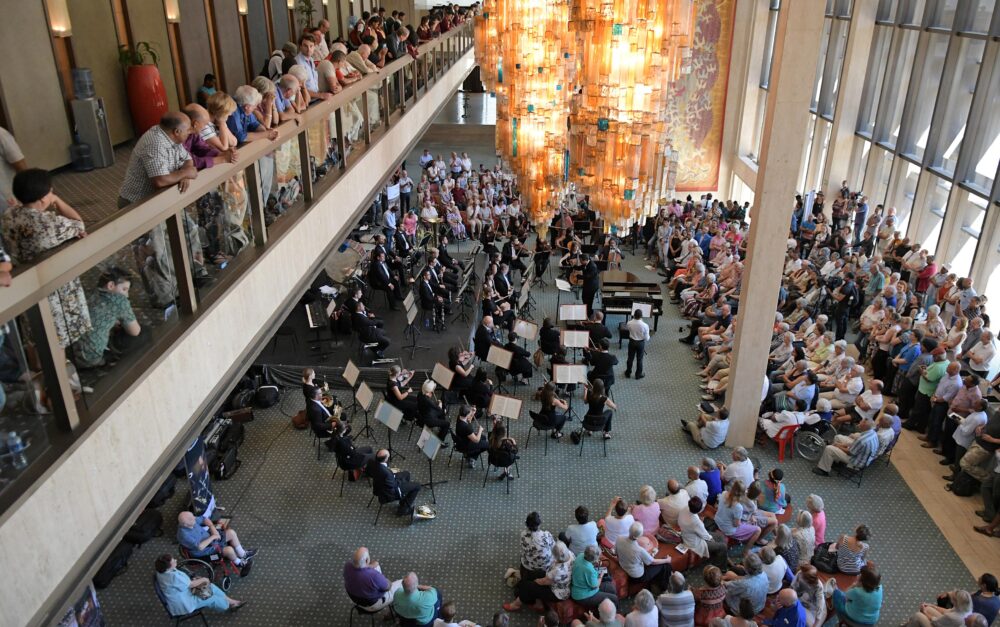
The broader orientation is visible in the anniversary programme. Alongside productions and concerts, Artscape will host free tours, public engagements and Saturday masterclasses running from May to November. The first, titled Fast Track to Opening Night, will explore the architecture and accessibility of the building, while another session led by broadcaster Africa Melane will focus on arts funding and sustainability.
A career expo scheduled for 6 June similarly shifts attention toward the labour ecosystem surrounding performance. Rather than focusing solely on actors and musicians, the initiative aims to expose young people to technical and production roles ranging from lighting and costume design to stage management and building operations.
The emphasis reflects a growing recognition in South Africa’s cultural sector that the arts cannot survive on symbolism alone. Institutions increasingly find themselves having to justify their economic and educational value alongside their artistic relevance, particularly in a climate where arts funding remains precarious.
Artscape’s anniversary messaging repeatedly returns to that point. Every production staged inside the complex depends on an infrastructure that extends far beyond performers themselves: technicians, stage crews, designers, administrators, maintenance workers and independent creatives who collectively sustain the venue’s ecosystem.
It is perhaps why the anniversary celebrations also include something notably practical: discounted tickets.
As part of the 55-year campaign, Artscape will release a limited number of R55 early-bird tickets for selected productions in the Opera House and Theatre. Available on a first-come, first-served basis through Dial-A-Seat, the initiative functions both as a symbolic gesture and an acknowledgement of a persistent affordability challenge facing live performance spaces across the country.
In recent years, theatres globally have grappled with changing audience habits, rising production costs and competition from streaming culture. In South Africa, those pressures are compounded by economic inequality and declining discretionary spending. Making theatre feel culturally open means little if audiences remain financially excluded from participating.
The year-long anniversary programme will culminate in a gala concert on 8 November directed by Basil Appollis, who also helmed Artscape’s 50th anniversary celebrations.
But the deeper significance of the milestone might lie in the institution’s continuing attempt to redefine itself. After more than half a century, Artscape remains a building burdened by history yet trying to imagine a different future for what a public cultural space in South Africa can be.
Submit and get free exposure here: Showcase Your Business | Advertise Your Special Offers.
