Meet Mozambique’s four leading presidential candidates:
More than 17 million Mozambicans are called on to vote for a new president on Wednesday with incumbent Filipe Nyusi, 65, prevented by the Constitution from seeking a third term.
Nyusi’s Frelimo party has held power since independence from Portugal in 1975 and its candidate, Daniel Chapo, is widely expected to become the new president.
Here are the main contenders:
Daniel Chapo, unknown favourite
At 47 years of age, Chapo was relatively unknown until he was named the Frelimo candidate in May, a surprise announcement after the party could not reach consensus.
With limited experience in politics and government, if he is elected, he will become Mozambique’s first president born after independence from Portugal and the first not to have served as a Frelimo fighter.
A former political science lecturer, Chapo has a law degree and has worked as a radio presenter. He was appointed governor of the southern province of Inhambane in 2016.
Venancio Mondlane, ambitious breakaway
Dapper and ambitious, 50-year-old Mondlane quit the main opposition Renamo party in June 2024 in a leadership struggle and joined forces with the smaller Podemos (We Can) party.
His charisma and fiery speeches have roused enthusiasm among younger voters, leading analysts to believe he might have a chance of overshadowing Renamo.
A forestry engineer and Renamo MP for Maputo from 2015, he was the party’s candidate for the capital’s mayor in 2023 elections but was defeated, claiming fraud afterwards.
He became known during the protests against alleged irregularities in the 2019 general elections when Frelimo was declared to have taken 73% of the votes.
Ossufo Momade, opposition veteran
Momade, 63, has headed Renamo since 2019, the year he signed an accord with Frelimo to end a new outbreak of conflict after the failure of a first peace deal in 1992.
He entered the civil war as a 17-year-old soldier, rising to become one of Renamo’s top military leaders.
After Renamo moved from a rebel group to a conservative political party, he was elected as an MP in 1999, a post he still holds.
When Frelimo swept the municipal elections in October 2023, Momade claimed fraud and called for demonstrations.
Renamo also alleged fraud after the 2019 general election, as did civil society and some international observers, and Momade refused to attend Nyusi’s inauguration.
Lutero Simango, centre-right
Simango, 64, has been president of the centre-right Mozambique Democratic Movement since 2021 when he took over from his influential late brother, Daviz Simango. The party was formed in 2009 in a split with Renamo.
Simango has led a campaign focused on the economy and access to healthcare. He is outspoken in his loathing of Frelimo, whose leaders he describes as “thieves dressed in red”, the party’s colour. — AFP
Joburg’s water woes are self-inflicted:
At midnight on 30 September, large gates were closed at two points along the Lesotho Highlands Water Project (LHWP), marking the beginning of a six-month maintenance shutdown, the longest in its 20-year history.
The stoppage comes amidst ongoing water provision issues in South Africa’s urban highveld, which draws water from the LHWP via the Vaal Dam. Johannesburg’s water provision problems have been linked to poor management of water infrastructure by municipalities, but in advance of the LHWP shut down, some analysts warned that the stoppage could exacerbate these problems.
But water management specialist Carin Bosman disagrees.
“An increasing number of people, including some who should know better, appear to believe that the planned shutdown of the LHWP will contribute to the water supply problems experienced in Johannesburg, but these aspects are in fact unrelated,” says Bosman.
The fact that the level of the Vaal Dam stood at 41% percent of capacity last week compared to 80% this time last year, “isn’t helping to dispel notions that we are facing water shortages,” says Bosman, who worked for the department of water before and after the advent of democracy.
She says, “It is not unusual for the level of the Vaal Dam to be around 40% at the end of the dry season. There is a difference between a meteorological drought, which is the result of rain not falling in the rainy season, and an institutional drought, which is the consequence of water management failures. Johannesburg is suffering from the latter.”
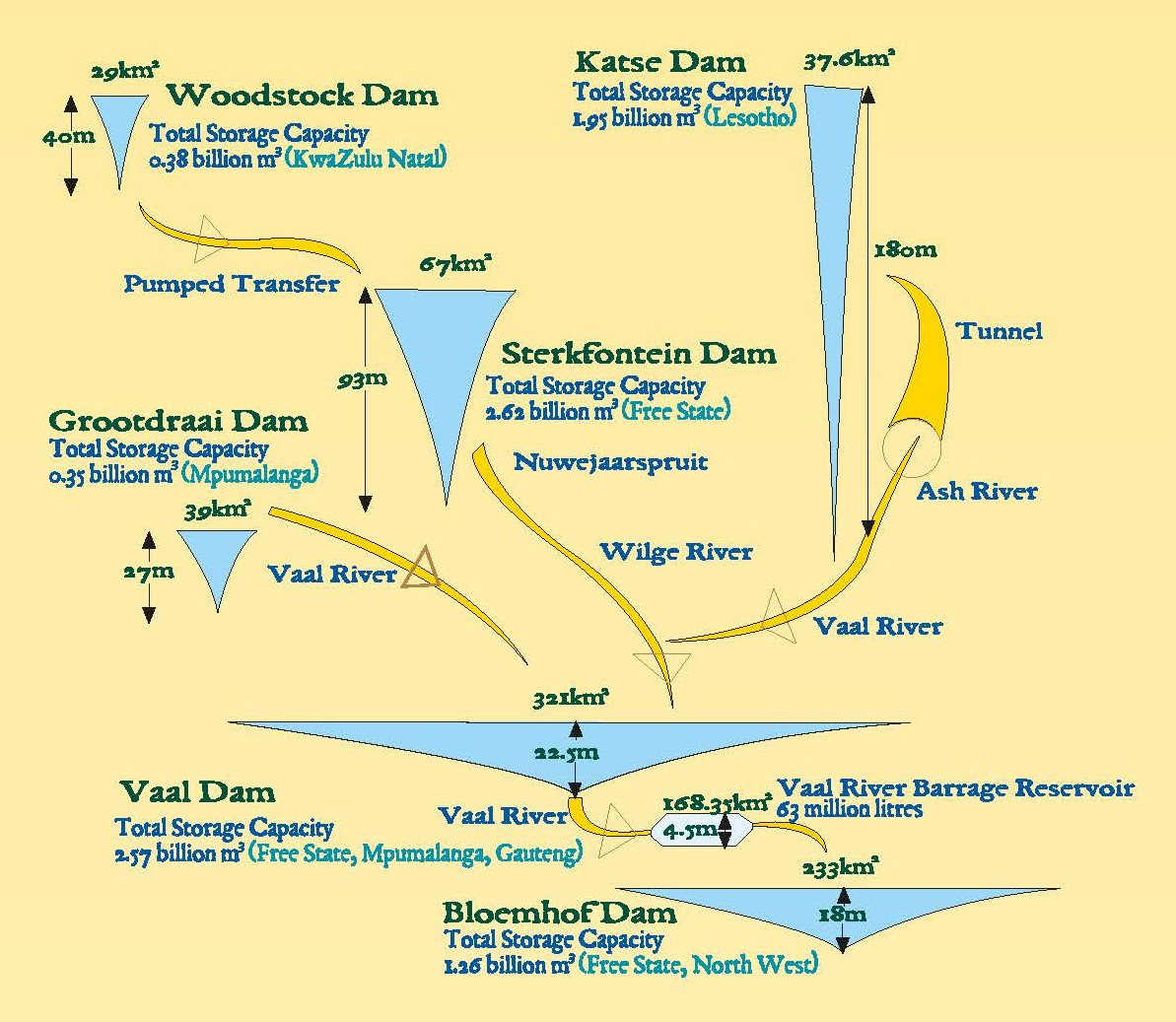
Department of Water and Sanitation (DWS) spokesperson Mandla Mathebula said the Sterkfontein Dam, on the edge of the Drakensberg escarpment, functions as a reserve dam for the Vaal Dam. Sterkfontein Dam has a similar storage capacity to that of the Vaal Dam, but according to Mathebula, “it is a deeper dam, and the environment is cooler, so it doesn’t lose as much water by evaporation”.
“The standard operating rule is that Sterkfontein Dam releases water to the Vaal Dam when the Vaal Dam reaches a level below 18%. The Sterkfontein Dam is currently full [98%] and will be used to top up the Vaal Dam should the need arise,” said Mathebula.
Richard Holden, a water and sanitation expert, put it more starkly: “Sterkfontein has a capacity of over 2,600-million cubic metres, which on its own is enough to meet the demands of Johannesburg and surrounding areas for almost two years,” he said.
But Johannesburg is using more water than is wise. Rand Water, which supplies bulk water to Gauteng Province, has exceeded the volume of water it is licensed to provide to Gauteng’s municipalities every year for the past six years. The utility is licensed to supply the province with 1,600-million cubic metres a year, but exceeded this by 193 million cubic metres in 2023/2024.
In a June speech to the Strategic Water Partners Network, DWS director general Sean Phillips warned, “It would be irresponsible to allow [Rand Water] to abstract more. If we had a drought, this could mean a day zero situation in Gauteng.”
The term Day Zero – referring to the day on which municipal water would be largely shut off due to supply shortages – was used by Western Cape authorities during the water crisis of 2015-2020 to galvanise people to use water sparingly. There is no official Day Zero campaign for Johannesburg but the term has been seized on by some.
“Some unscrupulous scaremongers are using it to sell water storage tanks, and it is increasingly present in media headlines, which is unfortunate because Johannesburg is not facing Day Zero,” said Bosman.
“It is important that people become more water wise and the department faces a delicate balancing act of putting pressure on citizens and local water authorities to change their ways, on the one hand, and on the other to avoid creating the impression that there isn’t enough water around to meet needs.”
And then there is the huge problem that nearly half of Johannesburg’s water is lost to leaks. We will be writing more about this in a future article.
How Johannesburg gets its water
Mathebula explained that Johannesburg receives water from the Integrated Vaal River System (IVRS), a network of fourteen dams that are linked to each other by a system of rivers, canals, tunnels, pipelines and pump stations, and which together store over 9,300-million m3 of water.
“The Vaal Dam is the most important impoundment in that system because it is from here that Rand Water abstracts water for treatment, but it is only one part of the very big system that the DWS manages, in which water can be transferred from one part of the system to another, as and when required,” he said.
According to Johan Tempelhoff, Professor of History at North West University, the complexity of the IVRS is a consequence of the fact that Johannesburg was built on a watershed.
“Several streams come off the watershed and there are some good springs in the area, but their ability to meet the rapidly growing city’s needs had been exceeded as early as the drought of 1895,” he said.
To solve the problem, the government looked to the waters of the distant Vaal river, completing an impoundment called the Vaal Barrage in 1923, and the much larger Vaal dam in 1938. Today, all of Johannesburg’s treated water comes from the Vaal dam.
“It wasn’t long before the water that naturally enters the Vaal dam was not sufficient to meet the demands of the industrialising highveld. It was for this reason that two major “inter-basin” water transfer schemes were developed, capable of feeding water into the Vaal’s main feeder rivers from catchments hundreds of kilometres to the south,” Tempelhoff said.
The first of the inter-basin schemes to be completed, in 1974, was the Thukela-Vaal Transfer Scheme, which is fed from Mont-Aux-Sources atop the Drakensberg escarpment.
According to Holden, “Water from the Thukela River enters Woodstock Dam, and some of this is ultimately pumped over the Drakensberg into Driekloof Dam for use in the Drakensberg Pumped Storage Scheme. When Driekloof is full, the excess water enters Sterkfontein Dam, and it is stored here until it is needed in the Vaal River System,” he said. The DWS does not release water from Sterkfontein until it is absolutely necessary.
“The fact that it is pumped water means that it is expensive water, so it is kept up there for emergency use only,” he said.
The other scheme is the LHWP, which impounds the water from several catchments in Lesotho in two large reservoirs called Mohale and Katse.
Water released from these reservoirs is gravitated through a series of pipes and tunnels into South Africa’s Ash River, which flows into Liebenbergsvlei, which joins the Wilge River, that discharges into the Vaal dam.
Holden chuckled when asked if the LHWP was the biggest supplier of water to the Vaal dam.
“We don’t operate the system that way,” he said. “Some parts of that system will always be compensating for other parts. That’s just the nature of the water cycle.”
He gave the example of 2015, a year in which, during a drought in Lesotho, “the flow of water from Lesotho was significantly reduced without impacting on the assurance of supply”.
Holden said that LHWP is, however, the most consistent provider of water to the Vaal Dam.
“There’s a hydroelectric power station on the Lesotho side, and water needs to run consistently through that plant to keep the turbines moving, so it runs consistently down into South Africa and the Vaal Dam, no matter how high or low the level of the Vaal Dam happens to be,” he said.
Mathebula said that the governments of South Africa and Lesotho annually agree on the amount of water to be transferred.
“This year the agreement was for 780-million cubic metres to be delivered while generating 72 megawatts of hydropower through Lesotho’s Muela Power Station,” he said.
The stoppage of the LHWP has meant that there is a shortfall of 80-million cubic metres, which Mathebula said will be made up when the LHWP resumes in April 2025.
Phase II of the LHWP, now scheduled for completion in 2028, will impound the waters of the Senqu and Khubelu rivers in a dam called Polihali, adding approximately 2,325-million cubic metres in storage capacity to the LHWP. According to Holden, the LHWP will then be the biggest contributor of water to the Vaal River system.
“It is for this reason that the maintenance stoppage is so important. If it isn’t done it could result in a longer stoppage in the future, and if this happens in a drought year it could spell trouble. If people could focus on that, instead of this misinformed notion that Johannesburg doesn’t have enough water, we’d all be better off,” said Holden.
This article was first published on GroundUp
Sex, power and control: The Hidden crimes behind the Gaza genocide:
As we reach 7 October, marking a year of the genocide in Gaza being broadcast live to the world, one glaring issue remains unchallenged — Western political elites not only enable this atrocity but are deeply entwined in its perpetuation.
While the focus often shifts to campaign donations, the true depth of elite complicity in fuelling the violence goes largely unexamined — beyond the shadows of money, there are darker motivations at play.
We have seen soldiers parading in the lingerie of dead or displaced Palestinian women on social media, a Rabbi justifying child rape and Israeli lawmakers considering legalising the rape of Palestinians. From this, it is easy to believe this horror is contained in the apartheid state. But the truth is far darker.
When leaders wield sex as a tool of power and domination, the conflict becomes an evil far beyond financial gain. Increasingly, it’s not just money controlling the elites — it’s sexual blackmail, turning moral depravity into a weaponised force that fuels the very essence of violence and control.
The recent revelations surrounding Jeffrey Epstein and the extensive network of compromised political figures around him suggest that their complicity in global atrocities, like the genocide in Gaza, might stem from fears of exposure. Pragmatically, one cannot ignore the power dynamics at play, where moral integrity and the fear of sexual scandal serve as tools of control for global leaders.
The genocide in Gaza has long been a symbol of settler colonialism, racism and apartheid, with Israel being accused of extreme violence for years and Western leaders turning a deaf ear. Western nations, particularly the US, Canada, Australia, the UK and some European states, like Germany, the Netherlands and Sweden, have continued to provide unwavering support for this racism, apartheid and ethnic cleansing, often citing economic, political and military alliances in support of Israel.
The billions of dollars in financial aid flowing from the West to Israel, primarily from the US, raise the question: Why is there such fierce loyalty despite clear human rights violations and evidence of the greatest crime of all — genocide?
Financial contributions are an easy scapegoat in understanding this support but the true dynamics possibly run deeper. Western nations have vested financial interests in the Middle East, from arms deals and securing energy supplies, to maintaining influence in a geopolitically critical region. Yet, beyond economic factors, the level of support from Western political leaders of Israel hints at something more personal and coercive — something that attacks their very morality.
If money alone does not account for this unyielding support, what else drives these political elites to remain complicit in such atrocities?
One must confront this question because it’s impossible to believe they are unaware of the brutality and evil unfolding. They’ve recognised and condemned similar atrocities — targeting hospitals, schools and children — in Ukraine. To suggest they do not see, understand, or feel the weight of Israel’s gross violations against the Palestinian people strains credibility.
Their silence speaks volumes, revealing a disturbing inconsistency that demands scrutiny more so now, when seemingly out of nowhere, they found their voices, rallying together to push for a 21-day ceasefire in Lebanon. The White House even published a statement to the effect.
One of the most compelling explanations for this complicity can be found in the way sexual scandals are used as tools of control. The Epstein case provides an unsettling window into how this operates.
Epstein, a financier and convicted sex offender, maintained relationships with an extensive network of high-profile politicians, business leaders and celebrities. His private island, “Little St. James”, and the infamous flight logs from his private jet “Lolita Express”, have come to symbolise a dark underbelly of power where influential individuals were allegedly filmed engaging in illicit activities with minors.
The full Epstein list remains sealed but the names already linked to the case include former US president Bill Clinton, who flew multiple times on Epstein’s jet. Clinton’s name resurfaced in discussions not only for his alleged participation but also for the strange painting of him in a blue dress that hung in Epstein’s New York mansion. As commentators have suggested, this was not merely art but a display of power — Epstein’s way of saying, “I own you.”
This suggests a pattern of manipulation that goes beyond money. Compromised by their illicit activities, figures like Clinton might have little choice but to comply with agendas that defy morality, such as turning a blind eye to the genocide in Gaza.
The case of Dominique Strauss-Kahn, former head of the International Monetary Fund, presents another clear example. In 2011, Strauss-Kahn was arrested in New York after being accused of sexually assaulting a hotel maid. Although the charges were eventually dropped, his political career was destroyed.
Strauss-Kahn had been a key player in global financial governance and many have speculated that his sudden downfall was orchestrated due to his challenges to the established financial order. Was it a coincidence that this powerful figure, who posed a threat to certain economic agendas, was brought down by a sexual scandal?
In both cases, the scandals did more than just damage reputations, they ended careers and reshaped the political landscape. These incidents suggest a coordinated effort to maintain control over individuals through the threat of exposure.
If a political figure can be manipulated by their sexual indiscretions, their loyalty is not just bought — it’s owned. Beyond individual examples, these cases reveal a systemic method of control that extends into international political decisions such as support for, and complicity in, genocidal actions in Gaza.
Sex scandals have always held immense power over political figures. Unlike financial scandals, which can be explained away or overshadowed by larger economic contributions, sexual misconduct — especially involving minors — can permanently stain a politician’s reputation. It attacks the very core of their morality and threatens to dismantle their integrity. Public figures, particularly in Western societies where sexual purity and moral righteousness are emphasised, live in constant fear of these skeletons being exposed.
The Epstein scandal illustrates the extreme fear that sexual misconduct holds over powerful men and women. Once a figure is compromised through illicit sexual activity, especially with minors or vulnerable individuals, they are at the mercy of those who possess the evidence. This allows for absolute control.
Politicians who are trapped in this web of moral decay will do anything to protect their secrets, even if it means supporting genocidal actions, such as those carried out in Gaza. The standing ovations given to Israeli Prime Minister Benjamin Netanyahu by members of the US Congress after his speeches raise eyebrows. Netanyahu is known for spreading lies and propaganda, yet members of Congress appear “owned”, clapping over 50 times.
Upon closer inspection of their facial expressions and body language, one might notice the vacant, almost fearful look in their eyes — a look that suggests these leaders are not merely politically motivated but controlled by something far more sinister.
It is arguable that for some of these individuals, supporting the genocide in Gaza might not be a matter of political agreement or economic gain but of self-preservation. The greatest threat to their careers and personal lives is not losing money but losing their moral standing and reputation. Individuals caught in these traps know that with all the propaganda tools at their disposal, they can dominate the narrative to contend that it is “morally correct” to bomb the “terrorist Hamas” into oblivion in Gaza and preserve Western “values” to protect their secrets. Thus, they remain complicit, trapped in a system that leverages their sexual indiscretions to ensure their silence, complicity and obedience.
Keeping up appearances comes at a significant cost, particularly when one’s innocence might be overshadowed by the circumstances, associations and how they’re framed by the lens of perception. In such cases, even a misleading context can tell a different, damaging story.
This understanding of sexual control sheds new light on many of the Western political elite’s willingness to ignore, justify and support the atrocities in Gaza and the continued ethnic cleansing of the West Bank and occupied Palestinian territories.
As the US approaches the November elections, a clear effort to secure Donald Trump’s return to power is emerging. The recent arrest of Sean “Diddy” Combs has fuelled rumours that he possesses damaging information on high-profile political figures, potentially implicating them in sexual blackmail schemes.
Should he meet a suspicious fate in custody — reminiscent of Jeffrey Epstein, a scenario Hillary Clinton herself once joked about — it raises serious questions about the extent to which the fear of exposure influences political decision-making among elites.
These incidents are not isolated; they reflect a disturbing pattern with profound implications for all of us. The conference under the title African Global Dialogues at Constitution Hill in Johannesburg, in late September, was perceived by many as an attempt to whitewash the ongoing genocide of Palestinians in Gaza and the occupied West Bank.
Cloaked in the rhetoric of so-called “dialogue”, this gathering mirrors a familiar tactic often employed by Zionist advocates — feigning a commitment to peace talks while simultaneously perpetuating grave atrocities. Additionally, several speakers listed as participants in the dialogue publicly disclosed that they had never been approached to participate, while others revealed they had not consented. The falsehoods, it seems, persist without restraint.
The director of the New South Institute, that would host the dialogue, Ivor Chipkin, tried to publicly undermine South Africa’s legal efforts at the International Court of Justice, dismissing the Palestinian right to resist occupation. His remarks, made soon after South Africa presented its opening statement to the court, were seen as an attempt to discredit the country’s legal team.
Chipkin, an Oppenheimer fellow, has held prestigious academic posts at institutions such as the University of Oxford, Wits University, and the University of Cape Town. However, his history is tainted by controversy. In 2018, he resigned as executive director of the Public Affairs Research Institute after allegations of sexual harassment. The New South Institute receives funding from the Millennium Trust, which was established by Capitec co-founder Michiel le Roux in 2010.
This raises an urgent question. How can we trust our institutions and leaders to navigate a path that genuinely uplifts people when many of those in power appear to lack basic respect for human dignity? The very people tasked with shaping public discourse and policy often seem more aligned with protecting elite interests, calling into question their commitment to justice and truth.
The implications of this system are vast and disturbing. As long as political, media and corporate elites remain vulnerable to blackmail over their sexual misconduct, global policies — including those that allow genocide to continue — will be shaped by coercion rather than moral conviction.
The world must demand transparency and accountability to break this cycle of control, starting with a full investigation into the sealed Epstein documents and the political figures they implicate.
Dr Quraysha Ismail Sooliman is a National Institute for the Humanities and Social Sciences postdoc research fellow at the University of Pretoria’s Department of Political Sciences.
Submit and get free exposure here: Showcase Your Business | Advertise Your Special Offers.