
Mentoring programme behind a new wave of young female climate advocates in South Africa:
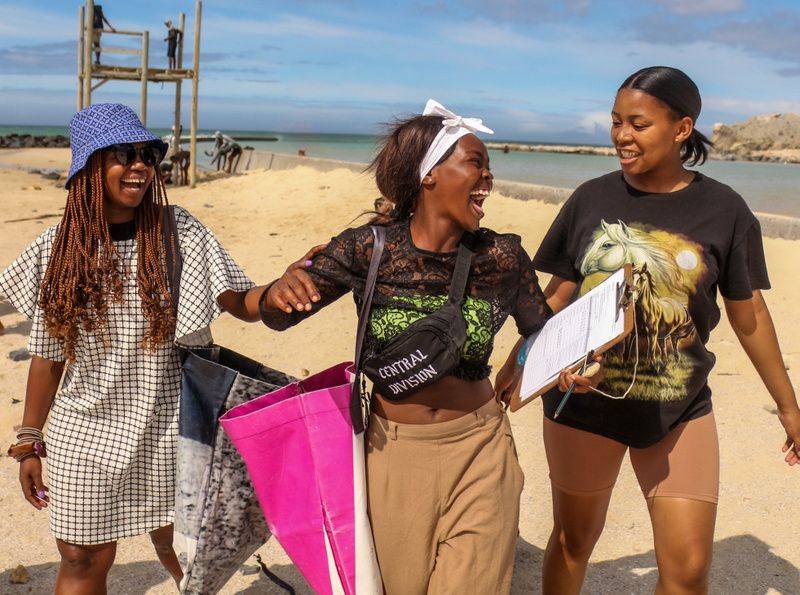
On Mother’s Day last month, Xoli Fuyani’s smartphone was flooded with messages from the young girls in her non-profit organisation, Black Girls Rising.
Founded in 2021, the organisation trains girls between 12 and 18 to lead climate action within their communities.
Fuyani has been pleasantly surprised to find that her role as an environmental educator and mentor has taken on a parental quality for the girls she is guiding.
Yola Mgogwana was among those who sent her messages.
“I always send her Mother’s Day, New Year, and birthday messages,” Mgogwana said, highlighting a mentoring relationship that stretches back more than four years.
Under Fuyani’s tutelage, a then-11-year-old Mgogwana delivered her first public speech in 2019. Fuyani had helped to organise South Africa’s first climate march and Mgogwana, who was then a member of Fuyani’s now-defunct Eco-Club, volunteered as a speaker.
She spoke in front of 2000 fellow young people gathered for Cape Town’s first-ever climate march, with viral images and videos instantly making her a recognisable face of South Africa’s climate movement. She is now one of its most influential voices.
Mgogwana’s success is a mix of courage and preparation. Growing up in an informal settlement in Cape Town’s Khayelitsha, she shared one communal tap with 55 other families, and when the taps ran dry during Cape Town’s infamous (and narrowly avoided) “Day Zero” water crisis in 2018, her family struggled because they could not afford the water sold in shops.
For Mgogwaana, it was a wake-up call to speak up for her community. But she lacked the training to do so.
“I remember when I started working with Yola Mgogwana, the teachers told me that she was not going to make it because of her background and grades. But I wanted to prove them wrong,” Fuyani said.
After her speech, Mgogwana became the subject of media attention and received invitations to conferences.
“She became an overnight ‘South African Greta’,” Fuyani said.
Since then, neither has looked back.
“I found myself shifting from just being an environmental educator to preparing Yola to be in these spaces,” Fuyani said.
Inspired by their success, two years later Fuyani established Black Girls Rising to extend this training to other girls from disadvantaged backgrounds.
“Currently, there are 30 girls in our Rising in Leadership Fellowship, and some, like Yola, are already leaving,” she said. The fellowship is the arm of the organisation focused on equipping the girls with practical skills to lead climate action in their communities.
Fuyani decided the organisation would focus on girls because she saw how climate change impacted girls and women differently.
The 2023 Afrobarometer survey on climate change awareness in South Africa shows that most South Africans who are educated about climate change believe it is making life worse in the country.
However, the impact of climate change is disproportionately felt by vulnerable groups like women, who are also the country’s least informed about climate change. Less than half of women in South Africa are aware of climate change, compared to 53% of men.
The survey suggests that empowering these vulnerable groups could contribute to developing a more inclusive and resilient foundation for addressing climate change.
Using her extensive environmental education experience, Fuyani developed a five-part training model for the organisation’s Rising in Leadership Fellowship.. Black Girls Rising fresh intakes are usually between 12 and 13, and everyone must go through the first level which focuses on self-development. “We value our process,” Fuyani said.
“At this level, we teach them how to self-regulate, deal with trauma, and they also get to learn about their communities.”
The training gets more intense as the girls move up the levels. At the second level, they are equipped with leadership and advocacy skills. “Because now they have a sense of who they are and know how to set boundaries,” Fuyani added.
Levels three and four are practical. The girls are given the autonomy to lead campaigns based on their interests. Not all are directly linked to climate. They can choose from four possible campaigns. “Their campaigns could be about clean air, water systems, period poverty or food security,” she explained.
The girls are allowed to recruit younger girls to support their campaigns.
“It is like starting a club, but within a campaign,” she said. The lead girls for each campaign are paired with top organisations in their areas of interest.
The girls who choose the clean air campaign go to playgrounds to measure air quality.
“The girls will help raise awareness on areas where the playgrounds don’t have clean air and highlight the privilege of breathing clean air,” Fuyani explained.
“With what they have learned thus far about clean air, they are very keen to partake in activities that help to clean up the air,” wrote Lihle Sabisa, a mentor for the clean air campaign and a Run Leader for Cityzens 4 Clean Air Campaign, an initiative with Urban Better developing interventions to support clean air in African cities.
Some of the girls have also taken on a food security campaign, leading by example and growing vegetables.
“We work with two local organisations that have community gardens. The idea is that the organisations will give them starter kits for their home garden,” Fuyani explained. “The campaigns are fun and not just about theory,” she said.
The fellowship is a hybrid programme. Fuyani meets with the girls three times a month, once in person in Cape Town and twice online. All of their meetings begin with a movement-based practice. It could be dancing, singing, drawing, craft making, yoga or mindfulness exercises.
“We believe in the power of arts as a tool and medium to transform and heal. Hence, whatever we do, has an art element,” Fuyani explained. She added, “A lot of the things we do in-person, we are able to translate online.”
“The experience we have are very exciting and out of the box,” said 16-year-old Lithalomso Chulayo, who joined the programme early in 2023.
“It’s very relaxing and just gives you a chance to dive deep into your inner self and soul,” she continued.
“We are training them to be young changemakers, but we also want to create a space where they could be themselves and be kids. It’s as if the world expects them to be adults, and I don’t want that for these girls,” Fuyani explained.
This year, the organisation had to accommodate highly motivated older girls like Chulayo, who is now taking lessons from levels one and two simultaneously.
While “everything is tailor-made according to a girl’s needs after we have accessed their maturity and leadership potential,” accommodating girls of above 12 is not usual.
“The age group is specific because of the programme’s design, and we have seen that in the climate space, there are not many of these opportunities for the younger girls,” Fuyani argued. Chulayo is appreciative of the opportunity, however.
“The experience has benefited me to believe that I can take all the information that I have learnt and use it in the outside world to give back to my community and inspire other young people,” Chulayo said.
Project Drawdown, a globally recognised extensive database of climate solutions, ranks female education sixth among 100 sustainable solutions to tackle climate change.
At the final level of the fellowship, the girls are matched with organisations to expand their advocacy beyond the grassroots level.
One of the girls at this level has been selected for the Ashoka Young Changemaker programme. At the same time, Mgogwana, now fifteen, is a young advisor with Child Rights International Network (CRIN), which aligns with her dream of becoming an environmental lawyer. – bird story agency
IF THERE’S ONE THING I DID THE OTHER WEEK …:

We all know the feeling of setting off to go and see our favourite bands in concert, and if you don’t I recommend you go out and experience it.
That is just what my wife Sam and I did on Saturday the third of June when we set off to see UB40. We had always planned to make a day of the experience, so as the sun began to set while we made our way along the N1 past Midrand we felt we may have started out a little late.
The feeling of lateness grew after we arrived as, having already decided to have dinner
before the show, we found ourselves faced with queue after queue of people waiting outside the various restaurants the Sun Bet Casino has on offer. We eventually made our way up three flights of broken down escalators to the third floor after being turned away from all the restaurants on the floors below. The dismissive, “you should have booked” (yes I know thank you) or, “there is a 45 minute wait” responses were still ringing in my ears when after one more dismissal we turned to the entrance of Rockets.
Upon entering a delightful young lady welcomed us at the doors and told us that they would be more than happy to accommodate us but… (“here we go again” I thought), they only had space on the couches, my almost scowl immediately turned into a smile. As we were led from the entrance towards the back of the restaurant I looked around at the gold decor, the attempt almost like a 1920’s speakeasy one sees in bad period films, classy if a little cliched until we arrived at an over-stretched brown leather couch several small tables in front of it.
We hadn’t been seated very long when a gentleman came to take our drinks order, just a beer on tap for me and a Long Island Iced Tea for Sam which, in her words, was “Very Nice.
We were handed two menus, the regular menu, flipped to the drinks pages, and their special Arena Menu which they use on concert nights to limit the menu and help the kitchen get everyone's food out as quickly as possible.I was perfectly happy with the limited menu,as main course number two was a Peppercorn and Feta Sirloin.
While we chatted waiting for our food Sam remarked that she could imagine several bachelorette parties taking place at the restaurant and I must admit I have to agree. While the venue itself was large and airy, the decor shiny and the tables and floors clean, it gave off the distinct impression of being a nightclub. This mainly due to overly loud music that made it difficult to carry on a conversation despite being shoulder to shoulder.
Our food soon arrived and I looked down at a beautifully arranged plate of 250 grams of medium rare sirloin sitting on a bed of rocket and topped with small cubed pieces of feta with a creamed green peppercorn and feta sauce on the side served with an order of fries.
The first cut into my steak revealed a beautiful pink turning slowly to red centre, medium rare just the way I like it. The fat of the meat was perfectly rendered and added wonderfully to the flavour of the meal, the meat was succulent and juicy almost breaking apart in the mouth and I enjoyed every piece. Unfortunately the peppercorn and feta sauce, while creamy, lacked the sharp pepperiness one looks for in a pepper sauce and had there not been feta on the steak I would not have known there was any in the meal at all, it was unfortunately more a cream sauce than a pepper sauce. The chips however were beautifully crunchy on the outside giving way to a fluffy interior that was most enjoyable. After we both finished our meals, we were very ready to go and enjoy a night of music.
We made our way back down the many broken down escalators, now returned to working order and headed to the Sun Bet Arena.
I am sure anyone who has ever been to a concert can attest that the most annoying thing about any concert is having to queue for what feels like hours to get refreshments. Here I must congratulate the Sun Bet Arena, they were well staffed with numerous refreshment stands and I was able to get us both a couple of drinks in under five minutes and we were very soon making our way to our seats.
I must stress here that while I have been to a few concerts in my time, this was the first time I was able to see what was happening on stage without having to rely on the giant screens either side of the stage. Let me say the difference in experience is really something special.
If ever you have the opportunity to go and see your favourite band I encourage you, if you can, to fork out that little bit extra to experience it.
We sat down and looked up at the lead singer of a five piece ensemble, keyboard, drums, bass and guitar of local South African Tidal Waves they make, according to them, original music for original people, and it was certainly an original sound. Jazz mixed with reggae and blended with a touch of hip hop to make a sound so uniquely South African it would not have been out of place alongside some of our local legends. It was not long before I understood why many regard them as one of South Africa’s hardest working Reggae bands. Song after song kept flowing from the stage as we danced in our seats until finally they sang their final song, a new one off their soon to be released album about the pressures we place on women in our society and a thank you to those women for staying strong in spite of it.
After a quick stage setup we were ready for the main event, of course we were reminded that UB40 is not a sit down band and we were encouraged to show our enthusiasm with more than just a polite round of applause. The indomitable Ali Campbell was introduced along with the rest of UB40.
Mr Campbell may no longer be the sprightly singer of his youth, but his voice has lost none of its vigour. Walking on to start the set with Here I Am a roar went up from the crowd as people cheered, climbing out of their seats, many made their way into the aisles to dance to some of their favourite songs. Here I Am was soon followed by I'll Be Your Baby Tonight, Me Nah Leave Yet and Cherry Oh Baby. While the entire concert was vibrant and enjoyable the moment of truth didn’t arrive until near the end when suddenly the entire stadium was on their feet and an explosion of sound battered the ceiling. Every person was on their feet and singing along to arguably UB40’s biggest hit Red Red Wine.
This was the start of the climax and the energy it inspired carried us all too soon to the final curtain.
As we made our way out of the arena, the house lights on, there was a definite sense of exhilaration. We didn’t feel like we needed more, although if they had offered I am sure we would have stuck around, and we didn’t feel like we hadn’t had enough. The set list was perfect rising and falling throughout and at the end we all felt elated.
Thank you UB40, and thank you Ali Campbell. You were phenomenal.
Equipping police will only address part of SA’s violent crime problem:

The quarterly crime statistics released by police minister Bheki Cele point to a dire situation we find ourselves in as a country concerning violent crime.
Although there has been a slight decrease in the number of child murders, the fourth quarter statistics released by Cele are consistent with previous quarters and they confirm one thing — we have high levels of violence in society and policing alone is not adequate to address it.
What South Africa desperately needs is a focused, massive, multi-sectoral and long-term behaviour-change campaign that talks to the crime crisis we are facing.
According to the numbers released by the police minister, between January and March this year (a period of about 90 days) more than 6 000 were killed, representing a 3.4% increase in murder during the reporting period. These are not people who died in road accidents or natural disasters such as floods or lightning strikes. These are people who died as a result of guns, knives, stones, garden spades and even bare hands.
But why is violence so pervasive in society? Why are we having so much of it directed at women and children? We need to determine what the police can successfully deal with before we are in a position to make a judgment whether our policing strategies are effective in combating crime.
There are many factors that merit our attention if we are to fully comprehend the nature and complexity of the violent crime we are confronted with.
First, we have a history of violence in this country where it was a preferred instrument or route to resolve differences and conflict. We had a state that was actively sponsoring violence by arming certain groupings, especially in KwaZulu-Natal and Gauteng, to carry out attacks in communities to attain certain political goals in its quest to derail the democratic process.
As a country we have not fully recovered from that violence — the seeds that were planted in the 1980s in particular are proving hard to destroy. This is the reason why we see, for instance, acts of criminality being carried out during student protests when property is attacked and destroyed as we saw at the University of Fort Hare and other campuses across the country when students are unhappy about an examination timetable, academic exclusion or unpaid NSFAS fees.
It points to a culture that is endemic and that the police alone can do very little about.
There is also violence of service-delivery nature that is directed at municipal authorities which were responsible for rendering services to the population. These administrations were perceived as an extension of “Pretoria” and everything had to be done to undermine and attack them through acts of violence including arson and other structural damages.
This kind of violence is apparent every time members of the community are aggrieved about service delivery that they get, or don’t get, from the government. What we see happen during these “service-delivery protests” are violent acts directed at officials including the police, public infrastructure and ordinary members of the public who are not part of the protest. Stones are hurled at passing motorists who have nothing to do with the protest.
What this points to is a mindset that is entrenched in communities and it sadly doesn’t end there — it finds expression in other areas of social life.
Second, we are sitting with a huge problem of illegal firearms in our society. These guns are used not only in committing other crimes such as robberies and hijackings, they are also used to commit social crimes such as murder.
This is an area our police, especially crime intelligence, should pay particular attention to. They must establish where illegal guns come from and whether there are syndicates that push these illegal guns, and then find ways to break the back of these syndicates.
Third, a lot of the violence that is unearthed by these crime statistics place women and children at the centre of our social dysfunctionality. Unlike other crimes, the nature of much gender-based violence (GBV) is that it happens in private, away from the eyes of the public and the police.
However, there are cases where incidents are reported to police and victims are told to “go home and settle the matter” only for the victims to later die at the hands of their attackers. This is indicative of a lack of understanding within our policing establishment. This is one area of the GBV crisis where the police can make a difference through training and units such as the family violence, child protection and sexual offences unit (FCS) dedicated to fighting crimes against women and children.
Violence against women and children should be treated as a social health issue and like other public health problems — such as TB, HIV and AIDS or mental health — we can only make a significant change if we invest in behaviour-change campaigns and be prepared to remain with it for long given the nature of these campaigns.
There are no quick wins in dealing with this multi-layered social crisis and the resources required are huge. So far we do not have behaviour-change campaigns addressing the scourge of GBV.
It is important that while working on social change campaigns to address attitudes and behaviour, the government has to move with corresponding speed to address the economic policy and skills challenges that account for a lot of what we see around crime.
We have an unacceptable situation of unemployed and disengaged youth in our country. Many of them get attracted to a life of crime driven by their survival instinct, starting with petty crimes and eventually graduating into more serious and violent crimes like infrastructure theft and armed robberies.
The situation is dire and demands that we adjust our way of thinking and doing things. It is unacceptable that we kill more people and brutalise women and children way more than countries that are at war.
Hadebe is founder of anti-crime advocacy and social change movement MACLA. Sabela is a journalism student at Durban University of Technology.
The views expressed are those of the author and do not necessarily reflect the official policy or position of the Mail & Guardian.
Submit and get free exposure here: Showcase Your Business | Advertise Your Special Offers.
