Meyiwa trial: ‘Accused was coerced into making confession’:

Defence advocate Zandile Mshololo alleged in the Senzo Meyiwa trial at the Pretoria high court on Monday that state witness Constable Wendell Jonathan remained at a police station to frighten one of the accused men and make sure he did what he was instructed to do.
Jonathan, a metro police officer in the Ekurhuleni region, took the stand last Friday and told the court he was part of the team called to escort Bongani Ntanzi to the Moroka police station on 19 June 2020 to make a confession about Meyiwa’s 26 October 2014 murder.
Ntanzi is one of five men accused of killing the Bafana Bafana captain at the home of his girlfriend Kelly Khumalo in Vosloorus, Gauteng.
Cross-examining Jonathan on Monday, Mshololo suggested Jonathan and his colleagues had been heavily armed in order to intimidate Ntanzi.
“That manner in which you were armed induced force to the accused and the reason you were so armed in the Moroka police station was to induce force and fear to comply with what police wanted,” she said.
During cross-examination by defence advocate Thulani Mngomezulu, representing Ntanzi and Muzikawukhulelwa Sibiya, Jonathan denied being present when Ntanzi was allegedly assaulted.
Mngomezulu put it to Jonathan that he was part of a group of police officers who had assaulted Ntanzi and forced him to sign the confession.
“You took off one handcuff and put it on the pole, then he was poured with water from the front of his body. That is when [officer Bongani] Gininda told the accused that he must tell the truth about the death of Senzo Meyiwa,” Mngomezulu said.
“I have no knowledge — the first time I saw him was at Moroka police station,” Jonathan said.
“There was a device that was used to electrocute the accused and he was electrocuted from his stomach. You, Mr Mabena and [Colonel Joyce] Buthelezi were taking turns on the use of this device,” said Mngomezulu, prompting another denial from Jonathan.
Mngomezulu told the court that Ntanzi started bleeding and Sergeant Vusimuzi Mogane said: “Yekelani die man [Leave this man].”
“He was wet and bleeding and was put back into the car. The Toyota Fortuner stopped at Chris Hani Baragwanath Hospital,” Mngomezulu said.
“I have no knowledge of that and the accused never got into our cars,” Jonathan responded.
The five men on trial for Meyiwa’s murder have pleaded not guilty to charges of premeditated murder, attempted murder, armed robbery, illegal possession of a firearm and the illegal possession of ammunition.
The post Meyiwa trial: ‘Accused was coerced into making confession’ appeared first on The Mail & Guardian.
Yes or no? Here’s what SA says sexual consent means:

This weekend, people took a sho’t left to Gallagher Estate in Midrand, some with coy curiosity, some with boundless excitement and some in stunned silence.
It was Sexpo time.
The exhibition is something that gets South Africans talking, whether in hushed astonishment about toys and techniques or with frank openness about orgasms and the basics of what healthy sex means.
A healthy sex life, says the World Health Organisation, is part of our well-being, and important for safe relationships too. But to have healthy sex, we have to tell a partner that we want to do it — or not.
This is called sexual consent, which experts at a webinar hosted by the World Association for Sexual Health (WAS) in September, explained as “essentially giving permission for sexual activity — from kissing all the way to intercourse”.
For the message to get across, relationship researchers say three things need to be in play — and both partners have to be part of the conversation.
- First, find out if you both want to get it on.
- If the desire is there, you have to tell the other person so, whether through your words or how you behave.
- And then, each partner has the responsibility to pick up on those cues and interpret what the message means: is it a go or a no?
But it’s here where things get murky, because the rules of the society we live in, our religious beliefs, cultural background and things such as our age, gender identity and sexual orientation influence what we think — and how we talk — about having sex.
Researchers call this “sexual scripting”. Much like actors learn lines and actions for their performances, who we are and the environment we live in shape our decisions about what we accept as normal in society and what certain behaviours mean.
And this got us thinking: what does saying yes — or no — to sex mean to South Africans from different backgrounds and what influences our decisions?
So we asked. Here’s what people said.
- Sex is taboo — and talking about it too
In school, sex ed lessons often focus on the risks of sex, like an unplanned pregnancy or getting an infection and so, often, abstinence is taught as the safest way to deal with sex. Despite South Africa’s public school curriculum promoting comprehensive sexuality education, teachers’ personal beliefs can shape what kids learn about sex and how to talk about it.
This, says Jaco Oelofse, 27, from Cape Town, is how it was for him.
“I went to quite a religious school and the emphasis there was very much on abstinence. Sex was something that wasn’t really spoken about and wasn’t supposed to happen. So, by extension, consent was not something that was spoken about [either].”
Later, at university and being in an all-male residence, consent was almost just a hurdle to get past, he says — and, to his mind, a harmful idea about consent.
- Someone takes and someone has to give
Saying yes or no to sex is often not an equal power balance. In focus group discussions with 77 teenagers and young adults in England, from different races and spanning different sexual orientations and identities, researchers found that the seemingly more powerful partner could ask for sex more easily, while the other generally had to exert their control through refusing sex.
But in many societies this choice is not free and it’s often linked to gender roles, with men being seen as dominant and women having to be submissive. Results from demographic and health surveys across 27 African countries have shown the more decision-making power women have in their homes, the better they can negotiate how and when they have sex which means they have more control over their sexual well-being.
“I think most men — and even some women — see sexual consent and relationships as one thing, whereas it’s two completely different things,” says Zaakier Yassiem, 26, a gay Muslim man from Cape Town.
- Consent is complex — but it shouldn’t be confusing
“We speak about consent like it’s a really confusing thing, as if, in some instances, someone has rights over another person’s body. That’s never the case,” says Candice Ludick, 41, from Knysna, who works with people who’ve been raped.
Consent has to be communicated, said Terry Humphreys, head of the psychology graduate programme at Trent University in Canada, during the WAS webinar. But that doesn’t mean you only have to say yes or no — often body language signals that you want to go ahead or stop.
The more intimate a couple’s relationship, the easier they pick up on each other’s cues and the better they know what the other wants or will accept, his research has found.
Gorata Chengeta, 30, a postgrad student from Wits says that she thinks being in a long-term relationship can also blur the issue of consent, though, because “if you’re married or in a relationship with someone, then [there’s this idea] they don’t always have to ask you for consent”.
To her, the situation in which someone agrees to having sex must be clear. “If someone’s being coerced, then it doesn’t count.”
- Doing it with desire
One of the main ideas of sexual consent is that it has to come from both partners, research shows. And, adds Planned Parenthood, a sexual health advocacy organisation from the US, saying yes to sex must fill you with enthusiasm. Pleasure is a part of sexual health, and as a previous piece by Bhekisisa says, pleasure can increase sexual agency.
Understanding that agreeing to sex because it’s enjoyable is something Tendai Matsika, 34, from Johannesburg learned only during his university years, he says. “I didn’t learn it in my upbringing — and it was pretty much the same for my peers too.”
Teaching kids healthy boundaries must be part of how we learn what consent means, he says.
Counsellors use the acronym “Fries” to help people understand what sexual consent means. It says consent has to be:
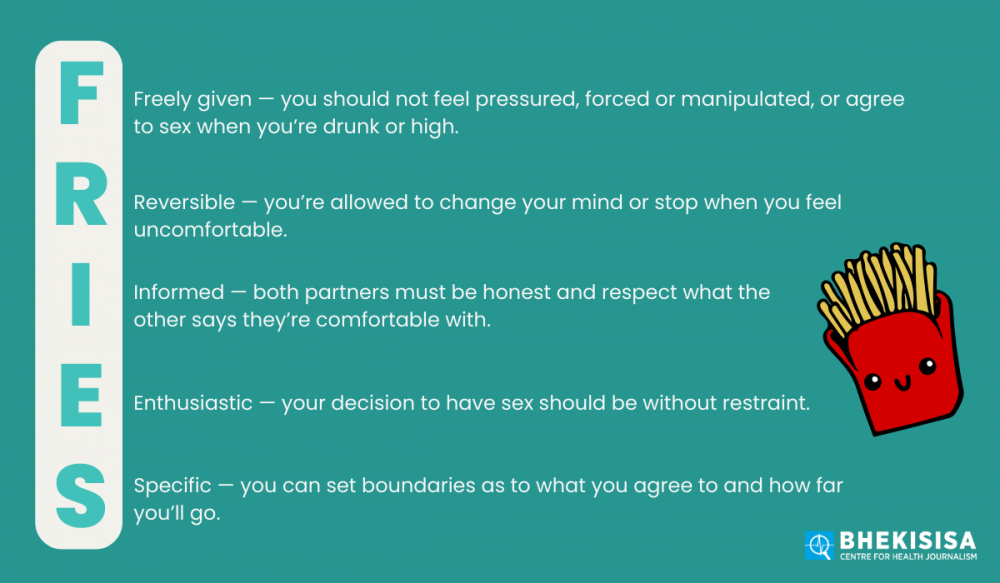
Lisa Welsh, a sex educator at My Sexual Health, breaks it down.

This story was produced by the Bhekisisa Centre for Health Journalism. Sign up for the newsletter.
The post Yes or no? Here’s what SA says sexual consent means appeared first on The Mail & Guardian.
ITB withdraws appeal in residential leases case:

The Ingonyama Trust Board (ITB) is in the process of withdrawing the appeal to the supreme court of appeal by its former chairperson, Jerome Ngwenya, against the high court ruling setting aside its lease programme.
The appeal had been set down for argument at the court in Bloemfontein from 15 November but will now be withdrawn on the instruction of the new board appointed by Agriculture, Land Reform and Rural Development Minister Thoko Didiza earlier this year.
The board recently met and resolved to instruct its lawyers to withdraw the appeal by Ngwenya, who was fired by King MisuZulu kaZwelithini earlier this year over a dubious R41 million investment exposed by the Mail & Guardian.
Ngwenya was replaced by inkosi Tnanduyise Mzimela, a close confidant of the monarch.
The decision paves the way for the evental refund of millions of rand to people living on land which falls under the Ingonyama Trust, of which the Zulu king is the sole trustee — and a process of improving their security of land tenure laid out in the original judgment.
The ITB runs the day-to-day affairs of the trust, which controls nearly 3 million hectares of land under traditional leaders on behalf of the king and had introduced the residential lease programme around 2012.
A source close to the process, who asked not to be named as they do not have permission to speak to the media, said this week that the appeal would not continue.
“The board resolved to instruct the attorneys to withdraw the appeal,” the source said. “The withdrawal process is now on.”
The challenge to the ruling in favour of residents by the Pietermaritzburg high court in June 2021 was brought by Ngwenya, who went ahead with the appeal, despite being instructed by Didiza to abide by the court ruling.
The new board appointed by Didiza after his dismissal is understood to have begun discussions around ending the appeal at its first meeting and had taken the final decision at a recent meeting held in Pietermaritzburg.
The Legal Resources Centre — which represents Linah Nkosi and other residents who challenged the legality of the leases with the assistance of the Rural Women’s Movement and the Council for the Advancement of the South African Constitution — said on Monday that they were ready to travel to Bloemfontein to argue the case.
Nkosi, Bongani Zikhali and other residents of ITB land had gone to court in 2018 to challenge the validity of the residential lease system, which forced them to pay rent to the board for land occupied by their families, often for several generations.
They argued that the programme deprived them of the right of tenure they had previously held via permission to occupy certificates, issued by the ITB, and that the conversion to leases had been done unlawfully and through coercion.
The Pietermaritzburg high court ruled in favour of the residents, ordering the ITB to refund revenue it had collected in the residential leases, which generated an estimated R90 million a year.
The court ordered Didiza, under whose ministry the ITB falls, to provide quarterly reports on implementation of the order and of further steps to ensure the right of tenure of people living on ITB land.
Didiza agreed to abide by the order, but implementation was stalled by the appeal, brought by Ngwenya and the then board.
Ngwenya also attempted to have the judgment set aside on the grounds that two of the judges who had heard the original case, the late Jerome Mnguni and KwaZulu-Natal deputy judge president Mjabuliseni Madondo, and their families, lived on ITB land and were biased against the entity.
This leg of Ngwenya’s appeal failed and was dismissed with costs but the appeal against the ruling by the Pietermaritzburg court had been set down to be argued at the supreme court of appeal.
ITB spokesperson Simphiwe Mxakaza undertook to provide M&G with a comment on the appeal hearing but had not done so at the time of writing.
The post ITB withdraws appeal in residential leases case appeared first on The Mail & Guardian.
Submit and get free exposure here: Showcase Your Business | Advertise Your Special Offers.