MG Cyberster: The roadster we never knew we needed:
Although MG has a history of making sports cars, the Cyberster is the first roadster to don the badge since the TF was discontinued in 2011.
Chinese automaker giant SAIC Motor acquired MG in 2007. While the brand remains rooted in British heritage, its lower model SUVs now have the technology that make Chinese cars popular.
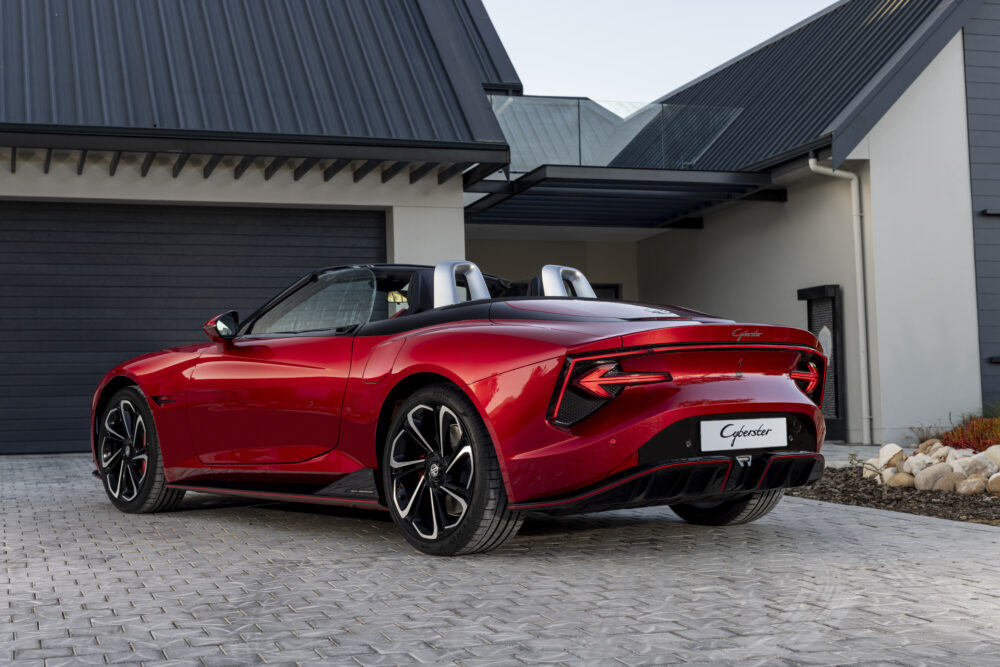
The Cyberster’s design embraces MG’s rich history of sports cars. It looks almost Italian — the long bonnet with storm-eye headlamps, a clean side profile that incorporates many design lines into the body and arrowhead taillights capped with a stylish lightstrip connecting them.
However, the ultimate party trick and feature that really makes heads turn are the scissor doors. Now, in the motoring world that is something you get only once you climbed high on the financial ladder. Yet, here it is in the form of a half-Chinese, half-British roadster.
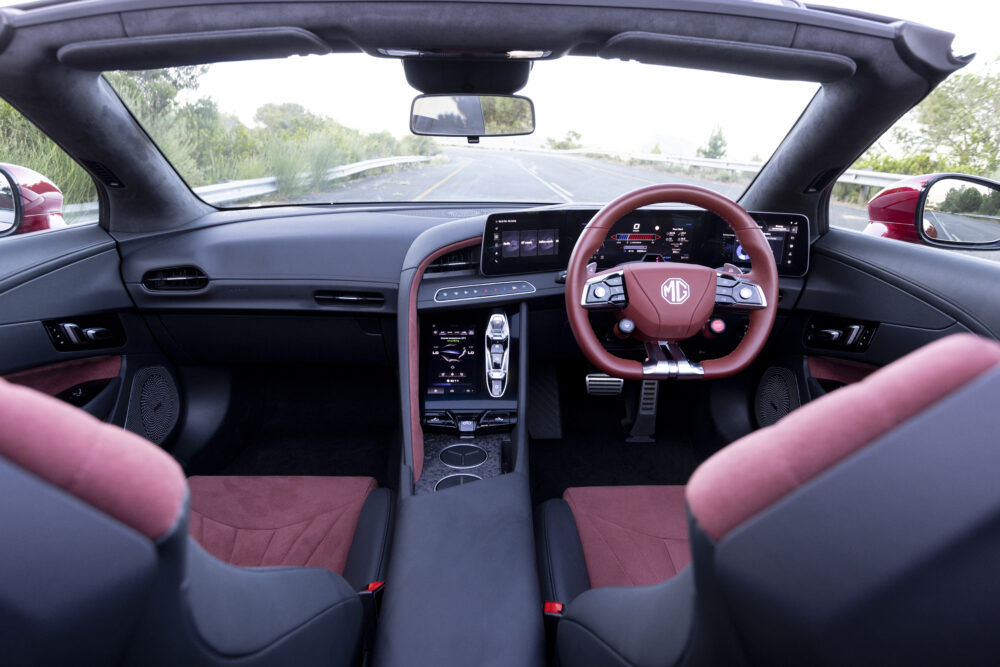
When you get in, a fantastic interior greets you. The cabin is decked out with a mix of leather and alcantara, contrast stitching and soft-touch materials along the dashboard.
The wine red adds to the sporty elements and evokes in the driver and passenger a wonderful feeling of elegance.
Chinese cars have made a habit of planting a big screen in the middle of the dash but MG has kept the infotainment in-line with that of a sports car. The vehicle is equipped with a triple-wraparound screen and two seven-inch displays that flank a 10.25 digital instrument cluster.
I love the setup because it pays more attention to the driver and less to technology.
However, one thing that did take some getting used to was the reverse camera. It appears on the screen on the driver’s right-hand side, rather than, like most cars, the usual left side.
There’s also a fourth vertical screen in the centre console that has other driver functions and climate control built into it.
Overall, the cabin is a wonderful place to be in — warm, welcoming, elegant and sporty.
What’s it like to drive?
The MG Cyberster is fully electric. It’s the only EV roadster in South Africa.
It has a 77kWh battery that has a claimed range of 443km on a full charge, depending on the way you’re driving it. I had 407km on a full charge but then again, I had it on test, so I didn’t care about maximising range.
There were other things to test out. The manufacturer claims the Cyberster has 375kW of power and 725Nm of torque and can achieve 0-100km/h in just 3.2 seconds.
This is possible thanks to a small button labelled “Supersport” on the steering wheel. It activates the dual-motor setup, which unleashes the peak output of the vehicle, sharpens the throttle response, stiffening the suspension and reducing traction control.
Once that is done, the car throws you back and hits 100km/h before you can even blink. It’s incredibly exhilarating and you want to keep doing it over and over again. Feeling the breeze when the roof is up adds to the experience.
However, when you solely rely on the motor mounted to the rear-wheels, the car has a lot of power but feels like a comfortable cruiser, rather than an overly ambitious sports car.
I like that it can be a beachside beauty or a racetrack monster and the best part about that is the driver is in control of that, not the car.
Pricing and verdict
Built with style, power and a drive-centric experience, the MG Cyberster sits pretty up there with the BMW Z4. Many would bark at that comparison but it certainly keeps up with the German brand and does some things better.
The MG Cyberster is priced at R1 399 900, making it even more appealing.
It’s definitely worth more than R1 million and I’m surprised that because it is the only fully electric roadster in the country, it doesn’t cost more.
SAPS head of organised crime Richard Shibiri axed:
The head of organised crime at the South African Police Service (SAPS), Major General Richard Shibiri, has been dismissed after a scathing appearance at the Madlanga commission of inquiry and subsequently, an internal disciplinary hearing.
In a statement, the police said Shibiri was found guilty of misconduct that brought the organisation into disrepute, including associating with known criminal, Vusimuzi “Cat” Matlala.
“The SAPS can confirm the dismissal of Major General Richard Shibiri, the former component head for organised crime, following the conclusion of internal disciplinary processes.”
Shibiri was among numerous SAPS officials referred for investigation in the Madlanga commission’s interim report. Fourteen senior SAPS and Ekurhuleni metropolitan municipality officials were referred for investigation after being implicated in the report.
Shibiri was accused of receiving R70 000 from Matlala, a controversial businessperson and alleged leader of the Big Five Cartel. Shibiri said the money was a loan to repair his son’s car. However, bank statements and testimony before the commission suggested it was a bribe and that he had sufficient funds in his account.
He was also implicated in attempts to influence the investigation into the 2024 murder of Vereeniging engineer Armand Swart. The investigation led to the involvement of the political killings task team and its subsequent disbandment.
Anonymous police witnesses alleged Shibiri tried to doctor the case docket implicating Matlala and hinted that three brown envelopes were floating in the office for investigators if they cooperated.
The SAPS said his dismissal was in line with police prescripts and principles of procedural fairness.
Ian Cameron, the chairperson of the parliamentary police committee, said he hoped Shibiri’s dismissal “marks the beginning of a new standard that will be consistently maintained”.
“The swift dismissal of Major-General Shibiri for misconduct relating to conduct that brought the organisation into disrepute is the type of consequence management required to rebuild trust in the SAPS and rid the organisation of rogue police officers who are more interested in personal gain than in ensuring the safety and security of the people of South Africa,” he said.
Action SA MP Dereleen James said revelations emerging from the ad hoc committee and the Madlanga commission had painted a concerning picture of the extent to which organised criminal interests had penetrated institutions tasked with upholding the rule of law.
While the decision was a significant step towards restoring accountability in the SAPS, it could not be the end of the matter, she added.
“Shibiri must now face the full consequences of the law for his alleged involvement with criminal syndicates while occupying one of the most senior law enforcement positions in the country.”
The cheapest climate defence we have is in the ground:
I have spent enough years on degraded grazing land and beside shrinking wetlands to recognise a pattern in how we talk about climate change in South Africa. The conversation tends to arrive late and be pitched high. We debate 2050 emission targets and global temperature thresholds while a farmer in the eastern Free State watches a wetland that once held water deep into winter dry out by August. Both conversations matter. Only one of them is deciding whether people have water to drink next year.
Climate change is not a forecast in this country. It is a condition we are living through. Cape Town came within weeks of shutting off its municipal supply. Towns across the Eastern Cape have rationed water for years at a stretch. In 2022, the floods in KwaZulu-Natal killed more than 400 people and destroyed homes, roads and water systems in a single night. Rainfall is becoming less predictable, heat more punishing and the gap between a good season and a ruinous one narrower. Farmers feel it first. So do the rural households whose food, income and water depend on the land around them.
For two decades, most of our climate effort and most of our climate funding has gone towards cutting emissions. That work is necessary, and South Africa carries real responsibility for it. But reducing emissions does nothing for the community facing a failed harvest or a flooded settlement. Adaptation, the work of helping people and systems cope with changes that are locked in, has been treated as the lesser priority. We can no longer afford that imbalance. The task in front of South Africa is less about how we slow the climate down and more about how we keep our footing while it shifts beneath us.
Here is where I think we have undervalued something we own. Roughly half of the country’s surface water comes from less than a tenth of its land: the high-rainfall grasslands and mountain catchments that feed our major rivers. These are not empty spaces waiting for development. They are working infrastructure. A healthy wetland slows floodwater, stores it and releases it through the dry months while filtering out sediment and pollution. Intact grassland lets rain soak into the soil instead of stripping it away. None of this appears on a municipal balance sheet, yet it does the work we would otherwise have to build, at enormous cost, in concrete and steel.
The organisation I work for, the Endangered Wildlife Trust, spends much of its time on exactly this kind of ground and the lessons reach well beyond any single project. When our teams restore a wetland in a catchment that feeds a community downstream, the point is not the wetland alone. It is the water security of everyone who depends on that river. When we work with cattle farmers on communal and commercial land to manage grazing so that veld recovers instead of eroding, the gain shows up as soil that holds water, livestock that survive drought and families that keep their main asset. This is climate adaptation, even when nobody in the room uses the word often enough.
The species we are known for protecting belong to the same story. People sometimes assume that conserving cranes or vultures is sentiment, a concern for the beautiful and the rare. It is something more practical than that. The Grey Crowned Crane, Blue Crane and Wattled Crane depend on healthy wetlands and grasslands, so their decline is an early warning that the systems supplying our water are failing. Vultures are the cleanup service of the veld. They strip carcasses before disease can spread. Where they have been wiped out elsewhere in the world, the result has been a surge in feral dogs and the illnesses they carry, paid for in human lives and public health budgets. Pollinators underpin much of our fruit and vegetable production, which makes their loss a food security problem before it is anything else. Protect the species and you are protecting the service they quietly perform for people.
There is a matter of fairness in all this that we do not name often enough. The South Africans most exposed to drought, flood and crop failure are usually those who did the least to cause the warming and have the least to fall back on. Rural and poorer communities live closest to the natural systems I am describing and feel their breakdown most directly. Investing in those systems is one of the few climate responses that delivers protection and dignity to the people who need it most. It is also among the most efficient responses we have. Clearing thirsty invasive trees from a catchment returns water to rivers and creates rural work at the same time. Restoring rangeland keeps farming families on the land. Ecological work tends to put money and skills exactly where the formal economy struggles to reach.
I am not arguing that nature can replace dams, pipes and flood defences. We need built infrastructure and we need to maintain what we have far better than we do. The argument is that the natural systems doing this work for free deserve the same standing in our planning, our budgets and our policy as anything we pour out of a cement mixer. That means managing landscapes at scale rather than in scattered fragments. It means decisions guided by science and long-term monitoring rather than the next election cycle. It means a real partnership with the communities that live in these places and understand them best. Where conservation has been done with people rather than to them, it has lasted.
World Environment Day usually draws fine speeches and short attention. I would rather it prompted a clearer decision. South Africa cannot stop the climate from changing on its own but it can decide how much of that change it is willing to absorb and what it puts in place to soften the blow. Our wetlands, grasslands, rivers and the wildlife that hold them together are not a luxury to be funded once the urgent problems are solved. They are part of how we solve the urgent problems. The most sensible thing we can do for the people of this country, in a future none of us can predict with confidence, is to keep the living systems that have always sustained us strong enough to carry us through. The resilience of our nature and the resilience of our people are the same project. It is time we treated them that way.
Kishaylin Chetty is the executive head of sustainability at the Endangered Wildlife Trust.
Submit and get free exposure here: Showcase Your Business | Advertise Your Special Offers.