Most people on ARVs stay on them. Does our health system know that?:
More than two weeks ago, Health Minister Aaron Motsoaledi announced that the treasury has given R622 million of emergency funding to his department to prop up South Africa’s HIV treatment programme.
About R590 million is for provinces’ HIV budgets and R32 million for the chronic medicine distribution system, which allows people to fetch their antiretroviral treatment from pick-up points other than clinics, closer to their homes.
This extra budget is just over a fifth of the roughly R2.8 billion funding gap that the health department says the country needed after the Trump administration pulled the plug on financial support for HIV in February. (The Pepfar budget for this financial year was just under R8 billion, but the health department calculated that it could fill the void with R2.8 billion if it trimmed extras and ruled out duplicate positions.)
So, how to get the best bang for these limited bucks — especially with the health department wanting to get 1.1 million people with HIV on treatment before the end of the year and so reach the United Nations targets for ending Aids as a public health threat by 2030?
By getting really serious about giving people more than one way of getting their repeat prescriptions for antiretroviral (ARV) medicine (so-called differentiated service delivery), said Kate Rees, co-chair of the 12th South African Aids Conference to be held later this year, from Kigali last week, where she attended the 13th IAS Conference on HIV Science.
At another Kigali session, Lynne Wilkinson, a public health expert working with the health department on public health approaches to help people to stay on treatment, said: “People who interrupt their antiretroviral treatment are increasingly common, but so are people who re-engage, in other words start their treatment again after having stopped for a short period.”
A big part of South Africa’s problem in getting 95% of people who know they have HIV on ARVs (the second target of the UN’s 95-95-95 set of cascading goals) is that people — sometimes repeatedly — stop and restart treatment.
For the UN goals to be reached, South Africa needs to have 95% of people diagnosed with HIV, on treatment. Right now, the health department says, we stand at 79%.
But the way many health facilities are run makes the system too rigid to accommodate real-life stop and start behaviour, says Rees. This not only means that extra time and money are spent every time someone seemingly drops out of line and then comes back in, but also makes people unwilling to get back on board because the process is so inconvenient and unwelcoming, she says.
Rees and Wilkinson were co-authors of a study published in the Journal of the International Aids Society in 2024, of which the results helped the health department to update the steps health workers should follow when someone has missed an appointment for picking up their medicine or getting a health check-up — and could possibly have stopped treatment.
“We often have excellent guidelines in place, built on solid scientific evidence,” says Rees, “but they’re not necessarily implemented well on the ground.”
To make sure we track the second 95 of the UN goals accurately, we need a health system that acknowledges people will come late to collect their treatment and sometimes miss appointments. This doesn’t necessarily mean they’ve stopped their treatment; rather that how they take and collect their treatment changes over time.
The standard ways in which the public health system works mostly doesn’t provide the type of support these patients need, as the resources required to provide such support is not available,” explains Yogan Pillay, the health department’s former deputy director general for HIV and now the head of HIV delivery at the Gates Foundation.
“But with AI-supported digital health solutions and the high penetration of mobile phones, such support can now — and should be — be provided at low cost and without the need to hire additional human resources.”
We dive into the numbers to see what the study showed — and what they can teach us about making the system for HIV treatment more flexible.
Does late = stopped?
Not necessarily. Data from three health facilities in Johannesburg that the researchers tracked, showed that of the 2 342 people who came back to care after missing a clinic appointment for collection medication or a health check, 72% — almost three-quarters — showed up within 28 days of the planned date. In fact, most (65%) weren’t more than two weeks late.
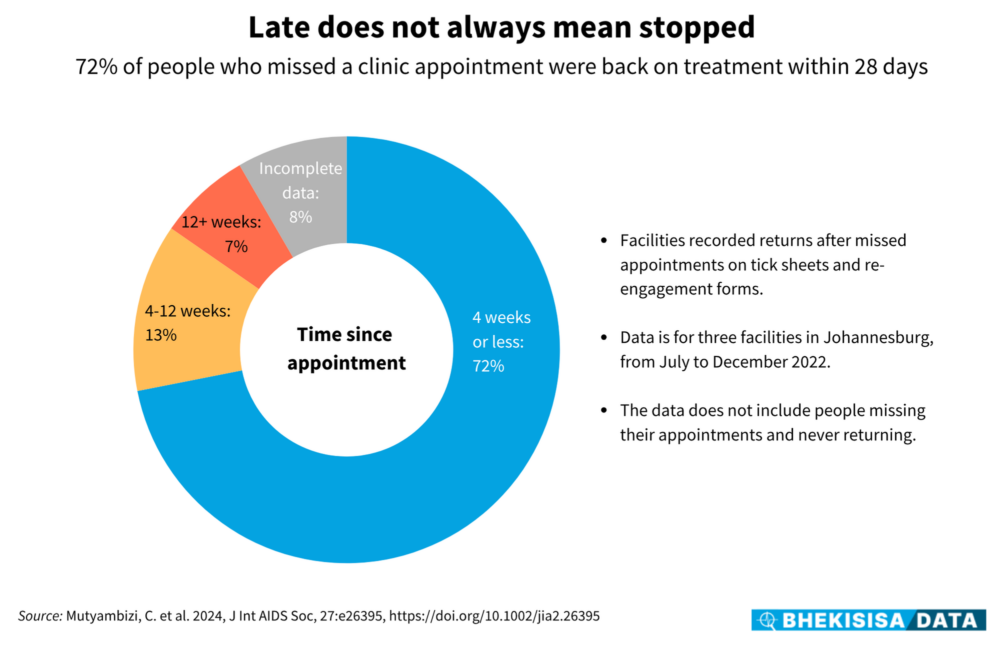
Of those who showed up at their clinic more than four weeks after they were due, 13% made it within 90 days (12 weeks). Only one in 14 people in the study came back later than this, a period by which the health department would have recorded them as having fallen out of care. (Some incomplete records meant the researchers could not work out by how much 8% of the sample had missed their appointment date.)
The data for the study was collected in the second half of 2022, and at the time national guidelines said that a medicine parcel not collected within two weeks of the scheduled appointment has to be sent back to the depot.
“But it’s important to distinguish between showing up late and interrupting treatment,” notes Rees. Just because someone was late for their appointment doesn’t necessarily mean they stopped taking their medication. Many people in the study said they either still had pills on hand or managed to get some, despite not showing up for their schedule collection.
Pepfar definitions say that a window of up to 28 days (that is, four weeks) can be tolerated for late ARV pick-ups. Pepfar is the United States HIV programme, which funds projects in countries such as South Africa, but most of them were cut in February.
Research has also shown that for many people who have been on treatment for a long time already, viral loads (how much HIV they have in their blood) start to pass 1 000 copies/mL — the point at which someone could start being infectious again — about 28 days after treatment has truly stopped.
Sending back a parcel of uncollected medicine after just two weeks — as was the case at the time of the study — would therefore add an unnecessary admin load and cost into the system. (Current health department guidelines, updated since the study and in part because of the results, say that a medicine pick-up point can hold on to someone’s medicine for four weeks after their scheduled appointment.)
Does late = unwell?
Not always. In fact, seven out of 10 people who collected their next batch of medication four weeks or more late had no worrying signs, such as possible symptoms of tuberculosis, high blood pressure, weight loss or a low CD4 cell count, when checked by a health worker. (A low CD4 count means that someone’s immune system has become weaker, which is usually a sign of the virus replicating in their body.)
Moreover, given the large number of people without worrying health signs in the group for whom data was available, it’s possible that many of those in the group with incomplete data were well too.
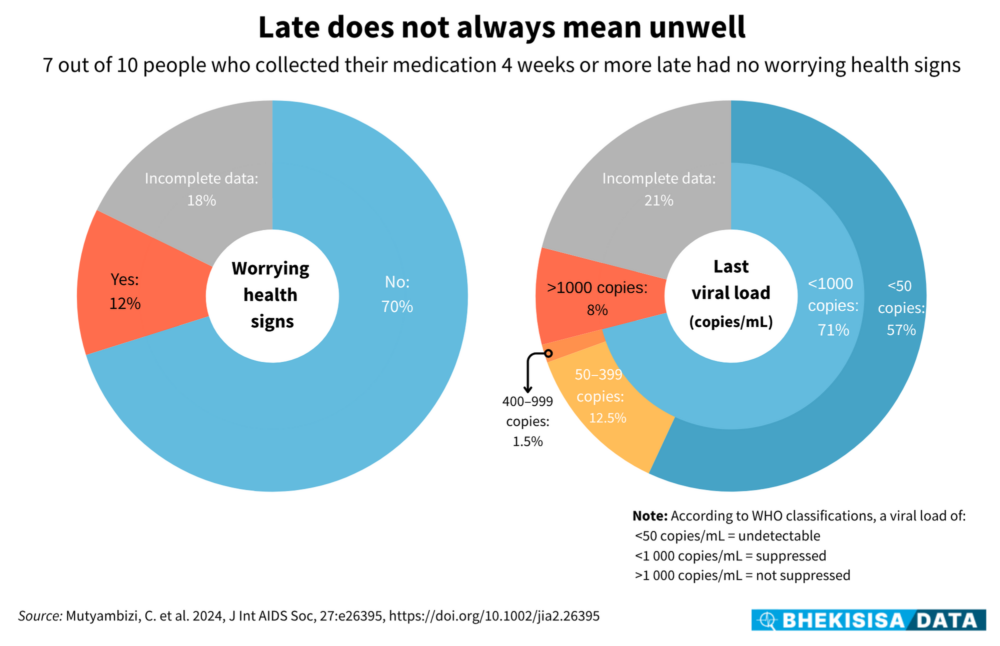
When the researchers looked at the patients’ last viral load results on file (some more than 12 months ago at the time of returning to the clinic), 71% had fewer than 1 000 copies/mL in their blood.
A viral count of <1 000 copies/mL tells a health worker that the medicine is keeping most of the virus from replicating. It is usually a sign of someone being diligent about taking their pills and managing their condition well.
Yet clinic staff often assume that people who collect their medicine late are not good at taking their pills regularly, and so they get routed to extra counselling about staying on the programme.
“Most people don’t need more adherence counselling; they need more convenience,” says Rees. Offering services that aren’t necessary because of an inflexible process wastes resources, she explains — something a system under pressure can ill afford.
Says Rees: “With funding in crisis, we really have to prioritise [where money is spent].”
Does late = indifferent?
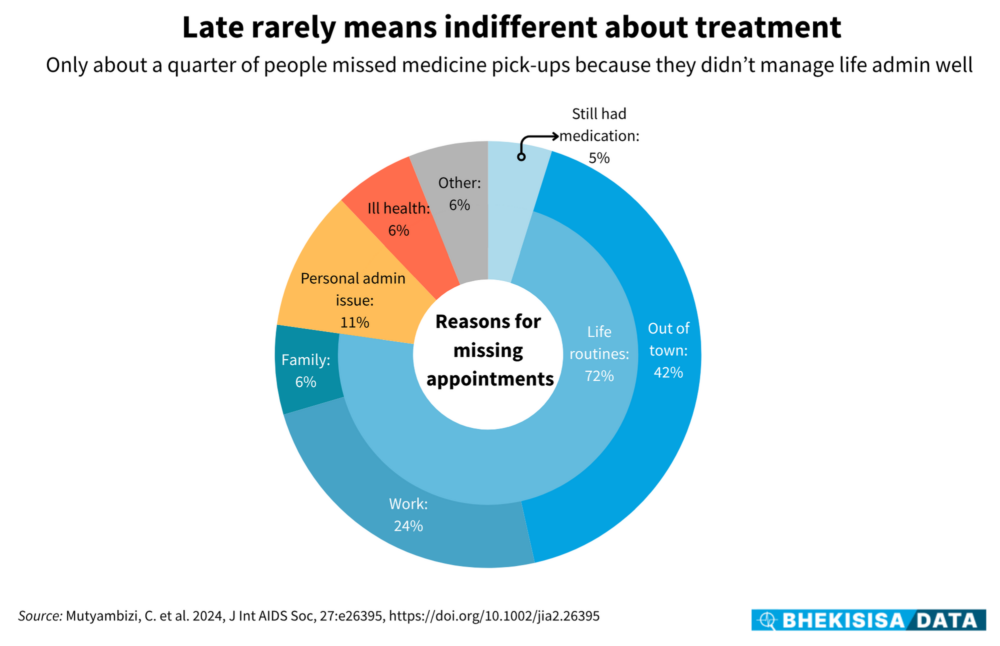
Rarely. Close to three-quarters of people who turned up four weeks or more after their scheduled medicine collection date said they had missed their appointment because of travelling, work commitments or family obligations. Only about a quarter of the sample missed their appointment because they forgot, misplaced their clinic card or for some other reason that would suggest they weren’t managing their condition well.
Part of making cost-effective decisions about how to use budgets best is to offer differentiated care”, meaning that “not every patient coming back after a missed appointment is treated the same way”, says Rees. Health workers should look at how much the appointment date was missed as well as a patient’s health status to decide what service they need, she explains.
Giving people who’ve been managing their condition well enough medicine to last them six months at a time can go a long way, Wilkinson told Bhekisisa’s Health Beat team in July. “Getting 180 pills in one go reduces the number of clinic visits [only twice a year], which eases the workload on staff. But it also helps patients to stay on their treatment by cutting down on their transport costs in their own time off work,” Wilkinson said.
Zambia, Malawi, Lesotho and Namibia have all rolled out six-month dispensing — and have already reached the UN’s target of having 95% of people on medicine at a virally suppressed level.
According to the health department South Africa will start rolling out six-month dispensing in August.
“But not everyone wants this,” explained Wilkinson, pointing out that experiences from other countries show that 50% to 60% of people choose six-monthly pick-ups.
It speaks to tailoring service delivery to patients’ needs, says Rees, rather than enforcing a one-size-fits-all system when more than one size is needed.
Says Rees: “Facing funding constraints, we really need tailored service delivery to keep the [HIV treatment] programme where it is.”

This story was produced by the Bhekisisa Centre for Health Journalism. Sign up for the newsletter.
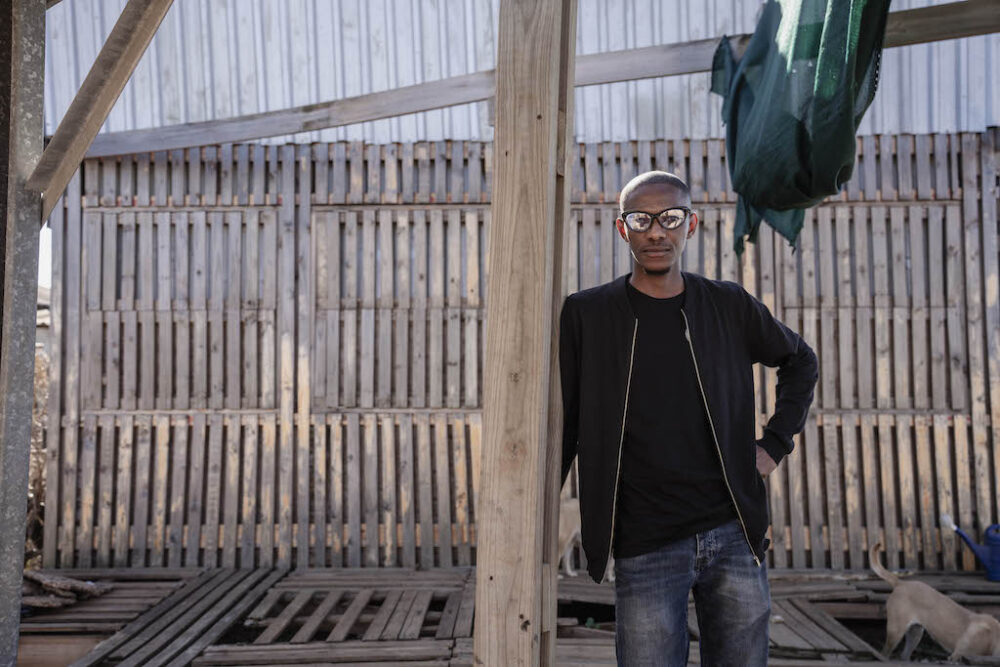
Patrick Bam is an executive member of a township cooperative in the Eastern Cape that is generating, managing and benefiting from its own sun-powered energy project. He says it has transformed life in his community.
“We were losing a lot as a community, especially as our food and appliances were being damaged due to load shedding,” he said. “But with this project, we’ve been able to generate our own electricity and even sell it to the municipality.”
Called the SalTuba Cooperative, the project is one of South Africa’s leading examples of socially owned renewable energy in action, and a model for energy democracy. Its cooperative model has inspired other townships to take on similar initiatives, and civil society groups and researchers use it as evidence that community-led renewable energy is possible, even in urban, low-income contexts.
Owned and managed by residents in KwaZakhele township in Gqeberha through a democratic cooperative structure, the project is built on public municipal land and governed collectively. Each household holds a stake and a vote, and members decide together how to reinvest revenue from electricity generation, whether into food gardening, maintenance, or other community priorities.


Socially owned energy
Unlike traditional energy projects, where private individuals, corporations, or government agencies own the means of production, participants in socially owned renewable energy (SORE) projects take charge of their own power supply. While there is no official registry of SORE projects in South Africa, #PowerTracker research has identified more than 20 operating initiatives across the country.
One example is the Ekhenana Solar Commune, based in the Abahlali baseMjondolo settlement, in Durban. The community-run solar project powers a library, study hall and phone-charging station.
Others are two local NGO-led projects, one based in Durban’s Austerville and the other in Emalahleni in Mpumalanga. In Austerville, the South Durban Community Environmental Alliance’s office has a grid-tied solar PV system and serves as a community charging hub. In Emalahleni, Vukani Environmental Movement members have installed an off-grid rooftop PV system.
On a larger scale, the Tsitsikamma Community Wind Farm in the Eastern Cape is cited as one of the earliest and most prominent examples of community ownership in renewable energy, making it a landmark case for socially owned renewables in the country.
A trust representing the local AmaMfengu people owns 9% of the wind farm, which began operating in 2016 and supplies electricity to Eskom under a 20-year power purchase agreement.


Cooperative born from crisis
#PowerTracker recently visited the SalTuba project, named after two long streets in KwaZakhele — Sali and Tubali — where most of the cooperative’s members live. The names were combined to create “SalTuba”, reflecting the project’s deep community roots.
Run by a cooperative of 36 households, the project emerged in 2019 as a direct response to rising electricity tariffs, relentless load shedding, and the powerlessness township residents felt over their energy supply. It was formally registered in 2021 as a primary cooperative.
Initially focused on food gardening and local business development, it worked with the KwaZakhele Development Agency and Nelson Mandela University to explore renewable energy solutions in response to the community’s struggles with load shedding and rising electricity tariffs.
What began as a modest grassroots initiative soon evolved into a pioneering solar energy project. In 2019 it installed its first solar panels and began generating power for local benefit.
Since then SalTuba has delivered measurable benefits to its members. Over the first 20 months, the project generated approximately 8,800 kWh of electricity, equivalent to R19,300 in value, or about R966 a month based on municipal tariffs.
The solar array is strategically mounted on a carport structure and a community-built waste recycling facility, maximising the use of available space. Over the years the energy system has been upgraded from 5 kW to 25 kW of capacity.
Beyond power generation, the cooperative has expanded its food gardening initiative, supplying fresh produce to the community and even offering vegetables on credit.
Crucially, the project has empowered women and youth: women lead the soup kitchen and gardening efforts, while younger members like Lubabalo Mkhiva have acquired technical skills in solar installation and energy management.
“I joined this project because I saw the impact it brought to the community,” said Mkhiva. “It encouraged me to be part of it, seeing the unemployment rate and poverty affecting our small communities.”


Bureaucratic barriers
But while SalTuba has demonstrated the potential of community-led energy, navigating municipal systems has proven anything but straightforward. According to Khaled El-Jabi, director at Energyworx, the engineering firm that helped design the system and structure of its power purchase agreement (PPA), the project faced serious bureaucratic hurdles from the start.
“There was no mechanism within the municipality to allow this type of connection to the grid,” he explained. Because the land is municipally owned, SalTuba first had to obtain permission to receive a municipal account number. Only then could a smart meter be installed to monitor and credit the electricity they produced.
The PPA, signed with PowerX, an independent energy trader, spans 10 years and is structured to optimise returns using a time-of-use tariff model. According to El-Jabi, this tariff is “split between peak, standard and off-peak sections – peak being most expensive, then standard and off-peak being the cheapest.”
“It is also split on seasons, with summer from September to May and winter being June, July and August. The PPA will pay based on the electricity generated during those times. For example, electricity generation during summer standard time will be allocated that particular tariff amount.”
El-Jabi believes this model is scalable: “There are 120 such ‘gap taps’ in KwaZakhele alone, with potential for three to four megawatts of community-owned solar. Communities can become prosumers, not just consumers,” he said.
Still, he cautions that developers need to be “extremely patient. Changing the system requires persistence, political navigation, and detailed planning.”


Municipal constraints
Although SalTuba has made strides in generating electricity, connecting that power to the grid and earning revenue from it has proved complicated. David Breitfeld, development adviser in the Nelson Mandela Bay electricity department, said the municipality supports the project in principle but is constrained by outdated policies and procurement rules.
“We’re happy to connect community generators,” he said, “but legally we can’t just buy electricity from anyone. If we buy from SalTuba, then why not the next household? We’d need to run 10,000 tenders. That’s not practical.”
Instead, the municipality enables net billing, which allows the project to reduce its municipal electricity bill to zero but not earn cash. A smart meter currently being installed will record exactly when electricity is generated and at what tariff value (peak, standard, off-peak). These meters are crucial, Breitfeld explained, because the value of electricity varies across time and season.
“If you export power during peak winter hours, that’s worth far more than during off-peak times,” he said.


Wheeling deal
SalTuba’s turning point came in 2022 with its PPA with licensed energy trader PowerX. The municipality enabled wheeling, a system which allows SalTuba to sell electricity through the municipal grid to PowerX, who pays the cooperative while covering wheeling charges.
“This model is finally allowing us to move forward,” Brietfeld said, confirming installation of the smart meter by the municipality is imminent.
Still, he noted structural problems in the system: since SalTuba’s solar installation is not physically linked to residents’ homes, community members don’t see reduced household energy bills directly. “If they had installed the system in front of their home meters, they could have consumed the power directly before it entered the grid — that would have saved them money immediately.”
Instead, power goes straight into the broader grid, making it difficult to attribute usage to individuals without more complex metering and agreements. “You don’t want to spend R100 to earn R10 worth of power,” he added.

Transition townships
Despite the bureaucratic hurdles, SalTuba proves that communities can successfully manage renewable energy projects, said Mareka Mokwatlo, manager of Transition Township pilot projects based in Limpopo and the Eastern Cape.
Mokwatlo joined the Transition Township Project, an action research initiative focused on developing sustainable local economies, in 2016 and works with SalTuba from a research perspective. In 2024 the project was awarded a three-year research grant by the National Research Foundation to scale up the SalTuba pilot and to implement additional pilot projects.
“Communities are capable of implementing such projects, and acquiring such assets. But they do face numerous challenges, and those challenges can include the regulations that they have to work within. Having strong community support helps, and that comes with resilience,” she said.
For communities considering similar projects, Mokwatlo offers practical advice: “Start engaging the community early. Tap into your existing assets first, like skills that are already there. We don’t have to go outside to hire people in our working-class communities. We know we have artisanal skills, and we have stokvels that can be used towards funding our operations.”
Land access remains crucial in the South African context, she said. “Access to land is necessary to generate and improve our livelihoods. We need to use land strategically and understand local regulations, which can be complex.”
Mokwatlo emphasised starting small and building trust: “Partner with local businesses before you go outside. Work with what you have. Building strong partnerships requires commitment, and people need to trust you.”
“For this type of project, start small, pilot, and design to scale. We started with 15 panels on a carport, and now there’s a structure and 40 panels.”

Broader vision
Professor Janet Cherry, head of the department of development studies at Nelson Mandela University, sees SalTuba as part of a broader vision for a just energy transition. Her work focuses on how community-owned energy projects can fundamentally reshape South Africa’s economy.
“Some critics think that this model is only going to meet a small part of the country’s energy needs. Our research shows otherwise: in theory household production could meet 83% of the whole country’s planned energy needs,” she said.
Community-owned energy projects can be a game-changer for local communities, Cherry emphasised. “By producing electricity locally, communities can create new jobs and economic opportunities. It’s not just about generating electricity, but about empowering communities to take control of their energy future.”
“You don’t have to have a big solar plant in the middle of the desert, you can actually do it on every single roof or every open space. The biggest opportunity is the inclusion of community-owned energy systems that can alleviate the electricity constraints experienced in South Africa.”
But realising this vision requires fundamental policy reform, she added: “Municipalities need to be able to buy electricity from community cooperatives like SalTuba, but the current regulations and administrative capacity are not supportive. We need policy changes to make it easier for community cooperatives to participate economically in the energy transition process.”
Cherry’s concept of a just transition goes beyond simply replacing coal jobs. “Just transition is not about people being laid off from the coal mines and then unemployment goes up, it’s about completely restructuring the economy to be owned and controlled by ordinary people,” she said.
“It’s about creating a more just and equitable society, where people have control over their own lives and livelihood.”
You can watch our recent webinar titled, Whose Land, Whose Power? The Nexus of Renewable Energy, Land Rights and Social Ownership to learn more about community-owned renewables – and find details of SalTuba and similar projects on our #PowerTracker tool here.
This investigation by Oxpeckers Investigative Environmental Journalism was supported by the African Climate Foundation’s New Economy Hub.
Ali Mazrui’s view on how Ethiopia solves the West’s ‘puzzle’ about Africa:
Western images of black Africans in earlier centuries portrayed them as people without history, incapable of poetry, too intellectually retarded to philosophise and too mentally slow to be scientific. Ethiopia’s historical experience unequivocally disproves these misconceptions, according to the late, great Kenyan scholar, Ali Mazrui.
It is worth noting from the outset what Mazrui was taking issue with: the distorted Western images of black people in earlier centuries. From his point of view, there have been improvements in Western understanding of Africa in the 20th and 21st centuries. As Mazrui put it in his Cultural Forces in World Politics (1990): “Blatant racial discrimination is on the defensive. The language of racial abuse is looking around for euphemisms. The racists have never been more reluctant to proclaim their prejudice in public. Racism on the world scene is at best declining and is at worst in search of disguise and camouflage.”
Sadly, the world today is quite different from the one Mazrui portrayed before he died in 2014. This is what adds greater significance and meaning to Mazrui’s reflection on this issue and makes it all the more timely and relevant for today.
Thomas Jefferson, president of the US from 1801 to 1809, should have known about Ethiopia, Mazrui suggested in his keynote address to a conference held at Cornell University in Ithaca, New York, in 2007. I assisted Mazrui with research for that address, in which he grappled with the issue in question. I later drove him to Ithaca, where I listened to his presentation as he reflected on Ethiopia and Africa, and did so with his characteristic imagination and sensitivity to history.
To allow the reader to take pleasure in the ease with which Mazrui clarified complicated concepts, qualities for which he had earned worldwide recognition, I present below an excerpt from his Cornell address, in his own words, with minimum adaptation.
For a long time, Ethiopia was in reality the one black country, which could demonstrate to Europeans that it had a recorded history of many centuries, that it had a heritage of written as well as oral poetry, that it had centuries of recorded philosophy and theology, and that it had demonstrated feats of science and engineering in its monuments.
Let us explore this remarkable story of cultural achievement in the context of the four intellectual charges, which Westerners have long levelled against the African people: lack of history, lack of poetry, lack of philosophy and lack of science and technology.
Does Africa have history?
The charge that Africans were a people without history goes back to German philosopher WG Hegel and beyond. There was no room for the African continent in Hegel’s Philosophy of History (1821).
This belief that black Africa was ahistorical continued well into the second half of the 20th century. As late as 1968, the Regius Professor of Modern History at Oxford University, Hugh Trevor-Roper, proclaimed his infamous dogma: “Maybe in the future there will be African history. But at the moment there is none. There is only the history of the European in Africa … The rest is darkness — and darkness is not a subject of history.”
Anybody with the remotest familiarity with Ethiopian history would surely not have made such a remark. Even if Trevor-Roper knew nothing about Menelik I, or rejected the Solomonic credentials of the Royal Dynasty of Ethiopia or accepted that the Queen of Sheba was part of Yemeni history rather than Ethiopian, he should at least have known that the army of Menelik II defeated a European army from Italy at the Battle of Adowa in 1896. If Ethiopians were a people without history, would they have been strong enough to defeat a European army early in the 20th century?
Indeed, as an expert on European Nazism and fascism, Trevor-Roper should surely have been more familiar with the rich history of Ethiopia long before Italy invaded and occupied it from 1935 to 1941.
Are Africans capable of poetry?
With regard to the charge that black people were incapable of great poetry, perhaps the most eloquent witness against the black muse was Thomas Jefferson, the author of the phrase “all men are created equal” in the American Declaration of Independence, who later became the third president of the US.
In Jefferson’s Notes on the State of Virginia (Paris, 1784), there occurs the following astonishing observation: “Never yet could I find that a black man had uttered a thought above the level of plain narration, never saw even an elementary trait of painting or sculpture. In music they are more generally gifted than the whites with accurate ears for tune and time, and they have been found capable of imagining a catch. Whether they will be equal to the composition of a more extensive rhyme or melody, or of complicated harmony, is yet to be proved.”
Jefferson goes on to make interesting observations about the link between pain and poetry. He argued that pain is often the mother of poetry — anguish a stimulant to the muse. In Jefferson’s own words: “… Love is the peculiar nostrum of the poet. [Black] love is ardent, but it kindles the senses only, not the imagination. Religion has indeed produced a Phyllis Wheatley; but it could not produce a poet. The compositions published under her name are below the dignity of criticism.”
He was referring to the enslaved woman who is considered the first African-American author of a published book of poetry.
Again, Jefferson knew almost nothing about Abyssinia-Ethiopia. While he was proclaiming that black people were a people without poetry, he seemed supremely ignorant of the historical fact that Ethiopians were writing poetry long before Jefferson’s ancestors in the British Isles were taught the Latin alphabet by their Roman conquerors.
And so enterprising is the poetic tradition in East Africa today that local newspapers receive not merely “letters to the editor” but also “poems to the editor” – from Dar es Salaam to Addis Ababa, from Mogadishu to Mombasa.
What about African philosophy?
The third European allegation against the African people is that they were a race devoid of philosophers. Less candid than Trevor-Roper there were Westerners who believed the following: “Maybe in the future there will be African philosophy, but at the moment there is none. We only have Europeans philosophising about Africa — the rest is ethnology, and ethnology is not really philosophy.”
Belgian Franciscan missionary in the Congo Father RP Tempels’ seminal book Bantu Philosophy (1949) was supposed to be a great revelation that the African cultural heritage included collective philosophy but not necessarily individual philosophers. Once again the debate about whether Africa had philosophers almost totally ignored Ethiopia as a source of great thinkers and great theologians across the centuries.
Technical innovations in Africa
The fourth basic European assumption was whether the African peoples were a pre-technological ethnicity, incapable of scientific feats. Indeed, negritude as a modern philosophical and literary movement virtually takes pride in Africa’s pre-technological innocence. As poet Aime Cesaire of Martinique put it: “Hooray for those who never invented anything, who never discovered anything, who never explored anything. Hooray for joy, hooray for love, hooray for the pain of incarnate tears. My negritude [my blackness] is no tower and no cathedral, It delves into the deep, red flesh of the soil.”
In reality, Ethiopia had built the equivalent of cathedrals. Its people had carved out the sunken churches of Lalibela, a major engineering achievement. They had built the castles of Gondar. They had built impressive obelisks that were attractive enough to be stolen by conquerors like Italy — at least for a while.
As compared with 19th century European industrialisation, Ethiopia was still technologically marginal. But, compared with earlier estimates of what black people were capable of achieving, Ethiopia had the credentials of a technological vanguard.
Ethiopians were thus a black people who could successfully refute racist allegations that black people were fundamentally ahistoric, non-poetic, pre-philosophical and pre-scientific.
Let us summarise. People of African ancestry worldwide have historically been accused of four congenital incapacities. Each of those alleged incapacities has, across the centuries, been contradicted by Ethiopia’s own demonstrated performance.
The ultimate refutation of the four alleged incapacities has been the achievements of Ethiopia. Are black Africans a people without history? Ethiopians have a recorded history across at least two millennia.
Are black Africans a people capable of composing great poetry? Ethiopians have been dazzling each other with great poetic compositions even before some of them were Christianised in the fourth century of the Christian era. And when persecuted Arab Muslims sought asylum in Ethiopia in the seventh century, the refugees and their hosts probably recited to each other their respective sacred hymns. The Ethiopian legend of Solomon seducing Sheba was itself pure poetry.
Are black Africans a people capable of philosophising? Ethiopians philosophised about nature, God, the Ark of the Covenant, love, sex and family long before Western Europe was introduced to the ancient works of Plato and Aristotle.
Are black Africans capable of feats of science and engineering? Ethiopians have left us obelisks, which tempted the greed of Italian invaders, and inspired the Washington monument in the American capital. Ethiopians have also left us the miraculous sunken churches of Lalibela.
May Ethiopians continue to inspire others.
Dr Seifudein Adem is a research fellow at JICA Ogata Research Institute for Peace and Development in Tokyo, Japan. He is also Ali Mazrui’s intellectual biographer.
Submit and get free exposure here: Showcase Your Business | Advertise Your Special Offers.