
Naspers accelerates profitability target and delivers on objectives:

The fundamentals of its operating businesses are improving, driving profitable growth
Please note: Group results are shown on a consolidated basis from continuing operations, which reflect all majority owned and managed businesses. All OLX Autos business units are classified as discontinued operations, in line with IFRS disclosures. All growth percentages shown here are in local currency terms, excluding the impact of acquisitions and disposals (M&A), unless otherwise stated.
Naspers is successfully delivering on its commitments. The fundamentals of its operating businesses are improving, driving profitable growth. The ongoing open-ended buyback continues to compound value over time and the removal of the cross-holding agreement has greatly simplified the Group’s structure. Lastly, with its strong balance sheet and through active portfolio management, the Group is well positioned to generate improved returns through smart and disciplined capital allocation, benefitting all its stakeholders.
Headlines
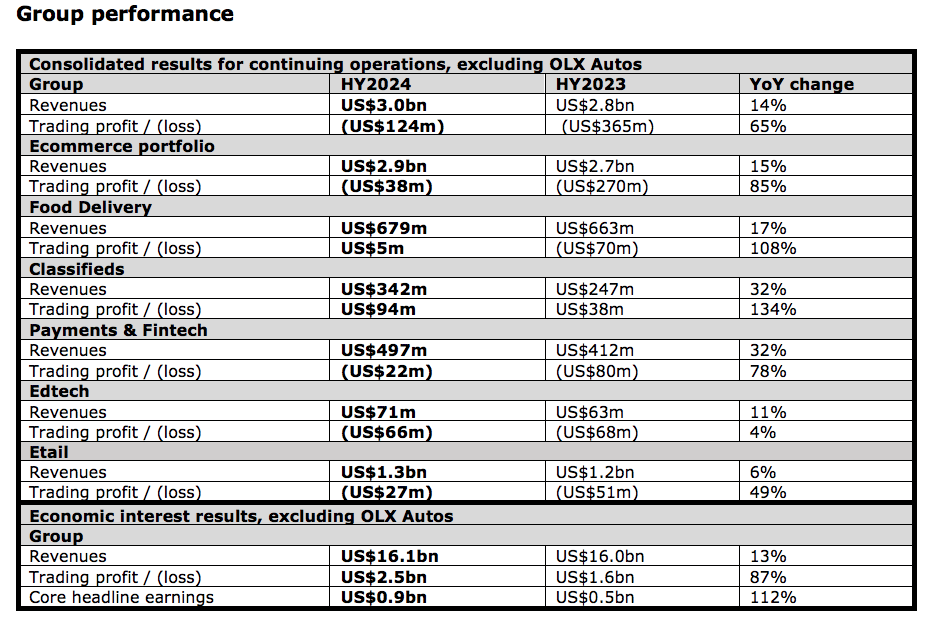
• Sustained topline growth of 15%, more than double the rate of peers, with Ecommerce consolidated revenue of US$ 2.9bn.
• Meaningful improvement in profitability, enabling the Group to bring forward its Prosus Ecommerce profitability target by six months to 2H 2024.
o Consolidated Ecommerce trading loss of only US$ 38m, representing a 9% margin improvement year-on-year.
o iFood is now profitable overall, not just in its core.
• Core headline earnings more than doubled, increasing 112%, on improved Ecommerce and Tencent profitability.
• Free cash inflow increased to US$ 677m, a 8x improvement year-on-year.
• US$ 25bn of value created by the ongoing buyback programme since launch, delivering 7% NAV per share accretion.
• Strong balance sheet with central cash of US$ 15.1bn.
• Removal of cross-holding agreement between Prosus and Naspers completed in September 2023, to simplify the Group’s structure.
Ervin Tu, Interim Group CEO, Prosus and Naspers, commented: “We are making substantial progress against our commitment to drive profitable growth. Through active management of our portfolio, we have delivered improved results as our Ecommerce portfolio is now close to breakeven and growing at scale. We’ve simplified our Group structure, and the open-ended buyback programme is driving daily NAV per share growth – magnifying returns over the long term. With deep institutional knowledge across a number of technology domains, including AI, we are well positioned to support exceptional technology companies around the world. We remain ambitious in our plans and disciplined in our approach to drive real returns for all of our stakeholders.“
Basil Sgourdos, Group CFO, Prosus and Naspers, commented: “The Group has delivered strong financial performance, beating industry levels of growth, while significantly accelerating profitability. Driven by continued strong execution across our Ecommerce portfolio, I expect this trajectory to continue at pace. Our Classifieds and Food Delivery segments are both profitable, and PayU is making strong progress towards profitability. Core headline earnings have doubled and the impact of the strong improvements in Ecommerce and Tencent are also evident in our free cashflow, which has increased six times. Our strong and flexible balance sheet, active portfolio management and disciplined capital allocation will underpin our success.”
Industry-leading growth and accelerating profitability across core Ecommerce
Portfolio
Food Delivery: Sustained revenue growth with significant profitability improvement
• iFood’s core restaurant business more than doubled trading profit to US$ 114m, with a 19% trading margin.
• iFood grew Gross Merchandise Value (GMV) by 15% and revenue by 17%, resulting in a trading profit of US$ 23m, up 149%.
• Strong performance by key investments:
o Delivery Hero grew group GMV by 8% in Q2 2023, with H1 revenue up by 27%, boosting profitability to an adjusted EBITDA of €9m.
o Swiggy grew GMV by 28%, as operating metrics improved, and trading losses reduced to US$ 208m.
Classifieds – OLX Group: Strong performance, with peer-leading growth and expanding margins
• Classifieds consolidated revenue grew 32%, driven by a strong performance in European auto verticals and OLX horizontal platforms.
• Trading profit more than doubled to US$ 94m, with trading profit margin increasing 12 percentage points, to 27%.
• Exited OLX Autos businesses (excluding the US), with expected proceeds of US$ 181m.
Payments & Fintech – PayU: Strong overall performance, with core Payments Service Provider (PSP) business profitable and sustained growth in Indian businesses
• Consolidated revenue increased 32% to US$ 497m, as core PSP business grew Total
Payment Volume (TPV) by 20% and delivered a trading profit margin of 2%.
• Indian credit business grew its loan book by 66% with revenue up 31%.
• Consolidated trading loss narrowed to US$ 22m, with a 15 percentage point improvement in trading profit margin.
• Agreed sale of GPO business, excluding PayU Turkey and Red Dot Payment, to Rapyd for US$ 610m.
• Strong performance at Remitly in Q3 2023, with revenue increasing 43%. At 30 September 2023, value of Remitly stake approximately 5x initial investment.
Edtech: Continued growth in majority-owned platforms, with investment to leverage the significant opportunity of generative AI
• Consolidated revenue grew 11% to US$ 71m with trading losses flat at US$ 66m, despite the macroeconomic downturn and continued investment in new technologies.
• Stack Overflow revenues grew 7% and successfully launched Overflow AI, a roadmap for the integration of generative AI.
• GoodHabitz grew revenue by 22%.
South African businesses
• Takealot Group grew GMV by 15% and revenue by 9%, while reducing trading
losses by 85%, despite challenging trading conditions.
• Mr D grew GMV by 15% and revenue by 11%.
For full details of the Group’s results, please visit www.naspers.com.
The post Naspers accelerates profitability target and delivers on objectives appeared first on The Mail & Guardian.
NSFAS budget cuts could leave more than 87,000 students without funding in 2024:

More than 87,000 university students could lose their National Student Financial Aid Scheme (NSFAS) funding next year due to budget cuts.
This was revealed by the acting CEO of NSFAS, Masile Ramorwesi, during a briefing to the Parliamentary Portfolio Committee on Higher Education on its plans ahead of the 2024 academic year on Wednesday.
“The average cost per student amounts to R63,935 for the 2024 academic year and R67,199 for the 2025 academic period,” Ramorwesi said. “Based on the calculation of the 10% reduction in university funding from National Treasury’s Medium Term Budget Policy Statement (MTBPS), 87,712 students will be left unfunded in the 2024 academic period. This will increase to 120,976 students in the 2024/25 academic year.”
Since the funding applications opened on 21 November, Ramorwesi said NSFAS has already received 205,752 applications. Applications close on 31 January.
For universities, NSFAS’s projected budget is R41.9-billion for 2024/25 and R43.7-billion for 2025/26. “With Treasury’s projected 10% budget cut … this will result in a shortfall of the universities budget of R5.5-billion for 2024/25 and R8.1-billion in 2025/26,” said Ramorwesi.
For Technical Vocational Education and Training (TVET) colleges, Ramorwesi said NSFAS’s projected budget is R9.7-billion for 2024/25 and R10-billion for 2025/26. “We project that R970-million will be cut from the TVET budget 2024/25 financial year, and R1-billion from the 2025/26 financial year.”
Ramorwesi said there are several risks to cutting the student funding, such as protests. “The potential changes could result in an increase in student protests due to a decrease in headcount funding.”
He said insufficient bridging finance options could have a “severe impact” on the sector as “NSFAS may not be able to pay allowances on time and when most needed by students at the beginning of the financial year”.
NSFAS has been sharply criticised by MPs in recent months for continuous problems at the student funding scheme. This is despite a briefing in Parliament earlier this year where NSFAS presented its new direct payment system and reported on various other issues.
NSFAS Board chairman Ernest Khosa told MPs that the probe by law firm Werkmans Attorneys and advocate Tembeka Ngcukaitobi into the appointment of direct payment service providers at NSFAS made three main recommendations: to terminate the former CEO’s contract; to terminate the direct payment service provider’s contracts; and that disciplinary action be taken against staff involved in the procurement process of the direct payments.
Khosa said former CEO Andile Nongogo’s contract has already been terminated. On the cancellation of the direct payment company’s contracts, he said they “agree with the report that we do that in the most responsible way, and that the guiding principle is that students should not be disadvantaged in the process”.
Khosa said they are dealing with the report’s recommendation that disciplinary action be taken against staff involved in the procurement process.
Tertiary institutions concerned by NSFAS woes
The Universities South Africa (USAF) CEO Dr Phethiwe Matutu raised her concerns with MPs over NSFAS’s capacity to manage student accommodation allocations.
“There’s a need for NSFAS to first consider university accommodation and university-leased accommodation before private accommodation to ensure public infrastructure is appropriately utilised.”
She said the R45,000 accommodation cap NSFAS introduced earlier this year has left many in debt. “We have calculated R606-million outstanding in accommodation fees. This accommodation cap amount has created debt for students in 2023 and this will impact the 2024 registration.
“So far NSFAS and the DHET have expressed that they do not have these funds and the student is going to be left owing these funds to the universities,” Matutu said.
Professor Marianna Phutsisi of the South African Public Colleges Organisation (SAPCO) said although NSFAS “made an undertaking that all current appeals and outstanding payments are being finalised, it is still a challenge that colleges are dealing with”.
She said the process of accrediting private accommodation needs to be sped up and told Parliament that 40,000 beds have been accredited so far.
Lukhanyo Daweti, secretary general of the South African Union of Students, said students need clarity on the direct payments and the companies facilitating them.
“The appeals process needs to happen concurrently with the application process. If a student is rejected [for NSFAS funding] from 22 November, they should be informed so that they can prepare for their appeals. [This is] so that students don’t wait until 31 January to find out that they have been rejected, and then NSFAS only deals with their appeals in the second semester.”
This article was originally published by GroundUp.
The post NSFAS budget cuts could leave more than 87,000 students without funding in 2024 appeared first on The Mail & Guardian.
COP28 no place to boost fossil fuels, says ex-UN climate boss:

The UN’s former climate chief said she was “giving up hope” that fossil fuel firms will be part of the solution to warming as pivotal COP28 talks started on Thursday in oil-rich United Arab Emirates.
With the UN climate negotiations expected to feature a showdown on the future of fossil fuels, Christiana Figueres expressed concern over reports the UAE planned to use its role as host to strike oil and gas deals.
Figueres, who led the UN climate convention when the landmark Paris deal was struck, told AFP that she had previously championed the idea that the world’s polluting coal, oil and gas industries should “sit at the table”.
“I’m actually giving up hope on that,” she said, adding that it was “unforgivable” that the industries funnelled the bumper profits of recent years into shareholder dividends and lobbying efforts – rather than invest in renewable energy technologies.
She also called for more transparency around fossil fuel influence from the COP presidency, which is held by the UAE’s Sultan Al Jaber, who is also head of the Emirates state oil and gas company.
Reacting to BBC reports of leaked documents suggesting the UAE planned to exploit its role organising the climate conference to strike fossil fuel deals, Figueres said if true the claims would mark a “serious breach of the responsibility of the COP presidency”.
“It is not a meeting to advance the interests of the oil and gas industry,” she told PBS News in a linked interview hosted by the organisation Covering Climate Now.
“This is a convening of all the governments in the world to advance the protection of the planet… precisely because of the negative consequences of mostly the operation of the oil and gas industry.”
Jaber strongly denied the BBC reports on Wednesday, saying they were “false, not true, incorrect”.
Global climate negotiations largely avoided mentioning fossil fuels for decades, until Glasgow’s COP26 agreed to “phasedown” unfiltered coal power and the “phase-out of inefficient fossil fuel subsidies”.
Momentum has built since then on a more ambitious pledge to move away from all fossil fuels and Figueres said an unprecedented surge in renewables and electric vehicles gave her optimism that the world can still achieve its climate goals.
Those centre on the 2015 Paris deal, which saw nearly 200 nations agree to limit global warming to “well below” two degrees Celsius since the preindustrial era, and preferably a safer threshold of 1.5C.
Must try harder
Figueres, a member of Costa Rica’s climate negotiating team before she took the helm of the UN’s climate change body from 2010 to 2016, said that deal was signed by leaders out of “enlightened self interest”.
But she said that the world was now “horribly close” to the 1.5C limit, with emissions continuing to rise and this year is almost certain to be the hottest in human history.
She called on leaders attending the COP28 meeting to respond to a damning Global Stocktake on the world’s climate action shortcomings by both accepting efforts so far have been “completely insufficient” and by doubling down on future action.
One key target, she said, should be fossil fuel subsidies, which the International Monetary Fund has said surged to a record $ 7 trillion last year — equivalent to around 7 percent of global gross domestic product.
“My outrage is fossil fuel subsidies,” said Figueres, adding that she would also be in favour of extra taxation on fossil fuel profits — a suggestion championed by developing countries facing the sharpest impact of accelerating weather extremes.
She said leaders must focus on the need to almost halve emissions by 2030, which the UN’s IPCC climate expert panel says is needed to keep 1.5C of warming a possibility.
“If we breach the ceiling that has been established by scientists for 2030, we have a serious problem in our hands, because we will have very likely opened a cascade of tipping points into the ecosystems that negatively affect each other,” she said.
“And that will be incredibly damaging to human life, but also to all other life on this planet.”
© Agence France-Presse
The post COP28 no place to boost fossil fuels, says ex-UN climate boss appeared first on The Mail & Guardian.
Submit and get free exposure here: Showcase Your Business | Advertise Your Special Offers.
