
Nations negotiate terms of plastics treaty in Nairobi:

The latest negotiations towards a global treaty to combat plastic pollution opened in Nairobi on Monday, with tensions expected as nations tussle over what should be included in the pact.
Some 175 countries agreed last year to conclude by 2024 a UN treaty to address the plastic blighting oceans, floating in the atmosphere, and infiltrating the bodies of animals and humans.
While there is broad consensus a treaty is needed, there are very different opinions about what should be in it.
As the talks formally opened, Peru’s Gustavo Meza-Cuadra Velasquez, chair of the forum’s intergovernmental negotiating committee, warned that plastic pollution posed “a direct threat to our environment, human health, and the delicate balance of our planet.”
“We have the collective power to change this trajectory,” he said.
Negotiators have met twice already but the November 13-19 talks are the first to consider a draft text of the treaty published in September and the policy options it contains.
Around 60 so-called “high ambition” nations have called for binding rules to reduce the use and production of plastic, which is made from fossil fuels, a measure supported by many environment groups.
It is not a position shared by many plastic-producing economies, including the United States, which have long preferred to focus on recycling, innovation and better waste management.
The draft presenting the various ways forward will form the basis for the high-stakes deliberations at the UN Environment Programme (UNEP) headquarters in Nairobi.
With more than 2,000 delegates registered, and advocates from environmental and plastic groups also in the room, the negotiations are expected to get heated as the details are hammered out.
Hundreds of climate campaigners, waving placards reading “Plastic crisis = climate crisis”, on Saturday marched in Nairobi calling for the talks to focus on cutting the amount of plastic produced.
Kenyan President William Ruto described plastic pollution as “an existential threat to life, to humanity and everything in between.”
“To deal with plastic pollution, humanity must change. We must change the way we consume, the way we produce, and how we dispose (of) our waste.”
Call for urgency
The meeting to debate the future of plastic comes just before crucial climate talks in the oil-rich United Arab Emirates later this month, where discussions over fossil fuels and their planet-heating emissions are due to dominate the agenda.
As in the UN negotiations on climate and biodiversity, financing is a key point of tension in the plastic talks.
Rich economies have historically polluted more — and for years exported trash for recycling to poorer nations, where it often winds up in the environment.
Some developing nations are concerned about rules that might place too great a burden on their economies.
Environment groups say the strength of the treaty depends on whether governments commit to capping and phasing down plastic production.
Plastic production has doubled in 20 years and in 2019, a total of 460 million tonnes of the stuff was made, according to the OECD.
Despite growing awareness of the problem surrounding plastic, on current trends, production could triple again by 2060 without action.
Around two-thirds of plastic waste is discarded after being used only once or a few times, and less than 10 percent is recycled, with millions of tonnes dumped in the environment or improperly burned.
The Nairobi meeting is the third of five sessions in a fast-tracked process aiming to conclude negotiations next year so the treaty can be adopted by mid-2025.
Campaigners say delegates in Nairobi must make considerable headway to remain on course and warned against time-consuming debates over procedural matters that caused friction at the last talks in Paris in June.
© Agence France-Presse
The post Nations negotiate terms of plastics treaty in Nairobi appeared first on The Mail & Guardian.
People, love and music … an artist behind bars:

“Every day I feel that my daughter is robbed of yet another day of her life.”
I have never met Nadezhda Skochilenko or even done a direct interview with her — she is in hiding in Western Europe.
But what she said tells me of a mother’s deep anguish for her daughter Sasha, the 33-year-old Russian artist, singer and writer, who has been incarcerated for political reasons in a St Petersburg pre-trial detention centre since her arrest on 11 April last year.
“The whole eternity passed since that day, but it still feels like yesterday — so stinging,” Nadezhda told me. I managed to contact her via Telegram, the secure messaging platform, and a family friend acted as a translator/go-between.
The arrest happened less than two months after the 24 February Russian invasion of Ukraine. As Nadezhda said, “Sasha couldn’t stay silent. Like so many people, she spoke out against the war, and did so like the creative person she is, independent and intolerant to injustice.”
The reason for her arrest — she went to the popular supermarket Perekrestok and placed five tiny leaflets, imitating price tags, with information about a Russian missile strike on a theatre in the occupied Ukrainian city of Mariupol in March last year; Russian conscripts who were sent to fight in the war; the deaths of thousands of soldiers and the corresponding silence on Russian state television, according to Mediazona.
One sticker read: “My great-grandfather fought in the Great Patriotic War [against Nazi Germany] for four years not to see Russia become a fascist state and attack Ukraine.”
She stands accused of distributing fake information about the Russian military, according to a new article of the Criminal Code of the Russian Federation, which went into effect on 4 March last year. It carries a sentence of up to 10 years in prison.
Sasha admitted to distributing the stickers but pleaded not guilty, denying that the information on the stickers was false.
But Nadezhda, when she was interrogated by a detective, “learned that from the top came an order to prosecute her. I got scared that I can do nothing to protect my daughter.” She left Russia after Sasha was arrested.
“Even if I’d stayed, I couldn’t free her but they could use somehow me to pressure her even further. I’m in a safe place now and I’m speaking for Sasha and other prisoners on every platform I’m lucky to have.”
Nadezhda is deeply worried about Sasha’s deteriorating health. She has a congenital heart defect and also celiac disease, so she has to follow a strict diet for the rest of her life — which is impossible in detention.
Court hearings resemble torture. During the trial, Sasha’s held in a cage, sometimes for eight hours straight, she was denied her medicine, food and even water.
“Being the mother of a political prisoner means a never-ending wait for hearings, the hope for a change of luck, and inevitable devastation, feeling of helplessness, and despair afterwards,” Nadezhda says.
“I’m always waiting for the news from her lawyers, who are supporting us for so many months, and serve as living letters from Sasha. You can’t get used to all of this.”
Skochilenko’s trial started in December last year and it’s still continuing with no outcome in sight.
When she is not in court, Sasha can go out of her cell just for an hour, to pace in another enclosed space of 14m2, where she can see the sky only through bars.
“She cannot read the books she likes. She can use the shower only twice a week. She cannot play music, which she used to do every day, or sing — and music is the most important thing in her life,” says her mother.
“Every day I imagine, how she has to abide by the prison rules — these thoughts bring pain but I know that her pain is many times stronger.”
Nadezhda says her daughter is a peaceful person — “she never called for violence; all she did was to stop the war. From early childhood she valued other people, love and music above everything. She combines all that perfectly.
“She knows that every human is a creator. And now she unites an incredible amount of people. She has won a lot of heart with her smile from behind bars. Her open letters from prison are full of life — often people read them and start crying.”
The threat of a long sentence haunts Nadezhda. “I forbid myself to think about the future, because I’m terrified of it, and I only hope for a miracle.”
The post People, love and music … an artist behind bars appeared first on The Mail & Guardian.
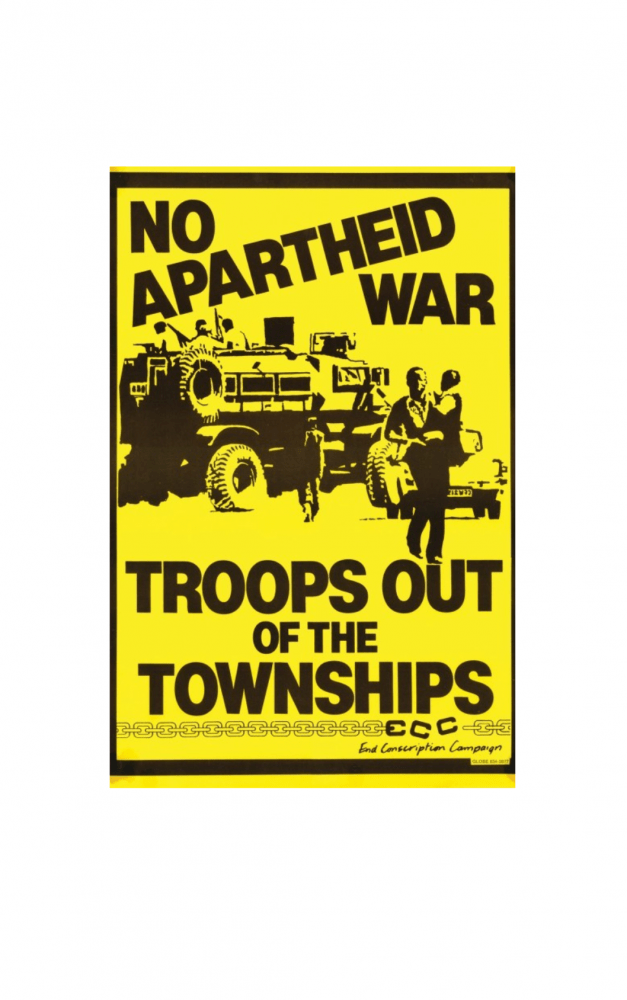
Warmongers need young men and women as fodder. But, as we are seeing again in the bloody conflicts raging in places such as Israel (see right) and Russia (see below), there will always be those who resist — refuseniks who say, “Hell no, we won’t go!” or “Not in our name.”
And with conscripts being mostly young people, popular culture is often prominent their in resistance.
Exactly 40 years ago, an organisation of young, white South Africans was formed and they immediately found themselves in a battle of fingers with the powerful apartheid state. The subversive End Conscription Campaign (ECC) showed a middle finger to the man with the wagging index finger, PW Botha, and compulsory military service.
PW, or “Die Groot Krokodil” (Afrikaans for “the big crocodile”), had been prime minister since 1978. In 1984, he became South Africa’s first executive state president, and stayed in the position until 1989.
The ECC’s members didn’t want to, as the satirical song Hou My Vas Korporaal (Hold Me Tight Corporal) by Bernoldus Niemand had it, “play war with their best days”.
But the paranoid Botha did not care, because white South Africa faced what he called a “total onslaught”. Forces both within the country and in its neighbouring states were resisting apartheid.
So, the South African Defence Force (SADF) regularly launched cross-border raids on suspected ANC bases and became an occupying force in what was then South West Africa (now Namibia).
In the 1980s, Botha used troops to occupy the restive townships.
The country had become increasingly militarised. A mischievous poster by the ECC summed it up best during the 1987 whites-only general election which was held during a State of Emergency: “The problem with this general election is we don’t know which general we’re electing.”
The SADF needed more and more men to serve in the army. By the 1980s, compulsory military service had been extended to two years (plus month-long annual camps for years after that) for all white men from the age of 18. They had no choice.
Many didn’t want to join the army and fight for a country whose policies they did not believe in. Some left and went into exile. Others went to university in order to avoid the draft for as long as possible.
Small numbers chose to be conscientious objectors — in return they were given a six-year jail sentence.
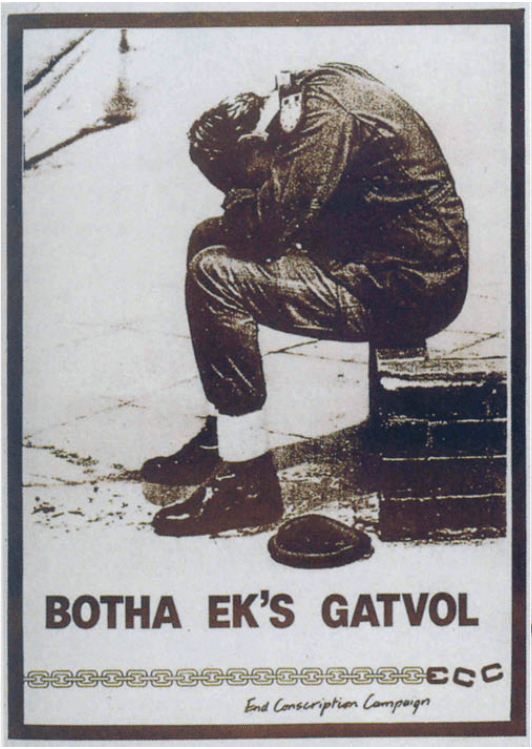
It was not until the formation of the ECC in 1983 that there was a co-ordinated response to conscription.
So far, so serious.
The ECC, unlike some of its serious allies in the left’s struggle against apartheid, understood that you had to fight this battle differently. Its weapons were humour, subversion and popular culture. Shit-stirring was their go-to setting, because this is exactly what appealed to their young, diverse audience.
In his 2002 master’s thesis about the ECC, Merran Phillips quoted academic Matthew Blatchford, who believed the organisation succeeded “because it cut itself loose from the deadening hand of the white left”.
“Nusas and UDF [National Union of South African Students and United Democratic Front] cadres were outnumbered by gays, greens, feminists and Unitarians and the arrogance of those organisations was voided in favour of mad schemes, publicity and sex and drugs and rock and roll,” Blatchford said.
When the ECC turned 25 in 2008, I wrote a piece about how the decision to use popular culture as a tool back then was a deliberate one.
“For the serious politicos in the ECC it initially was a nice-to-have,” former ECC leader Chippy Olver told me, but insanity prevailed with the formation of a very active and creative cultural sub-committee early on.
“The use of culture grew over the period of the campaign and, by using posters, youth culture and bands, our message reached a much wider audience.”
One of those culture sub-committee subversives was Mike Rautenbach, then a student at UCT. At a massive ECC concert at the Sea Point town hall he wore a huge PW Botha puppet head. Another ECC comrade was “first lady” Elize Botha.
The cops didn’t see the humour in this and shot teargas into the packed hall just as the “Bothas” made their way down the passage. No concert happened, but a whole bunch of young people got conscientised.
Former journalist Rautenbach, now in environmental management, is still droll and still puffs almost nonstop on hand-rolled cigarettes as we chat on Zoom.
“The ECC brought a lighter, more creative style to politics — we used a lot of humour, maybe a slightly black humour,” he says with a half-smile. “The culture committee was made up of a lot of artists, cartoonists, homosexuals — even, um, daggarokers …”
In addition to the best concerts, with the top lefty bands, the ECC held photographic and art exhibitions. There was also the ironically titled Forces Favourites album, a compilation featuring some of the strongest political songs of the time.
The ECC produced “know your rights” booklets in cartoon form for conscripts. Their posters were striking, witty and well-designed. Fellow sub-committee member and now archivist Marlene Powell tells me that a lot of hard work went into it.
“You’d meet, brainstorm and come up with the poster, then you would actually have to create the poster.
“Then you would have to make the poster, then you would have to go and put it up in the middle of the night. And, generally, by 8 o’clock in the morning, the police would take them down.”
By understanding the power of the party, the ECC got their message across in a more powerful way than many politicians managed to. It took the authorities a while to realise that. But when they did, they came for the ECC, military boots and all.
Defence minister Magnus Malan called it “disgraceful that the SADF, but especially the country’s young people, the pride of the nation, should be subjected to the ECC’s propaganda, suspicion-sowing and misinformation”.
His police colleague Adriaan Vlok declared that the ECC was part of the “revolutionary onslaught against South Africa”.
As it was still a State of Emergency in South Africa, it was no surprise that in August 1988 the ECC became the first white organisation in more than two decades to be banned by the apartheid regime.
Now, 40 years later, Powell believes there are lessons one can learn from the ECC, maybe even to be applied in other parts of the world.
“It’s always important for young people to be informed and to be part of a movement that changes the trajectory of where they’re going because, they’re basically starting their lives,” she says.
“They need to take the steps to try and shape it and they need to bring in the people who, in the end, would be most affected because that’s the country and the environment that they’re going to inherit.
“While it’s not really what you would want in the world, young people need to be thinking about war and stopping wars and creating an environment that’s equal, safe, peaceful and productive. But these are the times we find ourselves in.
“So, a youth component to whatever struggles are being fought is a necessary thing, because a lot of energy also comes from the youth.”
The post Giving apartheid the finger appeared first on The Mail & Guardian.
Submit and get free exposure here: Showcase Your Business | Advertise Your Special Offers.
