Thursday.
Down here in the Kingdom, Premier Thami Ntuli has just wrapped up a two-day lekgotla of his provincial unity cabinet ahead of his state of the province address in Pietermaritzburg next week.
It’s a replication of the process the president led nationally two weekends ago and has also come up with a basic common programme of action for immediate implementation by the provincial government over the next few months.
Basic is the operative word.
There’s an agreement to professionalise the civil service and the state-owned entities in the province and to hold senior officials accountable for corruption and maladministration in government departments.
There is also an agreement to focus on revitalising agriculture and the township and rural economy — and to promote business initiatives for young people — along with interventions in the municipalities in general, and in eThekwini in particular.
The more difficult issues have been kicked down the road to be dealt with later — as they have been nationally — but the coalition partners have come out of the lekgotla with a common vision and programme for the next few months.
There are disputes over local government between Ntuli’s Inkatha Freedom Party (IFP) and the National Freedom Party (NFP) — and with the ANC — but the premier believes that these are inevitable, and solvable, teething problems.
There are also court papers and letters of suspension flying back and forth between the factions in the NFP, which gave Ntuli’s government its single-seat majority in the provincial legislature and got him into the premier’s office.
The NFP barely made it to the ballot paper because of the internal power struggles that have been raging since the death of its founder, Zanele kaMagwaza-Msibi.
Within days of Ntuli proclaiming his government, the NFP’s internal battle was back on as the factions in the party reverted to form and went to war with each other again.
The NFP infighting now affects not only the party, but its instability threatens that of Ntuli’s government as well.
The premier has also appointed the ANC’s provincial chairperson, Siboniso Duma, as leader of government business in the KwaZulu-Natal legislature.
Duma held the position during Nomusa Dube-Ncube’s short — and inglorious — term as the province’s first citizen.
During Dube-Ncube’s tenure, Duma earned the dubious title of shadow premier with his microphone — and Rugby World Cup trophy — snatching tendencies.
At the post-lekgotla media briefing Ntuli said although he had given Duma back his old position as leader of government business, he had not appointed him as “deputy premier”.
Duma may have laughed along with Ntuli and the punters at the briefing, but he made sure he secured the premier’s go-ahead before approaching the microphone on the boardroom table to respond to questions from the floor.
Long may it last.
Elsewhere in the Republic, Oom Pieter Groenewald has been cooking — some would say braaing — since President Cyril Ramaphosa put him in charge of our prison system.
It’s not just the prayer meetings in the head office.
Oom appears to be committed to emphasising the correctional nature of his new portfolio, with a series of raids on jails across the country to introduce himself to his new constituents.
The minister appears to have —rightly — taken offence at the social media videos posted by prisoners bragging about their luxurious lifestyle inside.
The dogs have been unleashed — literally and figuratively — in response.
Oom has gone full John Wick and life — and cells — have been turned upside down in Johannesburg’s Sun City prison and elsewhere, where PlayStations, sex toys, cellphones and lipstick are among the more interesting items seized in the last two weeks.
Groenewald’s former — and current — parliamentary colleagues who are facing corruption charges and a minimum sentence of 15 years in the slammer must be having palpitations as we speak.
It’s not just the realisation that there will be no chance to play Grand Theft Auto — no Gucci blanket, no preferential treatment — if they do end up behind bars for their till-raiding escapades.
The Freedom Front Plus believes prisoners should pay for their own keep — and square their debt to society — through compulsory labour, rather than by playing computer games and making TikTok videos.
It made this intention very clear in its manifesto for the 29 May elections and Groenewald may well be enthused to pursue this agenda now that he is in a position to influence how our prisons are run.
Oom will have some constitutional difficulties if he does try to introduce forced labour behind bars.
Slavery is illegal, after all.
But if he does manage to deliver on what his party promised the voters, some members of our political and criminal class may end up actually working for a living — for the first time in their lives.
We are disparaging the legacy of Mandela by the many self-absolving acts that tend to categorise Mandela Day. I have been inundated with requests to make donations — food parcels, blankets, visits to orphanages — to mark Mandela Day. These initiatives, though important, miss an important part and obscure the real legacy of Mandela as a man who devoted most of his time to fighting structural injustices.
The manifestation of our society’s deeply structural inequities is glaring. Homelessness, poverty, sexual violence, and a general sense of alienation and powerlessness cannot be ignored. Mandela Day calls on individuals to do what they can in their personal and collective capacities to offset some of the effects of structural inequities. Herein lies the problem.
Shifting the burden of addressing the deeply structural ills by over-emphasising individual agency feeds into the Western logic and tactic of deflecting responsibility and the cause of the many catastrophes that plague our world. Within this frame, individuals are advised to recycle and compost to reduce waste sent to landfills, give to the poor, drive e-vehicles, eat a plant-based or low-meat diet, and practice self-care even in toxic environments.
The events of Mandela Day are part of this broader frame that puts primacy on individual action while ignoring how systems and structures shape our realities, behaviours, and attitudes towards each other and the environment, in the first instance. Think of the 10 million tonnes of food that go to waste every year in South Africa; this number accounts for a third of the 31 million tonnes of food that are produced annually in South Africa, according to Statistics SA. This is no accident, but an almost inevitable consequence of a world that prizes materialism and consumerism.
The rapacious and extractive prevailing economic paradigm of capitalism and its attendant scaffoldings are at the centre of the interconnected catastrophes of epistemicides, poverty and economic inequalities, and climate crisis that individual “good action” disconnects. The radical version is to connect, at the root, what produces these catastrophes. The “early” Mandela understood the interconnectedness of these crises and embarked, along with others, in the radical fight for structural change.
For good or bad reasons, the legacy of Mandela is becoming irrelevant to younger generations, particularly to those who were born or grew up after the institutional dismantling of apartheid in 1994. The Gen Zs, according to the recent report by Flux Trends, find it hard to connect with activism and political spaces. In the US, for example, this group uses social justice as a filter for where to work. In South Africa, this trend is different. Because of the high unemployment rate in the country, “financial freedom and alignment with personal values are more of a priority than social justice”, according to Flux Trends.
Young people are disproportionately affected by the rising unemployment in South Africa. According to Statistics SA, there is a 45.5% unemployment rate among young people (aged 15-34), in contrast to the national average of 32.9% in the first quarter of 2024. This phenomenon will only reinforce Mandela’s legacy as a “sell-out” who compromised too much in talks with the apartheid regime.
With growing poverty and inequality, young people are increasingly understating Mandela’s positive contributions in the annals of history and pretending that his efforts have no bearing on their contemporary struggles and fight for justice. Here I use “Mandela” to represent all those who have gone before us and made notable contributions to the dismantling of oppressive systems. We see this attitude in noble protests led by young people in recent times who boldly and unashamedly claim that #We Are Not Our Ancestors. This and other cognate articulations have been present in recent youth-led protests like the #BlackLivesMatter, #FeesMustFall, #EndSARS, and the recent #RejectFinanceBill2024 protests in Kenya.
These fights are not new fights, even though young people often want to frame their struggles as new. This is partly because they are unencumbered by previous generations’ nostalgia for figures like Mandela or Nat Turner in the US or simply a wilful ignorance of not understanding history.
While we as young people do not need to live in the nostalgia of previous generations, we cannot afford to only look forward in our fight towards the liberation of all people and the planet from greed and unruly extractive practices. A liberatory decolonial approach is to maintain a solid thread between the struggles of today and that of our ancestors. This is a sure thing that will remind us that the fight to end the oppression of historically marginalised communities has not been won yet, while still recognising the immense contributions of our ancestors on whose imperfect and bruised shoulders we stand.
To make progress against the headwinds of structural and systemic oppression, we must exorcise Mandela’s ghost and free him from the neoliberal trappings of the West that thrive on fragmentation and an over-indexing on individual agency as the panacea for structural ills.
For Mandela to maintain his relevance today as arguably the most influential leader of the 20th century, he must be commemorated as an icon who fought to bring about deep structural change in our world. Madiba is not merely a figure who inspires individual good action of giving to the poor and the disadvantaged once a year, irrespective of how these individual actions might make us feel absolved of our complacency in systems of oppression. A commitment to deep structural change is what will help young people make three multidimensional moves as they pick up the baton and continue the fight: backward and forward acknowledgements, upward and downward remedies, and lateral or side-by-side solidarity.
The first move is to balance the need to look back and look forward so that we are not stuck in the past but also do not take an ahistorical view that ignores the struggles we have inherited from our ancestors or paper over the need for redress. For the struggle of younger generations to have the needed force, they must acknowledge the past in all its complexities and forge a new future from that place with all the lessons learned.
The second is to engage in both upward and downward remedies. The latter is the immediate need to do what we can as individuals and collectively to address the material crisis of the persistent and deep poverty, inequality and unemployment that disproportionately affects black people around the world. The former — the downward remedy — is to dismantle oppressive systems and build equitable (economic) systems that put the social and ecological at the centre. Here I am reminded of another of our ancestors, Archbishop Desmond Tutu, that “there comes a point where we need to stop just pulling people out of the river. We need to go upstream and find out why they’re falling in”. And that point is now.
The third move is the lateral one of standing side by side in a Pan-African movement to resist oppression of all kinds in a way that transcends geographies. Elsewhere, I have argued that our liberation hinges on a unified response to the multitude of oppression we face in different parts of the world; he Marikana Massacre of 2012 in South Africa, the #EndSars ????massacre in Nigeria in 2020, and the recent killings by security forces of young people in Kenya who were protesting against the finance bill are all underlined by neo-colonial impulses and forces that continue to oppress black people beyond national boundaries. This requires black people to stand side by side with each other to resist oppression of all kinds — this is the positive picture of what Mandela Day symbolises.
Akanimo Andrew Akpan is a senior consultant at Reos Partners. He is a member of the African Centre for Epistemology and Philosophy of Science, University of Johannesburg. The views expressed here are his and do not reflect those of any of his associations.
Power struggle intensifies ahead of EFF elective conference:
A fierce battle for the second-most powerful position in the Economic Freedom Fighters (EFF) has erupted ahead of the party’s third elective conference at the end of the year, pitting deputy leader Floyd Shivambu against secretary general Marshall Dlamini.
The EFF is expected to convene its National People’s Assembly in December to elect new leaders and review some of its policies.
Five KwaZulu-Natal regions have come out against Shivambu following the leaking of VBS Mutual Bank kingpin Tshifhiwa Matodzi’s damning affidavit, which implicates EFF leader Julius Malema and Shivambu in receiving bribes totalling R16??million.
The 11 accused in the VBS case, including former ANC Limpopo secretary Danny Msiza, appeared in the Pretoria high court on Monday, and Matodzi is expected to give evidence against them during the trial.
The matter has been postponed to 14??August, when Msiza and one of his co-accused, “tenderpreneur” Kabelo Matsepe, will argue an application for a separation of trial. They will also apply for a stay of prosecution.
Shivambu’s brother, Brian, received about R16??million in payments from the bank, with the money allegedly benefitting both Floyd and Malema, but it appears that it is only Shivambu who will pay the price at the EFF’s meeting in December.
EFF leaders in KwaZulu-Natal expressed a common sentiment that Shivambu’s nomination for re-election should not be supported or seconded and that he should make way for Dlamini.
They said Shivambu has failed to meet leadership expectations and that they would seek to have him removed from the party’s second-to-top position after he failed to mobilise support in the province for the 29??May national and provincial elections.
“Matodzi’s affidavit is a nail in the coffin for the deputy president because, if you remember, we have always been wary of VBS coming between his aspirations to level up to the presidency. Now that just means he will be sacrificed because of the direct implications in this mess,” one regional leader said.
Another leader said Shivambu’s loss of support was evident even before the rise of former ANC president Jacob Zuma’s uMkhonto weSizwe party, which helped to reduce the EFF’s support in the province from 9.96% in 2019 to 2.56% this year.
Shivambu was sent to KwaZulu-Natal as a team convener and tasked with preparing for the May elections, with a mandate to seize power from the ANC and the Inkatha Freedom Party.
He was also mandated to stabilise the EFF’s ground forces after factional battles threatened to undermine its previous electoral gains. This included bringing back party members who had left after a rift between Dlamini and the EFF’s former provincial chair, Vusi Khoza.
Shivambu has been criticised in some quarters after struggling to fill the Moses Mabhida Stadium in Durban for an EFF event and failing to unite structures in the province, which resulted in him being redeployed to the Eastern Cape.
One KwaZulu-Natal leader said the confirmation that Shivambu had benefited from the now-defunct VBS bank had become a “threat to the party” and forced them to back Dlamini, who had been mobilising support for his future in the party.
“Twice is problematic; not long ago, parliament found him [Shivambu] guilty of this, and now Matodzi links him again. The CIC [commander-in-chief, Malema] better do the right thing and have him removed because his fingers are more tainted than all of them.”
The leader accused Shivambu of being dishonest and not the right person to advance and grow the party. These sentiments were echoed by the other four regional leaders in KwaZulu-Natal.
Tensions between them and Shivambu have been brewing since he was accused by former eThekwini ward councillor Mthandeni Zungu of misusing the province’s election funds.
But provincial leader Mongezi Twala has dismissed suggestions of rise of factionalism in the party, arguing that the EFF was focused on rebuilding the party after its poor showing at the polls.
Dlamini’s loyalists are looking to present MP Mbuyiseni Ndlozi as the secretary general candidate to replace him, with support from the party’s student wing, some Gauteng structures and those in KwaZulu-Natal.
“It is the will of ground forces to have commissar Ndlozi in the top six, and we have agreed that we will nominate him from the floor, but it only works if the leadership agrees. Remember, the slate is given by national leadership, and we have to accept it in the name of democratic centralism,” the leaders said.
“The conference is only a process; we all await the slate, but do hope commissar Ndlozi makes the cut. The man has showcased his ability to lead.”
Dlamini, a close ally of Malema, was nominated as the party’s premier candidate for KwaZulu-Natal, another indication of his growing stature in the EFF. This is despite his being sentenced last month to 18 months in prison, suspended for five years, for assaulting a police officer in parliament in 2019.
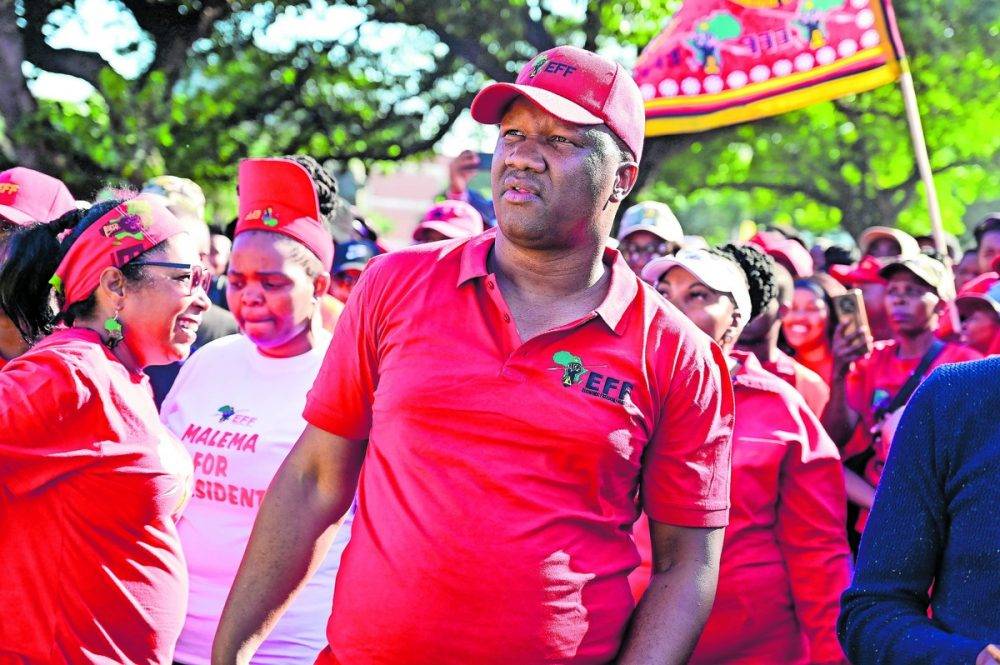
Malema’s control over the party appears to be unchallenged, despite its electoral losses in May and the collapse of its coalition agreements at city level with the ANC.
When asked why Malema was not facing consequences for the party’s poor showing at the polls, one party member said: “Because he would kick us out if we attempted.”
In May, during a media briefing after the elections, Malema said he would not resign as the leader of the EFF, expressed confidence in his position and dismissed any notion of panic in the party.
In a bid to stamp out factionalism in the party, its central command team said it would clamp down on any individual campaigning for positions.
At its second elective conference in 2019, EFF members raised concerns that the elective conference was being reduced to a “rubber-stamp” affair where the positions of the central command team — the highest decision-making body — had already been decided.
EFF provincial leaders have signalled their support for party chairperson Veronica Mente to return to her position unopposed.
The EFF’s conference in December will be attended by voting delegates from provincial branches, mandated by the party’s national assembly guidelines, which are to be released soon after the party’s leadership concludes its war council meetings.
Party spokesperson Leigh-Ann Mathys did not respond to questions from the M&G.
Submit and get free exposure here: Showcase Your Business | Advertise Your Special Offers.