While walking through Cape Town’s busy city centre, it is easy to catch yourself stopping to peek inside Brundyn Arts & Culture, a new space in the art world where collectors and enthusiasts are invited to connect on a deeper level.
Unlike most galleries, which are white-walled, Brundyn Arts & Culture’s are a warmer grey tone decorated with patterned tiles from the outside in while incorporating the raw and industrial vibe of the area.
Under the guidance of its founder Elana Brundyn, who was the founding CEO of the prestigious Norval Foundation and director of institutional advancement at the Zeitz Museum of Contemporary Art Africa, the new gallery and cultural consultancy is sure to be a major fixture on Africa’s bursting art scene.
“I’m fascinated by the psyche of the collector,” says Brundyn. “There’s also a lot of deep learning here. Even before the world was all about artificial intelligence and deep learning, this is something artists have been doing forever.”
Previously, Brundyn worked with some of the continent’s most celebrated artists and exhibitions including William Kentridge’s Why Do I Hesitate and Jackson Hlungwani’s Alpha and Omega, which received the Special Commendation from the Sotheby’s Prize body.
Now, through Brundyn Arts & Culture, Brundyn is able to put her stamp of approval on emerging artists who are not represented by any of the major galleries.
Every picture tells a story
You will be hard-pressed to find a spot in the Brundyn Arts & Culture space that is not intentionally designed for deep-rooted connection, whether you’re in the gallery, in the basement or looking in the windows from the street.
Walking through the exhibition with Brundyn, it is clear she and the team are believers in people coming together to celebrate contemporary African artists.
Beyond the exhibition space, there are a number of works by contemporary artists, including a painting by Lulama Wolf in her office.
Until October, visitors and passers-by will see works by Johannesburg artist and photographer Lebohang Kganye in her first solo presentation in Cape Town called Mmoloki wa mehopolo: Breaking Bread with a Wanderer, showcasing work from five projects from the last decade.
“We are particularly proud to launch our exhibition space in Cape Town with a show by Lebohang Kganye because her practice perfectly aligns with our mission and purpose, to foster sincere appreciation and comprehensive knowledge of art in a distinctly African context while promoting meaningful collaboration, deep learning and creative exchange,” says Brundyn.
On the lower floors are works from Kganye’s 2018 series Tell Tale and a short film called Shadows of Re-memory from 2021, which share an aesthetic of shadowy human silhouettes within Karoo-like dioramas, which feel like miniature theatre sets.
The scenes also explore the Owl House in the Eastern Cape’s Nieu-Bethesda, the home of recluse Helen Martins. It’s clear that Kganye is fascinated by how these stories coalesce memory, imagination, and fantasy.
Another theme explored through Kganye’s work is that of female lighthouse-keepers in the 19th and 20th centuries, via Keep the Light Faithfully (2022), which connects to Kganye’s surname, which means “light” in Sotho.
The one photographic series of Kganye’s that stands out is Ke Lefa Laka — Her Story (2023). The works are an ode to Kganye’s late mother.
The artist restages photos taken of her mother throughout her life — by wearing the same clothing and mimicking her stances and poses — and superimposes them on the originals, showing the clear similarity between mother and daughter.
Together, the photos feel like you are walking through a photo-montage of both their lives, which are full of joy and celebration.
But, at the same time, South Africa’s art world can be tricky to navigate as it exists more as an art economy than an art ecosystem, where the value of purchasing and participating in art creates rigid barriers.
Despite having won international awards, Kganye is not represented by any of the major local galleries. Even though she is exhibiting at Brundyn Arts & Culture, she has to remain neutral, explains Brundyn.
“Sometimes a barrier is as simple as buying an admission ticket. At Brundyn Arts & Culture, we are open by appointment or invitation only and that is a barrier, but our Boschendal space is for everyone because it’s not simply a museum setting,” explains Brundyn.
For those who can’t access the gallery, pieces from Kganye’s most recent body of work Mosebetsi wa Dirithi are on display in the large street-facing windows.
These large draping patchworks, featuring three large female figures, are inspired by images pulled from family albums, embodying kinship and strength.
Throughout Mmoloki wa mehopolo: Breaking Bread with a Wanderer, Kganye makes the viewer look back into their own memories and archives to understand what they make them feel today, in retrospect, or whether these memories were even factual representations at all.
If an inaugural exhibition at a new artistic space like Brundyn Arts & Culture has the ability to elicit memory archiving, then they are definitely doing something curatorially compelling. But isn’t that the purpose of an artistic exhibition? To feel like a wanderer in a space that feels like it is speaking directly to you.
Millions spent but 11 years later, police station is a drug den:

Almost R13-million has been spent on the Ngqamakhwe police station in Ngqamakhwe town, in the Amatole District of the Eastern Cape. But there is almost nothing to show for it.
The building has been stripped by vandals. Roof sheets have been removed, the windows are smashed, and the doors have been stolen. This is despite the abandoned building being just metres from an active police station. And residents say criminals and drug users currently hangout in the derelict buildings.
When we visited the site, we were warned to be careful. We saw a group of about six youngsters smoking what appeared to be nyope. One was burning plastic off wiring, possibly to prepare the material for sale to a scrap yard. When the young men saw us taking photos, some left, others hid.
In 2011, the Ngqamakhwe police moved into prefab structure, in preparation for a R16-million tender to renovate the old station, awarded to Somana Construction in 2012.
Former ward councillor Zinzile Gade said the work was meant to take just 18 months. “The contractor was there for a few months, then we heard that there was a dispute … We waited, thinking that the contractor would return back to the site, but that never happened … ‘Till now we are still waiting,” said Gade.
He said the dispute between Somona and public works’ consultant and engineers was around the job’s specifications.
National Department of Public Work and Infrastructure spokesperson Thami Mchunu confirmed that to date R12,852,950 has been spent on the project. He said construction was halted due to litigation.
Meanwhile, the current police station has no land line and police rely on their cellphones. The toilets have to be flushed with water fetched from a tank. At night, the station is dark as the outside light is not working.
Ward 18 Councillor Lunga Dyantyi (ANC) said, “Crime here is increasing every day.”
He said the police station was understaffed and didn’t have enough vehicles.
Andile Somana, of Somana Construction, said the matter is returning to court for a second time. He said six months into the contract there were various contractual issues, which he is unable to share with GroundUp at this stage.
He said the department halted the project after a few months in order to resolve the issues. He estimated work was then about 30-40% complete.
Somana then went to court and the matter was referred for arbitration, which was concluded in April 2017 in Somana’s favour, Somana says.
But the department never complied and he has now returned to court to compel the department to adhere to the arbitration award, and to hold the officials in contempt of court, he said.
According to him, in terms of the arbitration, the department was meant to finalise the project with Somana Construction and pay all outstanding amounts for the work done.
Somana says the department still owes them several million, but the amounts need to be adjudicated.
Mchunu would not give details of the litigation. He also revealed that another site is being considered and SAPS was deliberating on this.
Eastern Cape police spokesperson Priscilla Naidu said plans to build a new police station are already under way, and a site identified.
“Engagements are at an advanced stage between the SAPS and the Department of Public Works to finalise the project plans. The provincial commissioner has prioritised this matter in order to ensure that the communities of Ngqamakhwe and surrounding areas have access to services,” said Naidu.
She denied that the station had too few vehicles.
She said the current ablution facilities were being repaired and electrical repairs are pending. A mobile generator and rechargeable lights are currently in use.
This article was first published by Ground Up
Porsche adds pepper to bestseller:

As far as vehicle updates go, to call what has been done to the Porsche Cayenne significant would be an understatement.
You might not immediately notice it from the outside as you look at the pictures on this page, trying to work out precisely what has changed — we’ll take you through it shortly. First, let’s look at the reasons why.
The Cayenne is Porsche’s best-selling vehicle, responsible for a third of all sales globally. This mid-life update wasn’t just to freshen it up but also to ensure it sells well into the cycle of employing electric powertrains too, something Porsche will be adding to the range from 2025.
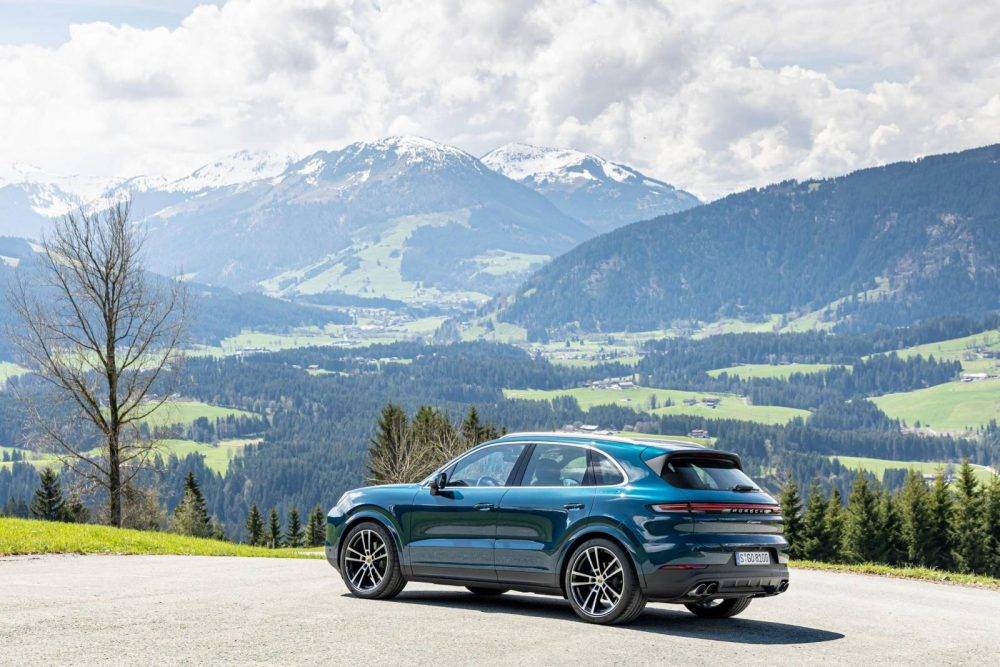
The exterior changes seem subtle until the pre-facelift version is parked side by side with this one. It’s one of those “I know something is different but I can’t quite put my finger on it” moments.
Let us help. For a start, Porsche has reworked the face. It’s repositioned the headlights to be higher and slightly fuller, while the bonnet seems to slope downwards, giving you the illusion of a lower nose, reminiscent of the lower-slung vehicles in the marque’s range.
The bumper incorporates a few more horizontal decorative pieces, into which Porsche has worked the DRL LED lights.
The doors have been reworked for a cleaner look that accentuates the front and rear wings.
At the rear, close inspection will reveal a cleaner look too, minimalist in its panel design, and augmented by new 3D light clusters and P-O-R-S-C-H-E lettering, which is no longer backed by glassware.
You’ll also notice that the number plate position is much lower, making for a larger and cleaner tailgate.
The redesign feels subtle, yes, but it comprises a long list of minor adjustments and changes that ultimately lend the Cayenne an uncluttered and well-proportioned look, finished by a selection of up to 30 alloy wheel options ranging between 20 inch and 22 inch.
Porsche has called in the services of the bi-turbo V8 once again, with enough work done to reduce emissions sufficiently for the Cayenne S to coexist with the other models.
The 349kW V8 is paired to Porsche’s 8-speed Tiptronic box with all-wheel drive and variable torque distribution between the front and rear axles.
Power aside, it’s this powertrain’s elements working in unison that makes the Cayenne S feel so good to drive. Even in the pouring rain, the chassis and grip levels offered through the Porsche Traction Management control system make for a confident and brisk drive.
The way it rotates through steering inputs is every bit the sporty SUV we’ve come to expect.
Part of this balance of dynamics and comfort has been enhanced in the new Cayenne via a reworked suspension setup, now featuring two valves on each damper.
The extra valve gives further adaptability to the rebound and compression stages, effectively making the Cayenne better at putting “comfort” and “sporty” in the same sentence.
This two-valve tech is standard on all Cayennes, whether fitted with air or steel-spring suspension. The tech is part of the PASM (Porsche Active Suspension Management) system, which is standard across the range for the first time. In practice, it makes the Cayenne all the more flexible in its use and driving experience.
We got the opportunity to swop the V8 for the base Cayenne, powered by a turbocharged V6 mated to a Tiptronic 8-speed. It’s immediately apparent that, at 89kW shy of the “S”, the Cayenne turns in with a noticeable agility and lightness. It’s every bit the performer in walking the line of on-road comfort and sporty dynamics.
Ditto on the chassis changes mentioned above. The V6 commands even more attention as it feels just as surefooted and exciting, albeit with a different exhaust note and, if you’re counting, slower acceleration times and top end.
It’s the pick of the range as far as the models we have driven are concerned and will turn in just over 10 litres/100 km on the efficiency scale.
As for safety, a big talking point is a new level of tech on the Porsche HD Matrix LED headlights, which are a R55?000 option, and come with a multitude of adaptations.
All-new interior concept
The cabin is the showstopper. The previous architecture and operating concept are gone, replaced by a layout that shares much of its design with the electric Taycan. The concept centres around the driver, presenting features and functions in the most efficient and flexible way.
Porsche products are synonymous with personalisation, which extends to how the driver enjoys the layout of the graphics and functions of the various displays.
The overall master material design is the use of black-panel surfaces that run across the whole dashboard.
It creates a harmonious home for display surfaces, from the driver’s floating console display to the two infotainment displays that sit centrally and in front of the passenger.
A 10.9-inch display allows passengers to access most functions without distracting the driver. Part of this update is incorporating video-streaming applications in order for passengers to enjoy entertainment while the driver focuses on driving.
Not a bad compromise, really — the Cayenne certainly is entertaining for the person at the wheel.
The passenger display is covered by a special film that masks the view from the driver’s side, much like phone privacy screen protectors.
The other key interior point is the driver’s instrument cluster, a free-standing, bezel-free, curved display.
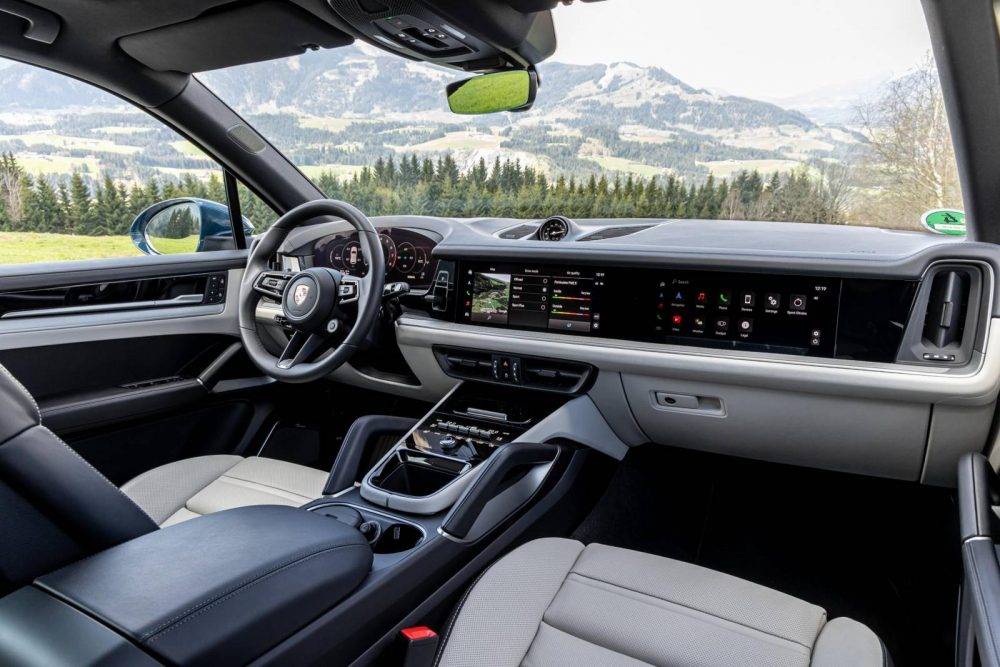
It integrates all driving displays within a new, customisable presentation that works in conjunction with a head-up display, also customisable, with six changeable information interfaces.
Traditional Porsche displays, such as large central rev counters, remain but there are also several options and menus for all the driver’s functions. The glaring omission here is that Porsche has altered the start/stop switch from the old “key” type to a start-stop button. Purists might weep. Also, the gear selector has been moved to the side of the wheel.
Despite its SUV nature and real-world use for family mobility, the Cayenne’s interior has been designed to ensure the sportscar feel is preserved and accentuated.
The new design architecture leaves room for signature Cayenne details, such as the dual handles flanking the centre console.
The console itself, now devoid of the gear selector, feels higher than before, giving the illusion of sitting lower in the cabin, a key trait of any sports car. The steering wheel, too, has been lifted from the Porsche 911 with its drive mode selector.
What Porsche has achieved with this new architecture is future-proofed this generation of Cayenne for the electric versions. It’s done it in a way that stays true to Porsche’s DNA, for the most part, but also in a way that isn’t as jarring as some of its German competitors.
Where there are multiple screens, there can be an uncomfortable sense of too much colour and too many clashing graphics.
On the tech front, Porsche has added something we’ve been wondering about for a while — a wireless charging tray for your smartphone with a cooling function.
The Cayenne has always been a very competent and compelling car. With this comprehensive update, one could argue it’s an unbeatable package. It’s subtle in styling yet offers more to the driver and passenger experience than ever before.
While we got behind the wheel of the Cayenne and Cayenne S in Austria, the local range includes these plus the E-Hybrid that couples the V6 to a 130kW electric motor. Porsche claims 85km of electric-only driving from the plug-in hybrid.
As you read this, the new Cayenne will already be at your nearest Porsche Centre.
Submit and get free exposure here: Showcase Your Business | Advertise Your Special Offers.