Nigeria reach Afcon final after shootout victory over South Africa:

Substitute Kelechi Iheanacho scored to give Nigeria a 4-2 penalty shootout victory over South Africa on Wednesday after an Africa Cup of Nations semi-final thriller in Bouake.
The match finished 1-1 after extra time and the three-time champions will face hosts Ivory Coast or the Democratic Republic of Congo, who meet later, in the final on Sunday.
Both regular-time goals also came from penalties with captain William Troost-Ekong scoring after 67 minutes for Nigeria and Teboho Mokoena equalised from a 90th-minute spot-kick.
The Mokoena equaliser came after Nigeria thought they had scored a second goal through a tap-in from star forward Victor Osimhen.
But play was called back to the other end of the field after VAR alerted the Egyptian referee that South African Percy Tau had been fouled in the area, and the match official concurred.
Khuliso Mudau had a chance to win the South Africa in added time at the end of regular time, but blazed over after goalkeeper Stanley Nwabali parried a Mokoena free kick.
South Africa finished with 10 men when Grant Kekana was sent off on 115 minutes for a last-defender foul.
Nigeria entered the match with a perfect record against South Africa in the premier African football competition having won three previous meetings.
The Super Eagles beat Bafana Bafana (The Boys) 2-0 in a 2000 semi-final in Nigeria, 4-0 in a group match four years later in Tunisia and 2-1 in a 2019 quarter-final in Egypt.
Nigeria coach Jose Peseiro made one change to the team that beat Angola 1-0, bringing in Bright Osayi-Samuel for left-back Zaidu Sanusi, who did not train on the eve of the match.
Star Napoli forward Osimhen started for the three-time champions after recovering from an abdominal discomfort that delayed his arrival in Bouake from Abidjan.
Osimhen scare
Some Nigerians in the stadium demonstrated their support for Osimhen by wearing replicas of the protective facial mask he still dons three years after suffering an eye socket injury.
Belgium-born South Africa coach Hugo Broos also made one change after victory on penalties over Cape Verde with central defender Siyanda Xulu recalled and Thapelo Morena dropping to the bench.
South Africa had an equal number of shots at goal, but more on target, greater possession, and forced more corners in a tense, lively opening half.
Barely a minute after the kick-off, reigning African Player of the Year Osimhen knelt clutching his abdomen, but he continued after treatment and worked tirelessly.
When pre-match favourites Nigeria were awarded a free-kick, Semi Ajayi headed tamely at goalkeeper Ronwen Williams, who saved four shootout penalties against Cape Verde.
Percy Tau had a couple of half-chances for South Africa, but a weak shot and later a heavy first touch let him down before a 32,000 crowd.
Nigeria goalkeeper Stanley Nwabali, who plays for South African top-flight club Chippa United, produced a good one-hand parry to foil Evidence Makgopa as half-time approached.
With the Super Eagles in the ascendancy, the deadlock ended midway through the second half when Mothobi Mvala fouled Osimhen and Troost-Ekong converted the penalty.
Makgopa fired narrowly wide with 15 minutes remaining as South Africa chased an equaliser in the central Ivorian city.
Then came the disallowed Osimhen goal, the Mokoena equaliser, the Mudau miss and 30 minutes of end-to-end extra time action, including a red card for Kekana, before the shootout.
© Agence France-Presse
A call to action through economic modelling:

Poverty is not an inevitable fate. It is a choice — and a very expensive choice — that, unfortunately, the more privileged often make on behalf of the less fortunate.
Globally almost a billion people live in extreme poverty, according to the World Bank — 18.2 million are South Africans living on less than $ 2 or R38 a day.
These headline numbers, read insightfully, are a window into a complex multidimensional challenge.
Poverty is created by the deprivation of resources, it is perpetuated by systems. In a situation of poverty, people lack access to education, basic services, healthcare, opportunities, assets and jobs. Poverty is amplified by political instability and corruption; income, social and economic inequality, and mobility limitations.
Cyclical un- and under-employment combined with low or inadequate wages complicates a poor person’s ability to change their situation. Mixed with other external factors, such as natural disasters, climate change and environmental degradation, poverty becomes an inescapable legacy for generations with no end in sight.
In a world where economic disparities persist and social injustices continue to thrive, it is imperative to recognise that there are pathways out of poverty; and there are tools we can use to illuminate those paths. One such tool is economic modelling.
Economic modelling, when built to reflect the inner workings of actual, not idealised economies, allows useful foresight into what the likely impact and outcomes of specific policy choices will be.
Yet, the effectiveness of such tools demands that they be in the capable hands of leaders committed to using them to address poverty. Wielded wisely, economic modelling can help reshape the future.
We have seen it do so throughout the developing world and in countries where it is a standard means of testing ideas prior to implementation. We have seen it used through monitoring and evaluation, to ensure that the policies have the desired impact for maximum effectiveness.
In South Africa, economic modelling supported, for example, powerful foresight thinking when used as part of the Indlulamithi Scenarios 2030.
Still, the power of economic modelling has not been harnessed to its full potential here, nor applied to the extent needed throughout government. Surprisingly, economic modelling has been limited to one South African department — and mainly geared to free market economics. Fixing this creates a clear pathway out of poverty for those 18 million people and generations to come.
A policy compass
Through economic modelling, we hold in our hands the power to plan our way out of poverty. Economic modelling is more than just a set of complex equations and statistical analyses. It is a visionary compass that empowers policymakers to design and simulate the impact of various scenarios, foresee potential outcomes and navigate the totality of economic and social policy as a means towards shared prosperity with evidence-based knowledge at hand.
In the midst of multiple crises and unprecedented shocks, economic models that reflect a country’s reality — and then support strategic decision making — can guide us towards a more equitable and sustainable future.
Such power was demonstrated in the ADRS study, Covid-19 and South Africa’s Future Economic Outlook, that examined the likely developmental impact of Covid-19 and presented recovery policy pathways.
But to unleash the potential of economic modelling, we must first recognise the urgency of the situation. A recent study that used an economic model of South Africa to analyse the effect of a basic income grant (BIG) is an urgent case in point.
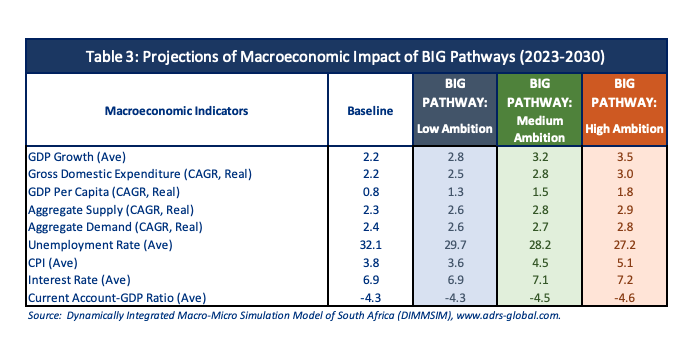
The report, Macroeconomic and Developmental Impacts of Selected Basic Income Grant Pathways for South Africa, highlights the transformative effect of a BIG for South Africa.
The study, which models three basic income scenarios, shows there is no trade-off between a BIG and economic growth and fiscal sustainability. Instead, a basic income grant produces win-win outcomes, significantly reducing poverty and inequality while fostering positive macroeconomic outcomes.
The model vividly illustrates that a BIG decision could disrupt the cycle of poverty and pave the way for inclusive prosperity.
Using the compass that is economic modelling, the study shows that we are not powerless in the face of poverty; rather, we have the ability to shape our destiny, and even with low ambition, GDP can grow between 2.8% and 3.5% when we support the most vulnerable.
Minding the skills gap
Understanding the intricacies of economic modelling requires more than just recognising its potential. It demands acquiring the skills necessary to interpret and implement these models effectively across the public and private sector.
Skilled application of economic models will change South Africa’s future pathway and can ensure a swing toward shared growth for all.
To tackle poverty and drive shared prosperity, we propose five essential steps:
- Invest in skills development: Governments and businesses must prioritise investing in the skills development of their economists, researchers, and leaders. Equip them with the expertise needed to navigate the complexities of economic modelling and make informed decisions that drive positive change.
- Executive training and re-skilling: Recognise the need for executive training and re-skilling programmes within government institutions. These programmes should focus on enhancing the understanding of complex poverty dynamics and the multifaceted factors associated with it.
- Leverage economic modelling for strategic planning: Encourage the integration of economic modelling into strategic planning processes. By incorporating data-driven insights, policymakers can design targeted interventions that address the root causes of poverty and promote sustainable development.
- Promote interdisciplinary collaboration: Foster collaboration between economists, social scientists, and policymakers. Break down silos to use comprehensive models that consider the interconnected nature of economic, social, and environmental factors influencing poverty.
- Advocate for inclusive policies: Advocate for policies that prioritise inclusivity and equitable distribution of resources. Economic modelling can highlight the potential impact of such policies, guiding decision-makers towards choices that uplift the most vulnerable in society.
The call to action is clear: poverty doesn’t need to be the future.
It is time for businesses and governments to embrace economic modelling as a powerful tool for change and use it.
By investing in these skills, promoting collaboration, and making informed evidence-based policy decisions, we can collectively steer our societies towards a future where prosperity is not a privilege but a shared reality.
In South Africa, the tools exist. Readily available training also now exists. It is imperative that we use them, and irresponsible if we do not. The choice is ours.
Cynthia Alvillar is the chief executive of the Economic Modelling Academy and Dr Asghar Adelzadeh is the EMA director of academics at the Gordon Institute of Business Science.
Corruption is not an excuse to abandon South Africa:

“A country never dies. People get sick and die, a country might get sick for a while but lives on forever.” — These are the astute words of my grandfather, Morris Lubner.
Such words should ring true for all South Africans as we prepare to witness the 2024 State of the Nation Address (Sona) which takes place in arguably the most contentious election year in South Africa to date.
While many of us may feel tempted to lean into apathy and despair, believing that the imminent collapse of the country cannot be thwarted, this is a dangerous attitude to adopt, and it is incredibly disheartening that some business leaders are doing just that.
Despite worrying calls for private entities to stop working with the government, ostensibly to curb corruption, civil society says that when it comes to rebuilding trust between the government and the private sector, “you can count us in”.
Although corruption and mismanagement have underpinned much of the country’s major system failures that have hampered development, industry leaders cannot adopt a divisive and pessimistic attitude when credible solutions point toward a spirit of collaboration in all spheres of society.
Government leadership has admitted to failures in delivering services to its people and appears to be taking steps to allow the private sector to help rebuild the economy and the broken systems that hamper service delivery in this disintegrating country.
Recent engagements between government entities and corporate SA are encouraging and suggest that a transformative process is underway that will see the government entrusting the private sector with a larger role to play in improving service delivery to the poor and uplifting communities in the process.
The continued downward spiral being experienced by key state-owned entities which have not embraced privatisation is a testament to this. It is encouraging to realise that certain public office bearers are starting to engage with the private sector and are more robust in looking for solutions that include offering the use of state entities to private entities in finding more effective and sustainable solutions.
Those who publicly suggest that private entities working with the government are propping up corruption are making ill-informed and dangerous statements that only seek to further widen the chasm of distrust between public and private organisations.
While it is no secret that crime and corruption are massive problems in the country, instead of driving more investors away, let’s be part of the solution.
I applaud the contributions of Discovery Limited CEO, Adrian Gore, Sibanye Gold CEO, Niel Froneman and Business Leadership SA (BLSA) CEO Busisiwe Mavuso, and many others to this national conversation. These captains of industry have all been engaged in discussion with the government on how private entities can work with state-owned entities (SOE’s) to optimise their ability to deliver on the services they are mandated to provide.
Active citizenship, not sitting and waiting for the country to collapse, is the only credible moral high ground we can stand on. Those who live luxuriously need to be more sensitive to the massive disparity in wealth and play their role in ensuring the skills are taught and the opportunities are created for the poor to build lives where water and food are not everyday crises.
However, I strongly condemn those who have used state capture, bribery and narcissistic self-interest to steal from the nation and its citizens. Devoted leaders and office-bearers who are willing to serve their country must prevail, a feat that cannot be achieved overnight.
I challenge those in positions of power to lead by example and bring to task those who steal resources and time from our country and its people. I have encountered a great deal of honourable leaders in the government sector, these are the ones who should be empowered to spread a culture of ethical leadership.
Civil society is a major piece of the puzzle
Government needs the non-profit industrial complex, to fill the service delivery gaps that its historically Marxist, centralised-control model has only managed to widen. As the government engages the private sector over the use of state-owned entities and resources to help the government to fulfil its mandate, civil society is a crucial element being left out of the conversation.
The current trajectory towards more public-private partnerships is a positive step in tackling the lack of accountability in government while making sure that state resources and private funds are used sustainably for the benefit of society, not just those in the private and public sector who benefit from corruption and inequality.
I urge that civil society and non-profit organisations must be part of these discussions. As soon as the government includes civil society in these engagements their planning will be far more holistically informed and pragmatic. For example, Kusile power station is being converted for renewable energy rather than coal fire and hundreds of workers who are trained to work on coal fire plants will require training and orientation.
Undertakings of that nature are not just about a transfer of skills but are also about instilling values and soft skills that create more harmonious, productive organisations. I cannot emphasise enough the importance of developing soft skills in conjunction with hard skills to enable holistic development.
There is so much expertise, knowledge and power in the thousands of community-based organisations across the country, the opportunity should not be lost to include the community-based organisations that have deep insights into what will be required to create a generation of empowered, capable young people in an economy of equal opportunity.
As much as it is a national issue involving major institutions and billions of misspent funds, SA’s lack of service delivery is a grassroots issue that requires deep-level introspection and solutions that come from within the communities needing to be served.
As we consider the state of our beloved country, let us not dwell on what divides and hinders us, but on the opportunities. We must rebuild a nation together.
Marc Lubner is chairperson & CEO at Afrika Tikkun Group.
Submit and get free exposure here: Showcase Your Business | Advertise Your Special Offers.