NWU vice-chancellor, Prof Bismark Tyobeka, pleads for aligned academic hospital in North West:
Prof Bismark Tyobeka, principal and vice-chancellor of the North-West University (NWU), has lauded Health Minister Aaron Motsoaledi’s announcement that plans are in place to add to the country’s 10 academic hospitals.
Minister Motsoaledi made this announcement during his budget vote presentation to the National Council of Provinces on Tuesday. There are currently no academic hospitals in the North West, Mpumalanga or the Northern Cape, although proposed projects in these regions are in the preliminary stages of development.
The NWU is in the advanced stages of constructing the NWU Desmond Tutu School of Medicine, and Prof Tyobeka says aligning this project with the proposed academic hospital in the North West would greatly benefit the citizens of the province.
The first intake of NWU Desmond Tutu School of Medicine students is scheduled for 2028.
“South Africa faces many healthcare challenges, and it is heartening to see that the public healthcare system, on which almost 90% of South Africans rely, is a high government priority. But more than a priority, healthcare is a promise to our citizens that we must keep. Therefore, I am elated by the minister’s pronouncement regarding plans in the pipeline to establish additional academic hospitals, one of which is earmarked for the North West province,” said Prof Tyobeka.
“This development strongly supports our NWU Desmond Tutu School of Medicine, which is presently under construction. While not wishing to pre-empt any formal decisions, we are hopeful that government will strategically locate this hospital in Mahikeng or within the Ngaka Modiri Molema District, in close proximity to our NWU Mahikeng Campus. Such a move would significantly enhance the university’s capacity to broaden the footprint of our NWU Desmond Tutu School of Medicine beyond the Kenneth Kaunda and JB Marks Districts, thereby improving equitable access to high-calibre healthcare professionals and clinical expertise across the province.”
The integration of the NWU Desmond Tutu School of Medicine with a future academic hospital in the North West holds immense promise not only for advancing medical education, but also for transforming healthcare access and outcomes in the province.
The first time I listened to Lavida Loca, I couldn’t help but groove to it. Sarkodie’s voice glides over M.O.G Beatz’s production with signature slickness, while Ghanaian rapper Lasmid’s hook worms its way into your brain with the kind of catchy ease only a summer anthem can manage. It’s effortless and infectious, the kind of track you want to blast with the car windows down, soaking up every moment.
Turns out, that’s exactly what Sarkodie did.
“I was in Washington, DC, during my last US tour, driving my sports car with the top down, just blazing the music,” he tells me during a video call from his home in Ghana. “It felt right. Like you’re outside having fun.”
The record had been sitting on ice for a while, waiting for the perfect moment. “I trust my instincts. I’m always right when I feel like I have to do something. And this just felt like the time.”
He was right. With tens of millions of streams, more than 80 awards and a career that’s seen him collaborate with everyone from T-Pain and Kranium to Idris Elba and Oxlade, Sarkodie remains one of Africa’s most decorated and respected rap icons. He’s sold out venues around the world, including London’s O2 Kentish Town Forum. His creative reach now stretches beyond music, with roles like a one-time stint as creative director for Ghana Party in the Park in London — a festival spotlighting Ghanaian talent in the diaspora.
So when he drops a track like Lavida Loca, the world listens.
Naturally, I had to wish him a happy belated birthday. I had read he’d turned 40 on 10 July.
He laughs. “Yeah, that’s the information out there. I’ve been lying so much that I lost count of my own age. But I’m definitely not 40 yet. I’m getting very close though.”
He spent the day quietly, just the way he likes it. “It was intimate. Just myself, my wife and my kids. We had breakfast together. That’s the kind of celebration I love.”
It’s clear that beyond the accolades and the acclaim, Sarkodie is at his happiest at home where he can be grounded, private and present.
When the conversation turns to music, he lights up. Sarkodie’s process is more instinct than strategy. He doesn’t hunt for songs; he catches vibes. “I record a lot. When I’m in the zone, I can do 30 to 40 songs in two weeks. Then I keep them. No pressure, no rush. Music needs freedom.”
That spirit of spontaneity explains why Lavida Loca, recorded in a hotel room during a US tour three years ago, still feels so fresh. The track came with Lasmid’s hook already in place. “It was just very simple and catchy. You feel something when you hear it. I don’t like music that’s too complicated.”
As for collaborations, he doesn’t throw verses around lightly.
“Everything is intentional,” he says. “I only link up with people who suit the song. There’s a saying in Ghana that Sarkodie knows how to pick collaborators because we barely miss.”
Still, there are artists he returns to again and again: Efya, Mugeez and Obrafour.
“We make some good music,” he says.
And although he’s proud of the Ghanaian sound, he’s just as invested in its place in the broader African movement. “I would say proudly that Ghana is the soul of what we now call Afrobeats.”
He traces the lineage from highlife — Ghana’s indigenous genre, steeped in palm wine guitar and melodic groove — through its modern evolution. “When you trace it back, it leads to Ghana. Highlife is Ghana. Even now, when you listen to artists like Wizkid and Davido, you can hear it.”
He’s quick to give credit to Nigeria for its role in taking the sound international but insists on setting the record straight. “Afrobeats is Highlife in a modern form. And Ghanaians played a huge part in shaping it.”
Sarkodie is also passionate about using music as a tool for unity, education and self-determination. He’s witnessed firsthand the power African artists have to inspire across borders, and he wants more of that.
“We’ve been sold stories about ourselves from outside,” he says. “Everyone wants to be on the Grammys or BET, and that’s fine. But that shouldn’t define our greatness. We go through so much on this continent. But our music lets us dance away the sorrow. It brings us together.”
Still, he believes artists can do more. “We need to speak on our realities. Music shapes minds. If we don’t speak, who will? I’ve always wanted to take our power back. We need to stop letting people come and take advantage of us.”
It’s that same mindset that led him to creative direct Ghana Party in the Park.
“I love behind-the-scenes work. I’ve always been that guy who reads the contracts before the lawyers,” he says of the one edition of the long-running UK festival, when he took the reins.
“Sometimes it’s not even about money. It’s about how you treat the artist, the vibe you create. I wanted to give these young artists a great experience; from the pickup, to the hotel, to the show, to studio time after. It was beautiful.”
He’s especially invested in emerging talent. “The future is the best era,” he says. “They’re going to shape what we’ve built. I like being involved with that.”
Even more impressive is Sarkodie’s achieved all of this success independently; he has never been signed to a major record label.
“I’m signed to myself,” he says with a quiet certainty. “I’ve never been under a label before. It’s crazy.”
It’s not a boast, just a fact, delivered with the same humility that runs through his career. But the road here hasn’t been smooth.
“It’s hard. Very, very tough,” he admits. “But I started enjoying independence earlier. Of course I wanted the deals, that’s what every artist wants, but I think maybe God had a different purpose for me.”
There were moments when the ink was nearly dry, when signing on the dotted line felt inevitable. And then something would shift. “I’d feel like I don’t have to. And I’d move past it. Then I’d figure out how to go through the obstacles. And realise: okay, it’s hard, but you can actually do it.”
That resilience is tied, in part, to a deeply rooted desire for ownership; not just of his music, but of his mistakes too. “I’m someone who works based on how I’m feeling. I can be productive when I’m responsible for my downfall. But things break me when I feel like I couldn’t do this because of someone else.”
That kind of self-awareness has shaped every business decision he’s made. He’s never had a private investor. Every tour, album and promo run is paid for out of his pocket. “It pays off with time. But it’s very hard.”
He doesn’t judge artists who choose a different route. In fact, he’s quick to defend them. “Some artists are true geniuses. They don’t want to read contracts. And people think it’s bad, but it’s not. Some artists create well when they don’t have chaos in their mind.”
For Sarkodie, though, the chaos is part of the equation, part of what makes him thrive.
“I know I’ll panic if I’m doing a promo run and I don’t know how much was paid for it,” he says with a laugh. “I’ll start checking the bank account.”
That mix of artist and entrepreneur, of rapper and chief executive, has become central to his identity. It’s why he founded his own label, sarkCess Music. And it’s why, even with all the obstacles, he wouldn’t have it any other way.
When I ask if there’s anyone he still dreams of working with, he pauses. “Not really,” he says. “These days, I hear a song and I know exactly who needs to be on it. Sometimes, if I don’t get that person, the song just doesn’t come out. That’s how particular I am.”
So what’s next?
Sarkodie has two more singles lined up for release, but his focus this year is on concerts. His flagship show, Rapperholic, a staple of Ghana’s music calendar every December, is expanding. “This year we’re taking it to Kumasi, my hometown. It’s called The Homecoming, happening on 27 September. Then we’re back in Accra on 25 December.”
And after that? “I’ll keep making great music and sharing it with the fans.”
Nomisupasta and Rapsody: The collab that took 13 years:
Nomsa Mazwai first came into contact with Rapsody when the producer 9th Wonder sampled Mazwai’s music for three songs on the North Carolina, US rapper’s 2012 debut album The Idea of Beautiful. The songs sampled music from Mazwai’s own debut album, the self-titled Nomisupasta, released in 2010.
On the song Kind of Love, Mazwai sings, “What kind of love is your love that you only feel when you happen to be with me?” as Rapsody opens her first verse on the track with the line, “Soweto, we feeling the love y’all.” Poignantly, Rapsody even travelled to South Africa and shot the video in Soweto, walking through the streets, hand-in-hand with groups of children, delivering her bars in front of spaza shops and in passages.
Mazwai is credited as a featured artist on this song as well as In This Town and When I Have You, but 13 years later she has not received a cent in royalties from any of the three songs. The systems meant to ensure that she collected money off the use of her intellectual property failed her.
“It’s not 9th Wonder or Rapsody’s fault,” Mazwai explains. “It’s our government. I can’t sit here and blame people for not forcing my government to do what they’re supposed to do. But, you know, I prayed about it and, luckily for me, I did not take my frustrations out on the wrong people.
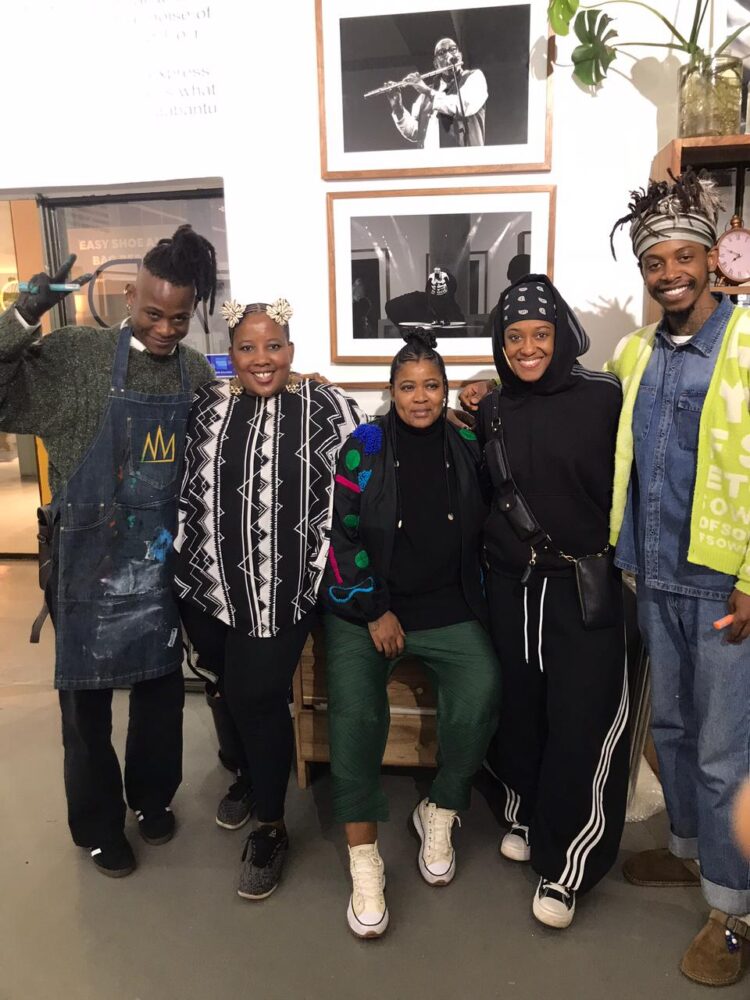
And Rapsody and I maintained a really wonderful relationship over the years. We performed together at Zone Six, but we never really spent time together and we were just in touch on social media. And so this time when she came, she came with the intention to record with me and have me on her next album.”
The friendship Mazwai and Rapsody developed over the years recently led to the two of them collaborating properly for the first time, over a decade after the release of The Idea of Beautiful. Rapsody visited South Africa for a week, accompanied by a crew of collaborators to make music for her next album.
The rapper has grown to become a celebrated musician, releasing several critically acclaimed albums, and working with artists like Kendrick Lamar, J Cole and Stevie Wonder. She was named Lyricist of the Year at the 2020 BET Hip Hop Awards and earlier this year she won her first Grammy Award for the song 3:AM featuring Erykah Badu, taking home the trophy for Best?Melodic Rap Performance.
Mazwai already had a lot of songs she had composed with just vocals and piano but hadn’t started the process of producing and recording any of the music. Through Rapsody’s visit she took the opportunity to work with some renowned producers and record the music for her sophomore album, which is now scheduled for release in October and is titled Surrender.
One of these producers is Mr Porter, most famous for having been a member of the Detroit rap group D12 and having produced music for fellow group member and legendary rapper Eminem as well as many others including 50 Cent, Royce da 5’9”, The Game, Method Man, Snoop Dogg and Jadakiss.
She also got to work with Madlib, most well-known for being a frequent collaborator of the late greats MF DOOM and J Dilla as well as Freddie Gibbs and Talib Kweli. Earlier this year, Madlib and Rapsody teamed up to release the EP MadRaps which is only available on vinyl and cassette tape. This week Mazwai started teasing the Mr Porter-produced single Next Week Tuesday with a 20-second snippet on her social media accounts.
This will be the first single off her album and she plans to drop it on National Women’s Day – 9 August. On Instagram she’s credited big sister Thandiswa as creative director for the visuals but plays coy when I ask if we’ll hear the sisters collaborating on Surrender: “You will see in the album.” She does tell me that the song she recorded with Madlib will be the second single and hints that these aren’t the only well-known producers she had the opportunity to work with. And of course Mazwai and Rapsody also recorded music together for both their albums.
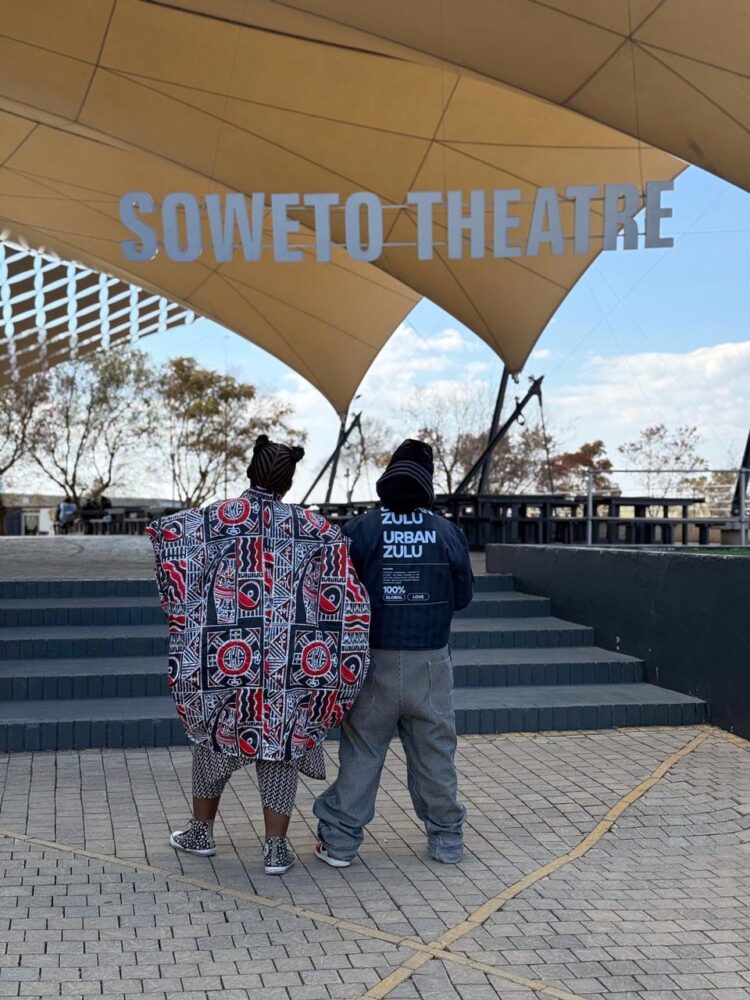
“God brought Rapsody into my life at the perfect time. We spent the whole week together and it really felt like it was God’s special art project for 10 days. It was this incredible moment of two creatives from two parts of the world coming together. And it was just amazing for us to connect and to meet and to really get to know each other. So while we’ve known each other for years, I would say we got to really know each other over the last 10 days. It was such a pleasure working with her.”
Mazwai even brought in the Karabo Ya Morena youth choir into the recording process and says that the Soweto teens are going to be featured on a song Rapsody’s doing with another famous rapper. She resists my attempts to pry some more info about who this prominent artist could be: “I don’t want to give all the gems away, but I can tell you that they’re featured on a banger alongside someone I would say is one of the forefathers of hip-hop.”
I’m dying to hear what Rapsody and Nomisupasta have created, though I know all good things require time and patience. Or as Rapsody raps on When I Have You: “Fake ones I had in my life can’t find ’em / They say God got a silly way with timing.”
Submit and get free exposure here: Showcase Your Business | Advertise Your Special Offers.