
Online shopping is booming in South Africa:
South Africa’s online retail sector surged 29% to R71 billion last year, and is swiftly on its way to making up a significant portion of the country’s overall retail sales.
A new study conducted by World Wide Worx in partnership with Mastercard, Peach Payment and Ask Afrika, which was released this week, forecasts that the online retail sector will break the R100 billion mark and reach 10% of overall national retail sales by 2026.
Retailers’ strategic shift towards competitive e-commerce and enhanced customer service, including the use of sophisticated AI-driven tools, has “fundamentally transformed” the local retail landscape, World Wide Worx chief executive Arthur Goldstuck said.
According to the study, Shoprite Checkers’ Sixty60 service experienced a 63.1% increase in sales in the latter half of 2023, while Pick n Pay grew its online sales by 76% and Woolworths reported a 47% online sales rise. The country’s largest online retailer, Takealot, grew sales by 6%.
Clothing (30%) and groceries (22.3%), footwear (12.6%), electronic goods (12.5%), children’s toys and games (11.7%) and medicines (11.7%) are the most purchased items online, with increased diversity in shopping choices reflecting growing consumer trust in online platforms.
Mobile phone use for online shopping passed the halfway mark (50.4%), indicating a growing preference over desktops and laptops.
Consumers aged 25 to 34 consistently led in online shopping activity (46.3%), with notable growth among people aged 65 and over from 16.4% to 24.9%. Higher socio-economic levels and living standards correlate strongly with higher online shopping activity as well as higher income and education levels, underscoring the digital divide, the study found.
This latest growth in online retail sales comes after a 35% increase to R55 billion in 2022 and growth of 39% in 2021.
The study noted that the boom in sales over the past few years could be attributable to the “pandemic dividend” because it was sparked by a huge demand for home deliveries that started in 2020 — when Covid-19 hit South Africa and the rest of the world — which saw 66% growth.
The growth was later driven by competitive e-commerce strategies implemented by major bricks and mortar retailers, with existing e-shoppers moving more of their traditional shopping to the online space, and credit card payment processing becoming more streamlined.
Goldstuck said Statistics South Africa data showed that South Africa’s retail sales were just over R1.1 trillion a year but growth had been stagnant for “many years”. But, he said, the study forecasts continued “robust growth” in the sector, partially driven by the arrival of Amazon in the local market.
“Over the past 20 years there has been a fairly stable level of growth in online retail. At the current rate online retail will reach 10% of total retail by the end of 2025 or at least 2026,” Goldstuck said.
“This is a truly significant number because when that level was reached in more mature markets like the United Kingdom and the United States, it caused tremendous excitement around online retail.
“At that level all companies realised online retail was now so critical to their strategies that it required companies to make even greater investments in some cases than traditional retail. It resulted in a massive boost in the online retail landscape which then fed further growth in the years that followed.”
Mastercard South Africa country manager Gabriel Swanepoel said the company had streamlined payment processes to make online shopping “easier and more secure”, which had increased consumer confidence and contributed to the growth.
Peach Payments chief executive Rahul Jain said a proliferation of new payment methods such as “buy now pay later” had met the evolving demands of consumers.
“In turn, this allows consumers to spend more online with greater confidence. Merchants are utilising our enterprise grade infrastructure to make their financial operations more efficient as they continue to capitalise on this growth,” Jain said.
An industry survey among retailers as part of the study showed customer service was paramount to online retail success, with 73.9% of respondents emphasising its importance.
Stock availability and having a wide range of quality products were also crucial, while competitive pricing and personalisation of offers were less important. But this is expected to change with the advent of artificial intelligence in personalising offers.
Retailers reported that the most significant operational challenges for the industry were payment failures (18.2%) and managing customer queries and complaints (16.8%).
The major issue for cart abandonment by consumers was reported to be declined credit cards (52.2%). Concerns about the security of credit card information and complicated checkout processes were also significant factors leading to abandoned carts.
Thabo Mbeki says KwaZulu-Natal will listen to ANC’s call and vote for it:
Former president Thabo Mbeki said the people of KwaZulu-Natal will listen to the ANC campaign and vote for the party.
He was speaking on Saturday at Heroes Acre in Pietermaritzburg, where he laid wreaths at the graves of struggle veterans Moses Mabhida and Johnny Makatini, as part of his campaigning ahead of the elections on 29 May.
In March, the former president confirmed that he would campaign for the ANC after months of speculation regarding his involvement. Mbeki said at the time that it was his “obligation” to make a contribution to the party.
On Saturday he said: “We came here and launched our manifesto [on 24 February 2024] at the Moses Mabhida Stadium. That launch was a commitment to the people and we must do what we can to implement it,” Mbeki said.
He continued: “My view is that the population of this province will listen to what we say and hopefully they will believe that we are not telling them inganekwane [fairy tales] and will believe us.”
Mbeki said that just as he is telling people to vote for the ANC, he equally is urging the party to respond to the needs of the people.
“We must make sure the movement that they [Mabhida and Makatini] led and sacrificed everything for lives up to the promises it makes to the people. It’s an obligation we owe to them,” Mbeki said.
KwaZulu-Natal is hotly contested by the ANC and Inkatha Freedom Party with the newly-formed uMkhonto weSizwe party at their heels.
Mbeki’s campaign coincided with the Democratic Alliance (DA’s) final rally, themed “Rescue KZN” as the party showed that it is not out of the race in the province.
“For the first time in 30 years, the ANC is going to lose its majority, both nationally and here in KZN. And they are not only going to lose — they are going to lose badly. The people of this province are not blind,” DA leader John Steenhuisen said.
This SUV is still in Ford territory:
The Territory is Ford’s most recent passenger vehicle entry into the South African market, having launched the Ford Puma earlier this year.
Where the Puma sought to take on the compact SUV segment, its price makes it a difficult proposition. The Ford Territory you see here, however, will certainly fare better when it comes to sales.
It still has its work cut out for it in the largest SUV segment there is, the burgeoning C-SUV landscape, which is responsible for about 13% of the market share.
Let’s get the fast facts out of the way. The Territory is now available at local dealers at a starting price of R590?000 for the base Ambiente 1.8-litre EcoBoost. The Trend and Titanium models come in at R646?600 and R721?000, respectively.
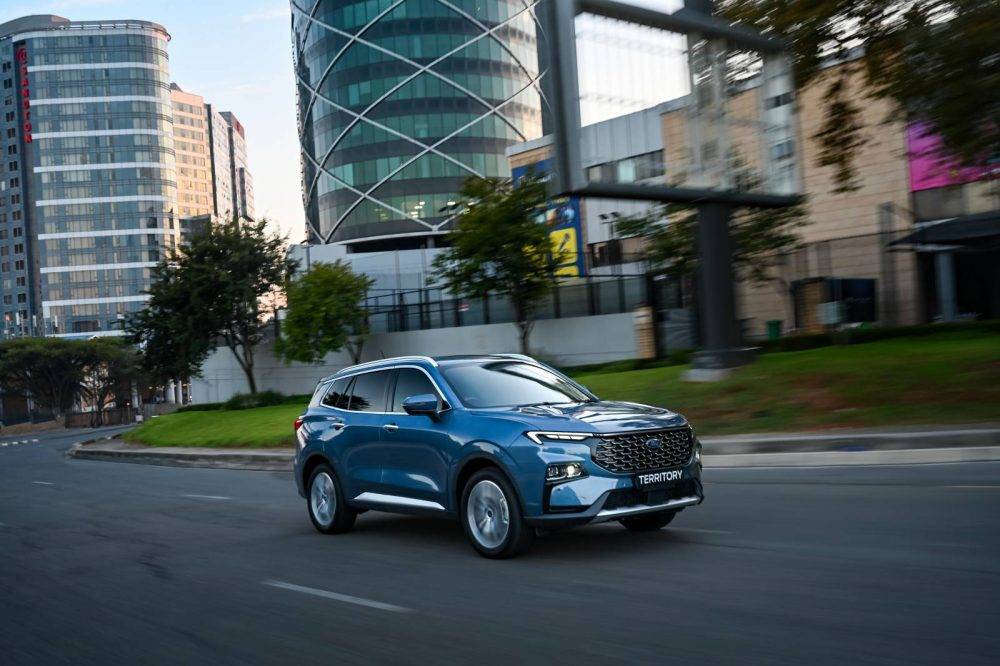
There is only one powertrain available across the range — a 1.8-litre turbo-petrol motor that develops 138kW and 318Nm. This is coupled to a seven-speed dual-clutch transmission (DCT).
With that done, let’s talk about the elephant in the room. The Territory is the only Ford SA vehicle sourced and built in China. It was essentially a business decision to partner with Chinese firm JMC to build the Territory on Ford’s behalf.
At base, the Territory begins life as a JMC-built SUV that Ford has then embellished and amplified to make the product feel like a Ford — and I’m happy to report that they’ve done a very good job.
If you were worried about the idea of the Territory being sourced and built in China in this way, don’t be. The Territory does feel like a Ford product and that’s not just in tactile and perceived in-car material, but also in the way it drives.
That 1.8-litre engine is sufficiently powerful and, coupled with the DCT, you won’t find the vehicle lacking in power, for the most part.
The ride is suitably supple for a family-oriented product, with commendable dynamic ability and not nearly as much body roll as you might expect. It does drive well.
As far as refinement levels are concerned, that too is worth commending, coupled with a well-packaged interior layout that sees excellent legroom and headroom for adult passengers.
Perhaps this has compromised luggage space, with Ford claiming a 448-litre boot that can stretch to 1?422-litres with the seats folded down. It certainly seems the boot can swallow more than that, but for now, we’ll take Ford’s word for it.
The Territory does come with a spare wheel but not a full-sized item.
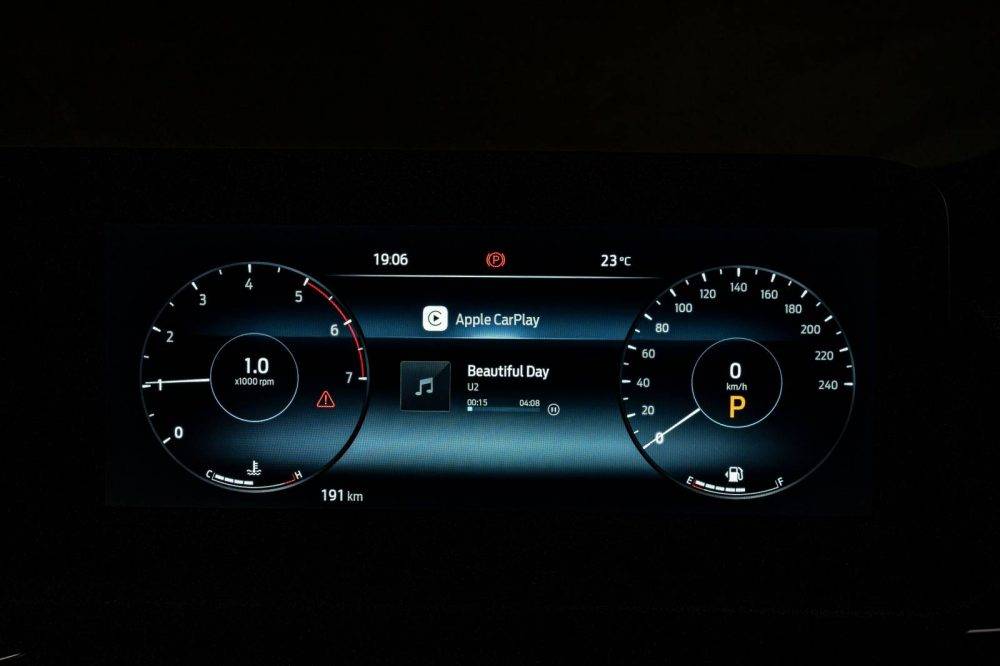
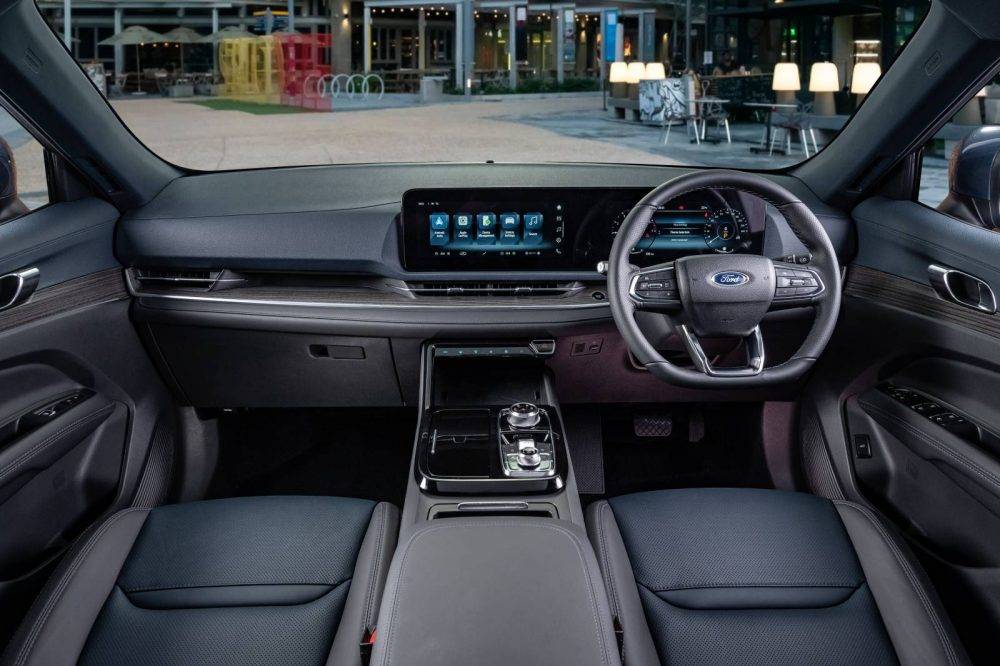
Features are aplenty across each derivative. The Ambiente boasts a strong list of standard features including Apple CarPlay and Android Auto connectivity in a 12.3-inch touchscreen infotainment system.
I’m not the biggest fan of housing almost all in-car functions on a touchscreen and it’s no different with the Territory.
Certain functions, such as climate control shortcuts, have been adopted across a panel under the screen itself, but you’re still likely to touch the screen to adjust the temperature. Putting this on the shortcut panel would make better sense.
Adding to the features are niceties such as tyre-pressure monitor, keyless access and cruise control.
The mid-spec Trend offers further convenience niceties, such as follow-me-home lights, which momentarily remain on after you have switched off the engine and locked the car; a reverse camera; auto headlamps and wipers; as well as wireless charging and a powered tailgate.
The range-topping Titanium adds smarter 19-inch wheels, electric driver’s seat adjustment, a panoramic roof and a whole list of safety features that come within the adaptive cruise control suite, such as lane-keeping assistance, blind-spot information system, emergency braking and a new alert feature that warns you of oncoming traffic before you open the door.
Family cars in South Africa are often subjected to towing some sort of trailer or caravan and the Territory is capable of doing that with a rating of 1?310kg.
When discussing the Territory’s driving dynamics and feel, Ford’s managing director, Neale Hill, was quick to point out the marque’s “trust markers” on any vehicle they import.
These are the absolutes, the things that they’re not willing to compromise on that make a Ford feel like a Ford. The Territory is proof so far that these have been adhered to.
Current Ford owners might notice an infotainment system, driver’s display or cabin layout is unfamiliar, but apart from this, the Territory doesn’t look, drive or feel unlike a Ford. And that’s about as good as Ford could have hoped for.
The SUV market remains as fierce as ever. Some competitors are cheaper, faster, more fuel-efficient or more spacious in some areas, but none trumps the Ford Territory on all fronts.
This car has a good balance of value and is priced on the lower-to-middle end of the pricing spectrum.
By all accounts, it seems as if the sales numbers will look a lot stronger with this one.
Submit and get free exposure here: Showcase Your Business | Advertise Your Special Offers.
