Organised crime strengthened by compromised police service, says crime intelligence head Khumalo:
Organised crime has evolved and has been strengthened by the infiltration and compromise of the South African Police Service (SAPS), crime intelligence head Dumisani Khumalo told the Madlanga commission on Monday.
He said in his view the attempt to disband a task team on political killings “was due to the influence of a particular organised crime cartel over the ministry of police, as well as the South African Police Service, who mistakenly thought the political killing task team was investigating the same cartel”.
“The intervention in the SAPS have never been so important nowadays because of the level of threats that are from within the department or the organisation itself,” said Khumalo, adding that he would discuss the level of internal threats with the commission further in camera for security reasons.
“My extensive experience within the crime intelligence division positions me to address the critical issues, more especially those that refer to the infiltration of both the divisions and the South African police, driven by these criminal cartels,” the intelligence boss added.
Khumalo echoed earlier testimony by KwaZulu-Natal police commissioner Nhlanhla Mkhwanazi, who said the now suspended police minister, Senzo Mchunu, disbanded the political killings task team as it was closing in on drug cartels in Gauteng.
National commissioner Fannie Masemola also testified that Mchunu’s decision to dissolve the unit was an “encroachment” on his duties and was motivated by efforts to shield criminal syndicates.
Masemola said suspects Katiso Molefe and Vusimuzi “Cat” Matlala — now facing murder charges — were arrested by the task team, and that seized phone records linked them directly to Mchunu and deputy national commissioner Shadrack Sibiya. Masemola said this showed the dissolution was intended to block further investigations into the syndicates.
President Cyril Ramaphosa established the commission chaired by retired judge Mbuyisele Madlanga after Mkhwanazi’s bombshell media briefing in July alleging 121 dockets were taken from the task team and sent to the police head office. Mchunu has denied the allegations and called them “wild”.
On Monday, Khumalo recalled that in 2011 when he was acting head counter and security intelligence within Crime Intelligence and during Mkhwanazi’s stint as acting national commissioner, there had been an attempt to halt corruption and misuse of resources after former crime intelligence boss Richard Mdluli’s slush fund scandal.
“Reform of crime intelligence did not happen because all the acting heads were removed — before attempts to reform the crime environment,” he said, adding that “everything was reversed within two months” of Mkhwanazi’s departure from acting role.
Mkhwanazi expressed similar sentiments to the Madlanga inquiry, saying crime intelligence had not been cleansed since 2011, with those implicated now occupying higher positions.
He said Mchunu disbanded the unit through a WhatsApp message, without getting a single briefing on its work, a decision he described as “irrational and irregular”. Masemola said the disbandment was disruptive and noted that 115 active cases were still before the courts.
On Monday Khumalo argued that crime intelligence remains the cornerstone of policing in South Africa, especially in the face of evolving organised crime.
“The interventions in the SAPS have never been more important than nowadays, from the levels of threats that are from within,” he said.
In June 2025 Khumalo was charged with corruption by the independent directorate against corruption for the “irregular appointment” of Dineo Makwele in a senior crime intelligence post. Mkhwanazi has testified before the commission that the charges were brought as part of a witch-hunt to halt investigations and protect cartels.
Khumalo on Monday said under his leadership, performance in the division had improved, particularly in combating organised crime and he had gained an understanding of “sophisticated methods used by organised crime to compromise” the police service.
“In the division, I introduced a management style that has since proven to be effective, resulting in enhanced stability, more especially in the management level and improved compliance with various policies and cessation of resources and crime intelligence abuse,” he said.
He added that in the past, investigations were not yielding results. To fix this, his division developed a “tried and tested” strategy in December 2018, moving from investigator-led to analysis-led investigations. The new approach, he explained, uses analysts alongside investigators and prosecutors, applying an organised crime model that has improved case outcomes.
Khumalo said crime intelligence was now at a “crucial time”, with both internal threats and external criminal networks undermining the SAPS.
Why Southern Africa’s ‘missing middle’ demands urgent action:
South Africa is a nation perpetually grappling with the shadows of its past. Despite decades of democratic rule, the economic ecosystem remains entrenched in patterns of inequality, a legacy of colonial and apartheid systems. Recent assertions by the department of employment and labour paint a grim picture — 62.1% of senior management jobs in the private sector are still occupied by white people.
This statistic is a symptom of a deeply saturated economy that continues to disadvantage historically oppressed people, cementing South Africa’s unenviable position as one of the most unequal societies in the Southern Africa Customs Union.
The concept of the “missing middle” is more than an economic anomaly, it is a sociological burden that stifles potential and perpetuates cycles of poverty. The World Bank’s 2022 Southern Africa Customs Union report highlights this, contending that inequality of opportunity accounts for almost half (47.7%) of the overall inequality in consumption per capita, with race contributing a significant 38.9% to this disparity.
This isn’t just about income gaps; it’s about systemic barriers that prevent a majority of the population from opportunities necessary for upward mobility and economic participation. The missing middle represents those individuals and small businesses that are too established for micro-financing but too small or risky for traditional commercial loans, creating a chasm in the financial landscape that impedes growth and innovation.
Moreover, education, enshrined as a constitutional right, paradoxically becomes a chasm rather than a bridge for many. While access to education is theoretically available, the quality and relevance of that education, coupled with a constrained labour market and soaring unemployment rates, create a vicious cycle. Differences in educational attainment account for a substantial portion of the inequality in outcomes, yet for those caught in the missing middle, individuals who struggle to afford tertiary education but do not qualify for financial aid, the promise of education remains largely unfulfilled.
Furthermore, the demographic, often comprising talented and ambitious young people, is left in economic limbo, unable to leverage their potential. The stringent financial criteria for tertiary education, often determined by a means test, inadvertently exclude a significant portion of deserving students. These are the students who are neither wealthy enough to self-fund their studies nor poor enough to qualify for state-sponsored assistance, falling squarely into the missing middle of the educational funding system. This gap not only deprives individuals of opportunities but also starves the economy of skilled labour and innovative minds.
The solution, therefore, must be multifaceted, both addressing the structural inequalities and fostering new avenues for economic inclusion. A vibrant culture of entrepreneurship, for instance, needs to take centre stage. Africa, with its burgeoning youth population, holds the potential to unlock more than $ 3 trillion in consumer spending.
This will require a proactive effort to cultivate entrepreneurial spirit among South Africa’s youth, enabling them to tap into the continent’s rapidly expanding consumer base. This means moving beyond the traditional job-seeking mindset and actively encouraging young people to become job creators.
The alarming unemployment rates across the region, often reaching 30% and soaring to 40 to 60% among youth, underscore the urgency. Much of this is “second-generation unemployment”, where even parents lack formal economic opportunities, perpetuating a cycle of disadvantage. Small and medium-sized enterprises are the undisputed engines of job creation, providing 80 to 90% of employment.
Empowering them to thrive is paramount to closing the missing middle. Yet, the financial ecosystem often fails them, placing them in a precarious position between microfinance and large-scale banking — too substantial for micro-loans, yet too risky or small for traditional banks. This critical capital gap stifles growth and innovation, preventing promising ventures from scaling up and creating the much-needed jobs.
To truly unlock this potential, a nuanced understanding of informal sector realities, systemic inequalities and cultural contexts is essential. Financiers must move beyond conventional models, promoting flexible lending solutions such as unsecured, cash flow-linked repayments that align with the operational realities of SMEs. This will not only foster investment in early-stage businesses but also catalyse a broader entrepreneurial ecosystem. Governments, in collaboration with the private sector, must convene forums to co-design these innovative financial instruments and dismantle operational friction.
Furthermore, there is a pressing need to bridge the gap between the current educational curriculum and the demands of the modern job market. Digital literacy and future-oriented skills must be integrated into the education system to ensure graduates are not only knowledgeable but also employable and adaptable in a rapidly evolving global economy. Africa, with its young workforce, has a unique opportunity to become a leading exporter of digital services talent globally, but this requires deliberate investment in skills development at scale.
The state bears a responsibility to cultivate a culture where entrepreneurship is a viable path. It must empower the youth to create solutions to pressing problems, instilling in them the confidence to take calculated risks and build their own futures. This involves creating supportive regulatory environments, providing mentorship and ensuring access to resources that nurture innovation.
Only through such concerted and collaborative efforts — from reforming education and fostering entrepreneurship to reimagining financial models and embracing digital transformation — can Southern Africa bridge its missing middle and forge a more equitable and prosperous future for all its citizens.
Ashley Nyiko Mabasa is the executive manager in the office of the deputy minister of Mineral and Petroleum Resources, co-chair of the Brics Youth Council and a board member at Charlotte Maxeke Hospital.
Phomolo Khitsane is an attorney and notary of the High Court of South Africa.
No choice but to take the Haval H6 seriously:
There’s something incredibly satisfying about watching a brand grow into its own. When GWM first introduced the Haval H6 to South Africa a few years back, it was a quiet contender. Not many knew the brand or had confidence in it.
Fast forward to 2025 and the conversation feels different. GWM is no longer “trying to make it” — it has made it. Sitting comfortably in the local top 10, the Chinese manufacturer is no longer the underdog. And with the latest update to the H6, Haval is clearly proving that it intends to stay.
The H6 has been a big part of this success story, offering buyers an affordable, well-specced family SUV at a time when the market is crying out for exactly that. This new model isn’t a ground-up redesign, but rather a careful and confident evolution of a proven formula. The test drive was rewarding. I soon realised that this isn’t just a facelift but a refinement that shows Haval is listening.
What’s the inside like?
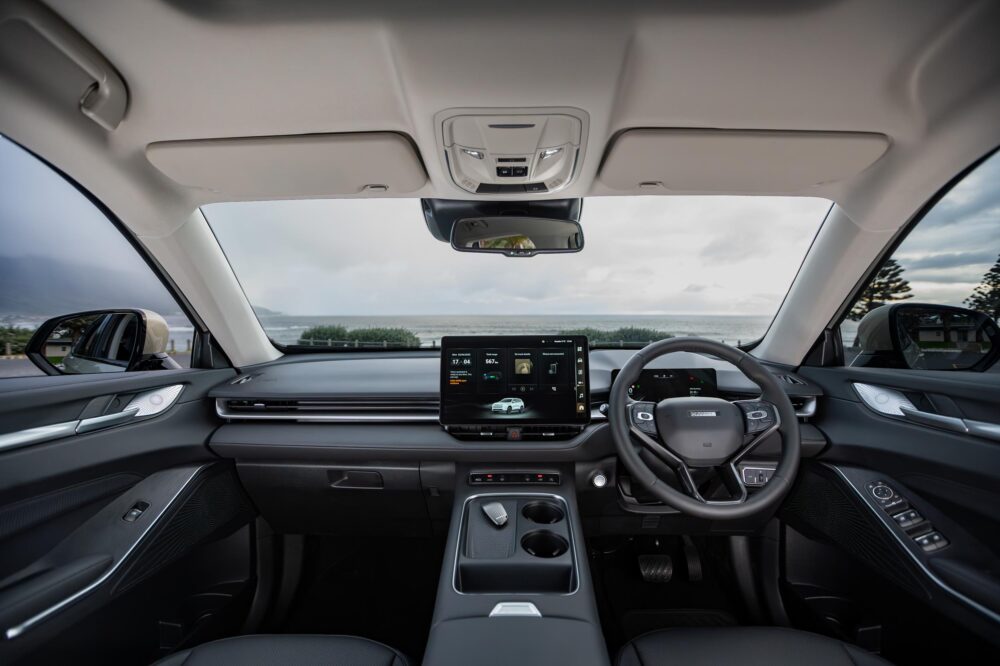
Inside, the H6 makes an excellent first impression. The cabin is draped in black trim that feels both smart and practical, particularly for families.
The first thing you notice is the new 14.6-inch infotainment screen dominating the dashboard. It’s large and crisp and wireless smartphone connectivity now comes standard — a welcome addition.
The screen is centrally positioned, which might bother some drivers used to a more cockpit-like set-up, but it actually makes sense if you think of the H6 as a car designed for family use. Everyone gets an equal share of the experience.
Storage is generous, with plenty of nooks and spaces for the inevitable odds and ends that come with everyday life. The 560-litre boot is one of the largest in its class, making it perfect for road trips or school runs with sports gear in tow.
Good looks
The H6 has always been a good-looking SUV, but the tweaks here make it feel sharper and more assertive. Up front, the new grille immediately grabs your attention, flanked by fresh LED headlights with a teardrop signature that gives the car a touch of elegance.
The bumper has been reworked, too, adding a hint of aggression without losing the family-friendly appeal. The 19-inch black alloys — now standard across the range — give it a more premium stance. I suspect South Africans will love that detail.
At the rear, the full-width light bar is gone, replaced with more conventional split tail lamps and a bold “GWM” badge across the tailgate. It’s a small, but telling move, a sign that the brand is aligning its visual identity across all its sub-brands.
On the road
The launch route gave us a good mix of city streets, open highways and a bit of rougher road surface and the H6 handled it all with confidence. The 2.0-litre turbocharged petrol engine produces 170kW and 380Nm, a jump from the outgoing model. The result is a car that feels punchier and more willing, whether you’re overtaking on the highway or pulling away from a robot.
Turbo lag is there, but only just, and the dual-clutch gearbox shifts smoothly under normal driving. It can hunt for gears if you push it hard, but this isn’t a performance SUV — it’s built for comfort and daily usability, and in that department, it excels.
It comes with a seven-year/200 000km warranty and a seven-year/75 000km service plan. On the hybrid models, you are rewarded with an eight-year/150 000km warranty on the battery components. All of these warranties are transferable from one owner to the next.
Ride quality is impressively supple, soaking up bumps and imperfections without feeling floaty. Road and wind noise are kept to a minimum, which makes long drives less tiring. This is no doubt an important factor for family buyers.
Safety matters
Safety remains a strong point for Haval. The H6 keeps its five-star NCAP rating and comes loaded with tech like adaptive cruise control, lane-keep assist, forward collision warning and a whole suite of driver aids.
It’s the kind of safety net that gives you extra peace of mind, whether you’re driving through Joburg traffic or heading down to the coast.
Pricing is still one of the H6’s biggest selling points. The range kicks off at R495 500 and tops out at R686 500 for the hybrid flagship — remarkable value considering the level of kit you get.
The seven-year warranty and service plan add even more reassurance and hybrid buyers get extra coverage for the battery components.
What’s the verdict?
What stands out most about this updated H6 is how mature it feels. The styling tweaks are tasteful, the cabin is a genuinely nice place to spend time and the drive strikes the right balance between comfort and performance.
Yes, the user interface could still be more intuitive and run-flat tyres remain a divisive choice in a market like ours where replacements can be tricky to source outside major cities. But these are small complaints in what is otherwise a very convincing package.
Haval has clearly been paying attention to its customers and refining what was already a winning recipe. The result is an SUV that feels more confident, more premium and more aligned with what South African buyers want. If you weren’t taking the H6 seriously before, now is the time to start.
Submit and get free exposure here: Showcase Your Business | Advertise Your Special Offers.