Palestinians accuse Israel of ‘apartheid’ at International Court of Justice:

Palestinians are suffering “colonialism and apartheid” under the Israelis, foreign minister Riyad Al-Maliki told the UN’s top court on Monday, urging judges to order an immediate and unconditional end to Israel’s occupation.
“The Palestinians have endured colonialism and apartheid…. There are those who are enraged by these words. They should be enraged by the reality we are suffering,” Al-Maliki told the International Court of Justice (ICJ).
The ICJ is holding hearings all week on the legal implications of Israel’s occupation since 1967, with an unprecedented 52 countries, including the United States and Russia, expected to give evidence.
Israel will not participate in the hearings but submitted a written contribution dated July 24, 2023, in which it urged the court to dismiss the request for an opinion.
Speaking in the Peace Palace in The Hague, where the ICJ sits, the minister appealed to the judges to declare the occupation illegal and order it to stop “immediately, totally and unconditionally.”
“Justice delayed is justice denied and the Palestinian people have been denied justice for far too long,” he said.
“It is time to put an end to the double standards that have kept our people captive for far too long.”
Summing up, Palestinian UN envoy Riyad Mansour struggled to hold back his tears as he called for a “future where Palestinian children are treated as children, not as a demographic threat.”
‘Impunity and inaction’
In December 2022, the UN General Assembly asked the ICJ for a non-binding “advisory opinion” on the “legal consequences arising from the policies and practices of Israel in the Occupied Palestinian Territory, including East Jerusalem.”
While any ICJ opinion would be non-binding, it comes amid mounting international legal pressure on Israel over the war in Gaza sparked by the brutal October 7 Hamas attacks.
The hearings are separate from a high-profile case brought by South Africa alleging that Israel is committing genocidal acts during its current Gaza offensive.
Al-Maliki charged however that “the genocide underway in Gaza is a result of decades of impunity and inaction.”
“Ending Israel’s impunity is a moral, political and legal imperative,” he said.
In January, the ICJ ruled in that case that Israel must do everything in its power to prevent genocide and allow humanitarian aid into Gaza, stopping short of ordering a ceasefire.
‘Prolonged occupation’
The UN General Assembly has asked the ICJ to consider two questions.
Firstly, the court should examine the legal consequences of “the ongoing violation by Israel of the right of the Palestinian people to self-determination”.
This relates to the “prolonged occupation, settlement and annexation of the Palestinian territory occupied since 1967” and “measures aimed at altering the demographic composition, character and status of the Holy City of Jerusalem”.
In June 1967, Israel crushed some of its Arab neighbours in a six-day war, seizing the West Bank including east Jerusalem from Jordan, the Golan Heights from Syria, and the Gaza Strip and Sinai Peninsula from Egypt.
Israel then began to settle the 70,000 square kilometres (27,000 square miles) of seized Arab territory. The UN later declared the occupation of Palestinian territory illegal. Cairo regained Sinai under its 1979 peace deal with Israel.
The ICJ has also been asked to look into the consequences of what it described as Israel’s “adoption of related discriminatory legislation and measures.”
Secondly, the ICJ should advise on how Israel’s actions “affect the legal status of the occupation” and what are the consequences for the UN and other countries.
Israel said the “prejudicial” and “tendentious” questions “represent a clear distortion of the history and present reality of the Israeli-Palestinian conflict.”
Israeli Prime Minister Benjamin Netanyahu’s office said in a statement that the conflict should be resolved through negotiations. It said the case that opened Monday was “aimed at harming Israel’s rights to defend itself from existential threats”.
Foreign ministry spokesman Lior Haiat in a message on X accused the Palestinian leadership of using the court as “a political tool to attack Israel harms both global trust in the international legal system and the chances of reaching a resolution of the conflict.”
Court to rule ‘urgently’
The court will rule “urgently” on the affair, probably by the end of the year.
Dozens of pro-Palestinian protesters demonstrated outside the court, waving flags and brandishing banners.
“I really hope justice will prevail,” organiser Nadia Slimi, 27, told AFP.
“I really hope all the combined efforts to pressure Israel, to demand a more humane policy, will finally lead to some steps to liberate the Palestinian people,” she added.
The ICJ rules in disputes between states and its judgements are binding although it has little means to enforce them.
However, in this case, the opinion it issues will be non-binding although most advisory opinions are in fact acted upon.
Human Rights Watch (HRW) said advisory opinions “can carry great moral and legal authority” and can eventually be inscribed in international law.
© Agence France-Presse
NSFAS accommodation project is a ‘time bomb’ says Outa:
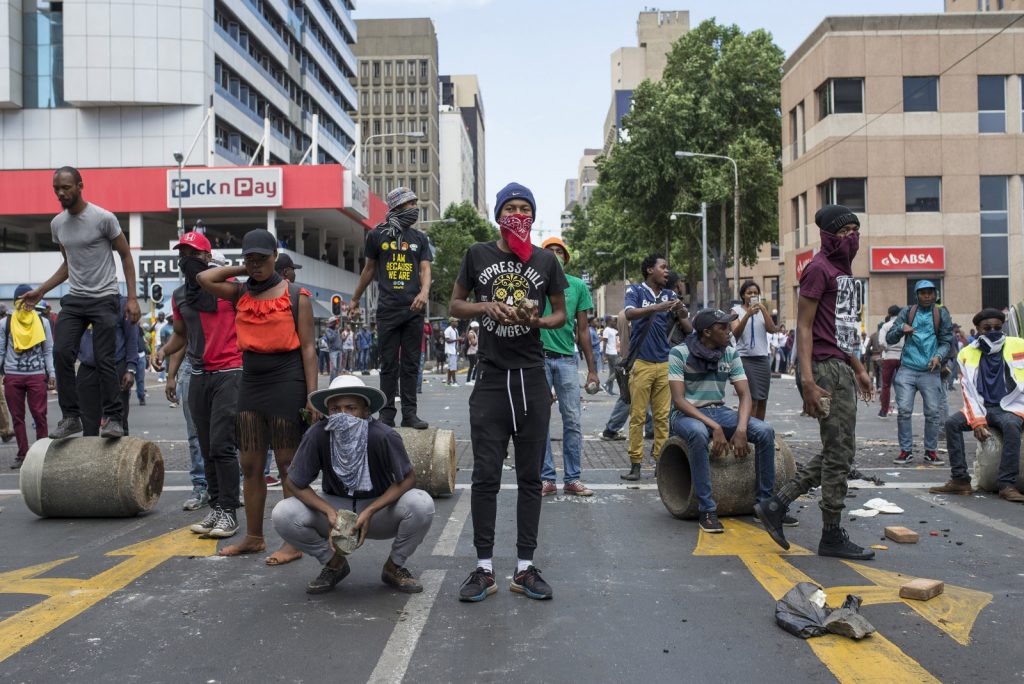
The National Student Financial Aid Scheme (NSFAS) pilot project on student accommodation is a “time bomb waiting to explode”, the Organisation Undoing Tax Abuse (Outa) has said, as tertiary education students scramble to find housing.
“The situation is a result of interference by NSFAS. The system worked well [but] all of that changed when NSFAS decided to take over the process of accreditation and renting out accommodation,” said Rudie Heyneke, Outa head of investigations.
Last week, GroundUp reported that more than 100 students were squatting with their belongings in the multipurpose hall at the Cape Peninsula University of Technology (CPUT) campus after the institution said residences had reached capacity.
“As of 9 February, the university-owned accredited and leased residences have reached full capacity,” read an email sent to students by the Student Life and Residential Services department on 10 February.
Many students have been living in the hall, without mattresses or other furniture, and have been struggling to find accommodation since 31 January.
Following the media traction on the accommodation crisis at CPUT, the financial aid scheme released a statement and said CPUT had requested to be exempted from the 2024 pilot project.
“It remains the NSFAS commitment to ensure that CPUT students are provided with student accommodation that is accessible, decent safe, and conducive to learning,” read the statement by NSFAS.
It added that management from the financial aid scheme would be visiting “hotspot institutions”, including CPUT, Buffalo City TVET College and the University of KwaZulu-Natal, in the coming weeks to find solutions to the accommodation crisis.
The student accommodation pilot project, which was launched this year, is aimed at ensuring NSFAS only pays for student accommodation that is conducive to studying and saves students from having to live in inappropriate housing.
The pilot project involves 39 public higher education institutions, including the University of Johannesburg and the University of the Western Cape.
“We held frank and cordial engagements with these selected institutions and are looking forward to equally progressive meetings with the other identified institutions, including stakeholders within the post-school education and training sector,” said NSFAS board chairperson, Ernest Khosa in a statement last year.
Students at NSFAS-accredited accommodation in Johannesburg, Horizon Heights, have expressed concern after they were told their lease was up in January.
The students, who started an online petition, said they had been removed from single rooms without reason.
The South African Students Congress Wanga Sigila Branch at the University of the Western Cape has called out NSFAS and the university management for their failure to provide accommodation.
“The institution has done little to none to secure more bed spaces for the many students who have been impacted by the NSFAS pilot project, which makes it difficult for many landlords to take NSFAS-funded students,” branch president McIntosh Khasembe told the Mail & Guardian.
According to Khasembe, students are being told to register for the academic year but have not been allocated beds, leaving many stranded.
“Students are sleeping in kitchens and hallways — there is an excess of students that don’t match the number of beds,” said Khasembe.
Outa warned NSFAS about the accommodation crisis after its investigative report in December 2023, saying the housing crisis was due to “inexperienced service providers”.
“These inspection and accreditation services were normally handled by accredited service providers on behalf of universities and colleges but NSFAS decided to contract this function out to inexperienced and understaffed service providers. All of this happened through a dubious tender process,” Heyneke said.
Outa said students have been reaching out to the organisation to intervene in the crisis and warned that if it was not solved, students would have no option but to take to the streets.
“It is despicable that NSFAS is allowed to gamble with the future of young people who want to better their lives through education. At this stage, the only logical decision would be for NSFAS management to stop the pilot project before this becomes a full-blown accommodation crisis that can easily spill over into student protests,” said Heyneke.
Meanwhile, NSFAS has announced that it had disbursed R2.8 billion in January 2024, which covers one month of student accommodation and book allowances.
ANC meets deadline to produce cadre deployment records:
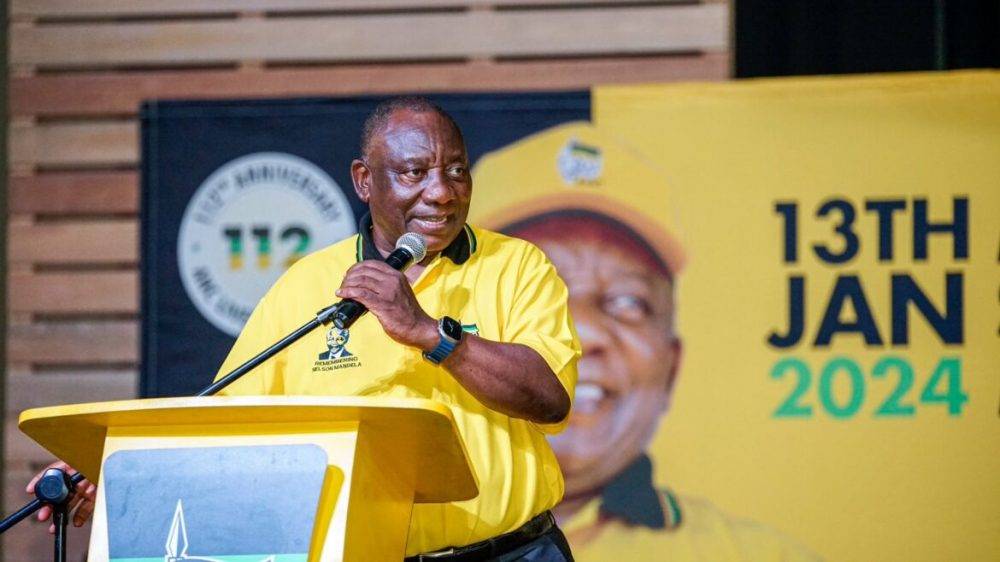
The ANC has met the constitutional court deadline of 5pm Monday to hand over its cadre deployment records to the Democratic Alliance.
In a statement, DA MP Leon Schreiber said his party was studying the documents.
“After a three year court battle, the ANC has been forced to bend the knee before the DA. For the first time in three decades, we have succeeded in piercing the ANC’s veil of cadre secrets. The DA is studying the documents and will update the public as soon as possible,” he said.
The DA is expecting that the records will detail ANC internal discussions on the deployment of key figures in three arms of government, which resulted in state capture.
The official opposition is particularly interested in cadre deployment records during President Cyril Ramaphosa’s time as the head of the ANC’s deployment committee.
Chief justice Raymond Zondo’s state capture report found that Ramaphosa failed to give an honest account of the ANC deployment committee’s role in recommending appointments in the judiciary.
Minutes subpoenaed by the commission found that the committee had made recommendations and indicated its preferences on judges.
The Zondo report revealed that the committee has wide-ranging power and arrogates to itself the decisions to “recommend” members of cabinet, directors and directors generals in government departments, chapter nine institutions and state owned entities.
Schreiber said the handover of the records was a victory for transparency and the rule of law. He added that the records must include complete meeting minutes, email correspondence, WhatsApp conversations, CVs and all other relevant documentation dating back to January 2013.
“If the ANC has erased and manipulated parts of the information, or sought to otherwise undermine the Constitutional Court’s order, the DA will launch further legal action to hold ANC leaders personally accountable,” he said.
“As soon as we have processed the voluminous documentation, the DA will fulfil our longstanding undertaking to make public the ANC’s dirty cadre secrets for every South African to see.”
Schreiber said the DA’s victory was yet another important landmark on its journey to abolishing cadre deployment corruption in South Africa.
“ANC cadre deployment laid the foundation for state capture, for systemic corruption, and for the service delivery collapse that caused load shedding, water-shedding, and the accelerating failure of the state,” he said.
ANC spokesperson Mahlengi Bhengu-Motsiri said the ruling party “remains steadfast in its respect for the Constitution and the laws of the republic”.
“The rule of law is a foundational stone of the national democratic society that we seek to build by working together with all South Africans,” she said.
“In pursuit of a united, non-racial, non-sexist, democratic, and prosperous society, the ANC will continue implementing its cadre development policy and deployment strategy to ensure that individuals with impressive qualifications, experience and credentials are deployed to build a better life for all South Africans.”
Submit and get free exposure here: Showcase Your Business | Advertise Your Special Offers.