Performance of the electricity grid has disappointed, Ramokgopa says after more unit failures:

The performance of South Africa’s power grid has been disappointing over the last two weeks, largely due to the failure of more generating units at Eskom, Electricity Minister Kgosientsho Ramokgopa said on Sunday.
During his fortnightly media briefing on the country’s energy action plan to tackle chronic power shortages and end load-shedding, Ramokgopa said the past two weeks had seen a deterioration in the unplanned capacity loss factor — the rate at which the generating units are failing.
“(Previously) we were averaging less than 15 000 megawatts; in some instances we were even sub 14,000 MW. We were doing exceptionally well. And that’s why you saw … the green period where we didn’t have load-shedding for a period of eight days. And of course, in instances where we had load-shedding during that period, it was not as intense as we’re experiencing it now,” he said.
“Part of the deterioration is as we have had a significant failure of a cluster of units in Eskom. If I were to compute from the 13th to the 17th of November, the available capacity was at about 26,499 MW. That is still lower than … what I use as the baseline case. The week before that we were 2 000 MW megawatts better than what has been the performance over the past week.”
He said the failure of the cluster of units at the Kendal, Medupi, Hendrina, Duvha, Kriel and Camden power stations had forced Eskom to ramp up load-shedding to stage three. The power utility however expected five units to come back online by Sunday night, Ramokgopa added.
The energy action plan was launched in July 2022 as a roadmap to end load-shedding as quickly as possible and promote the long-term sustainability of electricity supply in South Africa.
The plan outlines five outcomes which focus on fixing existing Eskom infrastructure, improving private investment, fast-tracking the procurement of new generation capacity, encouraging rooftop solar systems and sustaining the energy sector.
Ramokgopa said cabinet had approved implementation of the country’s Just Energy Transition Investment Plan (JET-IP) which sets out the scale of need and the investments required to support South Africa’s shift towards cleaner energy sources.
“Remember that what the JET-IP does is to say to the country how we intend to deploy the US$ 12.5 billion that has been made available by international partners,” he said.
“We are going to ensure that in the manner in which we tap from that, it meets the requirements of the country and one of the major determinations there is a principle of ensuring that whatever we do must meet both the pay scale and cost that is consistent with our socio economic situation here in the economy.”
Ramokgopa said Forestry, Fisheries and Environment Minister Barbara Creecy would provide more details on the JET-IP plan, adding: “It’s part of the totality of the efforts that we’re making, in ensuring that we are able to attain energy sovereignty and in the immediate ensuring that we end load-shedding.”
The post Performance of the electricity grid has disappointed, Ramokgopa says after more unit failures appeared first on The Mail & Guardian.

Going back to recount your steps is a gift, not a curse. It gives you a chance to look back, sit up, and take stock of what has gone before.
Going back to the drawing board to reassess is an adage commonly bandied about.
And for a manufacturer to admit, in no uncertain terms, that it has taken the wrong direction due to legislative pressures, and be mature enough to listen to customer demand and align its product offering to that, is something I greatly admire.
Porsche is one such company. After its disappointing move to a V6 twin-turbo engine layout in both its S and GTS Cayenne models in recent years, the Stuttgart brand has found it prudent to return to form by reintroducing the V8 engines.
It did this first in the GTS and most recently in the S models, one of which is the subject of this review.
It is indeed a good move to put a burbling V8 back into the Cayenne S, because it adds a layer of performance befitting a premium-performance SUV. For the Cayenne to remain significant, it has to match its rivals on every level and that includes powertrains.
But before we delve into the oily bits, it is also good to point out that the Cayenne has received some cosmetic updates — minute for the most part — but updates nonetheless.
These include a revamped front valance with a squared-off, jaw-like design and redesigned headlights.
The rear sees the P-O-R-S-C-H-E lettering strewn across the boot lid under a plexiglass cover — very neat — and the numberplate recess has been given a makeover.
The cabin arguably got the most updates, thanks to the Taycan-inspired dash that sees a new infotainment screen and instrument cluster, while the gear lever is now located on the drop-down console just to the left of the steering wheel column in the interests of using space more efficiently.
Overall, it is a clean, minimalist design that doesn’t detract from the premium ambiance but rather adds slivers of classy modernity to the painstaking German precision and functionality on offer.
Everything is where you expect it to be, breeding a sense of familiarity, just like that trusty pair of moccasin loafers contoured to the shape of your foot.
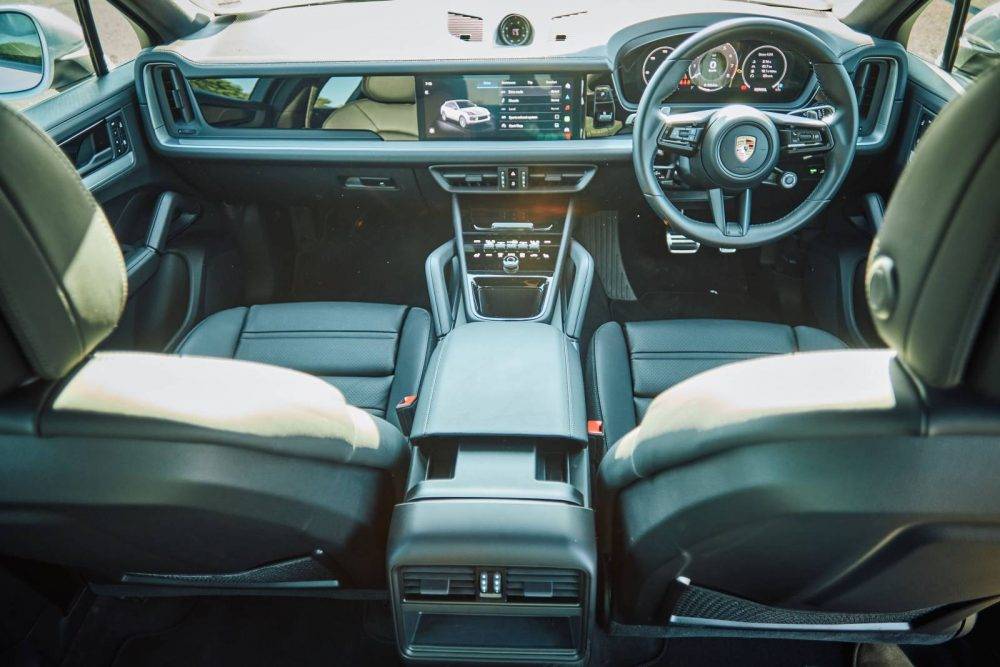
Of course, being a Porsche, there’s a great deal to glean from getting behind the steering wheel. So, find a comfortable position, crank up the V8 engine, and the bark from the sports exhaust is enough to quicken your pulse rate. It is a rorty-sounding thing that burbles and crackles in equal measure — and this is before you start fiddling with the drive modes.
On test here is the Coupé variant, replete with the sloping rear roof line that has become the rage among style-conscious buyers looking for something, well, a tad unique.
The 4.0-litre V8 turbo engine is no stranger, as it does duty in many of the VW Group’s products, to great effect. Pushing out 349kW and 600Nm via an 8-speed automatic transmission, there’s more than enough performance for daily trudges but also enough poke to exploit the chassis and keep the driver fairly engaged.
Much like the insanely capable Turbo GT flagship model we drove last year, the latest Cayenne S manages to mimic its more powerful sibling in the dynamic stakes.
Thanks to PASM (Porsche Active Suspension Management), the Cayenne’s body roll mitigation is one of the best in the business, helping this towering SUV to corner with the verve of a diminutive sports car, leaving you stupefied by its physics-defying abilities.
Traction from the massive 315/35/21 rear tyres is prodigious, while the 285/40/21s upfront offer great front-end grip and steering feedback alike.
As a sporty SUV, the Cayenne S delivers handsomely on this front, but it also delivers on the other end of the spectrum, offering a supple ride quality, despite the large, low-profile tyres. This, again, points back to the PASM system, which has resolutely rendered the correlation between low-profile tyres and brittle ride quality obsolete.
Once reserved for the GTS and above, the Cayenne now offers a more accessible entry point for those seeking V8 excitement.
The Cayenne S is the sweet spot in the range, with all the quality attributes that make this a well-polished package with contemporary tech updates and cabin appointments.
The fact that you can have a V8 powertrain in the S models places the Cayenne, once again, on the top shelf of premium SUV offerings.
Not convinced? Well, the proof of the pudding remains in the eating. Just remember to tick the optional sports exhaust option!
The post The Cayenne just got spicier appeared first on The Mail & Guardian.
Submit and get free exposure here: Showcase Your Business | Advertise Your Special Offers.