Prasa achieves first unqualified audit in nine years with 93% performance rate:
The Passenger Rail Agency of South Africa (Prasa) has achieved its first unqualified audit opinion in nine years, marking a significant milestone in the state-owned entity’s turnaround and governance reform.
This follows four years of disclaimer opinions (2019 to 2022) and two years of qualified opinions (2023 to 2024).
Commercial revenue reached R707.82 million. Of the 15 targets in its medium-term development plan, Prasa achieved 14, equating to a 93% performance score.
Chairperson of the board, Nosizwe Nokwe-Macamo, said the result reflected “rigorous oversight over the years” and a significant improvement in the relationship between the auditor general and Prasa as the auditee. She said the agency had moved from 2 500 pages of audit findings to a clean audit outcome.
“Where governance is strong in an organisation, where internal controls are strong, the picture will always be green,” said Nokwe-Macamo.
Group chief executive Hishaam Emeran said Prasa was on track for growth and expansion, adding that the transformation was remarkable given the organisation’s previous state.
He recalled that five years ago, headlines declared that “Prasa is broken”, following years of theft, vandalism, corruption, and a sharp decline in customer service and ridership.
The 2022/23 financial year marked a turning point, with performance rising from 19% in 2022 to 59% in 2023 and 93% in 2025. This compares with 21% in 2015.
“We say Prasa is the backbone of transport in the country, but we have not acted as the backbone,” Emeran said. He added that the accelerated return of passenger rail had seen 74 million passenger trips compared with 35 million last year — a notable recovery, though still below pre-collapse levels. Prasa aims to achieve 160 million passenger trips in 2025 and 600 million by 2035.
Service improvements were being felt by commuters, with 70% satisfaction levels now restored across 34 of the 40 lines, Emeran said. By March this year, 268 new trains had been delivered, 60 of them during 2024/25, with more than 75.8% deployed across the regions.
The agency reported that 84 718 jobs had been created through R21.2 billion in capital spending, both directly and indirectly. Prasa is now the fourth-largest state-owned entity by asset base, valued at R100 billion. Since 2022, it has maintained an annual capital expenditure rate of about R21 billion.
Long-distance travel, however, remains a challenge for Prasa. During the reporting period, 647 969 long-distance passengers were transported, slightly below the target of 651 670. Twenty-two long-distance trains operated — eight fewer than expected — due to ongoing challenges with locomotive and infrastructure.
Emeran noted progress in safety and infrastructure recovery, with 35 of 40 operational corridors restored.
“We’ve got five corridors to go, and we are busy with that as we speak. What this does is that it allows us to operate trains at a higher speed. It takes away speed restrictions,” he said. Trains are currently operating at 30km/h, though they are designed to run at 90km/h, he said.
Emeran said Prasa’s subsidiary Intersite Asset Investments was central to its strategy to diversify revenue through property and transit-oriented development. This includes the Cape Town Station mixed-use development, the Lab on Park student accommodation in Braamfontein, Johannesburg, the Goodwood social housing project in Cape Town, and the Diep River affordable housing development.
“What Prasa is doing is focusing on diversified transit development,” he said, adding that this would ensure that urban dwellers could live without relying on private vehicles by developing efficient, integrated transport networks. The agency aims to grow property revenue from R700 million to R2.5 billion by 2035.
Emeran said Prasa had also reduced irregular expenditure to R24 billion, with R18 billion already resolved, and plans to settle the remaining R6 billion by next year.
But while the agency celebrated its progress, the goal remained to achieve an audit with no findings by 2026.
Despite a R1.8 billion deficit, as expenses continue to outpace revenue, Prasa remains committed to financial recovery. Emeran noted that interest received from unspent capital budget funds remains its largest income source besides the government subsidy. The ultimate goal is for passenger fares to become the primary revenue stream.
Signalling upgrades on the Mabopane and Southern lines are expected to take 24 months to complete, with ongoing infrastructure recovery and digitisation, including modern ticketing systems, in corridors such as Daveyton and Motherwell in Gqeberha.
Namibia tables sweeping land bill to expand farm expropriation powers:
Namibia’s Agriculture, Fisheries, Water and Land Reform Minister Inge Zaamwani has tabled the long-awaited Land Bill in parliament, describing it as a “transformative instrument” designed to restore dignity, promote equity and empower the population through access to land”.
The land question remains “a complex and emotive matter” but is central to redressing the injustices of dispossession, Zaamwani told lawmakers, adding: “Our deliberations must respond to the aspirations of the majority of Namibians and lay a solid foundation for productive land reform and national cohesion.”
The 2025 Land Bill represents the most far-reaching change in Namibia’s land governance framework since independence and replaces not only the 1995 Agricultural (Commercial) Land Reform Act and the 2002 Communal Land Reform Act, but also a total of 12 laws and ordinances, consolidating them into one.
The aim is to streamline a fragmented system, strengthen administrative efficiency and provide a single, coherent framework for land reform, Zaamwani said.
Since independence, the 1991 National Land Conference and the 1995 Act have emphasised voluntary sales. More than 500 farms covering approximately 3 million hectares were transferred to the state through this model. But the minister reminded MPs that the system was slow, uneven and prohibitively costly.
Late former president Hage Geingob declared the willing-seller, willing-buyer approach a failure, declaring at the country’s 2017 independence anniversary: “After 27 years, the willing-seller, willing-buyer approach has failed to bear anticipated fruit.”
The new Bill explicitly shifts Namibia away from that model, embedding a state-led redistribution approach designed to accelerate resettlement and dismantle inequalities in land access.
Section 81 of the Bill outlines the purpose of acquisition — land may be taken and redistributed to Namibians who are landless, inadequately resourced, historically disadvantaged, or otherwise vulnerable, including the unemployed.
“The purpose is to address social and economic imbalances in Namibian society and bring about equitable access to land,” it states.
The legislation targets farms offered for sale, properties illegally held by foreigners, absentee-owned farms, abandoned or under-utilised land and holdings exceeding economic unit thresholds.
Expanded powers of expropriation
Section 89 gives the minister sweeping powers to expropriate property at any time, provided it is in the public interest and just compensation is paid. The power extends to surrounding or related properties, if necessary to achieve reform objectives.
If only a portion of a farm is acquired, the remainder may also be expropriated if it becomes uneconomical for the owner or under national agricultural policy.
Before any land is taken, the minister must issue a notice of intention to expropriate.
This must be served on the owner and all rights-holders, including tenants and sub-lessees, while also being published in the Government Gazette. Owners then have 30 days to submit written representations.
The minister is obliged to acknowledge submissions and invite negotiations. If no agreement is reached within 20 days, the minister can either abandon the process or proceed with expropriation. Importantly, the Land Reform Commission must consider the situation of farmworkers and their families before making a final decision.
Section 82 empowers the Land Reform Commission to authorise inspectors to assess farms earmarked for acquisition. Inspections cover the land’s value, current use, ownership history, state subsidies and the existence of both registered and unregistered rights.
Inspectors can survey boundaries, bore soil samples and request access to documents such as title deeds. Safeguards are in place — officers must provide landowners with at least seven days’ notice, carry certificates of appointment and cannot enter homes without consent. If inspections cause damage, the state is liable to repair or compensate.
If expropriation proceeds, the minister issues a formal notice of expropriation. This must detail the land or rights being taken, the date of expropriation, the date the state will take possession and the proposed compensation, supported by valuation reports. Owners must also disclose the names and addresses of other rights-holders.
From the date of expropriation, ownership automatically vests in the state, free of mortgage bonds but still subject to other registered rights, unless those too are expropriated. Possession passes to the state on the date specified in the notice or on a mutually agreed date. Owners can ask to hand over earlier by giving 30 days’ written notice.
Until then, owners must maintain the land, and can continue to use it and collect income, though they can be held liable if negligence reduces its value.
Compensation rules
The Bill introduces a structured compensation regime. Payments are capped at the property’s open-market value plus proven financial losses. In addition, a solatium of 10% — up to N$ 50 000 (about R50 000) — must be paid to compensate for the inconvenience of expropriation.
Owners and rights-holders must respond within 60 days of notice, either accepting the state’s offer or submitting their own claim with professional valuations.
If rejected, the minister must issue a counter-offer within 60 days. Any dispute is referred to the Lands Tribunal for binding resolution. Owners who fail to respond are deemed to have accepted the offer.
The minister can advance up to 80% of the compensation after possession is taken, even before a final settlement is reached. If land is mortgaged, or under a deed of sale, compensation can be redirected to creditors or buyers. If rightful recipients cannot be identified, funds are deposited with the Master of the High Court in the Guardian’s Fund.
Providing false information or failing to comply with requests for title deeds is a criminal offence, carrying penalties of up to N$ 10 000 or two years’ imprisonment.
The Bill allows the minister, after consulting the Land Reform Commission, to withdraw an expropriation within 90 days if it is in the public interest. In such cases, ownership reverts to the original owner, mortgage bonds are revived and title deed endorsements are cancelled.
It strengthens restrictions on foreign ownership and prohibits foreigners from acquiring either communal or commercial land. They can only lease land under special conditions if the investment creates jobs and benefits the economy. Any Namibian found colluding with foreigners to circumvent the law faces fines of up to N$ 50 000 or a 10-year prison term.
The Bill also introduces a Communal Land Development Fund to finance infrastructure and agricultural development in communal areas, while maintaining the Land Acquisition and Development Fund for resettlement farms.
A centralised Lands Tribunal will hear both communal and commercial disputes, with membership expanded from five to seven experts to improve efficiency. The Bill further provides for progressive land taxation, with valuation rolls compiled every five years to strengthen state revenue from commercial farmland.
Historic process
Zaamwani reminded MPs that the drafting of this Bill began as far back as 2007, with regional consultations in 2010, tabling in 2017 and withdrawal ahead of the 2018 Second National Land Conference. The latest version incorporates many of the resolutions adopted at that conference.
“This Bill is a reflection of the aspirations of the people as articulated through the resolutions of the Second National Land Conference,” she said, urging MPs to deliberate in the spirit of nation-building.
“The land we speak about in this Bill is not merely soil beneath our feet. It is the cradle of our dignity, the source of our sustenance and the foundation of our freedom,” she said.
The Bill is awaiting debate in the National Assembly, where it is expected to trigger robust discussion.
Freed SA activists call on governments to take more action against Israel:
The six South African activists who had joined a flotilla trying to get humanitarian aid to Palestinians and were detained in an Israeli prison have renewed calls to governments to take action against Israel for its war on Gaza.
Fatima Hendricks, Zaheera Soomar, Zukiswa Wanner, Reaaz Moola, Carrie Shelver, and Nelson Mandela’s grandson, Mandla Mandela, returned to South Africa on Wednesday after spending six days in an Israeli prison after the Global Sumud Flotilla was intercepted last Thursday.
The flotilla carried nearly 500 people from more than 40 countries who set sail to deliver food and medical supplies to Gaza, which has been under a heightened siege by the Israeli government for the last two years.
The activists said they had a glimpse of the humiliation and degradation that Gaza residents and Palestinians are subjected to daily.
“I feel disappointed because I don’t feel we accomplished the mission, because we were kidnapped before we could do so and one of the things that will stay forever with me is the image of the Palestinian children — the people in Gaza waiting hopeful that we would arrive and then we didn’t,” Wanner, a journalist and novelist, told the Mail & Guardian on the sidelines of the press conference.
“That breaks my heart all the time and I really wish at this point in time — seeing those images, seeing what happened to the flotilla that governments across the world, beyond just Colombia would go into a space and say ‘you know what, we’re going to do something because really this is not something civilians should be doing, this is something governments should be doing.”
The South African activists said they were treated differently from other detained activists due to their nationality.
“Forty-seven of our boats were intercepted, we were detained by apartheid Israel’s navy and taken to Ashdod. Many of (us) were denied food as we sailed to Ashdod,” Mandela told journalists.
“On our arrival in Ashdod, we came to the realisation that there will never be justice on stolen land. We were harshly dealt with by the brutal Israeli regime. We were handcuffed with cable ties, tied tightly behind our backs, taken off our boats, and put on the platform. Paraded for all the Israelis and their allies in Europe and the West and the global community to see.”
He added that the South African delegation was refused showers and had no right to legal counsel or legal representation during their detention.
Hendricks and Soomar said they were forced to remove their hijabs, were pushed against walls, and had to strip in front of Israeli forces.
They were taken to Ketziot Prison in Gaza, where they were detained and stripped of all their belongings. The names and blood stains of former Palestinian prisoners and martyrs were inscribed on the walls, Mandele said.
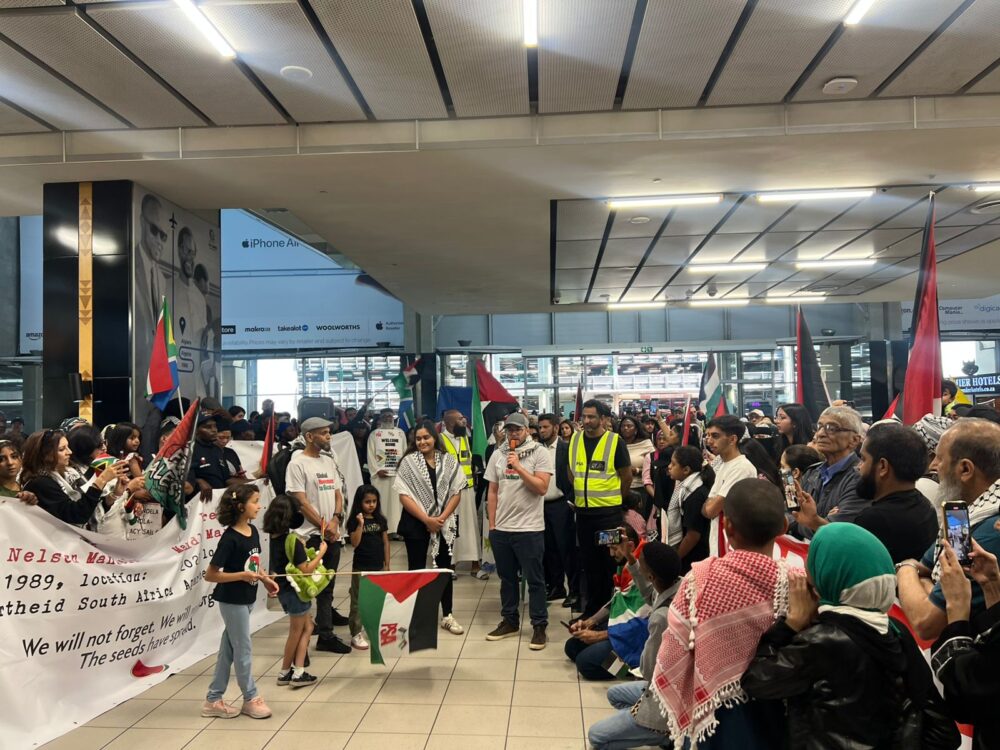
The delegates were forced to sign a document stating that they had entered Israel illegally, which they refused to do, he added. He urged supporters gathered at the airport to call on governments to act against Israel.
“We want to say as your representatives in the Global Sumud Flotilla, as we return, do not forget that six of our comrades are remaining in Israeli jails. One Spanish, two Moroccans, and three Norwegians. We call every one of you to exact pressure on our government and governments across the globe to call for their immediate release.”
Wanner said the South African government needs to “stop paying lip service to solidarity for Palestine”.
“We didn’t like the bantustans in our country, why are we okay with Palestinians having bantustans?” she said, referring to the homelands set aside for blacks during apartheid in South Africa.
Mandela said the activists’ experience had renewed their resolve to continue fighting the Palestinian cause and they would start planning the next flotilla and how to break through the besieged area.
“I said we will return. We will already, from our arrival, work on the second flotilla to send another wave to the shores of Gaza,” he said.
“We will also look at another avenue of accessing occupied Palestine through other borders. We call on you to utilise this period to devise a strategy and tactics as to how we can further the Palestinian cause.”
Submit and get free exposure here: Showcase Your Business | Advertise Your Special Offers.