
Public private partnerships can help close Africa’s infrastructure deficit:
There is a consensus that Africa can increase economic growth by making significant investments in connecting infrastructure — the physical and digital networks that connect towns, cities and countries, enabling seamless trade and data exchange. This includes transport, communication, energy, as well as water and sanitation, which are vital for the free flow of people, goods and services.
When this infrastructure operates optimally it facilitates increased trade, communication, commerce and social development — critical pillars in the objectives of the African Continental Free Trade Area (AfCFTA).
The Economic Commission for Africa (ECA) in 2023 stated that the Africa infrastructure deficit reduced continental economic growth by 2% annually and reduced productivity by 40%, an alarming state of affairs. To address this infrastructure deficit, the Programme for Infrastructure Development in Africa (Pida), an African Union initiative, produced the Pida Priority Action Plan (2021-2030) with the support of the United Nations. The plan has a critical list of 69 infrastructure projects to be developed in Africa for about $ 160 billion. Intra-Africa trade is extremely low at only 15%, compared with 68% in Europe and 59% in Asia. According to the ECA, once fully implemented, the AfCFTA aims to increase intra-Africa trade to 35% by 2040.
The objective is to not only increase trade volumes but also promote economic diversification away from reliance on commodity exports towards manufacturing and value-added industries. The changes in the global trade architecture, tariff regimes, aid cancellation, shifting political alliances and elevated geopolitical tensions indicate an urgent need for Africans to increasingly rely on other Africans. This means addressing the critical infrastructure deficits and unlocking intra-African trade is the most important task facing Africa today.
Financing connecting infrastructure
The technical White Paper, titled Missing Connection: Unlocking Sustainable Infrastructure Financing in Africa and co-published by the Africa-Europe Foundation and African Union Development Agency – NEPAD for the Finance in Common Summit held in Cape Town, South Africa in February 2025, noted the continent needs about $ 150 billion annually in infrastructure investment to address the infrastructure deficit.
Current investment is about $ 80 billion annually, of which only 40% of this financing comes from governments. About 35% of the financing is from donors and other international partners. The balance of current financing is from the private sector, whose role has taken on increased significance considering the changing donor patterns and decline in China-led financing in recent times. Creating enabling environments for private sector partners to invest in is critical for closing the significant funding gap.
Public private partnerships (PPPs) are increasingly viewed as one infrastructure financing modality that should be increasingly considered by African governments. These partnerships are long-term agreements that involve the granting of specific rights to the private sector to build new infrastructure or undertake substantial renovations of existing infrastructure using private financing and at significant private sector risk. In exchange, the private sector investors are granted long-term concessions over the operations of the assets and are remunerated through user charges, government unitary payments, or a blend of the two where revenue viability gaps exist.
The assets at the end of the partnership contract are transferred to the state and the state has the option to operate the assets or tender out to the private sector for another contract term.
Over the last few years, there has been a huge interest from African governments in using such partnerships to fund their infrastructure deficits. The continent has a low deal flow compared to other regions of the world, but this is set to change if the right policy interventions are applied. McKinsey and Company, in an article titled Solving Africa’s Infrastructure Paradox, noted that although Africa has a large pipeline of projects, for example, the Pida Priority Action Plan initiatives, but on average fewer than 10% of these receive funding.
There are international funds with an appetite to invest in Africa. So why are so few deals being funded? Some of the reasons for the slow conclusion of public private partnership deals in Africa are:
- Feasibility studies or business plans are not undertaken in sufficient detail to assess risks or commercial viability.
- Inadequate enabling legislation, frameworks, and policies tailored for concluding PPP transactions efficiently.
- The inability of governments to issue guarantees because of weak balance sheets or challenges with credit ratings.
- A shortage of skilled public servants who possess the necessary experience to conclude PPP contracts.
- Low liquidity or highly risk averse domestic lenders, thus making foreign lenders the primary option in some markets.
- Currency fluctuations and other political risk factors discourage investment because of the elevated perceived risks.
The African Legal Support Facility (ALSF) based at the African Development Bank undertook a study in 2024 to assess the progress in the development of public private partnership frameworks and supporting legislation. The study, titled Public Private Partnerships, Legal and Institutional Frameworks in Africa: A Comparative Analysis, produced some key findings:
- Out of 54 countries in Africa, 42 have enacted PPP legislation. Out of the 42 countries, 24 have civil law, 13 have common law and five have mixed legal systems.
- Western and Central Africa have the highest percentage of economies that have enacted specific PPP laws, with all countries in the region having laws in place, except for Equatorial Guinea and The Gambia.
- Eastern and Southern Africa have enacted the least specific PPP laws. Among the 12 countries that make up the Southern Africa region, four remain without a specific PPP law: Botswana, eSwatini, Lesotho and South Africa.
- Annual trends showed that the highest rate of enacted laws was from 2015 to 2017 with 16 laws passed over the three years.
- The first African country to enact a specific PPP law was Mauritius in 2004, while the most recent is the Republic of Congo in 2022.
- The restricted tendering method is the most common form of PPP procurement.
South Africa had concluded the most public private partnership deals in Africa as of the end of 2024, raising nearly $ 5 billion, with Nigeria in second place. South Africa appears to have had better success in PPP deal closure because of an advanced financial market, stable economic policy, favourable legal framework and a perceived transparent procurement process according to various studies.
The country uses Treasury Regulation 16 under the Public Finance Management Act for national and provincial governments and the Municipal PPP Regulation 309 under the Municipal Finance Management Act for local government. These regulations have been undergoing amendments, with Regulation 16 amendments complete and coming into effect on 1 July 2025 and Regulation 309 amendments still need finalisation.
Donor agencies and development finance institutions have directed funding to support the training and institutional building of PPP capabilities in African governments. The Public Private Infrastructure Advisory Facility, a World Bank programme, has successfully implemented institution-building activities to enhance the capacity of government officials around the world. This technical assistance helps to catalyse the adoption of PPP laws, regulations and guidelines in a streamlined manner to facilitate investments.
2025 and beyond
Attracting both domestic and global private sector investors to Africa is a critical part of closing the financing gap and making inroads to closing the infrastructure deficit that prevents Africa from growing at a rate fast enough to create meaningful opportunities, especially for its burgeoning youth population. One of the attractive features of PPPs is the transfer back to the state of the asset at the end of the agreement.
We have seen many privatisations of state-owned enterprises, usually accompanied by opposition from political parties or civil society because of the more permanent transfers of state assets to the ownership and control of the private sector. Governments have raised debt capital in private markets or by tapping into pension funds to fund infrastructure — another at times controversial route because of perceived risks to pensioners of the funds being mismanaged.
Public private partnerships are, however, not a silver bullet to the funding deficit because of the complex nature of the agreements and the real risk of African governments assuming contingent liability exposures inadvertently because of a shortage of skilled bureaucrats. It is incumbent upon our governments to develop the necessary legal frameworks and innovative de-risking mechanisms that will allow the successful conclusion of private sector investments.
Dr Mthandazo Ngwenya is a managing director at Bigen Africa Group and has also served as Africa director of Intellecap Advisory Services.
Sparrow-weaver nests help shape bird biodiversity in the southern Kalahari:
Conducting fieldwork under the blistering 40ºC heat of the southern Kalahari, Lesedi Moagi had to time her outings to align with the activity of her research subjects — white-browed sparrow-weavers.
“Some mornings, by 7.30am, it was already over 20ºC,” recalled Moagi, a master’s student at the University of Cape Town. “And the birds were already becoming less active. They have to split their daily activities depending on the temperature.”
Moagi’s research focused on understanding how the untidy yet intricate nest structures built by the sparrow-weavers, which live in cooperative family colonies of up to 14 birds, serve as a resource for other bird species in the semi-arid wilderness of the Tswalu Kalahari Reserve.
“We already knew that birds like scaly-feathered weavers, ashy tits and the Acacia pied barbet were roosting in these nests,” she said, noting this behaviour hadn’t been studied in detail.
The inspiration for the research came from another desert species — the sociable weaver — whose apartment-block-like communal nests are used by a variety of species. That research is well-established, Moagi said.
“With white-browed sparrow-weavers, their nests are also being used by other bird species but this has not been studied deeply and it hasn’t been understood as well. That’s how the idea came about — that it would be cool to actually try to understand the value that these nests hold in the ecosystem.”
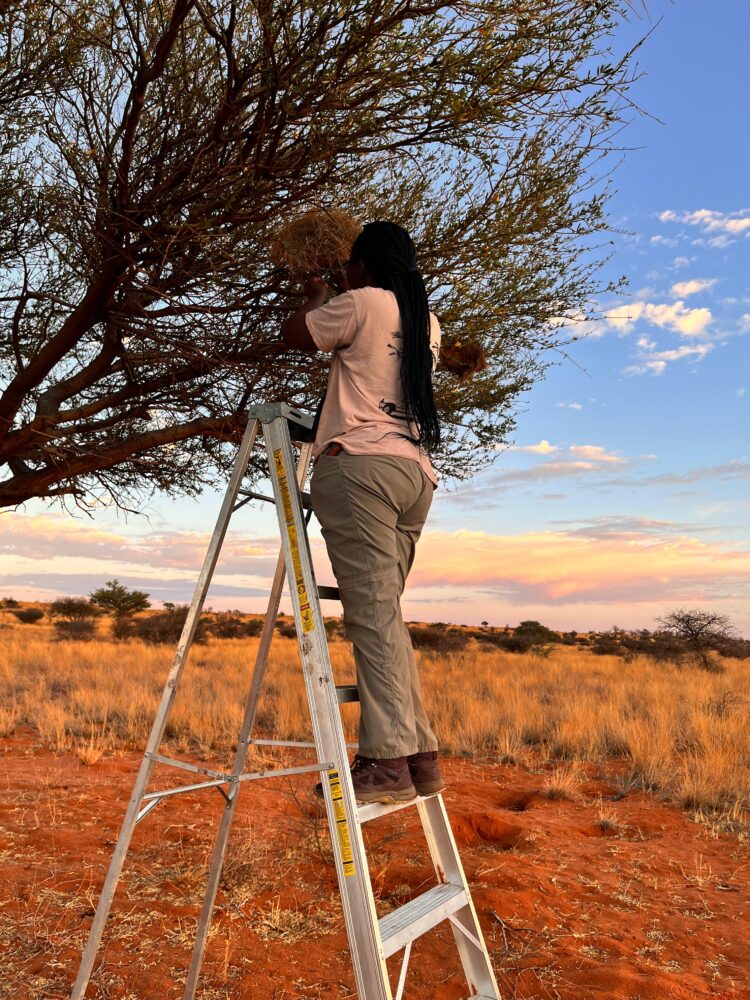
To assess the effect of the sparrow-weaver’s nest structures, she observed both naturally occurring nests and those that had fallen in the wind, which she relocated to trees without nests. She then compared bird abundance and species diversity in areas with and without nests.
“We wanted to see if they also affect the overall avian community in the Kalahari to see in an area with more of these nests,” she said. “We wanted to measure the avian abundance and the number of species that are actually hanging around these nests. We saw their numbers increasing.”
Her findings position the sparrow-weavers as ecosystem engineers — species that modify the environment in ways that benefit other organisms. But the sparrow-weaver population itself may be under threat.
Once common across the Kalahari, their numbers are declining in some areas. The causes are still unclear and could be linked to changes in rainfall patterns, food availability or habitat changes and need further study, she said.
Moagi said fewer sparrow-weavers could mean fewer shelters, which might force other species to expend more energy building their own, or even struggle to survive.
“The physical changes the sparrow-weavers make influence the distribution of the animals. If we have less of these sparrow-weavers, it might affect the number of the species that are using these structures; it might influence their distribution and their movement.”

The ability to find safe, insulated shelter is critical for survival in the harsh Kalahari environment. “The Kalahari is so hot. Birds can’t finish building a nest in a single day because it gets so hot and they need to conserve their energy.”
Moagi also placed temperature loggers inside and outside the nests to measure their insulation. The results showed that the nests provided a consistent buffer against extreme temperatures — up to a 4ºC difference compared to the surrounding air.
In the Kalahari, that kind of thermal stability is crucial.
With climate change making the Kalahari hotter and drier, such shelter could become even more vital for desert-adapted birds. Protecting the sparrow-weaver and its nesting habitat is crucial, Moagi said, not just for the species itself, but for the broader bird community.
She suggested practical interventions including providing water points and shaded areas in key nesting zones and preserving grasses used in nest-building.
The Durban July: The good, the bad and the ugly of Africa’s grandest gallop:
Each year on the first Saturday of July, South Africa’s most anticipated sporting and social spectacle gallops into the spotlight — a cultural jamboree known simply as the Durban July. Over time, the event has become more than just a horse race; it is a mirror of the nation’s aspirations, divisions and contradictions.
At its best, the Durban July is a dazzling display of high fashion, high stakes and high society — a multiracial carnival of couture, culture and class. It injects more than R150??million into the local economy and boosts jobs in fashion, hospitality and entertainment.
Rich history resides at this racetrack: from its past to democratic turf, the Greyville Racecourse, framed by the Warwick Triangle, Block AK and Berea, once stood as a symbol of colonial and apartheid exclusion.
Born under the shadow of Royal Ascot in the 1920s, the racecourse became a bastion of racial segregation by the 1940s.
The city’s Indians — many of whom are passionate punters — can today revel in the fact that one of its own, business person Sadha Naidoo, is the chair of Gold Circle Horse Racing and Gambling; he’s the chief steward who will present the main race prize to the winning owner and jockey.
Yet beneath the glitz and glamour lies a more complex narrative: one of exclusion, excess and inequality. The juxtaposition is jarring — luxury marquees with people sipping champagne stand a few metres from working-class punters lining the fences. The People’s Race, as it’s sometimes called, still plays out on unequal terrain.
The July is also where political theatre occasionally steals the show. In 2009, the infamous “Zuma Whisky Incident” saw a glass of whisky flung at the then-president Jacob Zuma — a moment of silent protest and defiance at a highly choreographed elite gathering. It was a symbolic rupture, revealing how political tensions can spill into supposedly apolitical spaces.
Concerns about safety, exploitation and unruly behaviour persist. From petty theft to gender-based harassment, the dark underbelly of the event often escapes the headlines.
Traffic congestion paralyses Durban’s inner-city, while residents complain of noise, gridlock, poor policing and the after-party blasts of music. For many locals, the event is more disruption than delight.
Yet the heart of the July beats far from the parade ring. It begins at dawn in Summerveld, as the elite racehorses undergo their final gallops — sleek, muscled athletes rehearsing for glory in the misty paddocks of KwaZulu-Natal’s misty hill country. Then begins their journey, meticulously choreographed, to Greyville Racecourse, where logistics meet legacy.
Greyville comes alive as the equine stars are welcomed into their stables. In the parade ring, amid the swish of silks, jockeys and horses find a fleeting moment of communion. Then comes the grand gallop — a thunderous sprint of colour and courage, speed and spectacle.
The July is also a kaleidoscope of identity: Zulu regalia, Indian couture, township streetwear and European luxury brands all jostle for attention. It’s an unofficial runway for the rainbow nation — though some ask whose culture is truly being showcased, and who ultimately profits.
Behind the scenes, deals are struck and alliances forged. Boardroom barons and powerbrokers rub shoulders in VIP lounges, while influencers race to out-dress each other in branded content disguised as lifestyle. Once mainly about horses, the race has been overtaken by a battlefield of brands.
There is also a spectre of race, power and representation: despite its rainbow nation feel, questions persist about ownership and access. Who controls the horse racing industry? Whose culture is being showcased? Who profits?
Hollywoodbets is the third most prominent sponsor on the heels of longstanding underwriters Rothmans, until then health minister Nkosazana Dlamini-Zuma snuffed it out of the sport of kings with the ban on tobacco, and followed by cellular phone giant Vodacom, until the silent grandstands of Covid-19 lockdown scratched it out.
Hollywoodbets, a sportsbook and betting operator became the title sponsor of the Durban July in 2020. Its purple branding now dominates the racecourse and the broader July experience.
Founded in Durban and rooted in the local racing industry, Hollywoodbets has grown from a modest operation into an international gaming giant with interests in sports betting, horse racing, online casino gaming and community development.
“This year’s Hollywoodbets Durban July is more than just a race,” said spokesperson Zandile Dlamini.
“It’s a full cultural experience. We’re thrilled to offer a lineup that celebrates South African music, lifestyle and diversity. Our goal is to create unforgettable moments for all who attend.”
Raceday is a showpiece of alcohol, excess, extravagance and exploitation — often enabled by the blurred lines of luxury and liberty.
Still, the July remains a symbolic stage for the city and the country. Its contradictions mirror our own: dazzling yet divided, aspirational yet uneven. If managed with vision and fairness, it could be a true platform for transformation — not only for racing but for South African society.
Much of the event’s sustainability now rests on leadership. Naidoo is widely respected for his strategic vision and transformation efforts. Under his stewardship, Gold Circle has navigated post-Covid problems and adapted to an evolving entertainment and betting landscape.
As millions of rands will be splurged, the biggest buzz surrounds the main race, which features 18 runners, with two reserve horses on standby in case of any late scratching.
This Grade 1 contest will be run over 2??200 metres. The favourite is Eight On Eighteen, currently leading the betting market at 14/10 odds. Drawn at gate 11, the colt will be ridden by champion jockey Richard Fourie and is trained by Justin Snaith.
As Durban catches its breath after another unforgettable edition on Saturday, 5 July, one thing is clear: the Durban July remains a metaphor for South Africa. What we choose to see — glamour or grit, triumph or tension — depends on how close we’re willing to look.
Here’s a personal tip: don’t lose your shirt, don’t drink and drive, and catch an Uber home safely.
Marlan Padayachee is a former political, foreign and diplomatic correspondent in the transition from apartheid to democracy and is now a freelance journalist, photographer and researcher.
Submit and get free exposure here: Showcase Your Business | Advertise Your Special Offers.
