
Quantum leap for new green taxis:

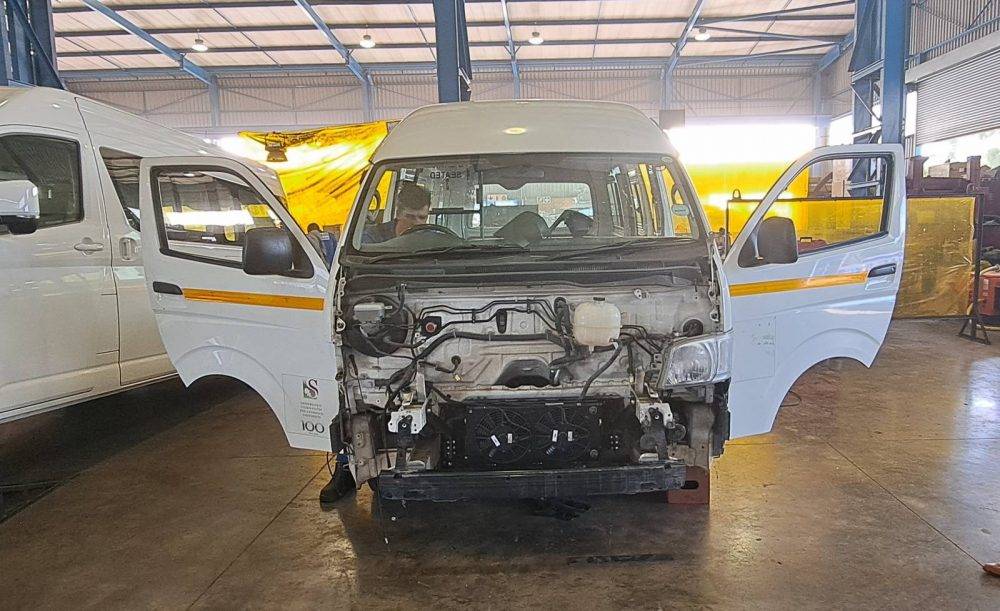
Thinus Booysen calls it a “reborn taxi”. That’s how he describes the minibus taxi that he and his team have given a second life by retrofitting the fuel-driven vehicle with electric propulsion.
This first electric taxi of its kind in South Africa is the result of a collaboration between researchers at Stellenbosch University and Rham Equipment, and was funded by the South African National Energy Development Institute.
The prototype, which will be used to prove the concept and for testing, was recently completed and is now operational. It is being checked for road safety, after which performance testing will start. Its development signals the beginning of the project, says Booysen, who holds the research chair in the Internet of Things in the university’s department of electrical and electronic engineering.
“More than 70% of the trips in South Africa are by minibus in the informal sector, which is why we are hoping to encourage the retrofitting of some of the 250?000 minibuses in the country with electric propulsion,” he said.
These retrofitted vehicles would be cheaper and much more environmentally friendly than new electric vehicles (EVs).
“With this venture, we want to help build the skills that will be needed to manufacture electric vehicles locally and also create awareness about how much we could save with electric taxis.”
South Africa’s electric vehicle manufacturers have a window of opportunity to open plants in Africa to produce these cars locally, he said. Most locally manufactured petrol cars are being exported but this boon to the economy will end with developed countries transitioning to electric vehicles in the run-up to — or even before — 2035.
Remaining in the slow lane of the electric vehicle transition could put thousands of jobs at risk and the “automotive industry and our government cannot afford to be asleep at the wheel”, Booysen said.
In the long-term, local production of new electric vehicles is key.
“We just wanted one vehicle to test with so we can validate our simulation models, so we built it. But we’re also trying to build the skill set in South Africa to prepare for eventual local production because we fundamentally believe that we have to produce them locally,” Booysen added.
South Africans pay 25% import taxes on electric vehicles, compared to 18% import taxes on their internal combustion-engine counterparts. But scrapping import duties on electric vehicles is not the answer “because it’s protecting the local production of vehicles and 500?000 jobs”, he maintained.
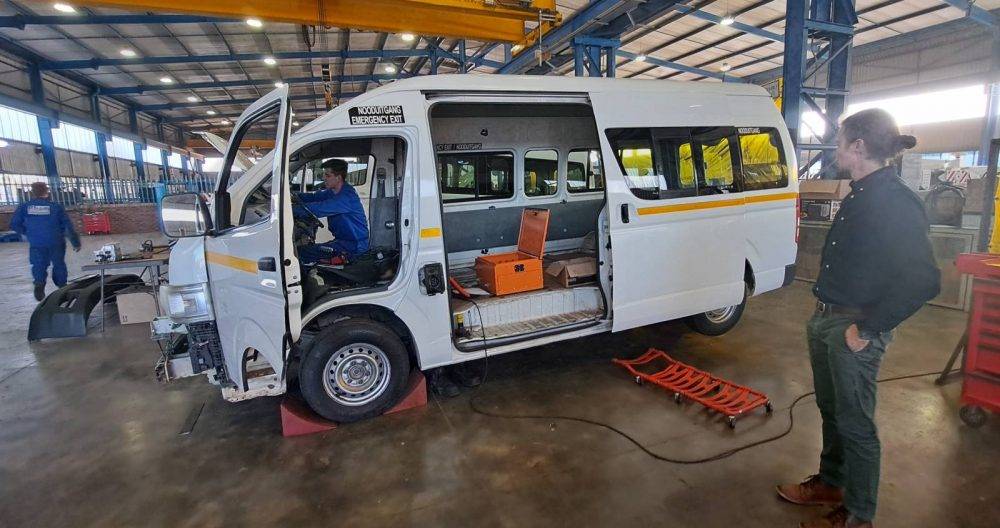
Stephan Lacock, one of Booysen’s team members, who is doing his master’s degree in electronic engineering at Stellenbosch University, helped design the retrofitted minibus with partners at Rham Equipment.
Lacock explained that Rham Equipment had been building battery mining equipment vehicles for several years.
“If you go and look at the engineering principles, it’s actually very similar in what you will use in an electric taxi or an electric car,” he said. “I spoke to the chief executive of Rham, who estimates that he will create at least two to three jobs per vehicle that he retrofits.”
The retrofit needed to comply with national road safety regulations, particularly the strict requirement not to make any permanent changes to the minibus chassis. For the retrofit, they removed the minibus’ internal combustion engine and the petrol tank, manual transmission, gas pipe and radiator.
The team successfully created a reproducible “kit” that includes the main components of the electric powertrain — the system that propels the vehicle forward. These include an electric motor, inverter, charger, electronic control unit and a single-speed reduction gearbox.
Lacock said the powertrain is “skilfully connected” to a custom-designed battery pack that meets the specific operational needs of a minibus. Its advanced regeneration system, which harnesses energy generated during deceleration and downhill driving, enhances the vehicle’s energy efficiency and range.
The minibus is equipped to travel an estimated range of about 120km, with a maximum speed of 120km an hour. It has an electric motor power of 90kW and a battery capacity of 53.76kWh.
Lacock said this ensures it meets all load and driving requirements comparable to those of traditional internal combustion engine minibuses. The inclusion of a 20kW charger means the minibus can be efficiently charged in just over two hours.
On the potential appetite for electric minibus taxis, Booysen said that he and his team surveyed just more than 5?000 people in the taxi industry, including drivers, owners and owner/drivers. The positive response was “overwhelming”.
“They were asked about 40 or 50 questions and what became clear very quickly is they don’t have a clue what an electric vehicle is and what it means but they were happy to entertain the idea of using one as long as it’s going to save them money.”
It will.
“The retrofit we’ve done costs about R700?000. But that’s just because it’s the first one. We believe that at scale, we should be able to do them for approximately R450??000.”
To put that into context, importing an electric taxi costs R1.2?million.
A retrofitted minibus costs a lot less than importing a new vehicle and has a substantially lower environmental impact.
“But, most importantly, if you convert [a minibus taxi] to electric, it takes a year to pay off in terms of savings in diesel and petrol versus electricity,” said Booysen.
While optimistic about retrofitting taxis, Booysen said there are difficulties in charging the vehicles in a country where the national electricity grid already operates at half its capacity. “The big question is, what about the grid?
“I can tell you now, when taxis start charging from the grid, it won’t work. All our simulations show that we will kill the grid. It’s going to require 5% to 10% of the grid just to charge the taxis.”
Booysen said it is imperative that whoever instals charging stations makes use of as much renewable energy as possible. They also need to install large battery banks to act as a buffer between the electricity grid and the vehicle chargers.
Johan Giliomee, a PhD student and a team member, said most taxis are stationary between the early morning and afternoon peaks, making it an ideal opportunity for charging from solar panels.
“This also means a single charge would only need to supply sufficient energy for half the day, significantly reducing the required battery capacity as opposed to being scaled to support a full day’s operations,” he said. “Further ideal charging opportunities are seen overnight when the national electricity demand is at its lowest.”
The team is advocating a new paradigm of electric mobility, which includes the system of charging, rather than electric vehicles alone.
“We need to stop talking about electric vehicles and start thinking about the whole system of electric mobility,” Booysen said. “You can’t just buy a car and just assume that there will be fuel just round the corner. You need to buy a car and, at the same time, ensure that you produce electricity for it.”
He suggested that the government subsidise the installation of solar power and the battery banks for people who buy electric vehicles, as is being done in other countries.
“The one thing that we have in this country is incredibly stupid and ridiculous inequality, which means that those people who can afford to buy EVs right now, they’re probably in the position where they can produce their own electricity and probably already do, because of load-shedding.”
For Booysen, the big question centres on taxi drivers and owners. “At that point it’s where the Development Bank of Southern Africa, the World Bank, et cetera, need to come to the party and say, ‘Let’s finance this because there’s a good business opportunity here and the money will be paid back in a year, which means on top of paying off the vehicle, which will be cheaper now, let’s let them pay back the investment in solar as well.’”
Booysen’s team will now collaborate with Rham Equipment and Golden Arrow Bus Service to retrofit one of the company’s diesel buses.
Mega Moolah prizes go to millions: Here’s how to play:

One of the essential and appealing aspects of this series is the huge jackpot
Developed and launched by Microgaming, Mega Moolah is a game series that is known all over the world, thanks to its enormous jackpot and big prizes.
The game series includes titles such as Juicy Joker, Mega Moolah Goddess, The Witch’s Moon, Atlantean Treasures, Immortal Romance and more.
While the themes vary from slot to slot, the game mechanics are similar, with most slots featuring five reels, three rows and 25 pay lines.
Basic rules of the game
The slot itself is like any other one, with regular symbols that match the theme of the game, a Wild, which substitutes for any other signs to create a winning combo, as well as a Scatter, which can trigger free spins bonuses or act as multipliers, according to each slot in particular.
In addition to that, the game is linked to a progressive jackpot that can be triggered randomly during the base game. When activated, the players see a giant wheel that they spin in order to win one of the four jackpots: Mini, Minor, Major or Mega.
What makes Mega Moolah so interesting
One of the essential and appealing aspects of this series is, undoubtedly, the huge jackpot. Winning this jackpot can change one’s perspective, so it’s no wonder that more players want to try their luck.
For several decades, Mega Moolah turned players into millionaires, thus making the game more and more popular across the entire world.
Deciding a budget and gambling limit
Prior to even making a deposit, players should decide upon the maximum amount they are happy to lose without affecting their lifestyle. Responsible gambling is essential, which is why one should never spend more than one can afford.
Take advantage of bonuses and promotions
Many online casinos provide their customers with a wide array of bonuses and special offers for the Mega Moolah series. By using them, customers can get free spins or credits, thus having extra chances to win big.
Choose your bet correctly
The minimum and maximum bets in the game settings are important if you’re playing with your money. However, you can go the casino coupon route. Casino Alpha indexes online casino bonuses for Mega Moolah. Their average deposit cost is $ 1. You can use the spins designed for Mega Moolah and play at a much lower cost. Our tip is to read the terms before you start playing, particularly the ones about the payment plan.
Understanding the slot’s rules and the mechanics of the progressive jackpot is crucial
As it was mentioned already, Mega Moolah is a series of slots, which means each of them has its own rules. This is why the players should consult and understand the “Information” section of the slot before wagering.
Another important aspect is understanding what a progressive jackpot is and how it works
There are three types of progressive jackpots: local, networked and combined.
The local jackpot links the slot machines within a land-based casino or a network of casinos belonging to the same brand. The jackpot is accumulated from all the bets made within the casinos that are linked together.
The progressive networked jackpot, however, links various online casino networks, and operators from all over the world can be part of said network.
The third type of jackpot is the combined one, which is linked to the machines inside a brick-and-mortar casino and to a network of casinos, thus allowing the amount to rise according to the number of players and wagers placed in each location.
The Mega Moolah progressive jackpot is networked
This is the reason why it can rise to impressive, life-changing amounts. The only downside is that since it is linked to hundreds, even thousands of worldwide locations, the number of players is enormous, meaning each one only has a slight chance to win.
Players who want to play this slot must never forget one thing: hitting the jackpot is strictly a matter of luck, and it has absolutely nothing to do with skills or wagering style, so if anyone ever tells you they have discovered the secret to becoming a millionaire via slots, they are either lying or have found a way to cheat, which is, of course, illegal and should be avoided at all costs.
Changing your life for the better
At the end of the day, the simple thought of winning an amount with so many digits is indeed something to dream of, but not something worth gambling away your economies, which is why you should always remember to gamble responsibly.
Online casinos, while they can change players’ lives, are not supposed to cause any harm, so always pay great attention when wagering.
Africa is for Africans – all of us:

If you ask Google which is the first country to gain independence in Africa, the answer it will give you is Ghana, on March 6, 1957. The thing with Google is that it is never wrong. It is also never correct. Google does not give answers, the Google search engine, through its algorithm, tells you which ‘answer’ is probably the most correct — not the answer.
Google will tell you that Sudan received its independence from Britain on 1 January 1956, more than a year before Ghana did. You will find some pseudo-intellectual explanation, that Sudan was under the joint administration of Egypt and Britain, but Google conveniently forget that Egypt itself was under British colonial rule.
Why do academic scholars, and basically everyone, not count Sudan’s independence from colonialism as the first African country to gain independence?
Maybe because our understanding of what is African is no different to a European or an Indian or a Chinese person — narrow and exclusive.
African and Black should be one. Because no single colour knows oppression better than Black. Steve Biko deliberately referred to the colour Black as political. Biko was not being rhetorical or playing to the gallery.
Africa, though, is not the continent of victimhood. We should not celebrate our massacres, because there won’t be enough days in the year for that. But equally, we cannot continue to celebrate our oppression on the basis of who is oppressed more. It is this thinking that allows xenophobia on our continent.
So what does it mean to be African? Or should we really ask if there is a difference between Black and African?
In South Africa, in the days of our struggle we used the oppressors’ perspective of differentiating between the disenfranchised. We acknowledged that the oppressive whites did not want any of us except how we could serve them. So we called all the disenfranchised, Black, because wherever a white person could go, none of us could.
However, the whites also distinguished between us, by calling some Coloureds, others Indians, and those from various tribes black. We fought against this ignominy of apartheid, but accepted our oppression was not the same and coined the phrase, “Black in general, and African in particular”.
This phrase originated in South Africa. If this phrase was known on the continent in 1956, today we would be celebrating Sudan being the first African country to gain independence from colonialism.
It is not by accident that the African continental body was named the Organisation of African Unity. The European Union does not mention unity — European countries have been at war many times. In Asia, there is the Association of Southeast Asian Nations. The Americas have the Organisation of American States. None include unity, except for Africa.
Why?
Because we do not have a problem with white people or those who do not care about Africa or Black people, we have a problem with each other. Africa may be the largest continent on Earth, but we act like there’s not enough space for anyone except those called African.
Many may be irritated by the ANC and their allegiance to non-racialism. However, non-racialism remains the most amazing and radical principle to be developed. It incorporates suppression based on colour or complexion, while factoring in both class and gender oppression.
Thabo Mbeki’s famous speech, “I Am An African”, helps us to acknowledge that Africa is not composed only of those whom Europeans found here, but time has passed, people have travelled, and the people who pledge allegiance to this continent have also changed.
I recall an African peer review mechanism heads of state and government meeting in the 2000s in Algeria.
The host, Algerian President Abdelaziz Bouteflika, in his opening address, said (I paraphrase because of memory and translation): “President Abdoulaye Wade, in my culture you are a barbarian. But you are not a barbarian, you are my friend. So I reject my Arab culture when it regards you as a barbarian. But, I am reminded on this continent when I say that I am African, that I am not, I am Arab. So can I be Arab and still be African? I give up that part of my Arabness so I am African, but can I still be Arab and be African?”
Non-racialism factors in the material conditions that have oppressed people based on their colour and culture. So, yes there’s only one race, the human race, but human beings with power normalised a system of oppression and prejudice where those with darker skin were made to believe they were inferior and those of fairer complexion were automatically superior.
The radical nature of non-racialism is that it does not truck on hate or envy. It believes in the innate goodness of all human beings. It embraces difference, so that we all are a part of something, so that we reject the divisions imposed on us by those who require anger to remain in charge.
Donovan E Williams is a social commentator.
The views expressed are those of the author and do not necessarily reflect the official policy or position of the Mail & Guardian.
Submit and get free exposure here: Showcase Your Business | Advertise Your Special Offers.
