
R83-million and three years later, only one RDP house has been built in Durban project:

The Namibia Stop 8 Housing Project in Inanda, eThekwini, started in 2019, but to date only one RDP house has been completed.
Residents say the construction company was on site from 2019 to 2020, but stopped because of the Covid pandemic.
According to eThekwini Municipality spokesperson Lindiwe Khuzwayo, the development – located about 30km from Durban centre – comprises 500 serviced sites and 343 new housing units. She said R83-million had been spent so far.
The money had been spent on roadworks, stormwater, sewers, platforms and foundations, water reticulation, and some top structures.
At a council meeting on 31 May it was revealed that R43-million is needed to complete the project, according to the Democratic Alliance human settlements spokesperson and member of the provincial legislature, Marlaine Nair.
She says no more money should be allocated without “a comprehensive report that addresses the project’s progress, challenges, and any potential irregularities”.
When we visited the area last week we found one road tarred for less than 500 metres, and the other roads still gravel. The stormwater system was incomplete. Some sewer trenches have been dug. A total of 13 houses were at foundation level. One house was complete.
eThekwini Councillor Zamani Khuzwayo (DA), who also sits on the human settlements and infrastructure committee, said the project was 51% complete and the new finishing deadline was December 2024.
Khuzwayo blamed delays on bureaucracy and obtaining the necessary approvals, the relocation of families to temporary housing units, Covid, the 2021 July unrest, and the KZN floods.
Families who were relocated in November 2019 said they were told the project would take 18 months. Three and half years later, they are still sitting in transit camps.
Community leader Thami Ngidi said residents had been sceptical from the outset. He said out of 500 families, only 311 agreed to be moved.
“Unfortunately the officials managed to convince some of us. We ended up agreeing to be moved,” said Ngidi.
The informal settlement of Namibia Stop 8 was established in 1960. Residents, who refused to be relocated, live in homes made of reused bricks and corrugated iron. Some built pit toilets for themselves.
Several hundred families who refused to move will have to be relocated to finish the project.
Resident Buzani Mkhize said, “I told them that I want to be closer when they build my house so that immediately when they finish I move in. We know houses are being [illegally] sold in other areas.”
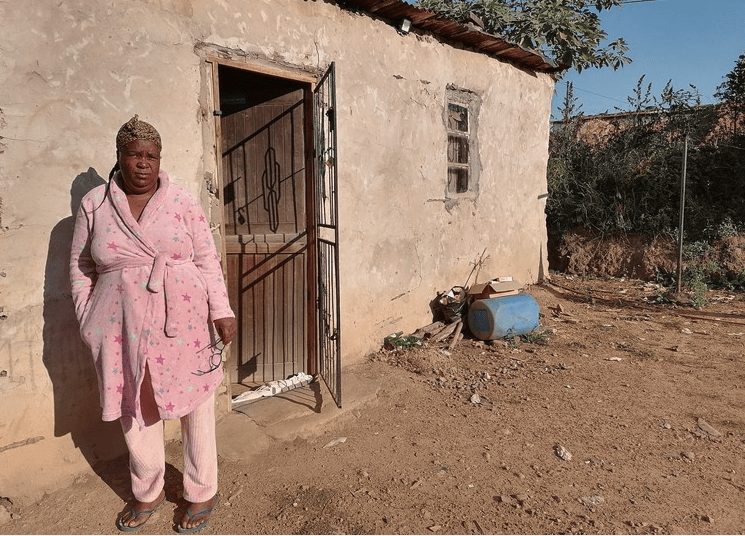
Tsepo Magubane said when his parents were relocated, his backyard room was demolished.
“I refused to go live in a one-room house with my parents and siblings. Our house is in the first row. We were told it will be done within six months but that never happened.”
Conditions at the transit camp are poor. Each family has to share a single room and there is a lack of toilets. Residents have to carry five and 10-litre buckets to the toilets for flushing. Water is currently being delivered by truck. Residents we spoke to said the water truck could be absent for weeks.
Mayor Mxolisi Kaunda said the municipality is busy with the repairs to vandalised pumps and apologised for the water situation.
This story was first published by GroundUp.
SA, US both lose if Washington breaks off relations with Pretoria:

Despite all indications by Washington that South Africa risks losing its most valued trade relationships at the height of Russia’s invasion of Ukraine, some in the government and political analysts believe the US also stands to lose significantly should it break off relations with Pretoria.
The US fired another salvo at President Cyril Ramaphosa’s government this week when its foreign affairs senate committee heads exerted pressure on Joe Biden’s White House to break ties with South Africa.
This happened just hours before government officials were due to travel to Russia and Ukraine on an African peacemaking mission during which they will meet their counterparts from the two countries.
It also comes as South Africa grapples with the headache of how to deal with Vladimir Putin’s likely attendance at the Brics summit in August while there is a warrant for his arrest issued by the International Criminal Court (ICC) for alleged crimes linked to the war in Ukraine.
While the South African government has remained coy over its economic ties with the US, Washington took a firmer stance, with Secretary of State Antony Blinken’s office issuing a subtle warning to Pretoria.
Blinken’s spokesperson, Matthew Miller, said Washington shared congressional concerns about South Africa’s potential security relationship with Russia.?
“Russia is waging a brutal war against the people of Ukraine, and we are constantly working to cut off support and funding for Putin’s war machine, and to undercut Russia’s ability to carry out this conflict,” Miller said.
“As part of those efforts, we have strongly urged countries not to support Russia’s war, but I’m not going to get into the contents of our private conversations.”
Miller insisted that Washington had a “strong” relationship with South Africa, which was going to continue based on the priorities of the American people and their South African counterparts.
“We are committed to an affirmative agenda and will continue to find ways to work with each other to bring our respective priorities to the table,” he said.
“These include issues of global peace and security, further growing our robust bilateral trade, working together on our shared health agenda, and finding ways we can collaborate with South Africa on its energy challenges through a just transition to renewable sources of energy as well as continued partnerships related to addressing climate change.”
Miller said the US government had raised concerns about South Africa’s security relations directly with multiple officials.
South Africa’s international relations spokesperson, Clayson Monyela, took to Twitter in an attempt to allay fears over the US’s suggested intention to cease trade relations.
Monyela said Pretoria had noted the US senate letter, adding that there was no decision by the White House to move a US-Africa trade summit to be held in Johannesburg to another venue. The forum will bring together US officials and African leaders whose countries benefit from export concessions under the African Growth and Opportunity Agreement (Agoa).
Monyela said South Africa’s diplomats in Washington continued to discuss these matters, adding: “South Africa enjoys the support of the US government, the Africa Group and Business in hosting the Agoa Forum which is planned for November. The relations between South Africa and the United States of America are mutually beneficial — even in the context of Agoa.”
Political analyst Ongama Mtimka said if the US were to pull its trade agreements with South Africa, it would have dire consequences. Given the large volumes involved and the current economic climate, he said, South Africa cannot afford any disruption to the export revenue that it collects under Agoa.
“The question is, do the US stakeholders see it as strategic in the long term to continue to be seen to be a bully and an imperial country that seeks to compel others to align with it from a foreign policy perspective regardless of the free will of that country based on its domestic politics?” Mtimka said.
“The history of Africa and the US has not been rosy even when they have come with deep pockets in as far as development. There have been allegations of bullying in the same way as Russia has had rogue elements.”
Mtimka said he hoped cool heads would prevail in Washington and officials there would recognise that beyond seeking to influence South Africa, there are limits to how far the US could go with its coercive diplomacy.
He noted that when right wing elements in South Africa attempted to influence the US to put pressure on Pretoria on various matters including its foreign policy, the Biden administration had shown restraint and other angles were explored.
“That attitude was appreciated by many of us who have studied international relations notwithstanding some of the machinations taking place pushed by elements high up in Washington. In the final analysis, keeping relations with South Africa still remains important. I doubt the US measures will go beyond what is seen as a signalling strategy.”
A South African diplomat said the recent uproar by Washington towards South Africa could also be driven by next year’s presidential election in the US, and that Biden’s Democratic Party administration wanted to be seen as intolerant towards trade allies who have ties to Russia.
“The elections place very heavy pressure on the current administration. If you are seemingly lenient on South Africa during this time, you give the Republican Party ammunition to use against you, and Biden and the Democrats cannot afford that,” the diplomat said.
During a routine weekly briefing on Monday, presidential spokesperson Vincent Magwenya said talk of sanctions was “rather reckless” and undermined the government’s efforts to shore up South Africa’s battered economy. At the time of speaking, Magwenya was not aware of the letter signed by US senators.
The New York Times broke the news that members of both the Democratic and Republican parties had asked Blinken to take punitive steps in response to what they termed South Africa’s support for the invasion of Ukraine.
The letter was co-addressed to Blinken, national security adviser Jacob Sullivan and ambassador of US trade Katherine Tai last Friday.
“The annual Agoa Forum offers an important opportunity for US and African leaders to bolster economic and diplomatic relations, and we support your continued work to convene a forum in Africa this year,” the letter read.
“However, we wish to express serious concerns with current plans to host this year’s Agoa Forum in South Africa. South Africa’s government has formally taken a neutral stance on Russia’s unlawful invasion of Ukraine, but has deepened its military relationship with Russia over the past year,” the senators wrote.
Agoa gives preferential access to the US to exports from qualifying African countries but it is due to expire in 2015. The summit is expected to see discussion about extending it.
South Africa’s minister of trade, industry and competition, Ebrahim Patel, will lead a delegation to Washington next month to make the case for South Africa to continue benefiting from Agoa.
The country has a clear interest in how this unfolds. In the first three months of this year, its exports to the US under Agoa totalled nearly $ 1 billion.
The summit is slated to take place soon after the Brics summit of the leaders of Brazil, Russia, India, China and South Africa scheduled for 22 to 24 August, which has turned into an international relations nightmare for Pretoria over Putin’s likely attendance.
An inter-ministerial committee has advised Ramaphosa and the cabinet to expedite efforts to ensure the summit is hosted by another Brics member or aspirant member. At the same time the government should approach the ICC and initiate consultations under Article 97 of the Rome Statute.
This section allows a state to consult the court on a problem that impedes its execution of a request. Article 97(c) provides a mechanism to alert the court if complying with a request would see it “breach a pre-existing treaty obligation undertaken with respect to another state”.
It is understood that Ramaphosa plans to raise the difficulty he faces with Putin when they meet at the Russia-Africa summit in Saint Petersburg at the end of July.
Much can happen in the next two months, which is also the deadline for the inquiry into the Russian vessel Lady R’s docking at the Simon’s Town naval base in December to deliver its findings to Ramaphosa.
South African Reserve Bank governor Lesetja Kganyago warned last week that international markets were behaving as though secondary sanctions were about to become a reality.
Negative investment sentiment, informed by South Africa’s stance on Russia’s invasion of Ukraine, was manifest in the sale of South African bonds and shares, he said.
Ramaphosa could, as head of government and commander of the armed forces, have chosen a number of ways to investigate whether Lady R uploaded a consignment of arms, as claimed by US ambassador Reuben Brigety.
His hope in establishing an inquiry chaired by respected retired high court justice Phineas Mojapelo, was to calm the diplomatic storm blowing in across the Atlantic, and to meet Washington’s condition that it would only release whatever proof of arms trade it claims to have to a “credible inquiry”.
Sanusha Naidoo, a senior research assistant with the Institute for Global Dialogue, said South Africa found itself caught up in an increasingly aggressive international system in which exercising non-alignment could have economic implications.
The country was in a chain of “provocation and reaction” and in a situation where the US was also determining how to deal with the changing situation around Brics and of multilateral institutions.
Naidoo said that the emphasis by the US on South Africa’s relations with Russia, as opposed to those of India, a fellow Brics partner, may indicate a decision to counter the bloc by singling out a specific member.
Countries were also no longer able to use non-alignment as it was conceptualised in the 1950s and 1960s because of the shift in international dynamics and the development of a “much more punitive” international system today.
“South Africa finds itself in a corner. It’s damned if it does and damned if it doesn’t,” Naidoo said.
No surprises as Ace plays the UIF card:

Tuesday.
Like many of my fellow South Africans, I’m shocked and surprised — or should that be visibly shocked — that we’ve made it this far into the week without President Cyril Ramaphosa appointing a retired judge to investigate the weekend earth tremor that shook Johannesburg and surroundings.
The head of state has also shown remarkable restraint in not appointing a minister of earthquakes in the wake of the early morning shake-up Gautengers were subjected to.
There’s not even been a minister in the presidency — or a presidential advisory council on earthquakes for that matter — introduced by the Government Communication and Information Service since Jozi first got shook.
It’s already Tuesday and there’s no dispatch of Bejani Chauke as an unpaid presidential envoy to the centre of the Earth; no proclamation gazetted; no further drain of the national fiscus to appoint somebody to fix that which is not fixable.
We are led.
Then again, Ramaphosa isn’t exactly known for his swift decision-making, so he may yet decide to be shocked and surprised and to throw a senior comrade — or a committee — at the problem.
There’s still time.
The former ANC secretary general, Ace Magashule, appeared to be neither shocked nor surprised when the governing party’s disciplinary committee announced his expulsion from the party on Monday.
Given that Magashule didn’t make any representations as to why the ANC shouldn’t expel him, his lack of shock and surprise is neither a shock nor a surprise — visible or otherwise.
Magashule probably had more pressing issues than expulsion on his mind with last Friday’s announcement by the Special Investigating Unit (SIU) that they were looking into the bursary programme run out of his office while he was premier of the Free State.
Not the way anyone would want to start their weekend, but again, Magashule would not have been surprised, given the notification of implicated persons process that comes with a SIU proclamation.
What is surprising is the speed of Magashule’s fall from grace; a swift, brutal relegation from the ANC’s premier league — and the secretary general’s office at Luthuli House — to the political bush leagues and beyond.
It’s taken the ANC way less than the five years Magashule predicted it would take his faction to regain control of the party way back in 2018, when he addressed the comrades in Durban and Pietermaritzburg on the fightback, to get rid of him.
Magashule’s first letter of suspension was issued by the ANC in March 2021, months after he was arrested in connection with the Free State asbestos scandal, with his final notice of expulsion going out in June 2023.
Two years, comrades.
One assumes that Magashule’s name will no longer be on a seat in the VIP area at the national Youth Day celebration at the Mangaung outdoor sports centre on Friday, given his excommunication from the broad church, as the ANC used to be known.
No blue light arrival.
No hugs and giggles in the holding room.
No seat at the VIP table for lunch.
Magashule will have to watch Deputy President Paul Mashatile give the keynote address from the extra strongs along with the punters whose municipalities — and lives — he ruined.
Or on the telly.
Perhaps Magashule will stay away on Friday and instead tread what is becoming something of a beaten path these days and head for the Economic Freedom Fighters commemoration in Durban instead.
Magashule is a bit long in the tooth to be fetching anybody’s ice, so the option of starting up his own party in the Free State may be the way forward — the criminal justice system permitting.
Magashule’s strategy of suspending his boss for suspending him was good for a laugh, an old-school barrack room lawyer’s stunt, but it was never going to work.
I tried something similar with a former editor I worked with a few years ago, jamming them up for trying to work me out of my job.
It made for some fun and games with the lahnee at the grievance hearing — and a payout — but in the end, it didn’t stop the Don’t Come Monday.
No Ace — just a UIF card.
At least the timing of the ANC secretariat’s study tour to China saved Magashule the added indignity of having secretary general Fikile Mbalula reading the statement about his expulsion from his old boardroom at Luthuli — live and direct on national television.
Things could have got out of hand: Mbalula cutting up Ace’s membership card for the cameras, setting it alight with a borrowed Bic, cackling maniacally and dropping the charred remnants into a metal rubbish bin as the flames begin to singe his fingers.
Small mercies, indeed.
Submit and get free exposure here: Showcase Your Business | Advertise Your Special Offers.
