Ramaphosa concerned by threats to elections:
President Cyril Ramaphosa turned an address to the nation into a last-ditch effort to garner votes for the ANC in the coming election, using his position in government to address the nation.
Ramaphosa said that he was addressing the nation to speak on the country’s readiness to hold elections – a responsibility usually deemed as part of the Electoral Committee of South Africa’s (IEC) mandate.
While Ramaphosa was concerned over possible threats to the elections, he said that the country’s law enforcement agencies and security services have made extensive preparations to ensure that these elections are peaceful and that all South Africans can freely exercise their right to vote.
He said that the security cluster has been deployed throughout the country to ensure that there are no disturbances or disruptions to the election process.
“We thank them for their professionalism, their dedication and their vigilance. Over the course of the last few months, many different parties and candidates have vigorously and enthusiastically campaigned for votes. While the contestation has been robust and has, at times, become heated, campaigning has been peaceful and free of intimidation.” he said.
On Friday, a warning of possible protests was issued by security company Fidelity in KwaZulu-Natal, following a similar notice by banking group FirstRand on Thursday, News24 reported.
The report added that the KwaZulu-Natal police were working with the South African National Defence Force, crime intelligence and private security companies in a bid to avert possible violence, both on election day and after the 29 May polls.
This comes after former President Jacob Zuma lost an appeal by the IEC to the Constitutional Court which saw him removed from a list of prospective political party leaders vying for a spot in Parliament.
“We should all be concerned at reports that came out today about the obstruction of election activities, including unlawful entry at IEC storage sites in KwaZulu-Natal” Ramaphosa said, calling on parties, candidates, supporters and every South African to refrain from any action that could interfere with the due electoral process.
“Regardless of the outcome, let this election further entrench our democracy and strengthen our commitment to uphold it,” he said.
Ramaphosa said he commended all parties that have upheld the electoral code of conduct adding that political leaders had ensured that their supporters adhere to the democratic principles that have long characterised the country’s elections.
Following this, Ramaphosa then used the better half of his address to campaign for the ANC.
He said that South Africa has endured a decade of corruption and state capture, weak economic growth and the erosion of our public institutions.
“Today, we have put that era behind us.”
This starkly contrasts statements made by the state capture commission head Justice Raymond Zondo who has publicly expressed his disappointment with the government’s failure to implement some of his recommendations.
Zondo’s statements have been criticised by ANC leaders including party chair Gwede Manatshe who accused him of mistakenly thinking he has ownership of the state capture report as well as the management and execution of its recommendations.
IFP’s Velenkosini Hlabisa calls on voters to ‘use our brains’ and vote the ANC out of power:
Inkatha Freedom Party (IFP) president Velenkosini Hlabisa has closed the party’s 2024 election campaign with a significant show of strength in its final campaign rally – and a call on voters to “use our brains” on 29 May and remove the ANC from power.
Hlabisa asked supporters and the voting public to make the 29 May elections “a watershed moment and a turning point away from unemployment, crime, load-shedding, corruption and poor service delivery.”
Thousands of supporters turned out for the party’s final rally, held in a packed regional stadium at Umhlathuze in northern KwaZulu-Natal, one of its strongest bases which it took back from the ANC in November 2021.
Members of IFP founder Mangosuthu Buthelezi’s family – including his son Zukifa and daughter Phumzile – also turned out to endorse the campaign with a show of solidarity and a call on voters to help the party leadership maintain his legacy.
The election is the first the IFP has fought without Buthelezi at the helm, but he has remained the face of its election posters and material, with Hlabisa’s face representing the IFP on the ballot.
The IFP hopes to remove the ANC from power and regain control over KwaZulu-Natal after 20 years, either alone or as part of the Multi Party Charter for South Africa, its coalition with the Democratic Alliance and other parties.
Hlabisa called on voters to abandon any emotional attachment they might have for the ANC due to its history and judge it on its failure to deliver and its descent into corruption.
“I urge you to consider the track record of the IFP, against the list of failures the ruling
party has produced,” Hlabisa said. “Let us not vote with our emotions. Let us vote based on facts. Let us vote based on our current realities.”
The “treasure we won in 1994” had been “damaged and pillaged” by “the people named in the Zondo Commission, people who sold out South Africa for their personal gain, people who are still sitting in high government positions, people who are standing for election again.”
Hlabisa said the IFP’s policies on ending load-shedding using renewable energy and other sources had found favour with voters, as had its plans to reduce the cost of fuel and to introduce a fixed term R3 000 a month state grant to graduates to sustain them while they looked for jobs.
Likewise, young people in particular were in support of its plan to reduce the cost of data by 50% and to place them in 12 month paid internships in municipalities, government departments and state entities.
Hlabisa questioned the “sudden and entirely predictable halt to load-shedding” on the eve of the elections, which has seen South Africans go for more than 60 days with no planned outages.
“How, after 17 years of rolling blackouts, can the lights suddenly stay on for two months? And every time we turn on the radio, another official is claiming that this has nothing to do with elections,” Hlabisa said. “ If it were not so damaging to South Africa, we would surely laugh.”
Hlabisa said South Africa would be “thrust into darkness just as winter sets in” because the temporary halt to load-shedding was “costing us millions that we do not have, just for
for the sake of politics.”
“It is unconscionable that the government would not only lie, but wilfully put our people in danger, distress and debt,” he said.
The IFP will end load-shedding completely. We will transform the energy sector in our
country, and we will endeavour to reduce the cost of fuel, by delinking RAF [Road Accident Fund] levies and other government taxes from the petrol price,” he said.
The party is contesting all nine provinces, and Hlabisa and other IFP leaders believe that they can grow its vote beyond KwaZulu-Natal, not only in Gauteng, where it has one MP in the legislature.
Its Gauteng leader, Bonginkosi Dlamini, told supporters that “no one will form a government in Gauteng without the IFP, as happened in 2016 and 2019.”
“The stronger the IFP is in our province and nationally, the better for you and the future of your family. Make sure you make the IPF strong in Gauteng and elsewhere. When we were in government in the city of Johannesburg, there was stability, service delivery and no corruption,” Dlamini said.
Buthelezi’s son, Prince Zukifa Buthelezi, delivered a message of support on behalf of the party founder’s family, saying that they supported the IFP leadership which was carrying forward his legacy.
“If we are not united, it means that we are wasting our time,” Buthelezi said. “To the leaders of the IFP, I thank you. You have been holding on to the legacy that he has left us with,” Buthelezi said.
Maserati’s leap into its SUV future:
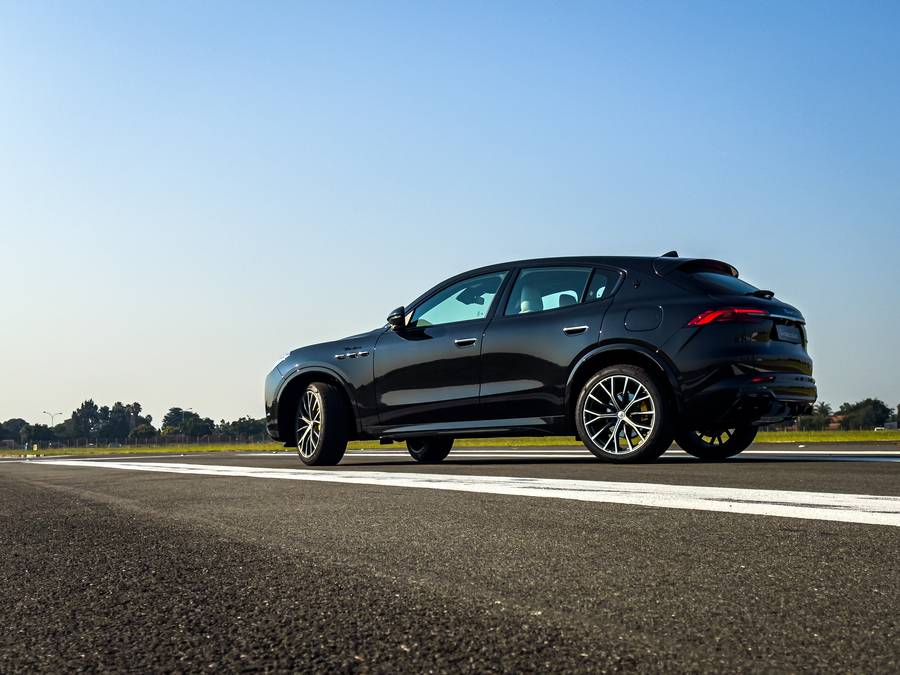
This is the Grecale, Maserati’s answer to increasing profits and clawing back market share from the glut of luxury SUVs available nowadays.
Given its smaller proportions and variety of spec iterations, including some beautiful colour combinations and Maserati’s trident-inspired wheel designs, the Grecale has a strong eye on bringing more women buyers into the stable.
The intention is clear. While it is a new model in the Maserati South Africa line-up, there is no doubt the Grecale will become a bestseller within the next few months. That’s the very point of its existence — to bring new buyers to the brand and keep them there.
Some criticisms have been levelled at its design, specifically its gaping grille, which some say bears a close resemblance to that of the Ford Puma, which was launched in Mzansi recently. While I see it, I certainly don’t think the Grecale is as offensive or as similar in the metal.
It’s a comprehensively designed vehicle with a focus on keeping Maserati details intact.
The trident badges on the C-pillars as well as the trio of side air vents finish the design, while the 21-inch Crio Matte aluminium wheels give it stance and presence.
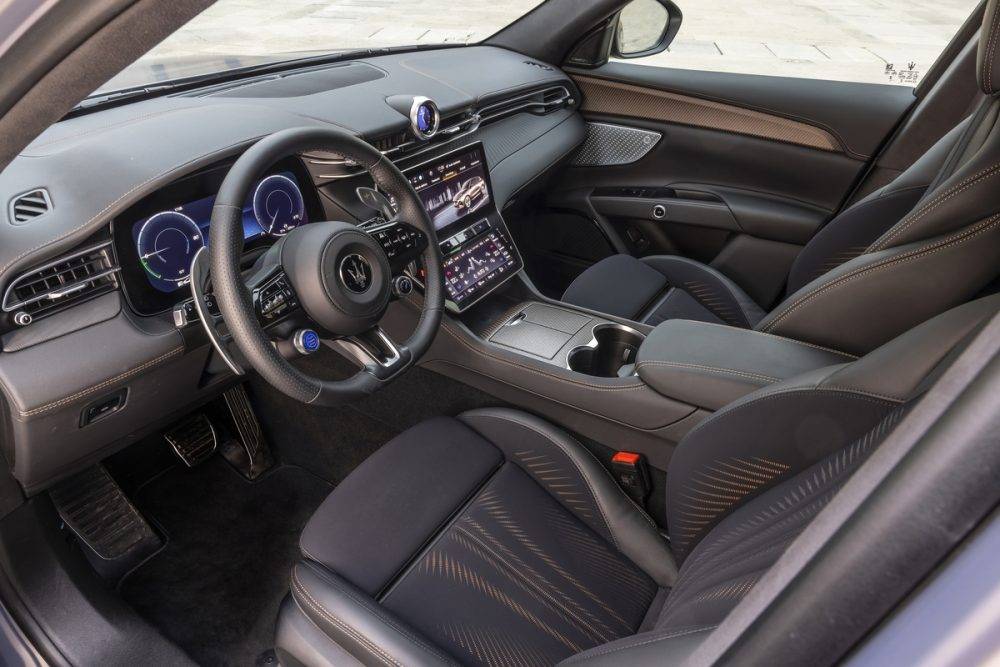
The Grecale’s newly designed interior is the real showstopper. It leaves you with the impression of a truly modern and high-tech vehicle. The centre piece is a dual-screen layout powered by Google, a double-combo of 12.3-inch above 8.8-inch LEDs.
These screens house most of the switchgear and cabin controls, which can be quite overwhelming, but within the layers of menus and control surfaces, the screen resolution, system speed and user experience are all top-notch, making it the best infotainment offering from Maserati in a long time.
Further into the cabin, the mix of materials and the way the design has woven in traditional stitching cues with sculpted air vents that blend into the dash is a tasteful execution from the Italian stable.
Behind the steering are large aluminium paddles fixed to the stalk, as usual, and they play to an overall sporty, yet trendy, Maserati feel.
It’s a genuinely well-appointed cabin, with excellent ergonomics all round, and supportive sport seats that can be ventilated and heated.
The optional Sonus Faber sound is something to have, offering outstanding audio quality but, at over R130?000, this must be something you’re really into.
You’ll be surprised by the spaciousness of the Grecale, especially in the rear quarters, where it feels more comfortable than its rivals in all respects.
The boot swallows 540 litres of stuff, and that too bodes well for Grecale, a car that will look to capitalise on those added features and benefits over its ever-popular rivals, namely the Mercedes-Benz GLC, BMW X3, Volvo XC60 and Porsche Macan — a batch of rather creditable vehicles.
So far, so good but how does it drive? In short, it’s like a Stelvio. I’ve spent a considerable amount of time behind the wheel of the Alfa Romeo, on which this Grecale is based. The driver feel is similar as far as the steering, ride quality and chassis are concerned. That is to say, very good.
The electric steering rack is a great compromise between sportiness and everyday comfort, which is really where the Modena specification needs to be.
The engine is a 2.0-litre, four-cylinder turbo petrol with an additional 48V starter generator that is designed to feed additional torque into the system at lower engine speeds but also to improve overall engine efficiency and downplay engine load.
But this is a Maserati, so performance is a big consideration, even in the mid-spec Modena.
Thankfully, the performance is there and 242kW is ample power to play with.
The ZF eight-speed transmission is fantastic, and you can interact with it using those attractive paddle shifters behind the wheel.
On a side note, you can also use the paddles to switch between reverse (left paddle) and drive (right paddle), when negotiating a parking spot, for instance. Nifty.
The engine is certainly not lacking in character, with the ability to transform through the drive modes into a burbly, excitable spirit.
The GTI-esque burp on the upshifts is entertaining, as is the overall drivability of this motor.
Even with the mild-hybrid system, the Grecale still exhibits some power lag at pull-off before all the systems spool up, but once that happens, it delivers the performance expected at this level.
It could do with some work on the balance to increase rear rotation, as it does tend to wash out as a default, but you can feel the chassis could give more to make the Modena a little more playful.
As far as driving modes go, the GT setting is the sweet spot, adequately sporty but erring on the side of comfort.
The driver’s display and graphics provide various layouts and layers of information that you might need but the one that I found myself looking at most was the battery gauge from the hybrid system.
Despite the car’s sporty character when you want it, the Grecale Modena is probably going to spend its time in urban settings, doing daily trips at slow speeds.
Here, the Modena demonstrates impressive levels of economy. I was pleased with under 11 litres to 100km. My economy cycle was able to get the reading down to 9.1 liters/100km over a 60km test route.
The Grecale scored 7/10 for this reviewer and I have not given all of the reasons for this.
On the down side, let’s start with the price of R2?320?000. Optional extras can quickly hike that by a few hundred thousand. It is a significant step up in price compared to its direct rivals and entices the consideration of some larger or more capable options.
This isn’t something Maserati South Africa can change — such is the nature of import prices with a weak rand.
Another problem is, within its richly textured and modernised cabin, there are concerns regarding the few buttons.
The steering wheel has the Starter button on the left-hand side and the Drive Mode selection toggle on the right. These are of inferior quality to the rest of the cabin, feeling like cheap plastic. Why, Maserati?
The gear selector buttons are between the infotainment screens. You might find the layout odd but that’s less of a concern than the feel and quality of these buttons, too.
It might sound nit-picky, but it’s noticeable and it raises the question again: Why? After spending so much time on the rest of the car, improving and innovating in so many areas, did they forget about these buttons?
Despite this, I can’t help but like the Grecale, as it is exactly what Maserati promised. It is a modern Maser and, even with its small capacity and mild-hybrid drivetrain, it’s a fun, trendy new product on the local market.
If budget is not a concern and you’re looking for something exclusive, the Grecale is worth a look. As a product, it’s very good. As an SA-market proposition right now? That’s where the points get deducted.
Submit and get free exposure here: Showcase Your Business | Advertise Your Special Offers.