Refuse Trump’s return to open racism:
Donald Trump’s chainsaw massacre of the rules and pieties that shaped the post–Cold War order marks a new moment in both American and global history. But, like the rise of fascism in 1930s Europe — when colonial ideas and practices were brought home — this moment is nested in longer historical continuities.
The United States replaced the great European powers as the dominant global power after World War??II, emerging with overwhelming economic, military, cultural and institutional power. During the Cold War, it shared global dominance with the Soviet Union but remained preeminent in the capitalist world. Its dominance was fully consolidated after the collapse of the Soviet Union in 1991.
Trump’s aggressive nationalism is an attempt to defend the waning global power of the US against new contenders, most notably China. It is also a response to broader shifts in global power, including initiatives by Brics to establish a bank and a unified payment system that facilitates transactions in local currencies — reducing dependence on the US dollar and the SWIFT financial messaging network — and the proposal for a common Brics currency.
During and after the Cold War the US used a mixture of hard power — invasions, coups, assassinations, sanctions — and soft power — its media, universities, think-tanks, state and allied private donors and its power over the international financial institutions — to sustain its domination.
Force was mixed with the seduction of persuasion and incorporation. Vietnam and Iraq experienced devastating violence and Chile and Haiti suffered coups while post-apartheid South Africa got funding for media, think-tanks, universities, NGOs spun as “civil society”, scholarships and regular invitations for selected editors, academics and others to the embassy.
Trump has not turned away from all forms of soft power — X and Facebook are being even more effectively weaponised than before — but he has radically scaled back much of the use of soft power in favour of crude intimidation and bullying. Bullying is always a sign of weakness and this is not the politics of a man or a country enjoying the unflustered assurance of unrivalled power.
Holding an old line
Trump’s turn to open and crude threats in domains where the US recently sought to win consent through persuasion and incorporation is not only about defending the US as the global hegemon. It is also about defending the imbrication of the US in older forms of domination.
Europe and its settler colonies have ruled the world since 1492 when Columbus arrived in the Caribbean. That domination was originally legitimated and organised through a claim to the superiority of Christianity. Since the latter part of the 17th century the dominance of religion has given way to race as the central ideology. After World War II claims to the superiority of the West began to displace open claims of racial superiority in polite company. But the West always largely meant Europe and its settler colonies and this was a refinement rather than a rejection of racial ideology.
Both Richard Nixon and Ronald Reagan were recorded making grossly racist statements in private during their time in office but after the moral victory of the civil rights movement in the late 1960s no US president made openly racist public statements. Dog whistles, particularly in reference to crime, were preferred. George H Bush infamously used the Willie Horton television advert in 1988 to stoke white fears about black criminality.
Trump has reasserted the open expression of brazen racism. One of the most astonishing expressions of this has been the contrast between his vicious hostility to Mexican and Haitian migrants and his bizarre claim that Afrikaners are an oppressed minority in South Africa.
With the support of South African emigres like Elon Musk, the most followed person on X, and Joel Pollak, an editor at the far right Breitbart News, this has placed claims about white South Africans at the centre of the open racial revanchism in the US.
Challenges to racial order
Just as Trump’s turn to bellicose grandstanding on the international stage is motivated by the declining power of the US, his turn to open racism is motivated by a set of challenges to white domination in the US. These include demographic change, a growing consensus on the need for diversity in elite spaces and the huge protests following the murder of George Floyd in 2020. These protests, which brought millions of people onto the streets, perhaps as many as 26 million people, were a direct challenge to the racial order, an order that has always been grounded in white impunity.
That order was also challenged by the growing popular refusal to accept impunity for Israel’s oppression of the Palestinian people and its murderous destruction of Gaza. The protests on US campuses were a direct challenge, as was South Africa’s brave decision, understood as unacceptable temerity by the US political class, to take Israel to the International Court of Justice (ICJ).
Trump’s personal connections with right-wing white South Africans predate his recent embrace of Elon Musk, and his support for conspiracy theories about white oppression in South Africa predate the ICJ case. He has a long-standing personal relationship with Gary Player who, in 1966, declared that “I must say now, and clearly, that I am of the South Africa of Verwoerd and apartheid.” These days Player speaks the standard part paranoid and part hyper-masculinist language of the dangers of wokeness and the benefits of ice baths typical of the red-pilled online right. It was back in 2018 that Trump tweeted about “the South Africa land and farm seizures and expropriations and the large scale killing of farmers”.
For any racist the idea of white people living as a minority among a black majority, let alone under largely black rule, is going to be deeply unsettling. But this is not the full explanation for the intense and escalating hostility to South Africa by Trump and others in the US. They are also exploiting racism and racist conspiracy theories to legitimate their attack on South Africa for the temerity of taking Israel to the ICJ.
It is essential that we understand that it is not only the Afrikaner right, organised most effectively in AfriForum, that have actively sought to build a transnational project to openly affirm white claims to special standing. There is a strong current in English-speaking white liberalism, often evident, for instance, on BizNews, that does the same, albeit in a different register.
Reject racial paranoia
South Africa confronts many serious problems, including a stagnant economy, massive unemployment, systemic impoverishment, rising prices, frightening rates of violence, decaying cities and municipal services, and rapacious and sometimes dangerous political mafias. Although there are, of course, whites who have been murdered or who suffer unemployment, and many white people struggle with surging food prices and municipal bills, white people are, on average, vastly better off than other South Africans and much better placed to deal with these difficulties. White people enjoy all the rights and freedoms affirmed in law after apartheid and participate in all aspects of society.
The idea that white South Africans are an oppressed minority is risible. White South Africans who are concerned about real problems, such as pervasive violence, should be working with all other South Africans to address these issues rather than succumbing to delusional racial paranoia or making deliberate attempts to assert the sanctity of whiteness — a sanctity always sustained by the reduction in the value accorded to others.
The problem here is not solely a matter of the hallucinations of racial paranoia being taken seriously by Trump and Musk, two of the most powerful people on the planet. It is also that it is being used to threaten and pressure South Africa and curtail its sovereignty.
White South Africans must make it clear that claims of white oppression in South Africa are absurd. We must oppose racism at home — whether from Afrikaner nationalists or English-speaking liberals — and reject any attempt by the US to punish South Africa for its principled stance at the ICJ. We must insist that the serious problems South Africa faces are addressed through democratic disputation by the South African people, not appeals to the power of the Big White Father in Washington.
Richard Pithouse is distinguished research fellow at the Global Centre for Advanced Studies, an international research scholar at the University of Connecticut and professor at large at the University of the Western Cape.
Cruise offers a floating escape:
The MSC Musica’s horn reverberated across the Port of Durban, declaring its departure as it gained speed, whooshing through the harbour mouth on a sticky, late summer afternoon.
The farewell cheers of the enthusiastic cruise passengers above us almost drowned out the clink of our champagne glasses as we celebrated the view from our deck 12 cabin balcony, and our freedom on the Indian Ocean for the next few days.
With a little help from a tug and marine pilot, who was swiftly airlifted into the helicopter thwapping above, the ship broke away and powered effortlessly into the horizon.
Our destination: the pristine sands of Portuguese Island some 6?798 nautical miles away in Mozambican territory. Three nights and two full days of blissful escape.
On deck 13, the 2?550-passenger capacity cruise ship’s pools were already bursting at the seams with rotund bodies. Drinks flowed in anticipation of the late Friday afternoon sail-away party, signalling the first night of our journey.
Weather: idyllic. Sunshine, blue skies. A gentle, cool breeze.
Leaving the sunseekers to satisfy our gnawing appetite after the champagne, my cruise companion, a local Durban blogger, and I took a walk to the Il Giardino Buffet Restaurant and Gli Archi cafeteria, to find lunch.
It was around 4pm. We had not eaten earlier as we were boarding the vessel. This was done VIP style, through the MSC Privé Lounge and the MSC Yacht Club, a breeze.
We then settled into our cabins, polishing off a bottle of complimentary French champagne.
Cruising, after all, is about sun, sea, sipping and supping — in equal measure. By day, and night, passengers streamed the entertainment decks with exotic cocktails — electric blue, shocking pink — and icy buckets of beer to party the wee hours away, while some migrated to indoor bars for a more refined feast and entertainment.
A slice of Margherita pizza from the buffet — I had been looking forward to the buffet pizza until 2am thanks to happy memories of taking full advantage on my first cruise on MSC Sinfonia years ago — and a delicious chickpea salad with tomatoes, lettuce and generous chunks of Parmesan on the side did the trick.
Before I knew it, it was almost 6pm and dinnertime — preferable to the late 8pm sitting in the Belle Époque on deck 6. It’s one of the ship’s two main dining rooms, serving Italian and other Mediterranean food.
I opted for a Greek salad for starters, which was delicious, and a sirloin steak with vegetables for mains. Those who chose the spaghetti bolognaise were delighted, and I thoroughly enjoyed the lasagne during a subsequent dinner, not to mention the delectably decadent tiramisu.
Here’s another thing about cruising, especially for us Durbanites who embrace slops and sandals, shorts and skirts almost as a uniform: it gives us the chance to dress up for dinner — gala gowns and dinner jackets, saris, silk dresses and high heels are all welcome here. You won’t feel judged or overdressed.
Dinner was a delight. We were served by bubbly Kenyan waitress Jenny. MSC’s mission to hire Africans, in particular South Africans, was evident. From the bars and lounges to the cabin cleaners, they abounded. On the Sinfonia cruise in 2017 the staff were mainly Filipinos — who have perfected the art of hospitality — so the nationality difference was notable. It’s refreshing when companies live up to their promises.
Some of our group headed to the 13th deck for drinks after dinner, a few went to bed early, while the rest partied the night away at the disco.
I had a good night’s rest in the king-size bed in my well-appointed cabin and awoke to the inviting view of the island. We had arrived.
Deciding to avoid the breakfast rush in the restaurants I had ordered a meal to be delivered at around 7am.
MSC’s breads, not least their croissants are a star of the show at meals, and breakfast was no exception. The hot chocolate was a treat and the pot of coffee served wonderfully hot.
I had been nervous about going on the boat that would transport us from MSC Musica to the island, as my Sinfonia transit to Pomene Beach had been a little rough. My fears were unfounded.
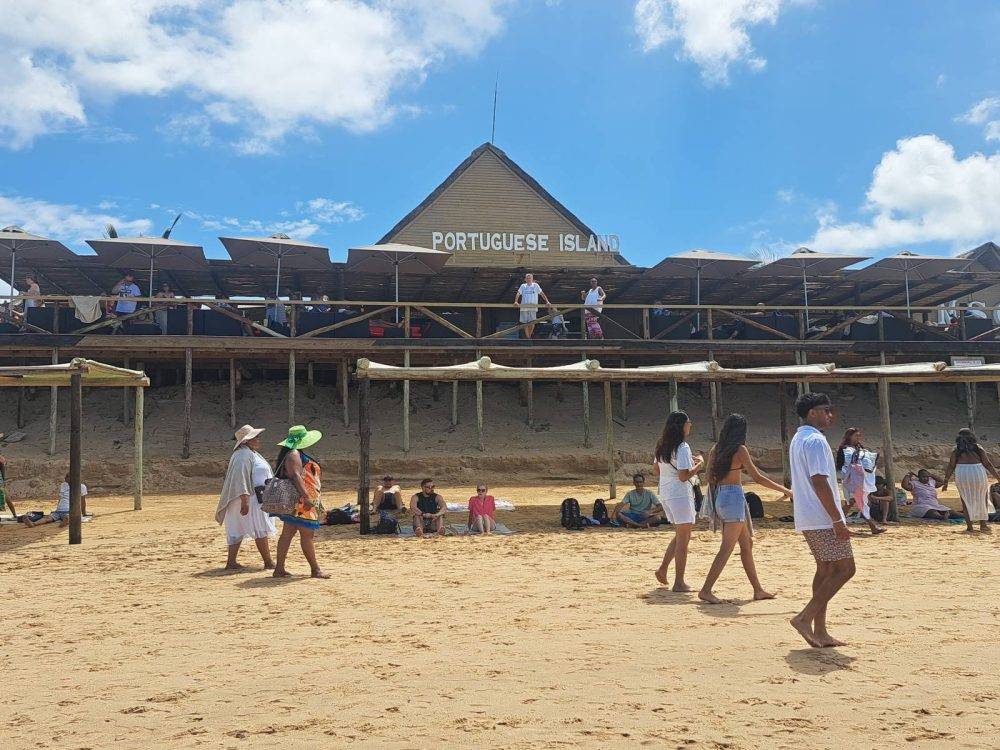
In 10 minutes my landlubber feet were on the pristine island sands enjoying a stroll along the shore to the Exclusive Beach Lounge, far from the madding crowd. This experience includes a private bar and a lounger with an umbrella, which comes at an extra cost, but is worth it.
About 2?000 passengers had descended on the beach, so the general access area was extremely crowded. But there were sufficient bathrooms and buffet stations with the same lunch — braaied pork steaks, chicken, boerewors and salads — as the exclusive lounge.
My only regret was that I found the pizza station in the general access area too late — there was no pizza in the exclusive area — and it had closed.
Some in our group wandered off to explore the island before joining us for recreational activities. These included tubing — an invigorating activity for adrenaline junkies as two to three people sit in a floating tube that is dragged at speed by boat across the water — paddle boating and snorkelling in a nearby protected coral reef.
I opted for the most relaxing option, in my view — snorkelling. It involved a short ride on a zodiac-type boat to explore the coral reef.
It was a little disappointing because visibility was poor, possibly due to recent rainfall, but the dip in the ocean was refreshingly cool on the sweltering day.
When we arrived back at the main beach we found the MSC crew rounding up passengers to return to the ship. The day was over too soon and it was sad to see the mess fellow passengers had left behind, especially the beer and cider bottles washing around the shoreline.
But it turns out MSC Cruises hires locals from the main island Inhaca to handle clean-up services and ensure the island is pristine to receive the next group of guests.
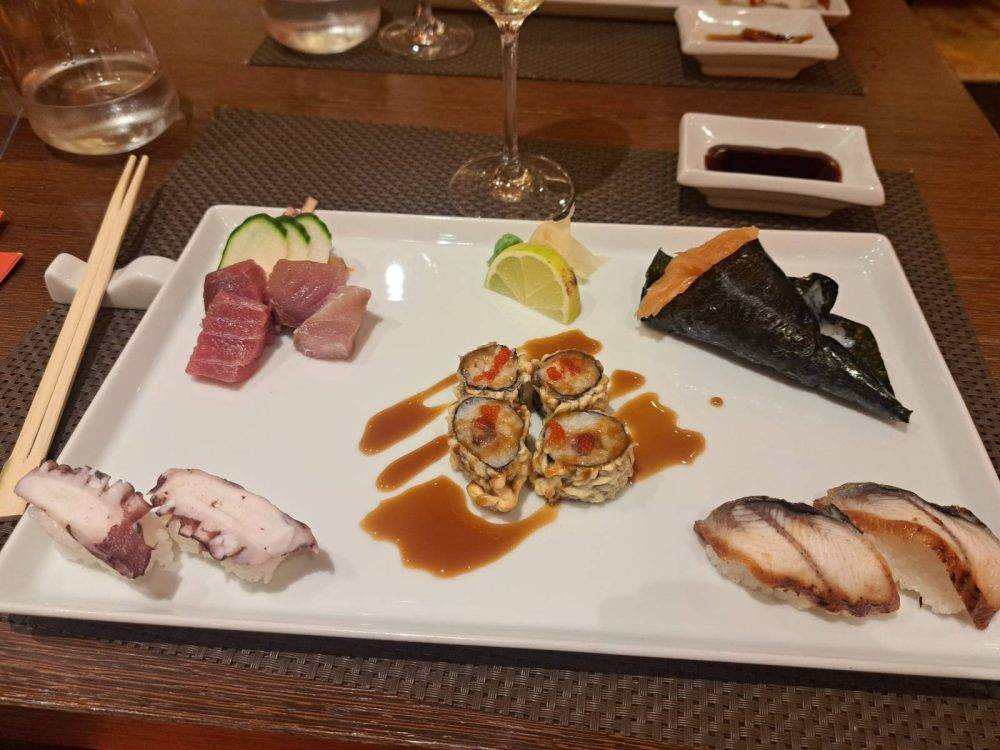
Sun-kissed and weary, we returned to our floating hotel where we dined sumptuously on sushi in the Kaito Sushi Bar. I tried miso soup for the first time — made from fermented soybean paste — and loved it, but gave the array of raw fish a miss, tasting only the tempera prawns, which were scrumptious.
Then it was off to Teatro La Scala to watch a dance and music show that eased us into an evening of cocktails and karaoke, which was such a blast that we joined in again on our last night aboard, almost forgetting it was Sunday, and that work loomed large on Monday morning.
Apart from the lazy day on the beach, breakfast in bed and karaoke, without a doubt, the luxurious Balinese massage in the Aurea Spa and the time spent relaxing in the jacuzzi on Sunday was the highlight of my cruise.
And then, unfortunately, all too soon, our cruise was over.
We woke up in the Port of Durban on a bright Monday morning, feasted in the dining room on a buffet breakfast — Italian hospitality will never send you home hungry — and disembarked.
Invigorated to my soul, I stepped out to face a day of deadlines, the week and the long year that still stretched ahead.
The journalist’s trip was sponsored by MSC Cruises.
Democracy on the line in global economic trade stand-off:
The Great Depression of the 1930s had begotten severe protectionist policies, with governments around the world imposing rigid tariffs and world trade shrinking drastically as a result. Gradually protectionism eased off, coming to an end after World War II when the United States-led initiative to liberalise trade among all capitalist countries took root. The 1947 General Agreement on Tariffs and Trade and its 1995 successor, the World Trade Organisation, opened the markets with the low-tariffs ideology becoming global in the wake of the collapse of communism.
This rules-based economic system that the US helped create came to an abrupt and dramatic end on 2 April 2025 when Donald Trump imposed huge tariffs on nearly every country in the world, snapping handcuffs on international commerce and causing what some already call a global trade war.
A mere week later, on 9 April, Trump stunned the world once more when he announced a 90-day “stay of execution” for the implementation of tariffs for all countries, except China which he punished for its retaliation with a 125% tariff. No one knows what will happen in three months’ time, but this confirms Trump’s obsession with tariffs, having said many times that it is “the most beautiful word in the dictionary”.
Trump deemed roughly 60 countries to be the “worst offenders”, accusing them of unfair trade practices towards the US and calling them “countries that treat us badly”.
South Africa is one of them.
Holding up a chart listing countries accused of undermining American economic goals, Trump proudly professed this to be “our declaration of economic independence”.
The very allusion this trumped-up (no pun intended) chart having anything to do with a document as fundamental to the idea of liberty and individual rights as the American Declaration of Independence, sticks in one’s throat like a bone. To say nothing of the overall hypocrisy.
Imposing a 30% import tariff on South African goods, Trump has singled out the country for policies he says discriminate against white farmers. Clearly ignorant of the terms of the new Expropriation Act, he accused the South African government of discriminating against the Afrikaner minority by seizing their agricultural property without compensation.
As if he cared about minorities. Prejudice against African Americans, Hispanics and, in particular, Muslims, is in Trump’s DNA. Even when he invokes the “we” when speaking of “making America great again”, the “they” pronoun slips in frequently when referring to non-white ethnic groups. Then it is “they” who want jobs, and “they” who want a better way of life. Bottom line: it is not about minorities; it is about defending white supremacy under autocratic rule.
South Africa has also been accused of allegedly undermining US foreign policy that poses a threat to its national security. It is ironic that South Africa maintains friendly relations with Russia, America’s purported enemy, while the Trump administration is engaged in a major reconciliation with Moscow that could trigger the biggest reset in international relations since the collapse of the Soviet bloc.
Small wonder then that Russia is missing from the “liberation” chart of the worst offenders. But this could be the carrot Trump uses to prompt the procrastinating Vladimir Putin to commit to peace talks with Ukraine in a war he had promised to end on “one day”. For Trump, losing face is not part of the game.
The exacting tariffs imposed on South African imports to the US do not bode well for the country’s economy. Agriculture and vehicle industries are especially vulnerable. The anticipated curtailing of the beneficial access to US markets through the African Growth and Opportunity Act (Agoa) looms large as another serious concern. Reduced export volumes can only exacerbate the country’s already evident economic weakness and financial strain — as the ongoing national budget debacle makes clear.
President Cyril Ramaphosa and several other leaders of developing economies reacted cautiously to Trump’s announcements. While expressing concern about the unilaterally imposed punitive tariffs, Ramaphosa said that staying committed to negotiations with South Africa’s largest trading partner was the best way to establish a mutually beneficial trade relationship between the two countries.
Responses from other leaders varied. The British Prime Minister, Keir Starmer, also declared that the United Kingdom’s national interest demanded securing a trade deal with the US to avoid a trade war. But he did add that additional options were not “off the table”. Canadian Prime Minister Mark Carney’s stance was more determined, indicating his country’s intention to react with purpose and force. China chose immediate retaliation, slapping additional 34% tariffs on goods imported from the US.
Whether individual countries or the European bloc respond with appeasement or retaliation to Trump’s provocation, remains to be seen. What is already obvious is that both anger and alarm grow as the fuse to a global trade war has been ignited, with markets taking a plunge. But maybe we should not worry too much about that because the US secretary of state, Mark Rubio, assured us these were just “teething” problems.
The still larger concern is that while the global economy is in deep trouble, so is the geo-political order as we knew it. Only a few months into Trump’s second presidency and the process of democratic erosion in the US is already in full swing. Besides issuing a string of executive orders of dubious constitutionality, the Trump administration has curtailed the powers of the Congress over the budget, repeatedly defied court rulings, violated the civil rights of federal workers, and weaponised US Immigration and Customs Enforcement laws.
What are the future implications for global democracy when its former leading advocate is turning into a belligerent autocracy?
Different scenarios can be contemplated.
The pessimistic one can be glimpsed from the 2012 book The Globalization Paradox: Why Global Markets, States, and Democracy Can’t Coexist by Turkish economist Dani Rodrik, who refers to the “international trade trilemma”. He postulates that it is impossible for nations to achieve full economic globalisation while at the same time retaining full national sovereignty and democratic control. Prioritising the latter at the expense of globalisation seems a sensible way forward.
Only that boat has already sailed. In addition to the deeply entrenched global trade interdependence, ecological frontiers refuse to align with geographical state boundaries. Meanwhile, the growing number of populist leaders trivialise and dismiss environmental concerns in favour of protecting industries critical to their electoral base. The current global economic trade standoff is bad enough; the failure to reach international environmental agreements will be worse. Dire consequences await humanity.
The logical scenario is to work round the US, creating new multilateral trade alliances that would exclude it from global networks. Hard to do, but not impossible.
“Democracy to the rescue” is the heading of the optimistic scenario. As Canada’s foreign minister, Mélanie Joly, stated: “Only the American people can stop this madness.”
The groundswell of discontent that we have witnessed in the “Hands Off” protests can only gain momentum, and not just in the US.
Professor Ursula van Beek is the director of the Centre for Research on Democracy at Stellenbosch University.
Submit and get free exposure here: Showcase Your Business | Advertise Your Special Offers.