
Residents force Nelson Mandela Bay councillors to walk in streets flowing with sewage:
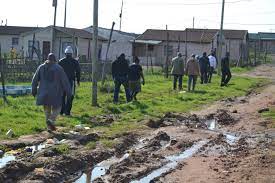
Nelson Mandela Bay councillors, who had come to deliver gifts to poor families in Peace Village, Kariega (formerly Uitenhage), last week were sent packing by furious residents.
The vehicles of the five councillors were blocked from entering the area.
Residents stormed out of their RDP houses, blew whistles and burnt tyres. They ordered the leaders to drive in a convoy through stinking Sakhwatsha Street instead.
A South African Social Security Agency bakkie and a municipal truck carrying sand to be put on the street where the event was to be held, were chased out of the area.
“All convoys must drive through Sakhwatsha Street,” shouted Lwamila Tayi, one of the protesters.
Protesters sang “amabhul’ amnyama andenziwari (black boers make me worried) and “isikhalo somntwana sihoye” (attend to a crying child).
Sakhwatsha and other streets in the area have been in a mess for years, with open drains, overflowing sewage, trenches, broken bottles and overgrown grass.
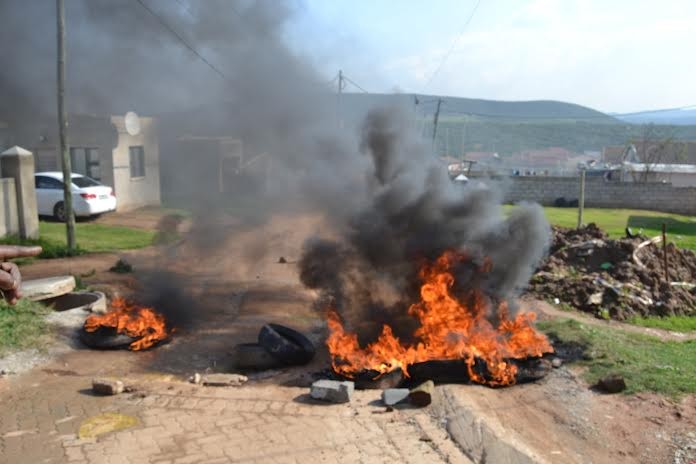
Protesters blocked the streets to divert the councillors’ convoy.
“When we call an ambulance, it can’t drive through Sakhwatsha Street. When we need police vans, they can’t access RDP homes through Sakhwatsha Street, because this stinking street is very bad,” said Tayi.
She told the visiting leaders, “We are not against your 67-minute project. All we want is that you must drive through Sakhwatsha Street and feel the pain. We are surrounded by stinking drains.”
Another resident, Mzwakhe Nyiki, said the councillors had brought a truck to make temporary repairs on the streets they were planning to visit. “What about the ones we have been reporting for over five years that are bad?” he asked.
Resident Vusumzi Celem shouted, “We are not here to talk to you. No negotiations. We have been reporting drains, stinking streets to deaf ears. And getting reference numbers doesn’t help, because no one is fixing anything. We are not against your event but we are saying: drive through Sakhwatsha Street.”
Councillors Lungile Langbooi, Sabelo Mabuda, Yolisa Pali (mayoral committee member for corporate services), Bongani Mani and Makhi Feni suggested that a meeting be held but Langbooi reminded the protesters that they had burned his office during a protest for electricity.
Celem said: “We are angry now. We are not willing to be addressed now. They must just do a convoy on Sakhwatsha Street.”

Angry residents refused to allow the councillors to deliver the Mandela Day gifts they had brought.
Finally Pali and her fellow councillors had to walk along Sakhwatsha and Siboni streets after being ordered by protesters to go and see the condition of the streets with their own eyes.
When they came back, they addressed the protesters. Pali said: “Give us a chance because that street [Sakhwatsha] needs resources and it’s a long term project to be undertaken.”
“We will make sure the streets are fixed,” she promised.
This article was first published by GroundUp.
Parents worry that learners’ misuse of electronic educational devices goes unchecked by schools:

Parents want the Gauteng education department to create a system to monitor the content on the electronic devices
Global egos trap Ramaphosa into socio-political quagmire:

South Africa’s “safe” positioning in the East versus West cat-and-mouse fight demonstrates a broader political battle Africa will forever find itself in. One wonders where the country would have been if former president Thabo Mbeki had been successful in continuing his tenure as ANC president after the party’s 52nd conference in 2007 and appointed a successor.
In 2008, Jacob Zuma succeeded Mbeki as president and, over the years under his reign, we saw South Africa become a member of Brics, which consisted of Brazil, Russia, India and China. This could have been regarded as a radical move in what leftist political populists would allude as the beginning to “breaking the shackles of Western colonialism”. Notwithstanding the history and relationship that South Africa has or had with Russia, one finds peculiar the complexities of politics and economics, more essentially South Africa’s economic quagmire with global political egos of the West and East.
For a better part of 2023, this country faced a battle of allegiance. President Cyril Ramaphosa’s predecessors had the political luxury to shape South Africa into what they deemed as a trajectory of success. Notwithstanding their differences, this propelled them to make firm decisions on policy positions and economic decisions. Mbeki, in particular, was a pan-African capitalist and was criticised for the development of the black bourgeoisie. The development of the Growth, Employment And Redistribution (Gear) macroeconomic strategy, as the anchor of the growth and development trajectory of this country, was characterised by neoliberal reforms, including a competitive platform for the tradable goods sector; a stable environment for confidence and private investment; a restructured public sector to increase the efficiency of both capital expenditure and service delivery; new sectoral and regional emphases in industrial and infrastructural development; and greater labour market flexibility. This interventionist approach yielded major infrastructure investments mainly from the private sector, particularly the international market, and through black economic empowerment (BEE) policy, it enabled the development of the black middle class.
Zuma’s tenure was marked by elevated levels of corruption and administrative inefficiencies. His pseudo leftist stances on policies and radical shifts in allegiance from East to West, for instance, shaped the “new” direction South Africa took. Despite “soft leftists” policies the neoliberal capitalist approach remained.
The former presidents laid foundations and established systems and policies that shaped this country with the political luxury of majoritarianism. Ramaphosa’s policy position is more complex, because in as much as he is a liberal and a capitalist, he finds himself in a socio-political quagmire. He not only does not have the luxury to make radical decisions without a threat from the ruling party, he is incapable of ripping the bandage off and deciding what he deems fit to be the success story of South Africa. To add on to the complexity, the political environment is now a contested terrain. It has unlocked the formation of political parties, which has resulted in the reign of the ANC dipping below 50% for the first time since democracy. The party is even at risk of losing its majority in the 2024 general Elections. This context provides the strand that explains the inability of the current president from making decisions.
Regarding Russia’s war in Ukraine, the United Nations turns its back on war crimes mostly emanating from the West and yet each day we are painted a picture of the evil that is President Vladimir Putin. We’re subjected to a long-standing ego battle between groups of men. The African child is now found wanting. Some countries have chosen their stances and South Africa has decided to stay on the fence. It is a safe choice.
The South African economy is characterised by low growth and high levels of unemployment. Unemployment rate at an 11-year high with youth unemployment contributing the highest. The governor of the South African Reserve Bank is on a mission to stabilise inflation, despite the prevailing socio-economic conditions. This is the state of South Africa and what comes with it is choosing among Goliaths who have the potential of destroying the economy. Had Zuma not decided to join Brics, had the outcomes of the Codesa negotiations turned out differently, had Nelson Mandela and Mbeki laid a democratic foundation of a socialist, leftist reform for South Africa, what would be our stance as a country today from an allegiance point of view? Would International Relations and Cooperation Minister Naledi Pandor have been so vocal on the hypocrisy displayed by the West? Would Ramaphosa have been so bold to lambast the French counterparts on the constant need to reduce Africa to a charity drive?
These are questions that connect the dots of today’s quagmire and if we’re being realistic, it depicts a picture of going nowhere slowly and with each election cycle, South Africa continues to deteriorate. Local government elections, for instance, have manifested a cohort of political bargaining at the cost of service delivery and with the complexities of global politics, can the current state of South Africa survive inconsistencies in political bargaining?
Speeches about peace demanding recognition from the Goliaths of the world are not solutions to prevailing realities. South Africans want leaders that are decisive and want to better the state of this country.
It is unfortunate that Ramaphosa’s geo-political standing and his standing with the ruling party leaves him in a tug-of-war between what’s best for his survival as a president, his approach in policy positioning, particularly on the global front, and his effect on the overall socio-economic disposition of South Africa.
Noma Gamede is an aspiring political economist and a senior research specialist by profession in the City of Ekurhuleni specialising in local governance and finance.
The views expressed are those of the author and do not necessarily reflect the official policy or position of the Mail & Guardian.
Submit and get free exposure here: Showcase Your Business | Advertise Your Special Offers.
