
Sanele Qwabe: Breathing life into nostalgia with Kind Kid:
Sanele Qwabe crafts toys in his home studio in Durban which, he says, embody his childhood memories and celebrate black experiences.
After years of creating animated short films that struggled to find an audience, the 28-year-old Qwabe sought a sustainable way to fund his creativity, leading to the birth of Kind Kid.
Representation is a cornerstone of his work, though he resists using it as a marketing tool.
“If I was making toys of white kids, no one would ask why I’m doing it,” he points out.
The name Kind Kid stems from a desire for self-improvement: “I wanted to be a kinder person.”
This sentiment resonates through his art, which he describes as a manifestation of kindness and nostalgia.
With a background in information design at the University of Pretoria School of the Arts, Qwabe says he channels his “creativity and technical skills in crafting toys that are not merely playthings but vessels of memory, emotion and storytelling”.
For Qwabe, Kind Kid is more than just a toy brand — it is a manifestation of a lifetime of experiences, emotions and aspirations.
“This is something I wanted to be really proud of — to leave a legacy,” he says.
His journey began as a filmmaker creating animated shorts inspired by his life and culture. His films were often inspired by shows like The Proud Family, which depicted the everyday lives of black people without leaning into stereotypes of struggle.
However, financial challenges forced him to search for a different creative outlet.
“I needed to find a way for the creativity to sort of fund itself, which led me to the toys,” Qwabe explains.
Toys that invite people to reconnect with their inner child. He realised that the characters he brought to life in animation could also exist as physical pieces of art.
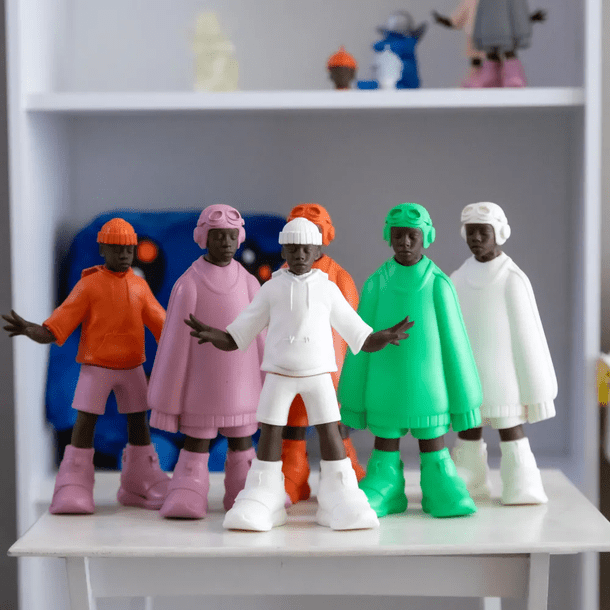
With toys, he found a way to make his work accessible and relatable,
enabling people to bring a piece of his creativity into their homes.
At the heart of Kind Kid lies nostalgia. Qwabe draws heavily on his own childhood and the those around him.
One of his earliest toys was inspired by a childhood memory of his sister perched on his shoulders, draped in their father’s oversized sweater.
“The pieces I make take you back to that younger self,” he says. “I think it’s cool to know that the little girl or boy is still somewhere in your heart.”
Each toy is designed to evoke these emotions, from its colours to its form, using a meticulous process that begins with a feeling and ends with a hand-painted masterpiece.
Qwabe is deliberate about the values Kind Kid represents. The brand reflects his personal ethos, which includes a commitment to authenticity and integrity. He has turned down lucrative collaborations with alcohol and vape brands to protect the image and message of his creations.
Sci-fi classic worth dusting off:
There may be no nerdier statement you read today but, if we take the mental leap and compare authors to rock stars, then books can be thought of as songs. Or, more accurately, albums.
I realise the above is ludicrous. First, there are no more rock stars. All we have left is the Gallagher brothers of Oasis calling each other names on social media.
And second, if any active creatives deserve the “rock star” label, it’s all the edgy, cool-attitude celebrity chefs who have crawled out of the woodwork in the last 15 years or so.
But here’s why I make this leap. Yes, it is great when a new artist comes onto the scene or when an established god-tier artist comes out with something new.
But, every now and then, you just want to hear the old hits — taking you back to a time and place — which are hits for a reason.
And with this in mind, usually, the esteemed staff at the Mail & Guardian reserve this space for fresh, new books but today let’s look at an older one that many more people should read.
Quick autobiographical note — in 1996, I was a first-year student at what was then known as the University of the Orange Free State. Coming from what was then the semi-rural Western Transvaal, even the relatively modest size and appearance of Bloemfontein and the UOFS blew my mind.
But, mostly, UOFS had the Sasol Library. Seven storeys of books? All available to me? Well, I do declare, this might be the best thing to happen to me since alternative rock reshaped my world.
I won’t lie and say I read every book in that library, top to bottom, but I certainly tried.
I had no car or girlfriend for the entirety of 1996, so free time was dripping out of my pores. And lack of funds meant I had to lean on what the world gave me for free. It’s in situations like this that you find novels like Blood Music by Greg Bear.
Now, anyone who knows the slightest thing about sci-fi literature will immediately associate Bear with his ground-breaking book Eon. And rightly so.

Published in 1985, Eon brought Bear to the public consciousness.
I’m trying hard not to spoil a 40-year-old book here but it deals with themes of parallel universes, manipulation of space-time and the concept of, “How infinite is infinity, actually?”
It does so with grace and candour, preserving the essential warmth and humanity of the central characters. This is no mean feat in a hard sci-fi book and it’s something Bear managed with most of his novels.
Eon is let down massively by its lukewarm sequel Eternity but let’s not concern ourselves with that. Let’s turn our attention to another book also published by Bear in 1985, Blood Music.
In this novel, we are introduced to brilliant renegade biotechnologist Vergil Ulam. He has figured out a way to convert white blood cells into very simple proto computers. In short, he has imbued single-cell organisms with the intelligence of rhesus monkeys.
Ulam dubs these new cells noocytes and is excited by the implications of their existence.
His employers less so. Intimidated by the concept of what are essentially the world’s first nano computers, they order Ulam to destroy his work.
Ulam, on the verge of doing so, looks down at a petri dish containing his creations and sees that they’ve organised themselves into a striated, hierarchical system.
It dawns on him that, if he were to hold that petri dish over a flame, it would be the action of a wrathful god destroying an entire civilisation of his own creation.
Unable to continue his work at his place of employment, but desperate to continue it elsewhere, and not commit what is, to his mind, genocide of a species, Ulam injects himself with a sample of the noocytes.
Over the next few weeks, Ulam experiences something unexpected. The noocytes are evolving. In large numbers, their intelligence is formidable and they have decided to reshape their environment.
It’s in subtle ways, at first. Ulam’s shortsightedness and back problems disappear, as his noocytes reshape his body from the inside. He begins to feel more energetic, more productive, stronger, faster. Even his sexual performance improves.
His new cells have noted the deficiencies in their host and begun to correct them.
But then, as will all intelligent civilisations, the noocytes begin to modify their environment to make things easier for themselves.
As an example, they set up a rapid-transit system, which takes the form of a series of channels under his skin, giving it an odd, veiny appearance. And soon, one vessel is not enough.
During his evening bath, Ulam notices that the water is turning pink, as the noocytes are sending envoys out of his body to seek other “worlds” to colonise.
The second half of the book deals with what happens when our intelligent macroscopic civilisation encounters the intelligent microscopic civilisation of the noocytes.
It is akin to the Gaia Hypothesis, if humans were planet Earth.
Bear successfully explores the concepts of the subjectivity of reality and consciousness and gives us a conclusion in which the nooctyes display a stronger grasp of the anthropic principle than humankind does.
In summary, if you’ve never read this book, and you like sci-fi, I urge you to give it a go. If you have read it, dust it off again and remind yourself of how good it is.
Vaal Dam’s levels are plummeting:
A dry early summer, successive heatwaves, Gauteng municipalities’ failure to maintain water infrastructure and ongoing work on the Lesotho Highlands Water Project (LHWP) have led to the precipitous drop in the level of the Vaal Dam.
The dam is at 24.9% capacity, compared with 66.8% during the same period last year, according to the department of water and sanitation’s provincial state of dams report issued on 16 December.
The levels of dams in the Vaal catchment are much lower than is usual in the middle of December, according to water governance adviser Carin Bosman.
“Our rainy season started very late. Our first rain was only on 14 October [and] then it wasn’t a lot of rain, and up to this week Monday and Tuesday, we only had a couple of showers. We didn’t get any proper rain yet; it’s a dry year.”
Bosman said the low inflows into the Vaal Dam as a result of closing the LHWP’s tunnel for planned maintenance work has obviously had an effect on dam levels. But she pointed out that it has to follow a specific maintenance programme: a one-day quick check once a month, a week-long check once a year and then a closure for a month every five years. Then there is a tunnel closure for three months every 10 years and for six months every 20 years.
“This is planned maintenance that is essential. If you don’t maintain the channel for the water project, it all fails and you have nothing. You have to do maintenance. We’re halfway through the maintenance planned to end in March, before the dry season, so that during the dry season, it will be online again,” Bosman said.
Another reason for low water levels is that municipalities are not reducing their water consumption.
The department’s water level scorecard recording average consumption from the Vaal Dam by municipalities shows that the City of Johannesburg had “quite a jump in consumption” mostly caused by leaking infrastructure and poor maintenance.
“Tshwane and Emfuleni do not show similar increases,” said Bosman.
Consumption of water from the Vaal Dam does not necessarily mean the water reaches the consumers, she said, pointing out that if maintenance is not undertaken, the increased leakages mean abstraction from the dam increases.
“If you have leaks, then you have to keep pumping more and that has had an impact on the availability of water in the Vaal.
“Drought, heatwaves, which increase evaporation, lack of maintenance by the municipalities — which leads to increased abstraction from the Vaal Dam — all of those factors contributed to the lower levels that we see now.”
Bosman referred to a graph of the Integrated Vaal River System — which consists of 14 dams feeding Mpumalanga, Gauteng, the Free State and Northern Cape — which showed that the system’s surface water storage stood at 72.2% on 25??November.
“We are on the upper edge of the ‘low supplies’ line. The last time we were at the same level was in July/August 2020 — the end of the dry season for that year,” she said.
“We have not seen the regular increases that are associated with the start of the rainy season in November/December, and there is a small gap before we hit the danger zone red peak at the end of January.”
Bosman said this meant everything possible had to be done to use water sparingly to have enough water until March next year.
“We are relying on good rains now to March to keep the levels to such a level that we’re okay.”
There is a backup plan: the Sterkfontein Dam, the level of which was 97.6% this week.
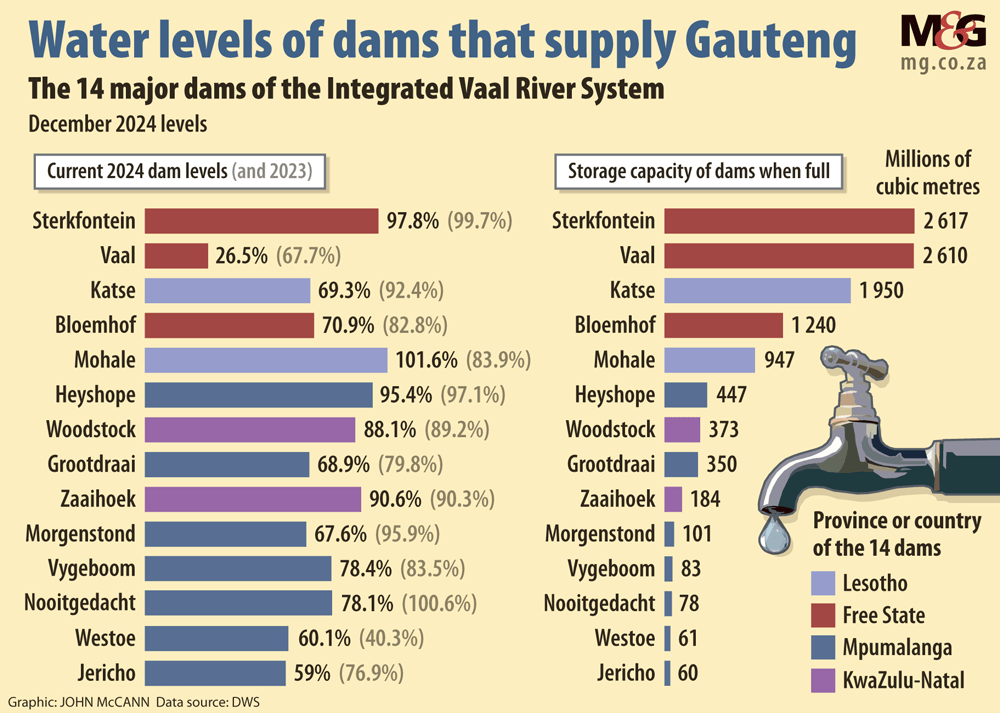
“The operational plan is when the Vaal Dam reaches 18%, then we release water from Sterkfontein. Sterkfontein contains about the same volume as the Vaal Dam; it’s a big dam, but it’s deeper and it’s got a smaller surface area, which means less evaporation. And it is almost full,” said Bosman.
“I don’t think people should panic because we do have this backup system.”
But there is uncertainty about whether there will be good rains from January to March, which means that people should remain vigilant and apply water-saving techniques.
“Every drop counts, save every drop that you can,” Bosman said.
This includes only flushing the toilet when it is really necessary; ensuring there are no leaky taps; taking five-minute showers; putting a bucket in the shower to collect water with which to flush the toilet; turning off irrigation sprinkler systems and only watering essential garden plants with a hand-held hose between 6pm and 6am because the water will evaporate at other times.
Further water-saving measures include not washing pets or vehicles with a running tap and instead using a bucket; not cleaning driveways and other hard surfaces with a hosepipe and not filling swimming pools, she said.
Residents should also put pressure on municipalities to fix leaks wherever they are spotted.
“Ask your municipality to set up a leak hotline so that leaks can be fixed as soon as they are identified. The best thing we can do is to keep the pressure on the municipalities, keep holding their feet to the fire so that they can do what they’re supposed to do,” Bosman said.
“In the medium to long term, we have to ensure that we hold municipalities accountable for their infrastructure maintenance and management, and we have to start considering alternatives such as non-waterborne sanitation.”
The department’s spokesperson Wisane Mavasa said the level of the Vaal Dam has been decreasing by 1.5% to 2% weekly.
She said this is primarily caused by low inflows to the dam because of low rainfall in the Vaal catchment area and elevated temperatures, which have led to increased evaporation losses.
The surface area of the Vaal Dam is wide and shallow and “therefore susceptible to high evaporation losses”, Mavasa said.
Another cause for the drop in the water level is the low inflow from the LHWP tunnel closure. The tunnel usually transfers 780 million cubic metres of water a year into the Integrated Vaal River System, but there was a shortfall of 80 million cubic metres this year because of the shutdown.
Mavasa said the primary objective for the augmentation of the Vaal Dam is to ensure that it does not go below the minimum operating level of 18% of full supply capacity, Mavasa said.
“This is to ensure that the water requirements of water users that depend on the Vaal Dam are met as stipulated in the operating rules,” she said.
Low water levels can cause erosion of the exposed areas of the dam that were once filled with water, she added. As a result, reduced dam levels can diminish the variety of habitats for a range of animals and plants.
“Furthermore, lower dam levels can prevent fish from migrating to spawn and reproduce, which can affect fish populations and other species in the food chain,” Mavasa said.
The department has not imposed restrictions on water use from a water resources perspective so the effect will be minimal regarding water supply for domestic, industrial and agricultural use.
“All users abstracting water from the dam continue to do so within their authorised allocation. [But] our water availability resilience is affected in the medium term when we start using our strategic reserves.
“To determine the extent of the use of these reserves requires a detailed economic impact assessment,” said Mavasa.
Kathy Manten, the owner of Manten Marina in Deneysville in the Free State, said the harbour on the Vaal Dam is dry.
“We had beautiful rains this week, which were really good up at Grootdraai Dam, which is in the catchment area, so hopefully we’ll be getting water coming through from the system,” she said.
“With the Katse Dam tunnel closed from the beginning of October to the end of March, we’re not getting any water from that system, and we get the bulk of our water from there,” Manten said.
“We’re really dependent on rain and, up until now, we’ve had very little rain in the catchment areas. Hopefully this is the turning point — you never know though.”
Submit and get free exposure here: Showcase Your Business | Advertise Your Special Offers.
