
Securitising responses to inequality conflict: Beware the Zim Way:
‘I was once a great democratic leader of a prosperous African country … never mind what happened after 1997.” Imagine former president Robert Mugabe rising from the grave and in his languid colonial British accent make such a remark. Only historians, political scientists and those old enough will make sense of him — able to recall the glories of a pre-Economic Structural Adjustment Policy (ESAP) Zimbabwe. The rest, who bow down to popular and populist history, only remember post-1997 Zimbabwe — the only Zimbabwe that matters, that still stands.
It is not particularly on account of the economic ravages brought on by ESAP measures that this is the only Zimbabwe remembered. It is because of the most hardened securitised responses to protests against economic hardships.
Post-1997 Zimbabwe has been reduced to the commanding figure of Big Bad Wolf Mugabe, who huffed and puffed it away. So unnerved were the victims of political persecution that pre-1997 Zimbabwe has been forever consigned to a footnote of history, written in size 6 font.
We can say the same for Seth, the Egyptian mythological god of deserts, wars, violence, thunder, storms, disorder and foreigners. No one remembers that he was once a good god. He famously stopped Apophis, the serpent, from disrupting the sun god, Ra, from its daily orbit of the earth.
In When a State Turns on its Citizens: 60 Years of Institutionalised Violence in Zimbabwe, Lloyd Sachikonye chronicles state-sponsored violence in post-2000 Zimbabwe. It is its evolution that unsettles him, how it morphed into institutionalised political culture, completely severed from its economic root causes.

It takes an incredibly short time for a palpably economic challenge to shapeshift into a political crisis of state legitimacy.
The political crisis then becomes the only thing that matters. All it takes is a series of flagrant human rights violations, meted out by the state against a people protesting against inflation, high food prices, unavailability of water, high electricity tariffs and closed-down clinics.
This is not a far-fetched likelihood for South Africa. This pattern also threatens to destabilise the legitimacy of the post-apartheid democratic South African state. It is going to be such responses to economic hardships, brought about sharply by home-grown austerity measures, in addition to the widening and seemingly perennial inequalities.
The shooting and killing of Andries Tatane on 13 April 2011 in Ficksburg, Free State, by the SAPS on live television during service delivery protests marked the first securitised response to inequalities conflicts in post-apartheid South Africa. The period 1998-2005 witnessed a spate of protests, particularly driven by threats of privatisation and public-private partnerships of public service delivery. Post-2005, these gained a particularly violent hue in Harrismith; Kennedy Road in Durban; Diepsloot, Balfour, Thokoza an Khutsong in Gauteng; and Macassar Village, Landsdowne Road and Mandela Park in Cape Town.
Stating the obvious, the spectacle of the South African state meting out violence on unarmed people over economic hardships protests is not new. However, a novelty that is highly likely to come to pass, a cataclysmic newness, is when such state violence gains institutionalisation.
It will contend with protesters pinned down by the height of austerity measures and the summit of inequalities. That is when economics becomes political. And then all the economic narratives will be on their way to the waste bin, consigned to the footnote of history, size 6 font.
Austerity measures are fiscal policies implemented by the state, aimed at resolving debt and economic growth during periods of economic stagnation.
Their common strategies are spending cuts, regressive tax measures, deregulating the labour market, and emphasising the role of the private sector as drivers of economic growth. In sum, the state attempts to shrink its social welfare role.
In this state, the economic distributive role of the state in favour of the poor majority citizens of the state becomes more circumscribed. As Finance Minister Enoch Godongwana stated in his 2024 budget speech, it becomes difficult to distribute the “economic pie”, particularly one that is not growing, in the face of worsening inequalities.
In Inequality Studies from the Global South, the inequality identified that resonates the most with South Africa is “existential inequality”. Its emphasis is on the discrimination of a particular, powerless group, and its basis is laid on skewed power relations.
David Francis, Imraan Valodia and Edward Webster argued: “It is not just about differences between individuals, groups, regions or countries. Differences are given or chosen, while inequalities are socially constructed. Inequality is about the condition that allows certain groups to dominate over others.”
How then should the South African state avoid the Zim way? How should the South African state contend with conflicts in the face of inequalities and the effects of austerity measures?
The solution lies in recognising that conflicts are likely to emanate from relationships with local or municipal governments over services delivery — and to utilise conflict transformation measures there.
Conflict transformation regards conflicts as motors of change that keep social structures dynamically responsive to social needs through nurturing and strengthening institutional and social relationships. At its heart is relationships.
These are formed between local government and community structures, creating and sustaining dialogue and engagement platforms that address immediate social needs.
Also, and more importantly, these platforms should, on an ongoing basis, engage in long-term conflict challenges. In that way, securitised responses to inequality conflict are edged out of the governance equation. And so, South Africa avoids the possibility of the securocratic elite embedding itself in the state for the long haul — as in the Egypt, Sudan and Zim ways.
Buntu Siwisa is a senior researcher at the Southern Centre for Inequality Studies (SCIS), Wits University.
Africarise: SA jazz to the globe:
Two distinctive human beings and two new albums simultaneously released. Their leaders Steve Dyer and McCoy Mrubata are united by more than the fact that both play tenor saxophone.
First, their latest releases, Dyer’s Enhlizweni: Song Stories of my Heartland and Mrubata’s Lullaby for Khayoyo, are launch albums for a new jazz label group from the New York-based RopeaDope. Africarise — “focusing on the art and music of Africa” — is the child of the US label’s collaboration with City of Gold Arts and helmed by Seton Hawkins.
South African by descent, but US-based, Hawkins has been an organiser of, and advocate for, our kind of jazz for many years in his roles as music writer, director of public programmes for jazz at New York’s Lincoln Center, a jazz studies faculty member at The Juilliard School of music in the city and the host of a South African hour jazz show on SiriusXM satellite radio station.
He’s facilitated many tours for City of Gold artists, supporting the kinds of working partnerships and ideas these albums reflect.
The two launch albums have a personal meaning for Hawkins, he says. Mrubata’s album Hoelykit? “got me into South African jazz”, while Dyer’s Life Cycles was a college favourite.
Beyond that, Hawkins feels, the albums are “two interesting representations of South African jazz — one fully developed within South Africa, with Southern African artists, and one featuring a transatlantic collaboration with American artists”.
“Both Steve and McCoy are extraordinary composers and players with very different voices and styles. Opening the series with two such iconic, but very distinct, saxophone legends felt like a strong foot forward.”
The second thing the two reedmen share is a core belief about the music they make — that it’s never just about the notes but about the intention and feeling performers bring to them.
Mrubata’s nine-track Lullaby for Khayoyo (the title tune is for his grandson) is a “testament to the power of collaboration”.
The saxophonist, plus South-African-in-New-York trombonist Siya Charles, are joined by five Americans in the group Siyabulela: guitarist Gary Wittner, altoist Evan Christopher, pianist Steven Feifke, bassist Jennifer Vincent and drummer George Gray. Dig deeper, though, and those aren’t the only underlying collaborations, with the SA connections going even deeper.
As well as compositional inspiration from work with guitarist Oscar Dlamini and ’bone player Jabu Magubane, Mrubata has been collaborating with Wittner since 2014, in groups and in a duo. Vincent is his regular US bassist; Feifke’s father, a drummer, was born in South Africa and veteran Gray is an Abdullah Ibrahim band alumnus.
Mrubata recalls how everybody showed passionate interest in how South African compositions should sound: “I’ve been sharing with Gary music from [guitarists] Allen Kwela and Billy Monama for a long time. In studio, we all had intense conversations about feel, about whether an idea felt too Afro-Cuban or South African — and what that really meant.”
That sharing bears fruit, for example, in a track like Oh Yini (a tribute to saxophonist Winston Mankunku Ngozi) where the collective leans gracefully and seamlessly into South African idioms that simultaneously evoke the Coltrane place both Mankunku and Mrubata come from.
It’s even more marked in Ezilalini, inspired by Mrubata’s father’s funeral and the polyphonies of village song. There, the reedman says, “I asked them to simply ‘play what you feel’.” The track enacts the idea behind it in the free, full textures of a live, collective gathering.
That concept of individuals collectively creating something new also infuses Enhlizweni. The album represents, Dyer says, “chapters in a book” of his reflections about what being a South African means, after historical struggle and amid all the work that desperately still needs doing.
Rich vocal arrangements twine through half the 10 tracks.
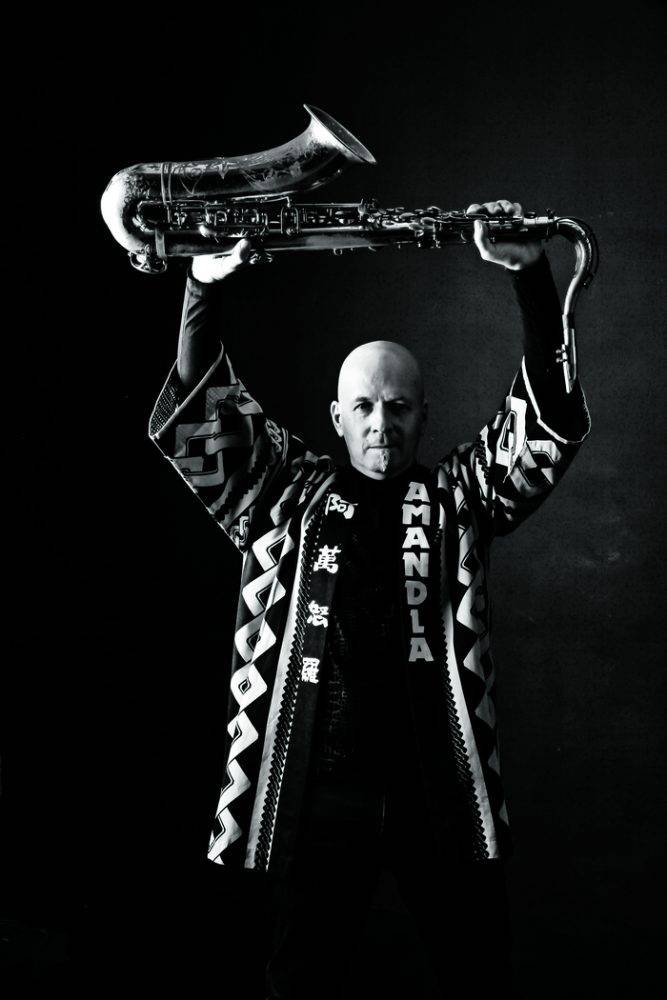
“You can’t get away from voices —human and horn voices — in South African music,” he says, reflecting on a formative childhood experience of hearing Nkosi Sikelel’ iAfrika sung by a stadium crowd.
“It’s that thing of the collective — acting together and working out how the parts all fit in … and that’s true whatever the problems are.”
The album features a large ensemble, but includes, alongside Dyer, reedmen Mthunzi Mvubu and Mark Fransman; horns Sithembiso Bhengu and Sydney Mavundla; pianists Bokani Dyer and Andile Yenana; guitarist Louis Mhlanga; singer Siya Mthembu and more.
There’s a parallel to the free collectivity of Mrubata’s Ezilalini in Kindred Spirits, also a spontaneous studio take, where the seamless chorusing and generous handovers embody how Dyer sees relationships in the jazz community.
Some tracks take a Sankofa perspective on the legacy of struggle — looking back to envision the future. Ihlasele (from the struggle slogan “mayihlome ihlasele” — arm yourself to attack) reflects on the new kinds of arming and struggling required to solve today’s problems.
And Dyer flips the meaning of struggle hymn Senzeni na? (What have we done? [to deserve oppression]) by crafting a fresh lyric: “Amaphupho ephelile” (The dreams are finished — what have we done to make things better?).
There are other parallels between the albums. Mrubata acknowledges a bit of the America he’s seen in his closer Hudson Bridge, a jaunty and very South African solo tribute to the structure’s “strength and flexibility”.
Dyer acknowledges the jazz interchanges between the two countries in Transatlantic, while asserting “we also have a voice in that interchange and it’s good that voice is becoming more prominent”.
And that takes us back to the point of Africarise. “We’ll be profiling South African music to a wider audience through this initiative,” says Dyer. “So, as cultural ambassadors, we need to think about the messages and images we’re bringing.”
Mrubata agrees: “There was a time when I was trying to be a little Grover Washington clone. But Bra Winston, Bra Duke [Makasi], they showed me everything we have here.
“Now, when I’m teaching, I’m not anti-evolution or new music from elsewhere — but never suppress what comes naturally, the things you’ve grown up with.”
Those musical things are so diverse they can never be fitted into a single exoticised stereotype of “Africa”. Hawkins, while paying tribute to “the instrumental virtuosity” of today’s South African artists, is “far more struck by how distinct South African jazz’s sounds and styles are — a very extraordinary embrace of local musical traditions with jazz traditions, unique in this world”.
The label’s first two outings, much as they share a feeling, profile two strikingly individual, highly personal, ways of playing it.
College closures and the pitfalls of privatisation: As austerity batters public universities, fly by night institutions leave students in the lurch
Submit and get free exposure here: Showcase Your Business | Advertise Your Special Offers.
