Senzo Meyiwa Trial: Defence says judge answered questions for witness:
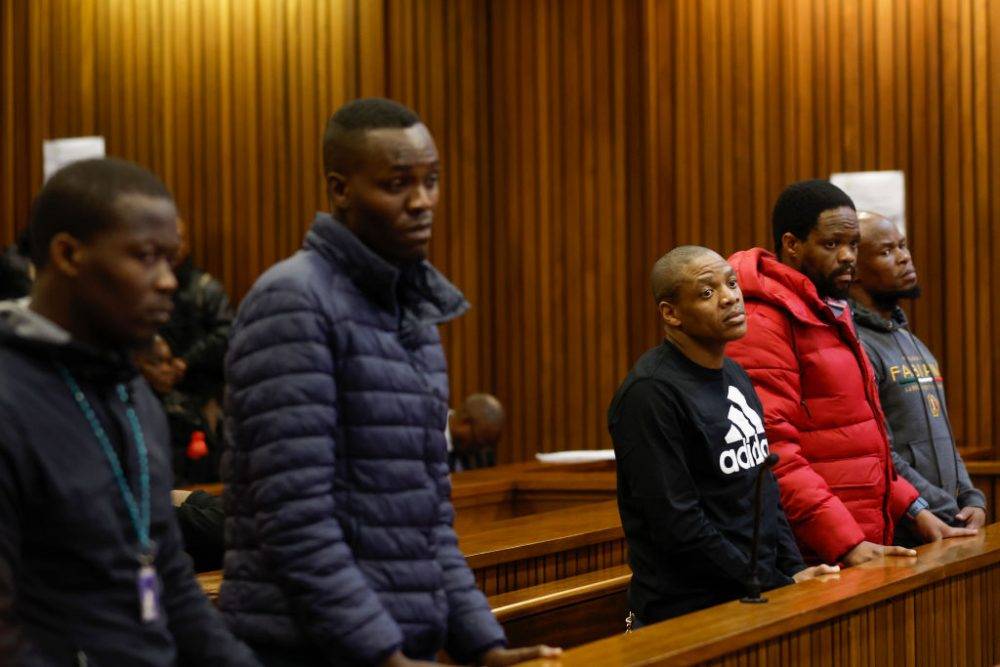
Defence advocate Thulani Mngomezulu has accused the judge in the Senzo Meyiwa trial, Ratha Mokgoatlheng, of answering questions on behalf of state witness police officer Batho Mogola about events that transpired after the arrest of accused number one, Muzikawukhulelwa Sibiya, in 2020.
“If the court intervenes in terms of giving evidence which is supposed to be given by the witness — the witness is under oath and it is expected from her,” Mngomezulu said in the Pretoria high court on Wednesday.
Mokgoatlheng responded that he was merely “citing the law and not giving evidence”.
The defence has cross-examined Mogola about allegations from Sibiya and accused number two, Bongani Ntanzi, that they were assaulted, tortured and unlawfully detained when they were arrested in 2020.
She has repeatedly denied that the two were assaulted or forced to make confessions on the murder of the Bafana Bafana captain.
The defence says Sibiya was taken to a site in Lethabong where police allegedly assaulted him.
“Accused number one gave us access to his home [in Tembisa] and I deny that he was assaulted by anyone that I was with that day and I also deny that he was taken to Lethabong,” Mogola told the court on Wednesday.
“When we went from Tembisa to Vosloorus, accused number one had already made admissions, hence, I put it upon myself to phone Brigadier Bongani Gininda to say he [the accused] is making admissions with regards to the murder of Senzo Meyiwa.
She said the reason Gininda had suggested that they all meet at the police station “is because I called him to say we have the admission and the information was now leading us to a hostel in Vosloorus”.
Mngomezulu has questioned the legitimacy of the arrest warrant issued for Sibiya.
“I want to mention that these witnesses are not reliable witnesses and, through my cross-examination, I will demonstrate that you are not a reliable witness — it is very easy for you when you are ascending that witness box to say you deny,” he said to Mogola on Wednesday.
The defence has also alleged that accused number two, Ntanzi, was taken to a dumping site near Alberton after his arrest and was choked and subjected to electric shocks by police officials. Last week, one of them, Vusimuzi Mogane, who escorted Ntanzi to the police station, denied allegations of assault made against him.
This comes after automatic vehicle location recordings showed that the vehicle used to transport the accused had stopped along the N12 in Johannesburg.
Mogane said he had gone to a petrol station to check the tyres because he felt that the vehicle was not balanced.
Sibiya, Ntanzi and three other men accused of killing Meyiwa at the home of his girlfriend, singer Kelly Khumalo in October 2014 have all pleaded not guilty to charges of premeditated murder, attempted murder, armed robbery, illegal possession of a firearm and the illegal possession of ammunition.
The post Senzo Meyiwa Trial: Defence says judge answered questions for witness appeared first on The Mail & Guardian.
South Africa’s freshwater crisis persists:

The reality of South Africa’s water problems and, in some cases crises, vary in the type, frequency, magnitude and intensity thereof. This situation has been developing and intensifying over the past two to three decades, threatening current and future water security.
Continued poor water governance and mismanagement, non-enforcement of legislation, poor or no planning, continual inaction and an entrenched culture of unaccountability and non-transparency, have either created new water problems in areas that have not had major issues in the past or have exacerbated existing ones that are now crises.
Dysfunctional, insolvent and non-performing district and local municipalities and other institutions for water service delivery, with the primary mandate of providing a reliable supply of safe drinking and sanitation services, have left people with an unreliable supply or try taps.
One such case is the City of Johannesburg. The causes are continued load-shedding, poor maintenance resulting in the collapse of infrastructure, and mismanagement.
Numerous examples of water crises are evident across the country, from the cholera outbreak in Hammanskraal to newly implemented water-shedding in the Johannesburg, Tshwane and Ekurhuleni metros. Sewage crises occur across South Africa, specifically within the eThekwini local municipality, destroying ecological functioning, threatening human health and having adverse effects on businesses and socio-economic growth, especially those dependent on tourism.
We need to remember that South Africa is a water scarce country, characterised by a predominant arid to semi-arid climate. Rainfall is unevenly distributed, leading to uneven distribution of water. The country receives below average rainfall of 465mm a year — 395mm less than the global average of 860mm a year — and is ranked among the 30th driest countries in the world.
The overall water crisis is ranked as South Africa’s second highest risk, after the unemployment crisis, for doing business in the country.
Other major water problems or crises include:
- Water supply not meeting current water demands and withdrawals;
- Unreliable or shortage of water supply and sanitation services in urban and rural contexts;
- Continuous breakdowns of dilapidated and unmaintained water infrastructure that increases the loss of non-revenue water. More than 41% of treated, potable water is lost before it even reaches the consumer;
- Increased and continued pollution from various sources causing the spread or intensification of eutrophication salinisation, sedimentation, acidification and microbial pollution of already scarce freshwater resources;
- Non-functioning and overwhelmed wastewater treatment works, which causes sewage pollution, degradation and destruction of aquatic environments — clearly visible with large-scale fish deaths — and human health risks such as diarrhoea, cholera and typhoid fever.
- Lack of enforcement and implementation of legislation, policy, strategies and set standards; and
- Unsuitable water monitoring networks with some sampling not taking place for years (specifically from 2012 to 2015), or the malfunctioning of monitoring stations or equipment, which is not replaced.
All of these primary driving forces have placed severe and increased stress on scarce water resources, both in the amount available and suitable quality for use. Water-shedding has now also been added to the list, emphasising poor water governance and management at all levels. The country’s already scarce water resources become unsuitable for use because of continued pollution, with just one example being the Vaal River system.
2023 in review
In short, South Africa’s water issues have increased in numbers and magnitude. The entrenchment of unaccountability and dysfunction of municipalities has become more evident because of an increase in water problems as well as civil society becoming more informed through engaged scholarship and investigative journalism.
Civil society and water users have been adversely affected by poor water governance, mismanagement and overall inaction caused by continued lack of political will and investments. The continued decline of water service delivery in the metros of Joburg, Tshwane and Ekurhuleni are prime examples of how a region can achieve an unfortunate perfect storm through the combination of no political will, instability of governance and continued infighting, poor or no planning, mismanagement and alleged corruption. Blackouts also affect non-maintained or poorly repaired water infrastructure, leading to erratic water supply or dry taps for days on end for some consumers.
Some progress has taken place in 2023 and includes the following:
- Giyani Bulk Water Project: Completion of Phase 1, connecting villages to the water source, which is still under development. Measures have been put in place to prevent corruption in the procurement process at the municipal level.
- New “Mega” Vlakfontein Reservoir: Launched in February; storage capacity of 210 megaliters adding a 24-hour buffer for areas around Tshwane.
- Release of the Green and Blue Drop Watch reports and the No Drop Report. The major delay of the release of the final Greed Drop Audit report and Blue Drop Interim Report is however of concern because these should have been released in July as stated by the minister of water and sanitation.
- National legislation and standards: Ongoing project to review and amend where necessary.
- Increased visibility of the water and sanitation department to increase awareness and communicate with relevant stakeholders and the public. The department announced the theme of the year, Accelerating Change, urging the policy and decision-makers to heighten their efforts in providing water access. It has been part of numerous panel discussions initiated by them and other role-players.
- The launch of the National Water Resource Infrastructure Agency with the sole purpose of administering, operating and funding all infrastructure related to national water resources.
The negatives outweigh these few progressive steps; the country’s water resources are still under major threat and some have become unsuitable for use because of continued pollution.
Freshwater outlook for 2024
First, the long overdue Green Drop Audit Report and Blue Drop Interim Report need to be released. This is once again an example of inaction or delays and non-transparency by government departments at all levels responsible for supplying water to consumers. These reports are of prime importance because they highlight the current state of wastewater treatment works, mostly at critical levels (Green Drop Watch Report), as well as the compliance of district and local municipalities in providing water access, a reliable supply of drinking water of a suitable quality as well as overall water and sanitation service delivery (Blue Drop Watch Report).
Second, the culture of lack of transparency, unaccountability, neglect and apathy is quite clear in the Green Drop Watch Report; only 50% of municipalities the department found to be non-compliant responded to their letters informing them of this, and fewer than 50% submitted the required water management intervention plan. This is a clear example of continued apathy and negligence.
Last, the current water monitoring network infrastructure and equipment need to function to assist decision-makers. Without these updated reports and water monitoring data, well-informed water management plans cannot be developed. Suitable short, medium and long-term initiatives, with the sole purpose of addressing and minimising the effects of continued water problems and crises, cannot be accurately developed.
Unaccountability, non-transparency and overall neglect persist because of poor governance, mismanagement and continued alleged corruption, significantly halting progress.
For the water sector to move forward, the blame game and talking to try to win an argument needs to stop and shift to taking action, developing context-specific actions and implementing these to maintain or improve water security and start addressing the country’s water crisis.
Anja du Plessis is an associate professor in the department of geography, College of Agriculture and Environmental Science, at Unisa. She writes in her personal capacity.
The post South Africa’s freshwater crisis persists appeared first on The Mail & Guardian.
Inflation rises towards Reserve Bank’s upper limit, pointing to rate hikes down the line:
Inflation ticked up within a hair’s breadth of the South Africa Reserve Bank’s upper limit in October, suggesting there could still be interest rate hikes down the line, even if monetary policymakers keep them on hold as expected this week.
Data from Statistics South Africa on Wednesday showed that consumer inflation increased to 5.9% year-on-year last month from 5.4% in September. The Reserve Bank aims to keep inflation within a 3% to 6% target range. Inflation floated above the 6% upper limit for 13 months, before finally falling back within the target range in June this year.
A higher inflation number was expected by analysts, but 5.9% is still higher than consensus forecasts.
On Thursday, the Reserve Bank’s monetary policy committee will announce its next interest rate decision. Prior to Wednesday’s inflation data, it was widely expected that the committee would opt to leave the cost of borrowing unchanged. And, despite higher-than-expected October inflation, there is still reason to believe that the Reserve Bank will hold off on hiking interest rates — which are already in restrictive territory.
Indeed, the Bureau for Economic Research (BER) expected that inflation would come in above consensus, forecasting a 5.8% yearly rate. Despite this, the BER also forecast that the Reserve Bank would keep interest rates unchanged, citing the fact that oil prices and the rand’s weakness no longer pose the same risk as they did earlier this year.
Core inflation, which excludes food and energy prices, is trending in line with the central bank’s 4.5% target, indicating a notable easing in underlying price pressures. According to the StatsSA data, core inflation came in at 4.4% year-on-year in October.
That said, the Reserve Bank will probably be watching developments in the United States closely. Though the US Federal Open Market Committee (FOMC) opted to hold interest rates for a second consecutive time on 1 November, minutes from that meeting revealed continued hawkishness on the Fed’s part.
Released last night, the minutes noted that inflation remained well above the committee’s 2% longer-run objective “and that elevated inflation was continuing to harm businesses and households, particularly low-income households”.
In her analysis of the FOMC minutes, Investec chief economist Annabel Bishop noted that the committee is looking to mollify expectations of imminent interest rate cuts.
“Market expectations for interest rate cuts next year have been building, and the Fed worries this will positively impact consumers and businesses by causing spending and demand to rise, and so derail its efforts to lower inflation,” Bishop wrote in a research note published on Wednesday morning.
The FOMC is scheduled to deliver its next interest rate decision on 13 December. According to Bishop, there are still expectations of no further rate hikes this year or next.
The post Inflation rises towards Reserve Bank’s upper limit, pointing to rate hikes down the line appeared first on The Mail & Guardian.
Submit and get free exposure here: Showcase Your Business | Advertise Your Special Offers.