Senzo Meyiwa trial: Witness adamant that accused was not tortured into confessing:
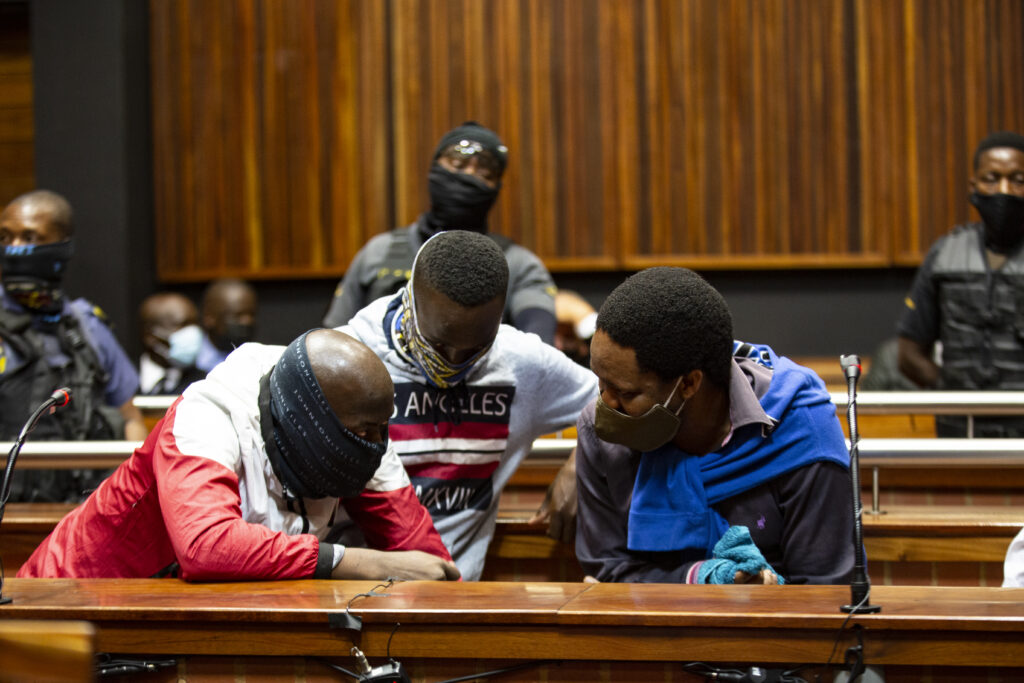
Another state witness in the Senzo Meyiwa trial denied that Bongani Ntanzi was assaulted and tortured before allegedly confessing that he was involved in the murder of the footballer on 26 October 2014.
Constable Yul Craig Liesering took the stand at the Pretoria high court on Tuesday as a witness in the continuing “trial within a trial” to determine whether confessions made by Ntanzi and Muzikawukhulelwa Sibiya are admissible.
Previous state witnesses and police officers told the court that Ntanzi was neither beaten nor tortured and that he was eager to confess.
On Tuesday Liesering said he had been part of the team that escorted Ntanzi to the Boksburg magistrate’s court, where he made a confession to magistrate Vivian Cronje.
Defence advocate Thulani Mngomezulu, representing Ntazi and Sibiya, put it to Liesering that his client was assaulted after the meeting with Cronje.
“He [Ntanzi] says he was taken to Germiston next to an industrial area where the assault took place and that is when he was ordered to sign the papers. It is my instruction that you were also present when he was forced to sign the document,” Mngomezulu said.
Liesering said Ntanzi was lying. “There are no papers that were signed in the bushes. He is not telling the truth. He was never taken to Germiston. He was taken straight to Moot police station [in Pretoria] from Boksburg and I was not present when he signed any documents.”
“There’s evidence that you were heavily armed. Were you also in full uniform?” Mngomezulu asked.
Liesering said he and his colleagues each had two firearms and he could not comment on whether they had intimidated Cronje by being armed.
“She just asked us why we were so heavily armed,” Liesering said.
Ntanzi and Sibiya are among the five men accused of killing the Bafana Bafana captain at the home of his girlfriend, Kelly Khumalo, in Vosloorus, Gauteng. They have pleaded not guilty to charges of premeditated murder, attempted murder, armed robbery, illegal possession of a firearm and the illegal possession of ammunition.
The post Senzo Meyiwa trial: Witness adamant that accused was not tortured into confessing appeared first on The Mail & Guardian.
Eskom records massive R23.9 billion loss:

Eskom has announced a staggering loss of R23.9 billion for the financial year ended March 2023, caused in part by a significant increase in load-shedding, a growing municipal debt burden, and soaring losses attributed to criminal activities.
The figure has doubled since the previous year when the power utility recorded a R11.9 billion loss.
The utility had to implement load-shedding on 280 days, compared with 65 days in the 2021-22 financial year, acting chief executive Calib Cassim said.
“We are now sitting at 202 load-shedding days in [2023-]2024. If Eskom is to not exceed 280 days this year, we will have to not have load-shedding for at least half the days during each of the next five months. This will be tough, but it is what we are trying to achieve,” Cassim said.
He added that load-shedding saw energy sales decline by 5%, while spending on diesel to run open-cycle gas turbines (OCGT) was R29.7 billion, an increase of 50%, for the year.
“Load-shedding placed pressure on the cost of production, especially in running the OCGTs, which come at an enormous extra cost of almost R30 billion and which filtered through the financial performance.”
The utility’s loss for the year comes despite a 9.61% electricity tariff increase and a R21.9 billion bailout from the treasury, which was approved for the utility to increase its revenue generation potential.
Cassim said Eskom also earned less revenue than anticipated as a result of not recovering electricity payments.
The year was characterised by a significant deterioration in performance, including a steep decline in its energy availability factor to 56.03% from 62.02% in 2022, Cassim noted.
He added that criminality and irregular expenditure also contributed to the R6 billion “material losses”.
Eskom said it incurred R105 million of new expenditure categorised as fruitless or wasteful, R2 million of which was recovered.
Other losses include R344 million related to theft and damage to equipment, R81 million attributed to fraud and corruption and R5.6 billion linked to “non-technical losses”.
Mounting debt is still a big problem for Eskom, weighing on its money-generation potential. Eskom said its debt stock swelled to R423.9 billion, an increase of about 7%, as a result of the weakening rand and additional borrowing.
Cassim previously told the Mail & Guardian that Eskom was in a fragile financial position and would need to have a conversation with the treasury regarding its plans for a healthy balance sheet as it continues to struggle to collect revenue from municipalities.
On Tuesday he said municipal debt had continued to increase to unsustainably high levels, amounting to R58.5 billion in 2022-23 compared with R44.8 billion in 2021-22.
Eskom acting chief financial officer Martin Buys said that with the inflow of debt relief payment from the treasury over the next three years the utility’s gross debt was expected to reduce by about 40% over the next five years to R270 billion. “The trick will then be to make sure we maintain it at that level,” he said.
Buys added that Eskom still has to place orders for parts a couple of years in advance for the big power stations. “Because we can now support our debt-servicing cost we can start placing lead orders long in advance,” he said.
Cassim said the 2022-23 financial year would be the last year that Eskom posts significant financial losses once the full debt relief programme from the treasury is delivered, and the utility starts recovering arrear payments from municipalities.
He added that Eskom expected to start seeing a turnaround in its financials by 2025.
“It is critical that Eskom’s performance does change. We are confident that we will turn around the operational performance, and we believe financials will then improve by end-March 2025.”
The post Eskom records massive R23.9 billion loss appeared first on The Mail & Guardian.
Charges against fake doctor ‘Matthew Lani’ dropped:

Charges of identity fraud and impersonating a medical doctor against Tik Tok influencer Matthew Lani were withdrawn at the Johannesburg magistrate’s court on Tuesday, his lawyer said.
Lani was due to appear in court but emerged from the building on crutches, alongside his lawyer Dumisani Mabunda, who told journalists that criminal charges laid against his client by the Gauteng health department and Dr Sanele Zingelwa, who Lani allegedly pretended to be, had been dropped.
“He was doing whatever he was doing on TikTok for entertainment — it is not impersonation and it’s not a crime,” Mabunda said, adding that the claims were baseless as no one had come forward to say Lani had prescribed any medication for them.
“The hospitals, the least they could have done was to maybe ban him going to hospitals and taking videos and, if he were to continue with that, then that would be trespassing and they would have a case against him.
“On the other hand, HPCSA [Health Professions Council of South Africa], the least they could have done was maybe to interdict him or stop him from doing those videos,” he said.
Lani was apprehended by security personnel when entering the main entrance of the Helen Joseph Hospital on Sunday night. According to the Gauteng health department, he asked to go to the toilet, where he attempted to escape through the window.
When security realised that he was trying to escape, they called for reinforcements, and Lani was captured and handed over to the police for an official arrest.
The 27-year-old influencer Lani gained attention after he began sharing medical advice and his experiences as an alleged HIV/Aids doctor with his 280 000 followers on TikTok.
But, earlier in October, his qualifications came under scrutiny when the University of Witwatersrand released a statement distancing itself from him.
“Following claims made by ‘Dr Matthew Lani’ on social media and based on the facts at hand, Wits cannot find any person who graduated by the name of Matthew Bongani Zingelwa or Sanele Zingelwa in recent years,” the university said.
Lani also claimed to have graduated from Cambridge International College, which was disputed by the institution. The department of education also said there was no record of Lani’s National Senior Certificate.
Following these disputes, Lani took to TikTok, claiming that he had graduated from both institutions, under a different name, and that ‘Dr Matthew Lani’ was a social media persona he had adopted.
The case is an illustration of how social media has influenced many people’s lifestyle choices because they want to be seen and crave a certain type of recognition, clinical psychologist Dr Pam Tudin-Buchalter told the Mail & Guardian.
“One major impact is the prevalence of online comparison, where [users] measure themselves against idealised images presented on various platforms which can lead to feelings of inadequacy and a heightened desire to conform to unrealistic standards,” she said.
Meanwhile, the South African Medical Association (SAMA) has expressed concern over the increase in the number of fake doctors after the HPCSA reported that, since June 2023, 124 people claiming to be doctors had been arrested.
“This practice undermines the trust and integrity of the healthcare system, in addition to jeopardising the health of those who seek care,” SAMA chairperson Dr Mvuyisi Mzukwa said.
SAMA has called on the public to be cautious when seeking medical advice or treatment and to verify a doctor’s credentials by searching for them on the HPCSA iRegister.
The post Charges against fake doctor ‘Matthew Lani’ dropped appeared first on The Mail & Guardian.
Submit and get free exposure here: Showcase Your Business | Advertise Your Special Offers.