Sexism, feminism and humanism: The irreconcilable trio:
It is once again August and Women’s Month in South Africa, and much will be said and done in the name of women empowerment, women’s rights, gender equality and feminism. Focus on women’s and girl’s interests is touted throughout the month as the antidote to patriarchy, male domination and bias, and sexism. Some arguments are also made about the absence of a Men’s Month, with all the accompanying hoopla.
During Women’s Month of 2023, I wrote an article maintaining that the commemoration of women and their strength, resilience and activism in society should not be synonymous with bashing men. My argument was that radical feminists usually use this time to blame men (and boys) for all that is wrong in society, without factoring in the agency of women and girls, and how they also contribute to the status quo.
This year, I take my argument further by exploring philosopher GWF Hegel’s dialectical method of “thesis-antithesis-synthesis” that is often used to attempt to reconcile two oppositional positions. In my view, sexism (and the associated patriarchy and male domination) are the thesis. In response, feminism has developed as the antithesis. I find that the idea of humanism is an attempt at a synthesis, that extracts the truth statements from the thesis and antithesis,and tries to reconcile or synthesise them.
Starting with the thesis, if we are to adopt sexism as the thesis that captures the attitudes of the masculine towards the feminine, we find that this position derives from the male perspective of gender relations. Bear in mind that there are also concepts such as benevolent sexism or benevolent patriarchy, which mean that sexism is not necessarily a malevolent or oppressive phenomenon.
But, over the past two centuries, sexism has come under fire from women’s interest groups and this mobilisation against the status quo of gender relations has given rise to the feminist movement and the ideology of feminism. I use the word “ideology” in its most charitable form, to capture an organised system of thought, laws and practice that can be utilised to navigate and practise political, social and ethical positions.
Very often, particularly on social media, the term “feminist” is used as a form of criticism or insult against women who invoke gender equality, who denounce gender-based discrimination and who support women’s rights. What is lost in this battle of words is the correct understanding and usage of the terms “feminism” and “feminist”.
Several years ago, I wrote an opinion piece about how feminism is sometimes confusing for men. A few years later, after studying South African feminisms, I wrote articles about the agenda of African feminism, the different dimensions of gender equality and the contribution of feminism to the fourth industrial revolution. I highlight that this was after actually studying the topic, in an attempt to gain theoretical, conceptual and practical clarity.
In terms of the literature and documented activism, the first wave of the feminist movement began in the late 19th century and focused on securing rights for women in the public sphere, such as the right to vote, to education and to a middle-class profession. The liberal pursuits of the movement advanced the notion that just like men, women were capable of rationality and reason, and were instead socialised and educated to be passive, emotional and helpless.
The second wave of the movement emerged in the 1960s, and it was concerned with revolutionising the private sphere, demanded control over reproduction through contraception and challenged the double standards of sex-based labour. There was also the view that motherhood was an oppressive institution, for those who did not desire it. Feminism in this wave also demanded social reform and welfare for the poor in the public sphere. The key slogan popularised then was: “the personal is political”.
The third wave arose in the 1980s and was focused on public issues such as equality in conditions of employment and access to financial services. It endeavoured to make private issues such as domestic violence and rape of public concern. Moreover, the monolithic concept “woman” was deconstructed and opened conceptual and theoretical room for studying non-Western feminisms.
The fourth wave started in about 2012, and coincided with the advent of post-feminism, which broadly analysed all systems of domination. The #MeToo movement, calling out male power and abuse is characteristic of this wave. This wave also overlaps with the movement of Black feminist intersectionality, which conceptualises the convergence of race, gender and class.
During the course of my doctoral thesis that was based on a Black feminist understanding of lived experience, I made a surprising discovery. I found that it is possible to know and understand what feminism as an ideology is, and what a feminist identity really means, without necessarily subscribing to them.
This was a significant discovery that I put into practise when I taught second-wave feminism to a third-year university philosophy class. I started the first lecture by citing the Greek philosopher, Aristotle, when he maintained: “It is the mark of an educated mind to be able to entertain a thought without necessarily accepting it.”
My point was that I did not expect my 90 students to suddenly accept or embrace feminism from my teaching. Instead, I advocated that the course was intended to cultivate an “educated mind” that is able to distinguish between the layman’s understanding of feminism or social media disinformation, and an actual understanding of feminist theory and practice.
Very interestingly, it was the male students who were the highest achievers in my class. In their term test, almost half of my students attained distinctions, and in the final exam, nearly a third passed with distinctions. I am not claiming to be an exceptional teacher. Rather, I believe that by giving my students permission to dissent, in that first lecture, this made them more open to engaging with the literature and theory on the subject.
In this way, feminism becomes the antithesis to sexism (and related concepts), which attempts to surmount the thesis, and to offer an alternative. Simply put, just like liberalism, conservatism, Africanism, socialism or any other “ism” for that matter, feminism is an ideology. Overall, I propose that feminism is a theoretical ideology, a mobilisation platform, a justice paradigm, and a political demand.
Theoretically, it is a critical theory of all aspects of male-produced and male-biased thought, sometimes dating back centuries and millennia. In other words, feminist theory recognises that because of restrictions and limitations to formal education for girls and women across all global cultures, in previous decades, centuries and millennia, there is an imperative to retrieve and include the female knowledge-production perspective. This is an important endeavour because it helps to account for the experience of at least half the world’s population.
This undertaking feeds into the social and political aspects of feminism, which usually inform the kind of mobilisation and lobbying required to ensure that policies in the political arena reconcile with the actual experiences of women in the social arena.
For example, traditional laws that usually cater to males who are the heads of their households, have to be updated to reflect the contemporary constitution of households that may not have a male head as a result of non-marriage, separation, divorce or death.
Another example is how women flooded the formal work space during the two world wars, while men were on the front lines. They realised their competence and proficiency and many fought to continue formal, paid work even after the wars. An example closer to home is the migrant labour system during apartheid that took many males away from their rural Bantustans and into the cities for work, which left women as the de facto heads of their rural households.
The ethical component of feminism examines the legacy of ethical frameworks such as deontology (what is right or wrong), consequentialism (what is good or bad), pragmatism (what is theoretical or practical), ubuntu (community versus individual), among others. The feminist account so far is that there is a particular feminist ethic of care that is missing from the above ethical theories.
Women and girls are often socialised to take care of their families, partners, communities, and even employers and strangers. Instead of viewing this as cumbersome duties and obligations, some feminist strands embrace this social responsibility by promoting it and calling for other genders to also recognise the societal value of the emotional and relational labour performed by females.
The above examples of how feminism is employed in the political, social and ethical arenas demonstrates that it is an ideology aimed at upholding rights for females, towards them being empowered to perform certain essential responsibilities that many of them embrace.
Remembering Aristotle, we need not agree with feminism but we need to be informed sufficiently to understand its position. But that does not exclude those who subscribe to it from our ethical consideration.
Coming back to my post-thesis realisation, I found that the idea of humanism is promoted as a synthesis of the two positions. In this case the starting point is to confer all human beings with inalienable rights such as dignity, recognition and reciprocity. These are indeed high ideals and, for the most part, they reconcile with the liberal ideals of liberty, equality and fraternity (sorority in the female form) that were established during the French Revolution, and went on to influence the constitutions of liberal democracies.
But humanism has some blind spots. Usually it promotes notions such as integration and assimilation while covertly maintaining the hegemony of the initial thesis. Those who are on the margins of the thesis are often co-opted into the status quo, provided that they comply and cooperate with already established rules and regulations.
An apt example is the slogan #BlackLivesMatter, which would be accompanied by the response #WhiteLivesMatter, and the synthesis would be #AllLivesMatter. The problem with this thesis, antithesis and synthesis formulation is that the dialectical progression does not capture the experience of all parties, and is instead a reactionary response to each stage.
One would also be surprised to learn that not all definitions of what it is or means to be human automatically reconcile with being homo sapiens. Other moral, cultural, political and metaphysical prerequisites are factored in the definition of human being.
The failure to systematically dilute and adapt both the thesis and antithesis results in a stalemate. So, to me, it seems that a call for humanism as the synthesis of the two positions (sexism and feminism) lacks the incorporation of the lived experience and related epistemologies and ethics of each interest group.
Perhaps next year I might have a further argument about how humanism is the initial thesis that requires a new antithesis and subsequent synthesis. For now, I find the two positions do not comfortably reconcile to humanism.
Dr Sarah Setlaelo is a writer who holds a PhD in philosophy from the University of Johannesburg and a qualification in African feminist and gender studies from the Thabo Mbeki African Leadership Institute. She is also a Harvard University Center for African Studies Fellow.
DA accuses MK party of plotting to collapse service delivery in KwaZulu-Natal:
The Democratic Alliance has accused former president Jacob Zuma’s uMkhonto weSizwe party of plotting to collapse service delivery in KwaZulu-Natal by ensuring that government funds do not reach “the poor”.
This after the MK party in the KZN Legislature had voted against the approval of all provincial department budgets in recent portfolio committee meetings.
The MK party — which has the highest number of MPLs in the KZN Legislature — failed to have the committees reject the budgets, after the 41 government of provincial unity (GPU) MPLs from the IFP, ANC, DA and NFP had voted in favour of the budgets.
Had the MK party succeeded in blocking the approval of the budgets by the portfolio committees, the departments would not have been able to access treasury funds to pay salaries and deliver services to the province’s residents.
DA KZN Legislature caucus chief whip Imran Keeka said the GPU did everything to ensure that the MK party and its ally in the KZN Legislature, the EFF, did not succeed in their attempts to “block the flow” of provincial government funds.
“Effectively, the GPU majority worked to block attempts by the official opposition and its EFF coalition partner to prevent the lawful flow of money to provincial departments and, ultimately, to the people of our province. Had they succeeded, services in KZN would have collapsed beyond recovery,” he said.
The MK party’s “obsession” with collapsing the GPU, Keeka said, had rendered the party ineffective in its role as KZN Legislature’s official opposition.
“Invective and naive chattering, a lack of understanding of the Public Finance Management Act (PFMA) and its requirements, and a definite dearth of comprehension of the legislature rules saw the opposition make a mockery of themselves and the proceedings,” said Keeka.
“With no valid contributions or alternatives to make things work better — and in some instances absolute silence from the majority of their members — they simply opposed budgets. To their credit, they expressed their lack of information and abstained in the vote on the KZN Legislature budget.
“They have a lot to learn and will need to get up to speed with the realities of the province’s finances and the challenges facing residents to be able to effectively work as an opposition.
“Until recently, the MK Party had not even allocated members to committees, possibly caught napping in the process,” said Keeka.
The KZN Legislature will next week hold a debate on the provincial government department’s budgets.
“The GPU will remain effective and resolute to ensure that citizens are placed first and the DA is determined to play our role in ensuring this. The DA remains committed to being a builder and not a breaker,” Keeka said.
Matatiele sports centre remains unfinished after six years and R37 million spent:
Six years after work started on the Matatiele sports centre in the Eastern Cape, more than R37-million has been spent, but the facility remains incomplete.
Construction of the centre started in October 2018 and was to be finished in December 2021. But the contractor, Isivivana construction, hired to do the first phase of the project, left the site in 2019, leaving only a fence and some grass.
A new contractor, MVI Construction and Maintenance, was appointed on 19 May 2023, according to the municipality’s tender document. The contractor was to build change rooms with toilets, grandstands and a guard house, and lay asphalt along the running track.
According to Matatiele Local Municipality spokesman Luncedo Walaza, approximately R23-million was spent on phase one of the project. And so far, an amount of R12.2-million had been spent for phase two.
Asked about the current status of the project, Walaza said the contractors had built the guard house and change rooms and installed steel for the stands. He said the project is within its timeframes, but did not respond to questions about when the centre will be finished.
But residents who live around the site say they haven’t seen workers there since April.
Despite several calls and messages over two weeks, GroundUp has not been able to reach MVI Construction and Maintenance for comment.
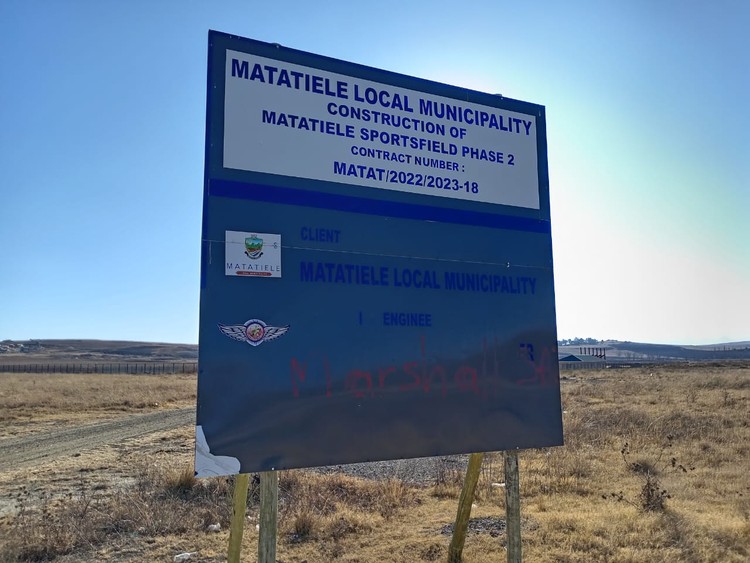
The Matatiele Local Municipality has spent millions of rand on the sports centre, which has been under construction for six years.
GroundUp visited the site twice last month and saw that a new guard house had been built, and poles had been erected for the stands — which are yet to be built. We saw no construction workers at the site.
Resident Viwe Khwababa says his brother was employed in 2019 to do the fencing in the first phase of the project. “They were only paid R2,500 each. They waited thinking that the company would give them another task but that did not happen. Our municipal manager then went on national television to tell the whole country that the stadium will be finished in December 2021, but we are still waiting,” she said.
Another resident, Simthembile Nogwaza, says construction re-started late last year and workers left the site in April.
“My brother works there. Some months he would work the whole month, the next they only worked for two or three weeks, until they were told to go home in April and wait to be called. He was told that the municipality will pay in July and they will return to work in August,” he said.
DA ward councillor Wonga Potwana said he had tried to question the municipality about the budget for the sport centre but had yet to get a proper answer.
“This is an old project. It was supposed to be done in one phase, not two. The second phase came after there were questions about the funds spent and little was done after so many years.”
This article was first published by GroundUp.
Submit and get free exposure here: Showcase Your Business | Advertise Your Special Offers.