
Social relief of distress grant extended until 2025:

The government will extend the social relief of distress grant until 2025, Finance Minister Enoch Godongwana said on Wednesday in the medium-term budget policy statement.
The document confirmed that the state has not found a long-term solution to funding the R350 grant, which was introduced during the Covid-19 pandemic to provide relief to poor households while the country was under lockdown.
“No policy decisions have yet been made on the grant and no funding solution has been agreed to.”
President Cyril Ramaphosa hinted ahead of the MTBPS that the grant would be extended by saying it served as a lifeline to millions of South Africans.
At an annual cost of R36 billion to the fiscus, the future of the grant has become a perennial budget quandary — and extending it a stop-gap response to calls to introduce a basic income grant.
The MTBPS makes plain that the state simply does not have the money to make that long-term commitment at the moment.
It recalled that Godongwana said in his main budget speech in February that any extension or replacement of the grant needed to be funded from a new revenue source or reprioritisation of current spending.
“Since then, fiscal space has declined markedly, reducing the scope for extension without additional financing,” Wednesday’s medium-term statement said.
The treasury said “a comprehensive review of the entire social grant system” was necessary to map the way beyond 2025.
At the moment, the state spends R945.9 billion on social grants, including the social relief of distress, older person’s, child support and disability grants. This makes its social support spending among the highest in developing nations, ahead of Chile, China and India, but the MTBPS calls for spending restraint in pursuit of fiscal sustainability.
Since Godongwana tabled the national budget in February, the treasury’s revenue collection projection has shrunk by R56.8 billion as commodity prices fell faster than expected.
A priority, the treasury said, is containing the budget deficit amid persistent low economic growth.
“Moderate budget deficits are not cause for concern. The difficulty arises when deficits are too large for too long, requiring ever-higher levels of borrowing that are unmatched by improvements in public services. This is the problem facing South Africa,” the treasury said.
It forecast GDP growth to average only 1.4% over the medium term.
The post Social relief of distress grant extended until 2025 appeared first on The Mail & Guardian.
Government budgets for natural disasters:

The government is developing a financing strategy to ensure the country’s public purse is able to deal with the effects of natural disasters.
According to the medium-term budget policy statement (MTBPS), tabled by Finance Minister Enoch Godongwana on Wednesday, the treasury is looking to address gaps in financing the public sector’s response to climate-related disasters and to reduce over-reliance on budget reallocations.
In April 2022, parts of the Eastern Cape and KwaZulu-Natal were ravaged by floods, inflicting large-scale damage to public infrastructure.
The 2022 adjustment budget allocated R3.6 billion to the department of cooperative governance and R1.8 billion to the department of transport for the reconstruction and rehabilitation of municipal infrastructure as well as the maintenance of roads damaged by the floods. Transnet received R2.9 billion.
The flooding came on the back of the Covid-19 pandemic’s economic onslaught and the public violence that swept through the country in July 2021 after former president Jacob Zuma was jailed for contempt of court.
A diagnostic report by the treasury and the World Bank estimated the average funding gap for financing disaster response in South Africa at R2.3 billion. Redesigning on- and off-budget financing can reduce fiscal costs by about R100 million on average per shock event and R7.5 billion in the case of large shock events, the report found.
The report recommended that the government develop a national disaster risk financing policy, including strategic priorities for financing disaster response.
The MTBPS notes that the treasury is analysing the country’s fiscal vulnerability to natural disasters and implementing reforms to improve resilience. This analysis will ensure that resources are efficiently allocated.
The treasury’s draft strategy is expected to be ready during 2024-25.
The post Government budgets for natural disasters appeared first on The Mail & Guardian.
Plans to reconfigure state will be announced in February:
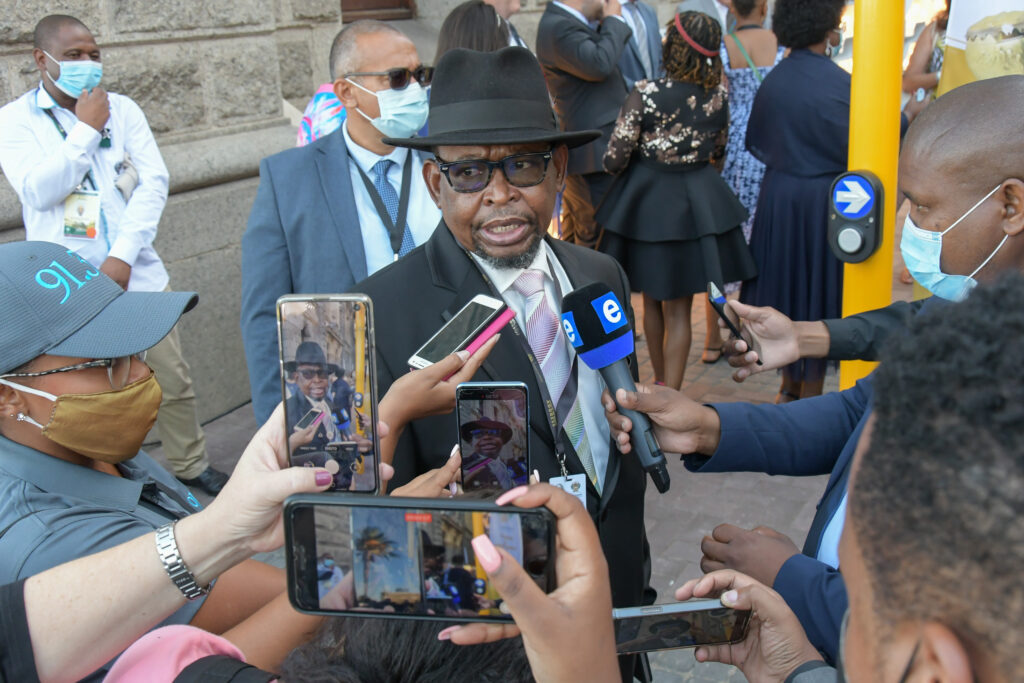
A review of the size and structure of the state is underway to lift the burden that poor performance places on the budget, the treasury said on Wednesday in the medium-term budget policy statement (MTBPS).
It listed the planned reconfiguration of the state as one of the priorities over the next three years, along with increasing infrastructure investment and adopting a prudent fiscal stance that stabilises debt.
The treasury echoed a commitment by President Cyril Ramaphosa in his State of the Nation address in February to stem the waste of underperformance by closing or merging government departments.
It noted it has conducted a number of spending reviews in recent years, and these have revealed poor policy choices, poor implementation and what it termed a “duplication of effort”.
“Too many government activities are inefficient, overlapping and non-critical,” it said. “Government considers these inefficiencies to place a further drag on the economy.”
Like the president, the treasury and Finance Minister Enoch Godongwana gave no indication as to which departments or government programmes may be closed. The steps to reconfigure the state will only be announced in the minister’s 2024 budget in February.
“The 2024 Budget Review will propose to scale down outdated and unproductive programmes and entities.”
But the MTBPS set out four criteria that will be used to determine whether a department should be closed or merged.
The first is the performance record and size of the entity, “especially if it is no longer fulfilling its mandate” or lacks the capacity to do so.
The second is whether there is a bigger department that can absorb the functions of a smaller department.
The remaining two considerations are where there is a duplication between departments, and whether there is lack of clarity about a legislative mandate.
Godongwana said he believed the process should be sufficiently advanced by early next year for Ramaphosa to announce incisive changes.
It is widely expected that a reconfiguration could affect the department of public enterprises, and that this will probably see the president fine-tune the allocation of powers in relation to Eskom. At present, these are spread out between the public enterprises and mineral resources and energy departments as well as the fledgling ministry of electricity, headed by Kgosientsho Ramokgopa.
The treasury said recommendations on closures are being drafted by itself, the presidency and the department of public service and administration and the planning, monitoring and evaluation department.
It gave no estimate of the savings it hopes to effect through closures or consolidations.
In his MTBPS speech to the National Assembly, Godongwana said the review would also seek to create “standards for more sustainable remuneration of executives that serve public entities receiving transfers from the fiscus”.
Asked at an earlier media briefing whether he believed trade unions would baulk at a review that could put public servants out of work, Godongwana said the perception that consolidation would result in jobs cuts was not necessarily correct.
As a hypothesis, he said it might be that the department of home affairs was severely understaffed while another department was bloated. Hence, reconfiguration would simply mean righting such an imbalance.
He did not expect a political outcry, the minister added, because unions had for some time opposed the proliferation of agencies within the state, of which there are some 200.
“We are likely to have built a consensus.”
The post Plans to reconfigure state will be announced in February appeared first on The Mail & Guardian.
Submit and get free exposure here: Showcase Your Business | Advertise Your Special Offers.
