
South Africa continues to fight for Gupta brothers extradition:
South Africa is continuing its efforts to extradite brothers Atul and Rajesh Gupta from the United Arab Emirates (UAE) and is also dealing with dozens of requests from around the world for the extradition of wanted criminals.
Minister of Justice and Constitutional Development Thembisile Simelane-Nkadimeng said at a media briefing on Friday: “We are committed to fulfilling our treaty and extradition obligations to ensure that justice is served in all relevant cases.”
She added that recent developments included “ongoing efforts” to extradite the Gupta brothers from the UAE and as well as fugitive Shepherd Bushiri and his wife from Malawi.
In the case of murdered rapper Kiernan Forbes, known as AKA, she said the department was awaiting the judgment on the main extradition application case involving suspects Siyabonga and Malusi Ndimande in eSwatini.
Justice director general Doctor Mashabane said he had visited the UAE just before the 29 May elections to discuss the Gupta extradition matter with the department’s counterparts in that country.
The Guptas are wanted in connection with the findings of the state capture commission, which revealed their alleged involvement in corruption and their close ties with former president Jacob Zuma. The brothers, who have denied the allegations, fled to the UAE where they were arrested last June and extradition talks began. But the UAE turned down South Africa’s extradition request on a technicality.
“The view of the UAE as the matter stands now is that we must resubmit the extradition request, and that has been their view since April last year, when their court took a decision that our application was not in order,” Mashabane said on Friday.
“We as the central authority take the final processes on the basis of what the NPA [National Prosecuting Authority] presents to us, hitherto the view of the NPA has been that we need to understand what was wrong with the previous application and that we have not been provided by the UAE.
“As we stand, we don’t have a new application because we are not getting a feedback from the UAE as to what was wrong with the previous application, save for the fact that they had mentioned that we had attached a cancelled warrant of arrest, but there was also valid warrant of arrest that was attached, and that was mentioned to the UAE. Since then, we have been in that situation.”
He said the NPA would need to provide more information as to whether it accedes to the UAE’s view that South Africa must submit a fresh extradition application.
Simelane-Nkadimeng said South Africa was handling “no less than 40” extradition applications and requests for mutual assistance from countries including Singapore, the Netherlands, Namibia and Botswana.
At the same briefing, NPA director of public prosecutions Shamila Batohi declined to elaborate on the current status of the investigation into the VBS matter allegedly involving EFF leader Julius Malema and his deputy, Floyd Shivambu, who has since left the party.
“We cannot speak about investigations. In fact, it is most unfortunate that the affidavit in the VBS matter was leaked to the press,” Batohi said.
“I urge the press to allow the law enforcement agencies to do their work. And we are certainly continuing with investigations with the DPCI [Directorate for Priority Crime Investigation] that’s leading it and we are working on a prosecutor guided model with the DPCI, and investigations are progressing.”
Simelane-Nkadimeng gave an update on the payout of damages claims by the state to injured victims and families of workers killed during the 16 August 2012 Marikana massacre that left 34 miners dead when police opened fire during a wildcat strike at the Lonmin platinum mine near Rustenburg.
“To date, approximately R352 million has been disbursed in claims related to Marikana. This reflects our ongoing efforts to ensure that those affected receive the compensation they are due,” she said.
“The beneficiaries include the families of the 34 mine workers who lost their lives, as well as the injured and arrested mine workers. Each case has been assessed individually to ensure that compensation aligns with legal frameworks and court directives.”
She said her department had resolved most aspects of the Marikana matter with the exception of constitutional damages, which are under consideration by the Gauteng high court.
Simelane-Nkadimeng said President Cyril Ramaphosa had on Thursday signed a proclamation to bring the NPA Amendment Act into operation, with the exception of section 8.
“The establishment of the Investigating Directorate against Corruption [Idac] as a permanent entity within the National Prosecuting Authority marks a significant milestone in our fight against corruption. Unlike the previous Investigating Directorate, which was subject to dissolution by proclamation, Idac’s permanence ensures its independence and the necessary parliamentary oversight. It also provides the Idac with criminal investigation powers,” she said.
“This will enhance our capacity to combat complex corruption, implement decisions from commissions of inquiry, and uphold the recommendations of the judicial commission of inquiry into allegations of state capture, corruption, and fraud in the public sector.”
Simelane-Nkadimeng said regulations to support the operations of the Idac would be published on 19 August, adding: “We are finalising regulations under section 8, which will allow for the appointment of a retired judge to oversee complaints related to Idac investigators.”
The justice minister said her department was involved in the roll-out of the national anti-corruption strategy, which includes the establishment of anti-corruption forums in the health sector, local government and infrastructure build, led by the Special Investigating Unit (SIU).
A “robust turnaround strategy” to address allegations of fraud, malfeasance, and corruption identified by the SIU was also under way within the offices of the state attorney.
Simelane-Nkadimeng said the Special Tribunal established in 2019 had to date recovered an estimated R15 billion for the state from the perpetrators of corrupt activities.
The event is a safe space for women to share their experiences and support one another
McDonald’s South Africa recently held its bi-annual Women in Conversation event, themed “Balancing Corporate Success and Mental Wellbeing.” The event focused on the complex relationship between achieving professional success and maintaining mental health.
Women in Conversation is held twice a year — in March and August — coinciding with International Women’s Month and South Africa’s Women’s Month. It has become a significant platform for addressing issues that impact women both within and outside the organisation. This edition specifically highlighted the persistent challenges women face in the workforce.
According to Stats SA, women in South Africa continue to face high levels of unemployment, underemployment, and lower workforce participation, largely due to disproportionate home responsibilities. This imbalance not only impacts their economic participation but also their overall wellbeing.
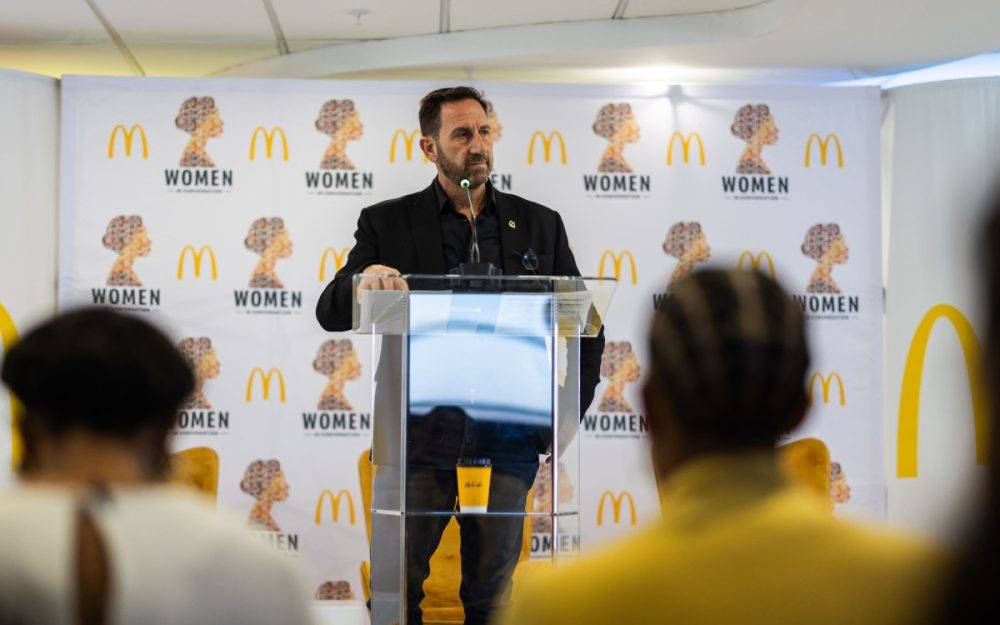
Greg Solomon, CEO of McDonald’s South Africa, highlighted the progress of women in the workplace, noting that the focus has shifted from the term “woman leaders” to recognising them as simply leaders. He pointed out that women now constitute 60% of McDonald’s South Africa’s workforce, showcasing their capabilities and potential.
Greg highlighted the role of leadership in unlocking wellbeing. “It starts with our leadership style. It requires a style of diversity, a style of inclusion, a style of caring, a style of ubuntu,” he said.
Maureen Mntonintshi, Chairperson of the South African chapter of McDonald’s Global Women’s Leadership Network, stressed the importance of events like Women in Conversation, which provide a safe space for women to share their experiences and support one another. She acknowledged the daily challenges women face, from career demands to family responsibilities, and the importance of collective effort in addressing these issues.
The event featured discussions on key themes such as mental health, career advancement, and the importance of vision and purpose in achieving personal and professional goals. One of the panellists was Victoria Moya, a McDonald’s Owner-Operator who joined the company in 2010. Victoria has grown a successful business that serves millions of customers each year and has contributed to McDonald’s strategic direction and policy development. She currently serves as a Treasurer of the National Leadership Council for South Africa and authored the book Resilience: Rediscover Yourself After Hardship. She shared her journey of balancing her demanding career with her personal life, emphasising resilience and the role of vision in overcoming challenges.
Zanele Mvelase, also a McDonald’s Owner-Operator running two stores in the Northwest area and serving on the board of Ronald McDonald House Charities South Africa, shared her perspective on leadership and mental health. Zanele, who previously held the position of Group Head of Corporate Affairs at a financial institution, spoke about the challenges of transitioning from a corporate environment to entrepreneurship.
Nombuyiselo Kahla-Nthangase, founder and director of Sinoluvo Consulting, discussed her extensive experience in employee assistance programmes, including her work as a military social worker and her role in the United Nations peacekeeping mission in the DRC. She emphasised the importance of addressing mental health issues, especially in high-stress environments, and highlighted the stigma that still surrounds mental health in many communities. She urged organisations to create safe spaces where employees can openly discuss their struggles without fear of judgement.
Portia Sibeko, a seasoned HR professional with 21 years of experience, 16 of which have been in leadership roles, also contributed to the discussion. Currently an HR Executive at United Pharmaceutical Distributors, Portia has a wealth of experience from various industries, including healthcare, banking and hospitality. She emphasised the critical role HR plays in supporting employees’ wellbeing and driving organisational success. Portia highlighted the need for organisations to not only implement wellness programmes but also to ensure they are accessible and effective in creating an inclusive and supportive work environment.
The event encouraged audience engagement, providing a platform for attendees to ask questions and share their own experiences. This open dialogue allowed for a diverse range of perspectives to be voiced, contributing to a more comprehensive understanding of the challenges faced by women
Women in Conversation once again demonstrated the power of dialogue and collective action in addressing the challenges faced by women.
What does the defection of the EFF’s Shivambu to MK party mean?:
News broke on Thursday that Floyd Shivambu has resigned as deputy president of the Economic Freedom Fighters (EFF). This development raises questions about its effect on political parties outside of the government of national unity (GNU).
Media reports suggest that EFF leader Julius Malema and Shivambu had a falling out after “Shivambu was approached by a group of wealthy businesspeople who allegedly promised him a lot of money to fund his campaign to contest Malema at the party’s elective congress in December.” This reportedly led to Shivambu’s resignation on Wednesday evening, followed by his announcement that he was joining the recently formed uMkhonto weSizwe (MK) party, led by former ANC president Jacob Zuma.
After the formation of the unity government following the 29 May general elections, the parties outside the GNU created what they called “a progressive caucus”, which initially consisted of seven parties but eventually dwindled to just four: the EFF, African Transformation Movement and the MK party. Al-Jama-ah, the Pan Africanist Congress, and the United Democratic Movement left to join the unity government. With Shivambu joining the MK party, questions arise about how this alliance will play out.
Speculation abounds regarding whether Shivambu will hold a senior position in the MK party. One scenario suggests that tensions may arise within the newly formed alliance. Malema, having lost another strong ally — someone he considered a “brother” — may be deeply concerned that Shivambu was willing to contest his leadership. The EFF, built around Malema’s personality, might struggle to shift from a leader around whom many have rallied. Moreover, justifying an alliance with the MK party, which took the EFF’s co-founder, could prove challenging.
This situation could leave the “progressive caucus” more fractured than before. With the ANC forming a relationship with the Democratic Alliance, which is viewed as more centre-right, there is a pressing need for a strong, united opposition to curb the power and influence the ANC and DA will hold in parliament as a result of the GNU. This division could also split the 23% voting power the EFF and MK party held in parliament.
But both the MK party and the EFF have strong leaders who have historically backed each other, even dismissing wrongdoings in the VBS Mutual Bank heist. The former chair of VBS, Tshifhiwa Matodzi, in a leaked affidavit alleged that Malema and Shivambu were involved in the looting of the bank, with their share being R16.1 million.
With Zuma now 82 years old, he will be 87 by the 2029 elections. It is unlikely he will have the capacity to run a full campaign and compete with many of his younger counterparts. This opens the door for Shivambu to take the lead and set a vision of his own. While this is speculative, it offers a hopeful future for those in the country who support their views.
That said, as seen in the 2024 election, the unexpected growth of the MK party significantly stifled the EFF’s growth. This means that both the MK party and the EFF are now contesting the same support base. Unless these parties can mobilise more people to vote for them and find ways to differentiate themselves, it is unlikely that this contestation will lead to a positive partnership.
Moreover, with funders willing to back a campaign against Malema and the EFF not experiencing the growth it once expected, the party may be on a steady decline, leaving Malema isolated.
He has already acknowledged that members of the party are likely to resign because of their loyalty to Floyd Shivambu. At the moment, the EFF does not appear to be strengthening but rather weakening. But the MK party also faces similar volatility — such as the sacking of 18 of its MPs and the resignation, rehiring and firing of its secretary general Arthur Zwane — and relies heavily on loyalty to Zuma. In addition, the lack of solidified policies, succession plans and a concrete manifesto, the longevity of the MK party remains uncertain.
As we come to terms with the new political landscape that has arisen after Shivambu’s announcement, we must ask ourselves: has this development furthered the “progressive caucus” or will it lead to a regression that allows the dominance of more centre-right parties?
Khumo Kumalo is the founder of the website Misunderstood, which unpacks social, identity and economic issues in South Africa, and a student at Morehouse College, studying political science. He is also a Mail & Guardian 200 Young South Africans 2024 winner.
Submit and get free exposure here: Showcase Your Business | Advertise Your Special Offers.
