
South Africa is eager to facilitate Russia-Ukraine peace talks, says minister Lamola:
South Africa continues to hope to be instrumental in bringing Russian and Ukrainian leaders to the negotiating table, with International Relations and Cooperation Minister Ronald Lamola saying this week it could serve as a bridge between Moscow and Kyiv.
Lamola pressed the point after talks on Tuesday with British Foreign Secretary David Lammy, who chose to visit South Africa and Nigerian on his first official trip to the continent.
Their meeting came a week after Lamola hosted his Ukrainian counterpart, Andrii Sybiha, shortly after returning from the Brics summit in Kazan, Russia, where President Cyril Ramaphosa sought to raise the point with Russia’s President Vladimir Putin.
Lamola said he gave Lammy feedback on South Africa’s efforts. Although Sybiha welcomed the prospect of direct talks to end the 30-month war in his country, Lamola conceded that he did not know what Moscow’s response to the proposition would be.
“We intend to further communicate with them and communicate that message and act as a bridge that must facilitate that peace process for the two countries,” Lamola told a media briefing in Cape Town.
“Our non-alignment position gives us the opportunity to do so and it is also in that position that we need to participate in the Brics platform that we continue to see as a developmental platform for us.”
It is reliably understood that Ramaphosa hoped to press Putin for a commitment to meet Ukraine’s President Volodymyr Zelenskiy but did not get this far in private conversation in Kazan. At the summit, Putin remained silent every time a fellow leader publicly called for peace with Ukraine, or de-escalation of the conflict, as China’s Xi Jinping did.
Russia has made rapid territorial advances in recent months, and there are fears that North Korean troops sent to Russia will be deployed to Ukraine.
Lammy said he had discussed this development with Lamola in their hour-long meeting in Cape Town.
“In the course of our discussions, I did raise my concerns that the DPRK [Democratic People’s Republic of Korea] have sent troops to Russia to fight in Ukraine and that is a matter of huge concern to us, not just in the UK but in Europe.”
He added that the issue was raised with him while he was in South Korea a few weeks ago.
On Wednesday, Lammy and the foreign ministers of the other members of the G7 issued a statement saying: “The DPRK’s [North Korea] direct support for Russia’s war of aggression against Ukraine, besides showing Russia’s desperate efforts to compensate its losses, would mark a dangerous expansion of the conflict.”
Besides the G7 members — the United States, Japan, Italy, Britain, Germany, France and Canada — the communique was also signed by South Korea, Australia and New Zealand.
Lammy was asked whether he was concerned that the newly expanded Brics bloc was positioning itself as a counter to the West, a perception that was reinforced by Putin’s efforts to use the recent summit to show that his power and influence was not diminished by Western sanctions and an International Criminal Court (ICC) arrest warrant for war crimes.
“On the question of Brics, it is for other countries to determine the groupings of the clubs that they want to belong to,” he said.
“I have been keen to engage with Minister Lamola as a friend, as a trusted partner, able to have dialogue on issues of mutual concern.”
Lamola added: “We have said it repeatedly — we don’t view it as a platform that is anti-West. We view it as a developmental platform that will continue to aggregate the interests of the Global South.”
Lammy said he had discussed the Middle East with Lamola but he treaded cautiously when asked about South Africa’s pending genocide case against the Jewish state before the International Court of Justice (ICJ).
South African last week filed a memorandum to the ICJ setting out its full case against Israel, which Ramaphosa said included compelling proof that it was in breach of the Genocide Convention. Diplomats have privately welcomed signs that Britain’s stance on Israel — as well as Africa — is shifting under the new Labour government.
Lammy has overturned the previous Conservative government’s decision to suspend funding for the United Nations’s relief agency in Palestine.
And in July, Downing Street said it would not challenge the jurisdiction of the ICC to issue an arrest warrant for Israeli Prime Minister Benjamin Netanyahu, contrary to plans by former prime minister Rishi Sunak to do so.
“Since coming to power the Labour government has been keen to stress the importance of international humanitarian law and that has guided our actions,” Lammy said.
“It is with regret that we have suspended arms sales that can be used in Gaza, on the basis of our very robust export licensing regime, and my judgment that there could be a breach of international humanitarian law.”
He added: “We of course have noted South Africa’s submissions, and this did come up in our bi-lateral discussions.”
Lamola and Lammy confirmed that they spoke about reform of the UN Security Council, of which the UK currently holds the rotating chair. It is understood that these did not extend to whether Britain supports Africa’s demand for at least two permanent seats on the council with full veto rights.
The current proposal, which emerged in September, would see the continent get two seats without veto powers. It is all the US will support but the matter is now the subject of text-based negotiations in New York.
“These are matters that take careful legal consideration and the UK government of course is giving that due consideration.
“The UK has had a long-standing position that Africa must be represented on the UN Security Council and I am keen to better understand if the recent position if supported by other members of the security council, particularly Russia and China, that have been a block on the UN Security Council’s expansion in the past, which is not the UK position.”
Lamola ventured that South Africa and Britain were “at one” with Britain on the issue.
He called for further expansion of trade relations, saying there was much room for improvement, and that he had raised access to finance for developing nations with Lamola.
South Africa is Britain’s largest trade partner on the continent, but bilateral trade contracted slightly over the past year to total £10.6 billion (R240 billion).
The government intends to use its upcoming presidency of the G20 to step up its campaign for the reform of multilateral institutions to afford more influence to the Global South.
This will include lobbying powerful member states, including Britain, France and Germany, for support for more permanent seats for African nations on the security council, in line with the 2005 Ezulwini Consensus adopted by the African Union.
The UK’s labour government has made strengthening ties with the Global South one of the priorities of its foreign policy — at a time when Russia and China are also looking to increase their foothold on the continent. Lammy on Tuesday stressed the importance of the Commonwealth in the context of closer cooperation with African partners.
Britain’s foreign office at the weekend said Lammy was looking to build “respectful partnerships that listen rather than tell” with African countries.
“I want to hear what our African partners need and foster relationships so that the UK and our friends and partners in Africa can grow together,” it quoted the minister as saying.
“Growth is the core mission of this government and will underpin our relationships in Nigeria, South Africa and beyond. This will mean more jobs, more prosperity and more opportunities for Brits and Africans alike.”
Lammy this week signed a strategic partnership accord with Nigeria.
Sewage flows in streets as KZN township faces water crisis:
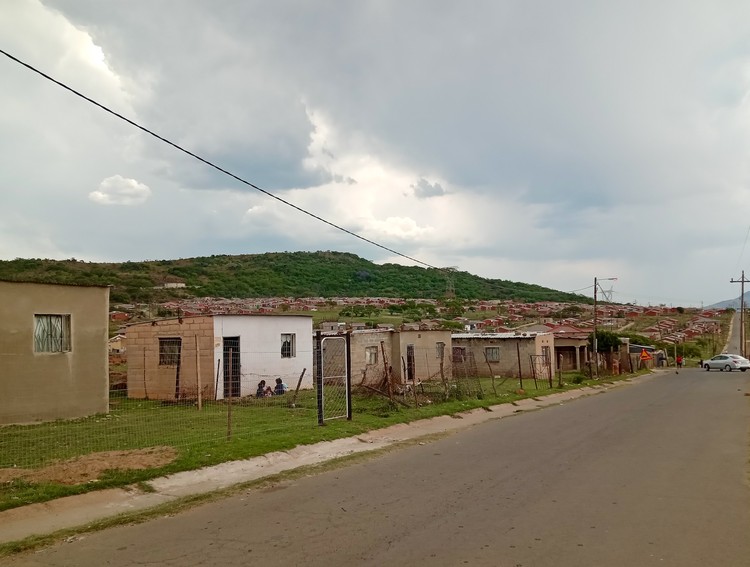
Raw sewage is flowing in the streets of Sithembile township in Glencoe, KwaZulu-Natal, where residents have been struggling with water shortages for six months.
Most areas in the township have had no running water since May 2024. Only parts of Red Location, Thembalihle and Emadoshini West receive intermittent water supply.
When the water does return after cuts, backed up sewers and stormwater drains overflow, sending raw sewage flowing towards homes and a nearby stream.
“Children wear dirty school uniforms daily because we must save water for drinking and cooking. Sometimes we go to bed hungry because there is no water,” says Bonginkosi Mahlaba, who GroundUp found pushing a wheelbarrow with his two nieces to fetch water.
Mahlaba lives in Marikana section and fetches water in Mtshotshombeni, where some homes still have water supply. By early afternoon, the communal water tanks in his area were already empty.
At the edge of Sithembile is a village of 14 households with small farming plots.
“Our village depends on rainwater. When it’s not raining, we walk a kilometre to fetch water from Mtshotshombeni,” said Thandazile Mntambo, a resident of the area.
Ward 3 Councillor Mbulelo Phakathi has used ward funds to install water tanks to be filled by water trucks.
According to Phakathi, officials of Mzinyathi District Municipality, which is responsible for water provision, told residents at a public meeting in May that only four out of eight filters at the Biggarsberg water treatment works, operated by uThukela Water, are working.
“I’ve learned that the district lacks a maintenance plan,” said Phakathi. “Their communication is also poor; councillors are not updated about water shortages.”
The KZN 2023 Blue Drop report from national government notes: “uMzinyathi DM’s performance has digressed since Blue Drop 2014, resulting in a significant decrease of the municipal Blue Drop score from 78% in 2014 to 32% in 2023”.
Endumeni municipality speaker Councillor Andile Nsibande said a contractor had started work on the water treatment plant two months ago. “However, I am not sure how long the project will take to finish,” he said.
Comment from uThukela Water and Mzinyathi District municipality will be added if received.
This article was first published by GroundUp.
US, Europe begin scramble for Africa’s satellite internet market:
A new scramble for Africa’s satellite market between the US and Europe is underway, as France targets connecting 26 African countries with high-speed space-powered internet.
Thales Alenia Space, one of Europe’s largest telecommunications, navigation and surveillance satellite makers, has entered into a memorandum of understanding with a Moroccan private equity firm, Panafsat, to develop a geostationary telecommunications satellite in Morocco.
As part of the MoU, the two companies said in a joint statement that Thales Alenia Space will develop “a very high-performance flexible satellite to accelerate Africa’s digital transformation- serving a combined population of over 550 million people”.
Panafsat Chairman and Chief Executive Officer, Ahmed Toumi described the project as the next critical stage in the digital transformation process and developing a digital economy in Morocco and across Africa.
“It will change the lives of millions of people eager to benefit from Internet access and all the essential services they need,” he said.
The MoU was signed during French President Emmanuel Macron’s state visit to Morocco at the end of October, in the presence of Nadia Fettah Alaoui, Moroccan minister of economy and finance, and Antoine Armand, French minister of economy, finance, and industry.
Most of the targeted African markets (23) will be French-speaking nations, with the remaining three being Anglo-phone.
“The project will make a significant contribution to bridging the digital divide in rural areas, as well as boosting economic growth and strengthening digital sovereignty across the African continent,” said Thales Alenia Space CEO Hervé Derrey.
The entry of Thales Alenia Space comes at a time when American spacecraft manufacturer SpaceX is recording significant milestones on the continent – including the recent sell-out of Starlink terminals in five out of 12 African countries, including Madagascar, a French-speaking nation.
Since it began making inroads into the continent more than a year ago, Starlink has faced numerous regulatory hurdles, especially in French-speaking countries like Côte d’Ivoire, Burkina Faso, DR Congo, and Senegal.
However, there appears to be some light in most francophone countries, with Starlink’s coverage map highlighting availability prospects in these markets by the end of 2024 and 2025.
Starlink projects it would go live in Mauritania, Senegal, Côte d’Ivoire, Gabon and Chad by the close of the year, with a 2025 start date for countries like Burkina Faso, Niger, Cameroon and DR Congo.
Starlink has been approved to operate in Mozambique, Eswatini, Botswana, Rwanda, South Sudan, Burundi, Benin, Ghana, Sierra Leone, Malawi, Zimbabwe, Kenya, Nigeria, Zambia and Madagascar.
Thales Alenia Space’s entry into Africa is also considered part of its strategic plan to counter diminishing “traditional telecommunications satellite markets” in Europe – from rising competition in the commercial customer space by global rivals like Elon Musk’s Starlink.
European aerospace group Thales, with a 67% stake in Thales Alenia Space, is reportedly exploring a merger of its satellite operations with another pan-European aerospace group, Airbus (also headquartered in France), that would make a market-dominating player to counter competition, according to the Financial Times and Reuters.
Research and Markets projects the global small satellite market to grow to US$ 11.2 billion by 2029, from US$ 5.2 billion in 2024, stimulated by increasing demand for commercial satellites boosting the launching of small satellites.
“They are widely accepted since they are affordable, have short developing periods and can serve various purposes such as telecommunication, earth observation, etc,” according to the Research and Markets report.
According to the International Telecommunication Union (ITU’s) Facts and Figures 2023 report, 37% of the African population had internet access in 2023, rising from a modest 16% in 2013.
Young and tech-savvy African consumers are driving demand for high-speed internet, with the rise of streaming, online gaming, voice calls over the internet, and remote working and learning, fuelling demand.
However, at 37%, Africa’s connectivity falls below 67% of the global average internet usage, sparking the satellite internet scramble on the continent.
— bird story agency
Submit and get free exposure here: Showcase Your Business | Advertise Your Special Offers.
