South Africa’s presidency confirms ‘regrettable’ ejection of ambassador to US Ebrahim Rasool:
President Cyril Ramaphosa’s office said on Saturday South Africa’s ambassador to the United States had been expelled — confirming the further deterioration in diplomatic relations between the two countries since Donald Trump was inaugurated in January.
“The Presidency has noted the regrettable expulsion of South Africa’s ambassador to the United States of America, Mr. Ebrahim Rasool. The presidency urges all relevant and impacted stakeholders to maintain the established diplomatic decorum in their engagement with the matter,” it said in a media statement.
“South Africa remains committed to building a mutually beneficial relationship with the United States of America.”
The statement came after US Secretary of State Marco Rubio posted on social media platform X late on Friday night, South African time, that Rasool “is no longer welcome in our great country”.
“Ebrahim Rasool is a race-baiting politician who hates America and hates @POTUS (Trump). We have nothing to discuss with him and so he is considered PERSONA NON GRATA.”
Relations between the two countries have been fraught since Trump said in early February that he was suspending all aid to South Africa over what his administration claims is legislation that discriminates against whites. He has since offered white Afrikaners refugee status in the US.
In a 2 February post on his social media platform, Truth Social on 2 February — days after Ramaphosa signed the Expropriation Act into law — Trump said he was cutting aid because “South Africa is confiscating land and treating certain classes of people VERY BADLY”, warning that “The United States won’t stand for it, we will act”.
Trump followed that up with an executive order cutting aid, and falsely claiming that the Expropriation Act enabled the government “to seize ethnic minority Afrikaners’ agricultural property without compensation”.
Rasool — who has previously been critical of Trump — first served as South Africa’s top envoy to the US from 2010 to 2015 and was redeployed to the post this year.
Washington has not yet appointed a new envoy to Pretoria after former ambassador Reuben Brigety announced his resignation last November, effective from January 2025, in line with the standard transition after a change in the US presidential administration.
Joel Pollak, an editor-at-large for the right-wing publication Breitbart and outspoken critic of the South African government, has been touted as a potential successor to Brigety.
In his X post stating that Rasool was no longer welcome in the US, Rubio attached a Breitbart article, with Pollak’s byline, which said the South African ambassador had told participants at a foreign policy seminar on Friday that Trump was “leading a white supremacist movement in America and around the world”.
The Breitbart report said Rasool was addressing the Mapungubwe Institute for Strategic Reflection in Johannesburg.
Pretoria had initially sought to repair tattered relations — even after a defiant Ramaphosa declared in his State of the Nation address last month that the country would not be bullied into abandoning policies that Trump’s administration has branded “anti-Americanism” — an apparent reference to South Africa taking US ally Israel to the International Court of Justice over its attacks on Gaza.
But earlier this week Ramaphosa’s spokesperson Vincent Magwenya told the Mail & Guardian that the government has revised its thinking around the purpose of a planned diplomatic mission to Washington, and now hoped to rather engage the Trump administration on trade.
Luxurious transition: Is the Mazda CX-60 a sign of things to come?:
“Jinba-ittai” is Mazda’s term for the intuitive connection between the driver and the car. It directly translates to “the horse and rider as one”.
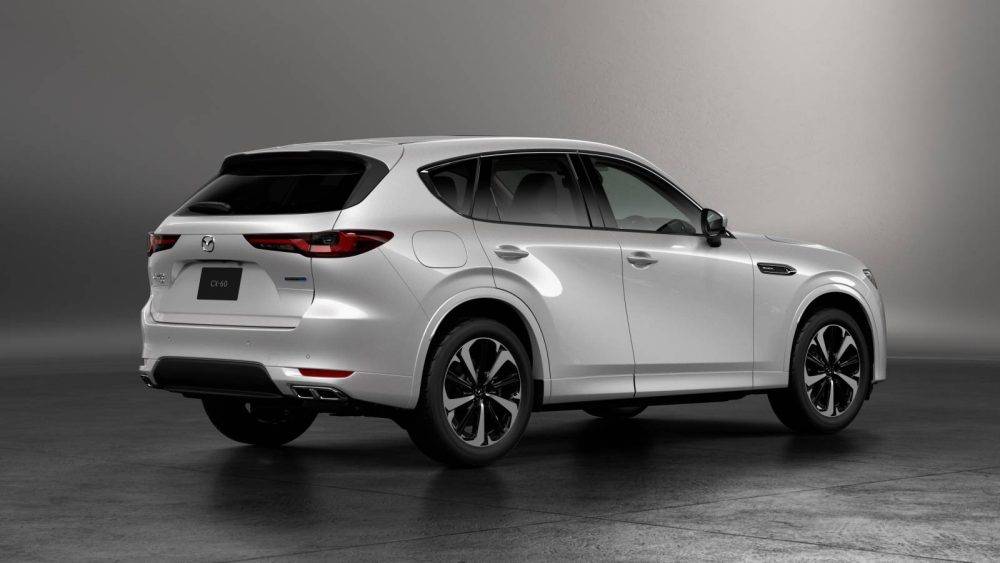
The brand’s CX-60, now the flagship of its range in South Africa, embraces the phrase wholeheartedly.
The Mail & Guardian test-drove the CX-60 Takumi, which is a 3.3-litre turbo-diesel mild hybrid. And that is as odd as it is long. We are not used to seeing diesel hybrid vehicles and these odd combinations can work wonders or fail abysmally. There’s usually no middle ground.
My expectations were high because Mazda released this powertrain with a lot of confidence. The 3.3 litre turbodiesel engine paired to an electric motor is advertised before anything else on their website and in the brochure, so that’s how I knew that this could be a recipe for success.
The Mazda CX-60’s mild hybrid electric vehicle technology combines an internal-combustion engine with a compact electric motor and battery. This harnesses energy while braking to assist the engine during acceleration, reducing fuel consumption and emissions.
The engine puts out 187 kilowatts of power and 550Nm of torque.
The Drive
I started with a journey from Johannesburg to Springs to get the feel of the vehicle, coming to grips with the acceleration and the handling.
At first, I found the steering wheel to be a little tight and heavy. But, on the next drive, I realised that sitffness was due to the lane-keep assist feature.
It was from my second long-distance drive in this vehicle that I really began to become one with it. I started to understand jinba-ittai.
The car handled the N12 and R21 highways effortlessly. You could feel every bit of power that Mazda has claimed from this 3.3-litre turbocharged diesel engine.
But it wasn’t just about the power, it was the supreme comfort while driving, the ease and the fact that I didn’t feel as if I had to adapt to the car, but rather that it was adapting to me.
Mazda has got this drivetrain so absolutely spot-on that it brings your driving experience to the fore.
The Mi-Drive feature contributes further to the success of this vehicle’s driving experience. The technology lets drivers choose between different modes to tailor the vehicle’s performance to their preferences and conditions.
Only the fuel consumption did not live up to the boasted figure. Mazda claims that you will get 4.9 litres/100km, but the most I could get the vehicle to was 6.9 litres/100km. That is quite a stretch from the claimed figure. But still, for a vehicle of its size, that consumption is very economical and it can easily do 800km to 900km on a full tank.
The interior
It’s not just the drivetrain that contributes to that complete feeling the CX-60 gives you, it is also the comfort you experience in the cabin.
Comfortable leather seats, a large armrest, electrically adjustable seats and, for once, an infotainment screen that isn’t a touch screen, but rather controlled by a knob on the driver’s left which, in my view, makes it much less distracting when managing the screen in the centre, which was also more angled towards the driver.
Mazda is really pushing that driver-centric approach in this vehicle.
However, the infotainment screen does come with its fair share of frustrations. While I prefer not to have touch screens while driving, I did not enjoy it when I was trying to toggle to an option and just could not get to it. I struggled to connect my phone to the vehicle via bluetooth and eventually had to connect a cable to use its Apple CarPlay.
The cabin comes equipped with a Bose sound system which gives the entire family superb sound, no matter where they are sitting. And, yes, the family can sit anywhere and sit comfortably as the legroom and headroom at the back are ample for the kids and for average-sized adults.
Exterior
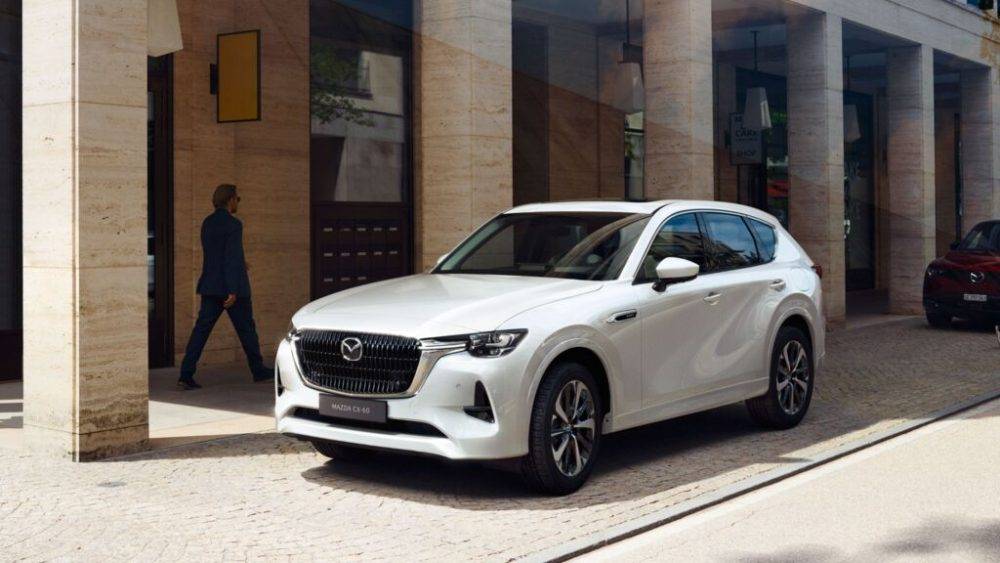
With the exterior, Mazda has done well with the large front grille and headlights that retreat into the body of the car, which makes it different, while the overall shape and look of the vehicle still allows it to maintain the Mazda identity.
The Mail & Guardian had the vehicle in platinum quartz and that is the colour I would recommend to anyone interested in this vehicle although it also looks stunning in sonic silver and machine grey. However, I’m not a fan of the vehicle in deep crystal blue and soul red, which detract from the exterior features of the vehicle.
The CX-60 Takumi also has a panoramic sunroof that I hardly used because of either the heat or the rain, but a sunroof is always a nice feature to have.
Safety
The CX-60 features advanced safety technologies like lane assist, lane departure warning, blind spot monitoring, rear cross traffic alert, driver monitor and advanced smart city brake assist to protect both occupants and other road users, enhancing driver confidence.
One of the coolest things about this vehicle is the driver personalisation settings. The vehicle will detect when a new person is sitting in the driver seat. Once you register and personalise your settings, the system uses a facial-recognition camera to automatically adjust the driver’s seat, steering wheel, head-up display and exterior mirrors, based on body height and eye position, eliminating the need for manual adjustments.
Verdict
The CX-60 comes in three variants: a 2.5L Dynamic Auto RWD, a 2.5L Individual Auto AWD and the 3.3L DE Takumi AWD, the variant we tested.
The price on the 2.5 Dynamic Auto RWD is R770 900 and the 2.5 Individual Auto AWD is priced at R879 900. The Takumi however, comes in at R 1 074 700. This makes it Mazda’s most expensive car in South Africa ever.
The vehicle really does embody Mazda’s shift to becoming a luxury brand and, as I mentioned earlier, it does give you the feeling of jinba-ittai, but that price is a touch heavy for a brand entering the luxury space.
With Mazda bringing in four more luxury vehicles in the next two years, including a fully electric vehicle, those prices might not drop, but it will be interesting to see if the brand can use the CX-60 as a stepping stone to competing among the luxury brands.
New energy: Mazda is here to stay, despite recent challenges:
In 2019, Mazda decided to reposition itself in the global car market as a more premium brand. The change has seen its sales figures fall in South Africa.
Pushing the brand into a more premium position was always going to result in a sales decline, but other factors have also created challenges for Mazda since 2019.
While sales for most brands have still not reached pre-Covid levels, one of the reasons behind Mazda’s even bigger decline has been the new entrants into the market over the past few years, Mazda managing director Craig Roberts told the Mail & Guardian.
“From a Mazda perspective, we’ve been going through a brand repositioning globally and, since 2019, we’ve been moving to larger-platform vehicles. The CX-60 is actually the smallest of those larger-platform vehicles,” he said.
“So, we’ve got more challenges. With moving upmarket, and brand repositioning into higher segments, there’s less volume opportunity and pricing is much higher in those segments. So, we’ve had to balance and manage that and, essentially, we are now trying to compete on a value proposition.”
While Mazda is a legacy brand in South Africa, companies like Chery and GWM continue to sell more vehicles. In January, both Chinese brands were in the top 10 for new vehicles sold in the country, while Mazda had fallen off the list.
Roberts noted that the emergence of Chinese vehicles had also contributed to the drop in sales for legacy brands, but added that Mazda had aligned its prices more to what the Chinese manufacturers were bringing in now.
Mazda is advertising its best-selling CX-5 model for R499 000, which lines up with prices for Haval’s Jolion Pro, Chery’s Tiggo 7 Pro and Jaecoo’s J7.
While the powertrain in the CX-5 outdoes those vehicles, the technology might be where it falls behind.
Roberts acknowledged that Mazda had to update the technologies for its vehicles to keep up with competitors.
“We also are talking about a generational challenge. It is now more based around technology. Before, when you launched a car, it was all about the powertrain. We’ve had to upgrade certain technologies in the facelifts that we’ve brought in because we’ve had to adapt,” he said.
“We can’t rely on just Skyactiv reliable 2.0 litre engines anymore to sell vehicles — we have to adapt in terms of technology.”
However, despite rumours of an exit from South Africa last year, Roberts confirmed that Mazda was here to stay and would be bringing more models into the country over the next two years.
“We will bring the CX-80 plug-in hybrid this year, a new CX-5, a CX-60 plug-in hybrid by 2026 and then the Mazda 6e in 2028, to cap off this particular series of models,” he said.
Three of the four new models Mazda is bringing into the country will be new-energy vehicles. This will push the brand further into the more premium space.
Roberts said it was important for local manufacturers to embrace new-energy vehicles and build hybrid or battery-energy vehicles.
He believes that, once this happens, South Africans will begin to adopt new-energy vehicles, which should be around 2028. This is why the marque needs to phase in its new-energy vehicles from 2025, until 2028, when it introduces the all-electric Mazda 6e to South Africa.
Submit and get free exposure here: Showcase Your Business | Advertise Your Special Offers.