
Star witness continues to unravel on the stand in Joslin Smith trial:
Lourentia Lombaard irks the judge with her ‘assumptions’, while Kelly Smith is again portrayed as a callous mother
A daily battle: Commuters still suffer from apartheid spatial planning:
Commuting to and from city centres and economic hubs for work in Gauteng — and across South Africa — is daunting. The race against time, unreliable transport systems, safety concerns and costs are some of the many obstacles commuters face. I know this from my personal experience of commuting to an economic hub in Johannesburg, which I documented on TikTok.
This article is based on the habits of daily commuters to economic hubs and places of work across the Johannesburg metro. The sad reality in South Africa is that commuters spend up to 50% — sometimes more — of their salaries on transport every month.
Apartheid policies and institutionalised racial segregation have had a long-lasting effect on commuting today. Townships are typically more than 20km from Gauteng’s economic centres, such as Sandton and Centurion, for example. This spatial divide, coupled with an unreliable public transport system, significantly affects the commuting experience in the province and across the country.
A first-hand experience of the daily commute
I commute from Johannesburg South to Modderfontein in Ekurhuleni, a 10-minute drive to the east of Sandton. The journey begins with a five-minute walk to a taxi stop at 5.30am, then into a taxi to the MTN Taxi Rank, where I take another taxi to Modderfontein. The journey is documented on my @phano styles TikTok page, highlighting commuting realities in Johannesburg, such as transport mode transitions, safety concerns, costs and the perpetual race against being late.
The objective was to document the whole commute, showing how early I have to leave home to arrive in Modderfontein before 7 am for work. The post is captioned: “What time do you wake up to get to work on time?” Because I arrived at my destination at 6.30 am, I claimed that I could have slept an extra 30 minutes. But this is an assumption one should never make, given the unpredictable nature of public transport. The post gained more than 100 000 views and extensive responses from viewers, many of whom shared their commuting stories.
Stories from other commuters
One commenter shared that they wake up between 4am and 5am, board a minibus taxi at 5.30am and reach work by 6.30. Any disruption to this routine means failing to arrive at work by 8am. This emphasises the inefficiency of public transport.
Several others mentioned leaving home early in the morning and only returning after sunset, demonstrating the exhausting nature of their daily journeys. Many also spoke about the physical and mental toll of long and unpredictable commutes.
A similar post on X asked users to comment on their daily commutes in Cape Town. Many of the responses talked about the level of congestion on the roads. One of the most extreme cases involved a private-car driver who took 45 minutes to travel just 7km.
South Africa is experiencing some of the worst traffic congestion in its history, with Cape Town the most congested city in the country and ranking ninth in the world.
The big question — what is the solution?
Despite some inefficiencies, and limited access due to availability and pricing, South Africa does have transport options available for the public. These include bus rapid transit systems such as Rea Vaya and MyCiTi; the Passenger Rail Association of South Africa’s Metrorail, which is being upgraded; conventional bus services like those offered by Putco, Golden Arrow and Metro Bus; the high-speed Gautrain and the minibus taxi system. The latter carries the majority of daily commuters, despite its informal nature and lack of regulation.
Part of the solution for commuters would be integration because the various public transport systems operate independently of each other and differ in affordability and quality. Integrating transport modes into a single, cohesive system with a universal payment system has worked in many cities around the world.
From an urban planning perspective, integrating transport modes would enhance accessibility and efficiency for people of varying income levels. Certain modes of transport require payment in physical cash, whereas others use smart cards or a ticket-purchasing system, for instance.
London’s underground railway, tram and bus system, using Oyster cards and contactless payment, is a great example of an integrated payment system for South Africa to follow.
In addition, the public needs to be educated about other modes of transport, especially the renovated Metrorail system, which is often unfairly perceived by the public as being unsafe.
A recent effort by civil society to sync the Metrorail schedule with Google Maps and the Cape Town MyCiTi bus network deserves applause as a step in the right direction.A recent effort by civil society to sync the Metrorail schedule with Google Maps and the Cape Town MyCiTi bus network deserves applause as a step in the right direction. The Young Urbanist South Africa nonprofit, in collaboration with the Passenger Rail Association of South Africa, has integrated the Metrorail schedule in Cape Town into Google Maps, where MyCiTi schedules are already well represented. This initiative is progressing and will soon include trains. It is set to expand nationwide, making the information accessible to the public across the country..
The daily struggle faced by commuters in South Africa highlights the urgent need for improved public transport infrastructure, more reliable systems and better urban planning. Addressing these issues is not just about improving transport, it’s about restoring dignity, opportunity and efficiency. As one commenter on my TikTok post aptly put it: “To us that keeps the economy running.”
Phano Liphoto, an urban planner and master’s candidate at the University of Cape Town, researches cycling history in the city and has contributed to an upcoming book on cycling in African cities.
Dancing with the machine: autoplay and the future of AI-driven art:
Like huge wraiths, their shadows danced on the walls to a haunting soundtrack. Four dancers in identical cropped wigs and tunic dresses repeating sequences of gestures on the large turntable on the performance space.
Their movements and rhythms were simultaneously strange and familiar, the music they moved to a synthesis of organic and electronic. An integration of real and digital that in many ways is what life has become.
Later, the mournful, plaintive voice of singer Inge Beckmann pierced the air, transforming what had looked like an avant-garde ballet into something more akin to alternative opera, an amalgamation of dance moves, semi-synthetic music, human vocal gymnastics and screen projections.
And all of it coaxed the audience into some kind of altered state.
The show — billed as “Africa’s first AI opera” — is not easily categorised; it doesn’t neatly fit into any genre box. It’s more profound than the sum of its parts, refuses to give up its meaning and doesn’t pretend to have answers to the questions it provokes.
Choreographer Louise Coetzer is too smart and too interested in exploring the limits of creative possibility to pretend she has answers.
Instead, autoplay uses machine learning to venture down the rabbit hole, exploring ways in which humans can collaborate meaningfully with technology, or hand themselves over to it, potentially relinquishing their autonomy entirely.
Different each time it’s performed, autoplay is having a brief run at the Baxter’s Flipside Theatre in Cape Town after it premiered in an industrial warehouse in the city last year.
“The entire performance is an experiment in collaborating with machine learning,” says Coetzer, who co-founded the dance theatre collective Darkroom Contemporary.
Coetzer is known for incorporating elements of chance into her shows and autoplay was created using input from generative AI which she has been exploring as part of a wider body of research.
“I have done works where the whole piece is about how the audience selects what happens next. In autoplay, I started those discussions with different AI platforms.
“Initially, the responses were silly and predictable — stupid things such as making the performers look like machines. But I would respond by saying, ‘No, I want it to be more conceptual, more abstract.’”
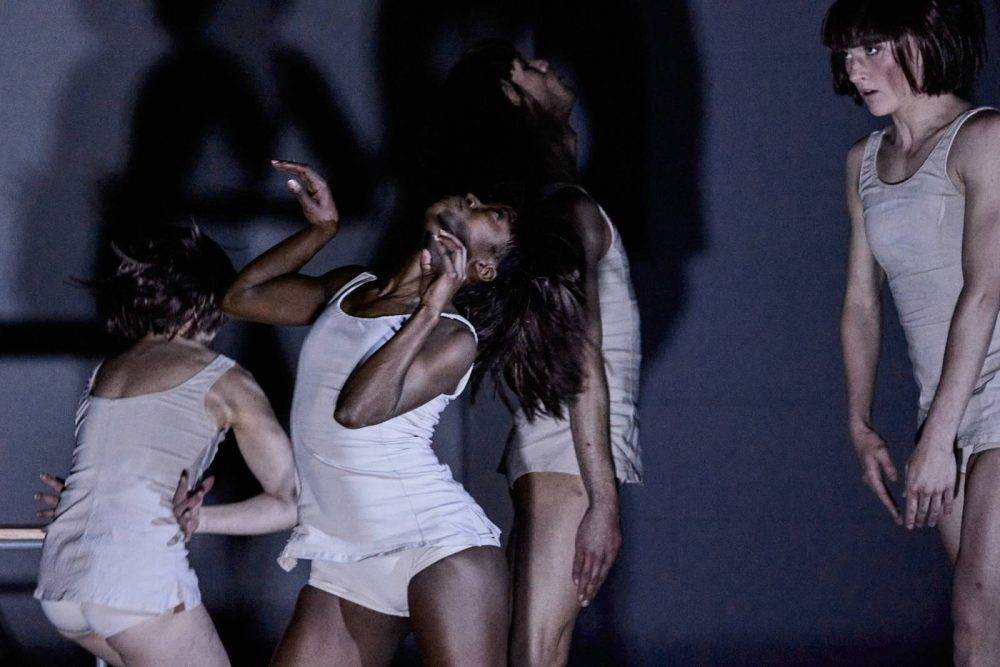
Coetzer reports that the platforms adapted to her way of thinking, played along with her interest in something deeper and supplied her with more radical options.
“Eventually, the responses became a lot more interesting because the AI platform had realised I wasn’t after such obvious choices; that I wanted something more unusual,” she says.
She’s clear that, while AI has been a collaborator, a sounding board for ideas and a generator of options, autoplay is very much a work for and by humans. “It comes from this very artificial thing that gives these inputs but I’ve filtered those through my own humanness,” she says.
The piece is in some sense a re-imagining of the biblical story of creation. Despite the presence of real apples in this show, though, it’s not quite the Garden of Eden. Rather, it’s an alternative beginning, with (Apple) computers the source of infinite knowledge in a world where we humans collaborate with AI to re-engineer our own genesis.
This is a version of creation in which machine learning enables us to reconstruct ourselves, not so much in God’s image, but as a series of godlike 1s and 0s.
And so autoplay contemplates what happens when we allow algorithms to dictate the next step. Whether that step is the next sequence in a choreographed dance piece or the next step in our evolution, what it confronts audiences with is the question of what happens when human creativity itself becomes consumed by digital processes.
Coetzer does, to some extent, wish to terrify us — or at least wake us up.
“I want to prompt reflection. I think it’s necessary with art to instigate thought. I’m not trying to preach or force my opinion, but perhaps it’s worth reflecting that there is some crazy shit going down.”
She would like her fellow humans to pay attention to the deep changes that are occurring thanks to the many ways in which machine learning has infiltrated our lives.
“I think it’s interesting how unalarmed we are about AI and its ability to morph beyond our control. There’s very little concern from people. We’re all just happily consuming.
“We’re, like, ‘Oh, there’s another app to play with!’ but paying no heed to the possible dangers.
“That’s an interesting tension and I’m always interested in the tension in things, because that is what our experience is — it’s navigating these tensions between the real and this really artificial-virtual space that we increasingly find ourselves in.”
A crucial part of autoplay’s hybrid mix of artistic forms is the music, a dazzling interplay of human voice, digitisation, improvisation and live mixing.
Created by Beckmann with composers Njabulo Phungula and Brydon Bolton, the soundscape is a captivating force, edging the work into a sublime, in-between space at the intersection of organic and synthetic, human and digital. It doesn’t merely haunt, it consumes the air molecules and causes your brain to vibrate at a different frequency.
That’s how I felt, at least.
It’s this thrilling interaction between human and technological creativity that sparks autoplay’s quandary: the question is what happens if these things — dancing, creative expression, human voices — become subsumed by machines, infiltrated by digital corrections, polished and perfected by algorithms that know us and know our hopes, desires, and even our dreams, better than we do? Do we really want to live in an artificially perfect world?
Coetzer says there is a sense of loss: “It’s in the process of creating that we, as humans, learn, become smarter, or discover new things. To just hand that over to AI, is robbing ourselves of something.”
She hopes the audience will wonder whether the performers are playing human characters or not: “Are they mechanical? Are they something in between? Are they a new organism that has been coaxed into existence?”
In a sense, autoplay reimagines the dawn of time but commencing at this moment when we are intensely tied to machines. It ponders how we evolve in relation to the machines we’re living alongside, that are increasingly ingrained in our social fabric.
Coetzer is in two minds about whether she’d like to be around to witness how AI’s impact on human evolution will play out.
“It’s like Brian Eno said, whoever is designing this stuff is designing the future, and it’s not somebody who’s interested in making the world better, it’s somebody who’s trying to get rich quickly, and we’re basically going along with it. I think we’re going to see a lot of crazy, crazy stuff.”
In the meantime, autoplay is a reminder to exercise our creative autonomy. A reminder that it is human to sing and dance and play.
autoplay is on at the Baxter Flipside in Cape Town until 29 March.
Submit and get free exposure here: Showcase Your Business | Advertise Your Special Offers.
