
Steel industry struggles deepen as ArcelorMittal retrenchments highlight systemic problems:
South Africa’s largest steel maker has warned that without urgent government protection, it will be a matter of time before local production is no longer viable.
This follows the announcement that more jobs are to be cut at ArcelorMittal, following last year’s statement that 3??500 jobs at its Vanderbijlpark plant would be slashed. Initially, the company said it would have to wind down its entire long steel operation, but later reversed that decision.
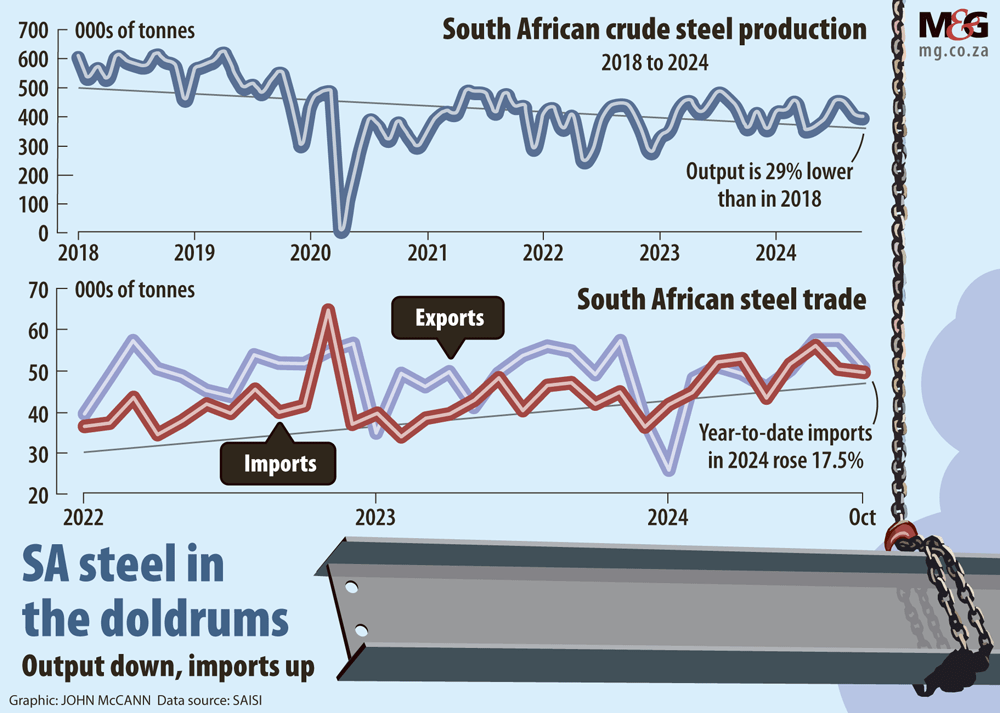
The industry has teetered on the brink of collapse for more than a decade because of low global demand and rising price pressures. Chinese and Thai price undercutting has been a key factor in its decline.
ArcelorMittal employs 9??000 workers, but many more downstream jobs are at stake.
Company spokesperson Tami Didiza said that “should these issues not be addressed as a matter of extreme urgency, it will only be a matter of time before the viability of the local integrated primary steel industry will be at risk”.
Didiza declined to give a figure for the number of retrenchments now on the cards, saying this will depend on how many workers can be reassigned.
He said voluntary severance packages in certain areas of the business will be offered, while some employees will be able to apply to fill new and existing vacancies.
The company, working with the National Union of Metal Workers of South Africa, announced that it will try to help affected employees by applying for benefits under the government’s training lay-off scheme through the department of employment and labour.
During a lay-off, the state covers the worker’s training costs and provides an allowance for up to six months. Companies qualify if they face closure or distress but have a strong likelihood of becoming sustainable with short-term support.
But it is unclear what training programmes are in place for jobless steel workers and how their skills can be repurposed.
Asked how steelworkers can be upskilled or re-skilled, the department of employment and labour said this falls in the ambit of the Commission for Conciliation, Mediation and Arbitration, which did not respond to questions from the Mail & Guardian.
Skills in the manufacturing sector should be transferable but research has shown that there is no crossover between industries, said Ayabonga Cawe, the chief commissioner of the International Trade Administration Commission.
“This is because there are no roles. There are no labour demands that can absorb these skills. One fundamental characteristic of the South African labour market and its economy is its inability to mop up workers who have certain skills that may be relevant to other industries,” Cawe said.
ArcelorMittal’s Didiza said the company would offer voluntary severance packages to bargaining units in raw materials, the sinter plant, blast furnace, tar plants, foundries and the steel plant based at Vanderbijlpark.
“The redundancies are for operational reasons rather than because of labour cost savings. The coke batteries have come to the end of their useful life and jobs there became redundant,” he said.
This is the second retrenchment notice issued by ArcelorMittal in 12 months, following its decision in November last year to wind down its long steel business, which produces wire, rods, rail and bars.
Cheap steel imports from the Asian market, particularly in China, have subdued the demand for South African produced steel products, putting pressure on the sector.
South Africa’s official trade statistics show a significant surge in imports of value-added steel products, with year-to-date imports rising by 17.5%, according to a South African Iron and Steel Institute report released in November this year.
“Cheap steel imports of variable quality continue to impact the local market. The absence of trade safeguard measures (which currently operate extensively internationally) apply to the importation of cheap steel products of variable quality,” Didiza said.
This week the International Trade Administration of Commission of South Africa (Itac) announced that the South African Revenue Service (Sars) will provisionally implement duties on imported structural steel.
This follows Itac’s request to the tax agency to impose 52.81% duties on steel imports from China, and 9.12% duties on imports from Thailand, for six months from 29 November, while the investigation is finalised.
The investigation began after Itac found prima facie evidence that China and Thailand were dumping steel in the Southern African Customs Union — that is, at prices below production costs — causing material harm to the local industry.
Didiza said such practices “have far-reaching effects on the local integrated primary steel industry, including a negative impact on the downstream, direct and indirect job losses, an increase in imports and a loss of critical local manufacturing and opportunities for localisation and beneficiation”.
Ramaphosa must be pushed to act on Thembi Simelane:
South Africa is not a normal country. That is the explanation we could offer ourselves during our diary planning sessions this week to explain how Thembi Simelane remains a member of the cabinet.
Reports by the Daily Maverick and News24 have alleged that our new human settlements minister has benefited from illicit kickbacks.
The details of how she profited are shocking. As mayor of Polokwane in 2018, she reportedly spent 569% more than her disclosed annual income. She wore the trappings of a story with which we are sadly familiar: luxury bags, expensive cars and family holidays.
Yet President Cyril Ramaphosa decided to fall back on the failsafe reshuffle button, replacing her as justice minister this week but not firing her.
Our leader, for all his executive power, has still not escaped the labyrinth of party politics — which is too often prioritised ahead of national politics. That is the only conclusion we can draw when confronted with the confounding events of this week.
Voters punished the ANC for this very behaviour in May. By stripping its previously invulnerable majority, the message was clear that the petty chicanery that has dominated public discussions for so long would no longer be tolerated.
But the hope that it would listen or would be forced to comply by the dynamics of the government of national unity (GNU) now appears naive. It has yet to shed its skin.
If we are to move forward as a country then it must be compelled to do so.
We are not a normal country because we are riddled with contradictions. We have spoken ad nauseam on these pages about the strength of our institutions and the distinct separation of our powers. But blatant political moves always arrive to undermine that assessment. How robust is a democracy if its leader is beholden to forces other than the people he serves?
The allegations against Simelane represent the betrayal of trust that has so often haunted us. Which is why such allegations are so infuriating to so many people, people who have seen power and privilege routinely abused with impunity.
Ramaphosa must, through public demand or GNU nudging, be pressured into severing the tether that still connects him to agenda-based decision-making.
It is clear he will not do so of his own volition.
Danny Jordaan: The dream sours:
For the first part of this story, please click here
Ahead of the World Cup I was dubbed the Sunday Times’ 2010 correspondent. It was less an honour than one of those jobs nobody else wanted to do because they already had their plates full with other stuff. I would meet Danny Jordaan — the person largely responsible for bringing the event to our shores — for breakfast in Sandton occasionally.
I remember agreeing to meet in Eastgate, a shopping mall on the Eastern side of Johannesburg.
Miraculously, Jordaan, who drove a massive BMW, managed to get lost. He seemed so stressed and so absent-minded that I wondered sometimes how he managed to wake up in the morning, or if he perhaps needed to get somebody else to do that for him.
Despite escapades on golf carts in the Caribbean and late-night phone calls, we became fond of each other. He was a left-arm medium-pace bowler, he once told me, which somehow fitted. He asked me to write his book, either to be a ghost-written autobiography or a biography.
He sometimes looked green from over-work, which went well with the permanently dishevelled look. There was a period, let’s not forget, during which Fifa became uppity about South Africa’s perceived lack of building progress, and parachuted a whole lot of their Swiss A-team down to South Africa.
I remember a name — Delia Fischer. If you needed anything, you went to Delia. She was so time sensitive she ticked all the chronological boxes.
The World Cup was a jol, from Siphiwe Tshabalala’s equaliser against Mexico in the opening game to Diego Maradona press conferences, from Spain’s tiki-taka to Ghana’s better-than-expected run and that hand-ball. But eventually, the vuvuzelas stopped blaring and the fun ended. The dream began to fade. Worse still, the dream began to sour.
It transpired that pre-World Cup Bafana friendlies against Thailand, Colombia, Guatemala and Bulgaria had been fixed by a group of mainly Singaporean match-fixers with assumed names like Simon Mega-Diamond and Jason-Joe Lourdes.
They infiltrated the South African Football Association’s (Safa) referees’ department, very few of whom thought there was anything amiss when the fixers — men they had never set eyes upon — offered procure referees which they hadn’t vetted. And at less than the going rate.
Safa, of which Jordaan became president after his World Cup golf cart and mayoral duties were over, became byzantine and inefficient. Its executive was massive. Chief executives came and went. Here was a culture that appeared to be more in thrall to factionalism and patronage than it did to delivery.
In 2011, Chuck Blazer and Jack Warner, the companeros Jordaan had been schmoozing in Grenada, stopped scratching each other’s backs. Warner was exposed by Blazer in a money-for-votes scam and resigned from the Fifa executive, but not before he had secured his pension.
In one of his more ingenious scams, he built a football centre of excellence on the outskirts of Port of Spain. He renamed the facility the João Havelange Centre of Excellence (COE) without the Confederation of North, Central America and Caribbean Association Football’s (Concacaf) knowledge, Havelange being the Brazilian bruiser and head of Fifa who was once accused in the Brazilian media of running guns into Bolivia.
Using a front company owned by himself, his wife and his son called Renraw, which is Warner spelled backwards, he bought the land for the João Havelange Centre of Excellence from Lever Brothers West Indies.
They rented this land back to Concacaf, who thought they owned both the centre and the land upon which it was built.
Sir Anthony Cathcart Simmonds, former attorney general of Barbados, wrote an Integrity Report about Warner and Blazer’s goings-on published in April 2013. “In the end, as a result of his fraudulent conduct, Warner divested Concacaf and Fifa of approximately $ 26 million, and Warner obtained title to the COE property, which rightfully belongs to Concacaf.”
Warner didn’t get to where he got by retiring to the front lawn to do tai-chi and frolic with his grand-children. After Blazer had shopped him, he returned the favour. And so the FBI came after Blazer. The man who had once rented an apartment in Trump Towers in Manhattan only for his cats was pulled off his scooter and told to put his diary on hold.
Blazer was nabbed on tax-evasion and money-laundering charges. It was found out that he loved to pay himself commissions. His world — and that of Warner’s — I remember writing at the time, was not of one checks and balances, but of cheques and balances.
Jordaan wasn’t just dimly aware that all of this was going on somewhere in the middle distance. He was surely also aware of the shenanigans in the so-called African Diaspora Program. The details need not concern us here, suffice it to say that Warner was again involved.
In 2015, for example, the Financial Times followed African Diaspora Program money. It concluded that at roughly the same time that Fifa was paying Warner for the “Diaspora Legacy Program”, so $ 72??million found its way into a Tunisian business person and international football power-broker’s HSBC account in Switzerland. It is an amount, they said, that roughly corresponded to $ 70??million the South Africans admitted using to “assist[ing] African football federations”.
Let’s not beat around the bush, this is tantamount to admitting you are paying bribes in return for votes. And it was not going on while Jordaan was peering into his briefcase, trying to remember what it was that he thought he was looking for.
The feeling that more could have been made out of the World Cup is widespread. There was so much energy, so much goodwill, generated by South Africa’s successful hosting in 2010, that the years since seem like an opportunity missed. Jordaan, surely, is part of this missed opportunity. With the goals at his mercy he, as in rugby, hoofed it over the bar.
He told me and many others in the mid-1990s that football in this country wanted its place in the sun. Given the legacy of apartheid, who would disagree? But what have we done with that place?
Do the fields blush with flowers? Are we producing a small percentage of the world’s best players, the world’s best administrators, the world’s best referees? We all know the answers to these questions. Last week Bafana Bafana beat South Sudan in an Africa Cup of Nations qualifier. In some quarters this was hailed as a victory worth celebrating.
The Safa saga seems like a long-running pantomime. There is always some kerfuffle about money, where it is, where it is not and where it has gone. Safa’s auditors, PwC, didn’t only resign once, they resigned twice — in 2019 and 2020. We have all read about the President’s Discretionary Fund. That’s not a phrase anyone but the president likes the look of.
And how about the Jennifer Ferguson rape allegations against Jordaan? Why would a musician like Ferguson, now living in faraway Sweden with children of her own, concoct rape allegations if she didn’t feel compelled to do so? What would there possibly be to gain?
The slightly jaundiced among us can’t have helped noticing that the current charges against Jordaan, of theft and fraud amounting to R1.3??million, are negligible ones. This suggests that there are those who want Jordaan to go and, after this conclusion was reached, they needed to find charges against him to support their desire to be rid of him.
Jordaan, however, has nothing else. The cut-and-thrust is what he lives for. And here’s a cheeky thought: given the company he keeps — or, more accurately, the company he once kept among the power-brokers of the international game, the comedy duo that was Warner and Blazer — is it really surprising that he’s charged private security to Safa’s account? These are glimpses into a hidden world of dysfunction of which Jordaan is only a part.
One can’t help but notice Jordaan has a nasty habit of sticking around, hogging the ball like an old-fashioned playmaker. Whenever someone has shouted for him to come off, he’s gestured back that he can’t hear. He’s been staying on for close to 30 years now.
He’s in illustrious company. Havelange, Warner’s chum, was president of Fifa for 24 years; Sepp Blatter, Havelange’s successor, was president for 17.
It tells you that men of their ilk, through amiability, patronage, the breezy arts of back-slapping and the dark arts of secret handshakes, tend to like the positions they’re in. That means they stick around.
When they need to go to ground, they do so. A couple of months later, they’re up and running again, which enables them to stick around until at least the next drama. These are guys that play for the full 90. They always have.
Look out for The Luke Alfred Show, his weekly podcast on all matters sporting with an edge of mischief. It’s available on Spotify, Apple podcasts and YouTube. Feel free to become a paid subscriber through Patreon.
Submit and get free exposure here: Showcase Your Business | Advertise Your Special Offers.
