Study finds that negative media stereotypes drain African economies:
African nations could be losing up to $ 4.2 billion annually on debt servicing alone as their risk profiles increase, driven by media stereotypes, a new study has found.
The study, titled The Cost of Media Stereotypes to Africa, was conducted by Africa No Filter, a nonprofit organisation that works to challenge African narratives, and strategic advisory firm Africa Practice.
As the basis for their research, the companies hypothesised that “negative or biased media coverage about Africa affects economic development by creating a negative perception of the continent and reducing its attractiveness as an investment destination”.
“Through our modelling, we estimate that Africa’s perceived high-risk profile, fuelled by stereotypical narratives in global media, could be costing the continent up to $ 4.2 billion annually in inflated interest payments on its loans.”
The study found that negative and prejudiced narratives have real-world consequences because they inflate perceptions of risk, leading to unjustifiably high borrowing costs.
Sovereign bond yields or interest rates were used as an indicator of financial flows for the study because they determine investors’ perception of risk.
If a country is considered high risk — in this case because of negative stereotypes — investors might demand a higher interest rate to lend money. This means the country has to pay more to borrow which can increase its total debt servicing costs in the long run.
“Negative media coverage increases a country’s perceived risk, which leads to higher borrowing costs. Conversely, positive media sentiment is correlated with a lower-risk profile and reduced bond yields.”
The study found that, “African countries are unjustifiably perceived as higher risk by international investors, leading to significantly higher credit costs compared to countries with similar political and socio-economic conditions.”
The researchers tested the study in four African nations — South Africa, Kenya, Nigeria and Egypt — and in Malaysia and Thailand as developing countries outside of Africa. They also used Denmark, a developed nation.
They highlighted that African media often focused on negative stories, relating to subjects such as poverty, conflict and disease, and failed to report on positive developments and achievements, including in education and healthcare.
Media stereotyped and grouped Africa’s cultures, economies and political systems and often reported through a Western lens, leading to misinterpretations.
The researchers analysed reporting during election cycles and found that although negative events are common during elections globally, African nations get more negative coverage during these periods, and that the language used is highly emotive and often includes words like “rigging” (elections) and “corruption”.
The study further highlights that violent incidents are rarely discussed in reporting on non-African countries, whereas they are frequently featured in that on Africa. Furthermore, negative sentiment is more prevalent in articles about African countries when compared with Asian countries.
The study found that media sentiment is a key determinant of investor sentiment and perception of risk, which plays a critical role in influencing decision-making regarding the allocation of capital and the rate at which African countries can borrow. It added that if media sentiment levels were more “realistic” about Africa, the interest rate for borrowing money would also decrease.
“This would result in African countries paying much less money over time to repay their loans. They are therefore paying extra money towards debt which could instead be used to pay for public infrastructure and other critical expenditures,” it said.
Sooliman relies on dubious sources to promote Antisemitic conspiracy theories:
In her article, Sex, Power and Control, published with an apparent blind eye toward editorial responsibility by the Mail & Guardian, Quraysha Ismail Sooliman purports to make the three points:
1) Israel is involved in sexual deviancy,
2) Israel uses the threat of exposure of sexual deviancy as leverage to keep international countries and politicians in their pocket and
3), local academic Ivor Chipkin is a sexual deviant, and his institute is funded by a neo-liberal organisation, so therefore cannot be trusted.
To support these outrageous claims, Sooliman relies on dubious X accounts and overtly racist conspiracy theories.
It’s frankly shocking that a postdoctoral scholar would take such sources seriously, and even more disheartening that a reputable publication like the Mail & Guardian would allow such an article even to be published.
The central conceit of this smear piece appears to be a crude attempt to introduce a new antisemitic trope — that one of the ways in which Jews control the world is through the fear of exposure of sexual deviancy.
The idea that Jews control politics, media or foreign governments is not only misinformed but also deeply conspiratorial and bigoted.
While Sooliman is careful to avoid using the word “Jew”, the sources she relies on have no such restraint, openly claiming the existence of a global Jewish conspiracy.
The premise of her argument and the clear insinuations it makes form a seriously antisemitic concept that should be widely and loudly admonished.
Sooliman is quite comfortable about accepting an international Jewish sexual deviancy conspiracy yet is apparently incapable of accepting that people are able to believe in Israel’s moral legitimacy without needing to be coerced.
One can only assume that her sense of perspective in this area has been hopelessly distorted by her own unbridled anti-Israel prejudices.
All reasonable people accept that measured criticism of Israel does not constitute antisemitism, but when the nation state of the Jewish people is effectively demonised, defamed and falsely depicted as some kind of rampaging monster, it is all but inevitable that such smear tactics will cross over into vilifying Jewish people in general.
Much as she will no doubt deny it, Sooliman’s article is just one more example of this.
In addition to its use of plainly despicable source material, the article is full of blatant falsehoods, inaccuracies and omissions.
In the first line, she states that 7 October marks a year of alleged Israeli crimes in Gaza, which is of course untrue, as October 7 marks a year since Hamas heinously attacked Israeli civilians; the Israel Defence Forces never entered Gaza until some time after these attacks.
Sooliman states that politicians and rabbis have supported the rape of Palestinian minors — which is also plainly untrue, not to mention libelous.
She also uses an isolated sexual assault case as proof of a strategy of mass sexual violence, a leap in logic that is both offensive and absurd.
By her reasoning, any country with ongoing sexual assault cases — including South Africa — would have to be accused of adopting mass rape as a policy.
As goes without saying, the mass rapes perpetrated by Hamas on 7 October, something even the generally biased United Nations has acknowledged and condemned, features nowhere in her piece.
Now, let’s discuss the sources on which Sooliman relies: conspiracy theorists on X.
In one example she goes so far as to use clearly doctored videos, one titled “How Does Killary Plan to Kill Puffy,” in which Hillary Clinton is animated to discuss her plans to kill P Diddy, just as she supposedly killed Jeffrey Epstein.
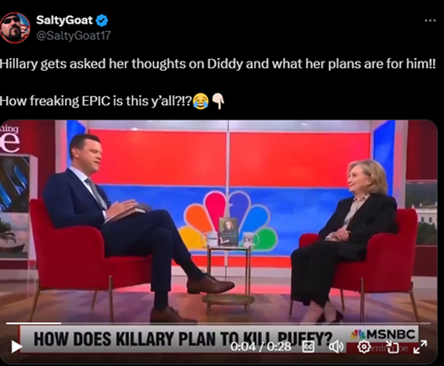
In another instance, Sooliman states that sexual blackmail is used as a weapon to “fuel violence and control” with an image provided as the proof, “The revelations surrounding Jeffrey Epstein”.
The image states that Epstein is linked to Harvard and was appointed there as a visiting fellow by Jews. Epstein’s religion, as well as those who appointed him, should be irrelevant to her argument, which, in any event, is not made, anywhere in the screengrab. This is clearly a bigoted and antisemitic conspiracy that Sooliman maliciously uses to push a modern antisemitic libel.
These are only two of at least 12 such sources that apparently can be used to prove a conspiracy by a postdoctoral student in a legitimate news source.
It is frankly laughable that the X accounts that Sooliman cites to legitimise her hatred would be considered as credible in even the least respected of papers.
What a pity then that once again the M&G has failed its readership, and dropped the baton on its responsibility toward journalistic integrity.

It is with reference to these unreliable and morally repugnant examples that Sooliman purports to bolster her assertion that sexual blackmail is a tool used by the pro-Israel movement to fuel violence and control.
She uses the example of Epstein, suggesting that the Israeli intelligence services were somehow complicit in his crimes.
This is then explained as a new tactic to add to the already widely used, and blatantly antisemitic claim, that Jewish money controls the West.
She then references a sexual scandal involving Dominique Strauss-Kahn and asks, “Was it a coincidence that this powerful figure, who posed a threat to certain economic agendas, was brought down by a sexual scandal?”
At this point, Sooliman takes a bizarre turn to discuss the African Global Dialogues which she claims took place at Constitutional Hill (which it didn’t), arguing that it was an attempt to whitewash supposed Israeli atrocities in Gaza by feigning commitment to peace talks while perpetrating atrocities.
She appears to have taken offence to the conference organiser, Ivor Chipkin, for his stance against South Africa’s case against Israel before the International Court of Justice.
Rather than engaging with what Chipkin might have to say on the subject (which is what one normally expects of reputable academics) she dredges up a discredited case of sexual misconduct from his past — the inference, unsupported by any logic or evidence, is that those who support Israel are somehow all sexual deviants.
For good measure, Sooliman smears Chipkin’s New South Institute, insinuating that its funding from the Millennium Trust somehow makes it less trustworthy.
Put together, this article is libellous, antisemitic, unscholarly and conspiratorial. It is an embarrassment to the publication that carried it.
For Jews, antisemitic rhetoric too often leads to real-world violence. We have long memories, recognising the dangerous patterns in such discourse.
Such hateful stains against any recognisable community, whether Jewish or otherwise, should not be allowed to become part of the public record.
Adam Charnas is a member of the SA Jewish Board of Deputies.
Alex La Guma and Third Worldism: A legacy of global activism:
When Alex La Guma, the activist and famed writer of A Walk in the Night (1962), went into exile in 1966, he left South Africa and his cherished birthplace of District Six never to return. Unlike many of his peers, he never had a chance to come home and witness the long-awaited transition to democracy.
Instead, he died unexpectedly of a heart attack in Havana, Cuba, in 1985 during the liberation struggle, having committed himself fully to writing and diplomacy for the ANC and the South African Communist Party (SACP).
Havana might have been his last home but it formed part of a broader geography for La Guma. Though leaving for exile with his wife Blanche, and two sons Eugene and Barto, had palpable costs, La Guma also entered a new world of freedom, politics and intellectual engagement in the decades ahead.
Having experienced extended periods of house arrest and solitary confinement in South Africa, the sense of freedom he attained was undoubtedly liberating from a personal standpoint. La Guma’s British passport, acquired after he first arrived in London, enabled him to travel the world. However, as a communist internationalist, his political commitments actually motivated him to do so.
The result of these extensive travels was an eclectic series of essays, pieces of reportage, speeches, reviews, short stories, memoirs and other writings that have recently been collected in Alex La Guma: The Exile Years, 1966-1985.
La Guma visited a wide assortment of places, including Algeria, Lebanon, India, Vietnam, Germany, Tanzania, the Caribbean, Eastern Europe, Central Asia and the Soviet Union. In essence, he documented in personal and political ways the emergent Third World — what is referred to today as the Global South — and its benefactors, such as the USSR.
Much of this exile writing has remained unknown, having received only scholarly attention. La Guma is still thought of as an elegist for District Six, having depicted its crowded urban landscape and vibrant atmosphere with vivid detail in A Walk in the Night, his first novel, which has since become a canonical work of South African literature.
La Guma’s fiction remained anchored in Cape Town. His second novel, And a Threefold Cord (1964), completed before he left for exile, depicts the plight of shack dwellers on the Cape Flats. His third, The Stone Country (1967), addressed incarceration in a fictionalised version of the Roeland Street Prison, where La Guma had been detained. In the Fog of the Seasons’ End (1972) examined the activist underground in the Mother City, of which he was a key part.
These fictional works were unmistakably political, depicting the commonplace ways that apartheid affected ordinary people, especially working-class Capetonians, whether through racial profiling, prison, police brutality or abject poverty.
The frequent violence in his novels was never entirely attributable to any single person or community. It was contingent and random, reflecting systemic conditions of precarity and injustice that made people constantly vulnerable. Many of the issues that La Guma identified persist today.
However, reading La Guma’s South African fiction, including his memorable short stories, gives only a brief sense of his writing life and a limited view of his generative imagination. Once in exile, he began writing prolifically for journals and periodicals like Sechaba, The African Communist, Présence Africaine, The Black Scholar and Tricontinental. These periodicals and others were based in locales like Paris, Havana and the US. Sechaba and The African Communist, which were venues for the ANC and SACP, respectively, contributed to the liberation struggle.
La Guma addressed a range of topics. He argued in support of uMkhonto weSizwe’s armed struggle. He wrote about apartheid legislation, such as the Immorality Act, for the UN. He described his attendance at the first Pan-African Cultural Festival in Algiers, Algeria, in 1969.
He eulogised international writers such as Octavio Paz and Maxim Gorky. He reviewed fellow South Africans like Athol Fugard, Nadine Gordimer and Oswald Mbuyiseni Mtshali. Not least, he wrote two memoir essays that movingly explained why he joined the communist party.
La Guma also tested his fiction writing in new contexts. Notably, he wrote a short story set in North Vietnam, based on a visit there, titled Thang’s Bicycle. Consisting entirely of Vietnamese characters, it is a parable about the resilience of the Vietnamese against both French and American imperialism. A second story, Come Back to Tashkent, is set in the Uzbeki city in central Asia — again, a departure from his more familiar South African environs.
These experiments reflected his travels as well as his involvement with the Afro-Asian Writers Association, an organisation that brought together novelists, poets and dramatists from both continents with the purpose of restoring local literary and cultural traditions after decolonisation. La Guma received the association’s 1969 Lotus Prize for literature along with the Palestinian poet Mahmoud Darwish. Later recipients included Chinua Achebe and Ng?g? wa Thiong’o.
The Afro-Asian Writers Association consequently provided La Guma with an international community of writers that was politically and intellectually minded, in addition to being committed to the literary arts. As he would write in a 1973 essay for Lotus: Afro-Asian Writings, the organisation’s journal, the purpose of this community, which held conferences in places like Beirut, Luanda and Tashkent, was to bring “the literature of our continents into the arena of world literature”.
In summary, La Guma’s exile was a time of connection and possibility. Like many other South African activists and writers, his decision to leave was difficult, based on concerns for his family’s safety as well as his political commitments. In some ways, La Guma never entirely left, with his fiction providing him with a constant means to reconnect with the country he passionately loved.
Yet, it is also important to acknowledge La Guma’s internationalism and how he became a globally recognised writer after his departure from South Africa. He would be elected the second secretary general of the Afro-Asian Writers Association in 1979. As an activist and writer, he played a key role in drawing connections between the South African liberation struggle and those elsewhere in Southern Africa, South-east Asia, the Caribbean and Palestine.
La Guma insisted that South Africa’s situation was not unique. It was a crucial part of a broader fight pitting the Third World against the last remnants of empire. His prolific body of exile writing demonstrates the steadiness and momentum of this vision.
La Guma believed he would return home. That he did not remains a source of lament. However, we have his exile writing as a means of solace, which reveals his growth and evolution while away. His devotion to South Africa never diminished. It was only supplemented by a new and more expansive dedication to the world.
Christopher J Lee is a historian and the editor of Alex La Guma: The Exile Years, 1966-1985, recently published in the Voices of Liberation Series by the HSRC Press.
Submit and get free exposure here: Showcase Your Business | Advertise Your Special Offers.