
Taking back the Soweto night with Nomsa Mazwai and Rapsody:
This past Friday I walked for nearly 3km through the streets of Jabavu in Soweto from 8pm to 10pm on a winter night in July. That might sound crazy, but it was actually a lot of fun.
I was part of a group of 100 people and along the way we chanted and sang with Karabo Ya Morena, a youth choir from Soweto that were part of our parade. At the front of the crowd, leading us through the streets and keeping the energy up, was Nomsa Mazwai, the originator of Soweto Night Out. At every stop she would yell out “Funk it, I’m walking!” and the crowd would yell back “Let’s walk to freedom!”
What were we thinking, you might ask? Well, partly it was a unique way to celebrate Nelson Mandela Day. But it was also a chance to meet American Grammy award-winning musician and respected emcee Rapsody, who was in the country working on her next album and who joined in on every step of the way.
For most of us, the journey started in Rosebank, where we boarded a bus courtesy of the organisers, which was really appreciated because it muted any worries about transport from Soweto back to town, especially after a long night out.
We arrived at Soweto Theatre where we gathered on the front steps and enjoyed a welcome performance by the youth choir while people clamoured to get their photo opportunities with our illustrious American guest — including yours truly, because there’s nothing wrong with pausing work mode to have a fan moment.
After that we started our walk, accompanied by members of the community policing forum, walking up and down the Jabavu streets with white banners with “Soweto Night Out Tours” written on them at the back and front of the procession.
“What we like to say about ourselves is that we are an alternative protest,” says Mazwai. “When you look at us in the street, we look like a protest, but we’re not. We’re a business. Everybody there is making money. We’re solving the unemployment crisis in South Africa. We’re solving the crime crisis in South Africa. It’s a drop in the ocean. We are not government.
“If we were the government, it would be far greater impact, but we are not. So we are doing what we can, where we can, in the ways that we can do it. And this is just one of the ways that we do it.
“And we are a performance to the community of the possibilities of safety because we’ve shown communities that there is an economic value to safety and we’ve unlocked it for the communities that we work in.”
The origin of these walking tours, which Mazwai now hosts for paid groups of at least 20 people on request, stretches back for more than a decade, when she returned to South Africa after living abroad for years in places such as New York in the United States and Newcastle in the United Kingdom.
“I love walking, and I’ve lived in other parts of the world where I walked everywhere, any time of day, all the time,” says Mazwai.
“And when I came back, I realised I was feeling down because I wasn’t getting to walk.”
So she said, “Fuck it, I’m walking!”
Mazwai even wrote a Facebook post about how she wasn’t going to let anything stop her from walking around as she did when she lived abroad. It was a friend who encouraged her to make the slogan more child-friendly and so she started saying “Funk it, I’m walking!” instead.
At first it was an activist movement that would mobilise walks in support of various causes such as for water with the World Wide Fund for Nature.
But when Mazwai left her job at the Soweto Theatre, where she had spent five years as the general manager, she decided to set her mind to building #FunkItImWalking into a business.
Mazwai put years of research into developing it into a sustainable social enterprise, drawing on her background in economics as a Fulbright alumna with an MA in international political economy and development from Fordham University in the US.
“It took a while but eventually we zeroed in on what our mission or intention was. And it’s that #FunkItImWalking aims to make it safe for a woman to walk at any time of day, in any condition. And how it does that is by thinking about sustainable businesses that enable women’s safety.
“Because I am an activist woman, I have been part of the marches and the seminars where we call the president to come and account. I’ve been part of all of those things and they’ve yielded zero results. The talking has yielded nothing. There’ll be a law that’s passed. Then they say they’re opening centres but the material condition on the ground has not changed.
“And I think for myself, I believe that’s because South Africa decided to be a neoliberal country and it decided to follow that economic policy. That economic policy puts capitalism at its centre. It sees capitalism as the answer. And capitalism puts money above all else. And so it became very clear to me that if I wanted to enjoy safety as a woman, it had to make economic sense,” says Mazwai.
After leaving Soweto Theatre, we first made our way to Kwa-Khaya Lendaba, the late great Credo Mutwa’s cultural village. Once we entered the compound it was so dark we had to use our phone lights to guide our steps. I asked my friend if we weren’t absolutely sure we weren’t being led to a mass sacrifice.
Fortunately, there were no sacrifices, and it turned out to be worth the journey. Once we got to the centre of the compound we sat around the bonfire and listened to Zamalek Giza, a rasta sage, tell us about the life of Credo Mutwa and the fables about creation and the universe.
After that we hit the road again, walking past the notorious Jabulani flats.
“The Jabulani flats are one of the most dangerous parts of Soweto,” says Mazwai. “I’m sure people have read about them a lot in the news. There’s always drama there, but there’s never drama when we do our night tours because our CPOs [community policing officers] are within the community and the community understands the value that we’re bringing into that community.
“Our night walks are incident free to this point. In addition to that, we also work with the Seth Mazibuko Foundation, which is a heritage and youth development-focused foundation. So where we are very focused on women’s safety, they are very focused on youth employment as well as heritage. And so working with Seth, we then started incorporating heritage sites into the routes. Now, because of the way communities have welcomed our work, the museums also came on board and they open at night.”
We made our way to the June 16 Memorial Acre, which opened after hours just for us.
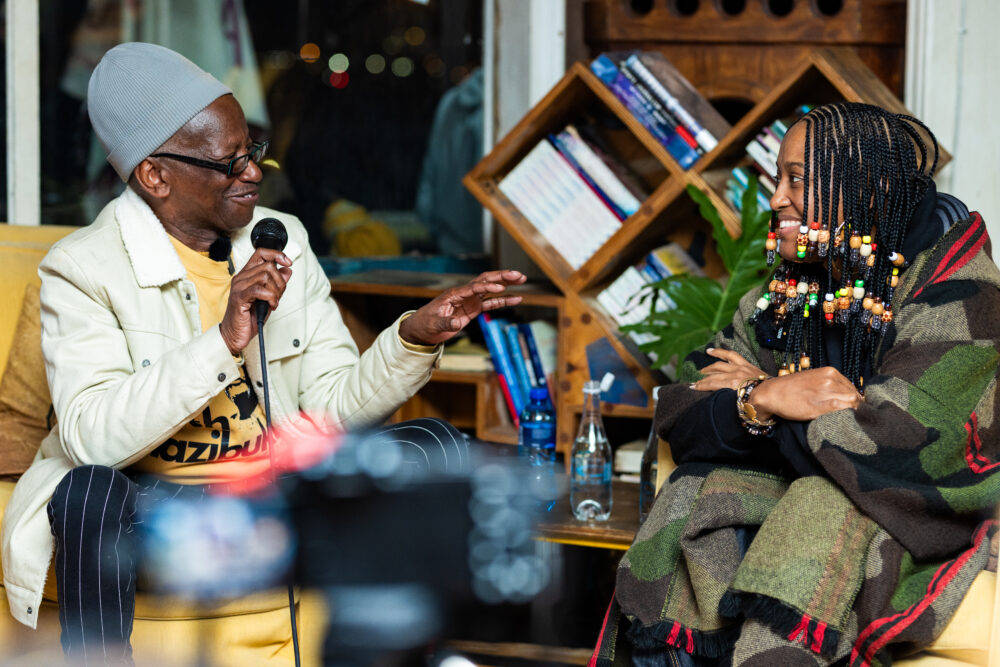
And then finally we walked to Native Rebels, a restaurant and our last stop of the night. It was there where we sat down to watch the main attraction —Rapsody in conversation with the legendary activist Seth Mazibuko.
While some may have initially thought Rapsody would be the one answering questions, it turned out she was interviewing Mazibuko. Their conversation touched on a variety of themes including activism, youth engagement, Pan-Africanism and the future of South Africa.
“I see Rapsody as a voice of the youth,” says Mazwai. “She has built a career that is very conscious, very grounded, and wholesome, and I love that. And so I believed that for Rapsody to level up, she really needs to hear from somebody who changed the trajectory of an entire nation.
“I feel like myself and Rapsody are soldiers on the same battlefield, fighting on the same side, you know, for the lives and the livelihoods of young black people and for black people and brown people all around the world.
“And so when I spoke to her, I said, ‘You know, Rapsody, a lot of young people don’t know Seth Mazibuko, and you don’t know Seth Mazibuko. And so I want you to ask questions that you would ask Seth Mazibuko.
“‘I don’t want to tell you what to ask him, because what I want you to do is to ask him the questions that young people in South Africa are afraid to ask because they don’t want to look stupid.’ I wanted young people to watch their hero not know and be so willing to know and be so fearless in asking because Rapsody has that skill of not being afraid to ask. She wants to know.”
The night ended at about midnight, and I boarded the bus back to Rosebank feeling physically tired but spiritually uplifted and inspired. It was the kind of night that reminded me what’s possible when people come together with purpose, creativity and a little bit of courage.
In a country where safety is too often a privilege, not a right, a night out reminded me that joy, community and economic opportunity can carve out new paths through even the most neglected corners of our cities. Walking through Soweto in the company of song, story and solidarity, I felt like we weren’t just remembering the past. We were actively imagining a better future. And for a few beautiful hours, it felt within reach.
Standard Bank sweeps the board at 2025 Euromoney awards:
Standard Bank has once again demonstrated its leadership as the best bank in South Africa and Africa after receiving 26 accolades across its continental footprint at the Euromoney Awards for Excellence 2025. At an awards ceremony hosted in London, Standard Bank was recognised for its excellence in corporate & investment banking, customer experience, SME banking and corporate responsibility in 14 markets.
Euromoney evaluates the world’s leading financial institutions through performance data and surveys, and has led a comprehensive awards programme for more than 30 years.
“Our purpose is clear: ‘Africa is our home, we drive her growth.’ As the continent’s leading financial institution, and with Africa poised to remain one of the world’s fastest-growing regions, we are uniquely positioned to capture the immense opportunities ahead while delivering strong returns for our shareholders and positive impact for our clients and the communities we serve,” says Sim Tshabalala, Chief Executive of Standard Bank Group.
Commenting on CIB’s exceptional performance that earned 18 Euromoney awards, Luvuyo Masinda, Chief Executive of Corporate and Investment Banking at Standard Bank said: “Our deep sector expertise, particularly in energy and infrastructure combined with strong client relationships where we offer strategic insight, capital solutions, or trusted advice, has positioned us to lead in landmark transactions. By aligning our lending and global markets capabilities, we were able to deliver market financing solutions tailored to our clients’ needs.
“We aim to sustain and grow this performance by focusing on high growth sectors such as energy, infrastructure, mining and technology media & telecommunications (TMT). We are investing in data and analytics to identify origination opportunities and bring solutions faster to our clients. We are also focused on deepening our competitive advantage in structured capital, expanding our equity capital markets (ECM) and debt capital markets (DCM) solutions beyond South Africa, and investing in the next generation of investment bankers,” Masinda added.
Full list of awards presented to Standard Bank by Euromoney:
Standard Bank Africa’s Best Bank
Standard Bank Africa’s Best Bank for Large Corporates
Standard Bank Africa’s Best Investment Bank
Standard Bank Africa’s Best Investment Bank for ECM
Standard Bank Angola’s Best Investment Bank
Stanbic Bank Botswana’s Best Investment Bank
Stanbic Bank Ghana’s Best Investment Bank
Stanbic Bank Kenya’s Best Investment Bank
Standard Bank Malawi’s Best Bank
Standard Bank Malawi’s Best Investment Bank
Standard Bank Mauritius’s Best Bank for Large Corporates
Standard Bank Mauritius’s Best Investment Bank
Standard Bank Mozambique’s Best Investment Bank
Standard Bank Namibia’s Best Investment Bank
Stanbic IBTC Bank Nigeria’s Best Bank for Securities Services
Stanbic IBTC Bank Nigeria’s Best Bank for SMEs
Standard Bank South Africa’s Best Bank
Standard Bank South Africa’s Best Bank for Large Corporates
Standard Bank South Africa’s Best Investment Bank
Stanbic Bank Tanzania’s Best Bank for Customer Experience
Stanbic Bank Tanzania’s Best Investment Bank
Stanbic Bank Uganda’s Best Bank
Stanbic Bank Uganda’s Best Investment Bank
Stanbic Bank Zambia’s Best Bank for Corporate Responsibility
Stanbic Bank Zambia’s Best Bank for Customer Experience
Stanbic Bank Zambia’s Best Investment Bank
Operation Vulindlela: Big on policy but low on results:
The government’s flagship economic reform programme, Operation Vulindlela, has registered modest progress in the second phase of its roll-out — particularly in visa reform — but faces mounting criticism for delays in key infrastructure areas and a lack of transparency in outcomes and expenditure.
The latest progress report notes that more than 11 000 visas were processed in the first three months under the Trusted Tour Operator Scheme, launched in February. In March, the government accredited qualifying employers under the Trusted Employer Scheme to support the recruitment of foreign skilled workers.
These visa reforms aim to “attract skills, investment and tourism through a streamlined and modernised visa system”. The home affairs department has also upgraded its digital verification system to enable remote authentication and reduce downtime — a step toward building a digital identity system.
Yet the gains made in visa systems are in contrast to widespread delays in fixing constraints in water and sanitation, electricity and freight logistics. Most work so far has been legislative, with little tangible implementation.
Operation Vulindlela, initiated during President Cyril Ramaphosa’s first term, aims to boost economic growth through structural reform. Ramaphosa has touted the operation as a key achievement, and in his latest newsletter called the halting of load-shedding a crucial win in the battle “to remove the binding constraints that have long held back our economy’s growth”.
“The reduction in load-shedding over the past year was supported by the reforms we introduced to unlock private investment in electricity generation, while reforms in the telecommunications sector have brought down the cost of mobile data,” he wrote.
Launched in May after cabinet approval, phase two expands the reform scope to seven areas: electricity, freight logistics, water, visas, local government, spatial inequality and digital transformation.
But despite policy work being under way in several areas — with the Electricity Regulation Amendment Bill, the Water Action Plan, the Digital Transformation Roadmap and the Local Government White Paper among the documents drafted — implementation remains limited. The progress report itself concedes that of the seven priority areas in phase two, only visa reform has moved into tangible outcomes.
The electricity sector reform includes the establishment of the National Transmission Company of SA, which will eventually separate power utility Eskom’s grid from generation and distribution. The government has also finalised a national wheeling framework to enable third-party access to the grid.
Yet, the new transmission company still awaits licensing as a market operator. The National Energy Regulator of SA is also finalising market codes for private wholesale.
Legal adviser and social activist Nkanyiso Ngqulunga was scathing in his assessment, saying Operation Vulindlela represents an acceleration of neoliberal policies that are proving counterproductive.
“It has been a complete failure. The unbundling of Eskom has not yielded any positive results but rather put the country’s energy generation into the private sector,” Ngqulunga said, adding that the reforms have not attracted the promised investment.
“It hasn’t attracted investment as intended. We are implementing policies that have been proven to fail — allowing the private sector in with the hope that it will boost the economy is counterintuitive.”
Ngqulunga believes the government should focus on building state capacity and investing in public infrastructure.
“We need to unlock opportunities by empowering public assets,” he said. “At a time when the government is underperforming, geopolitical tensions are high and tariff wars are growing, it’s misguided to think these reforms will attract investment.”
In logistics, a new Transnet Rail Infrastructure Manager division has been created to modernise operations and enable private operator access. In December, the rail, port and pipeline parastatal released network access tariffs and received 98 slot applications from private freight operators. Conditional awards will be announced by 15 August.
Ntokozo Buthelezi, an economist and researcher, is concerned about the Vulindlela initiative’s accountability.
“I remember from the budget speech, the minister mentioned phase two and I wondered what happened to phase one,” she said, adding that she found it to be “vague” with regard to outcomes and money spent. “We don’t know what happened, how much was spent and what the outcomes were. There is so much secrecy — we have no clue as the public on how investment and loans are spent by the government,” she said, also criticising the absence of oversight.
“They don’t tell us much. It’s just numbers — billions here, billions there — but no tangible outcomes.”
Submit and get free exposure here: Showcase Your Business | Advertise Your Special Offers.
