
Taking the poo-lution out of nappies:
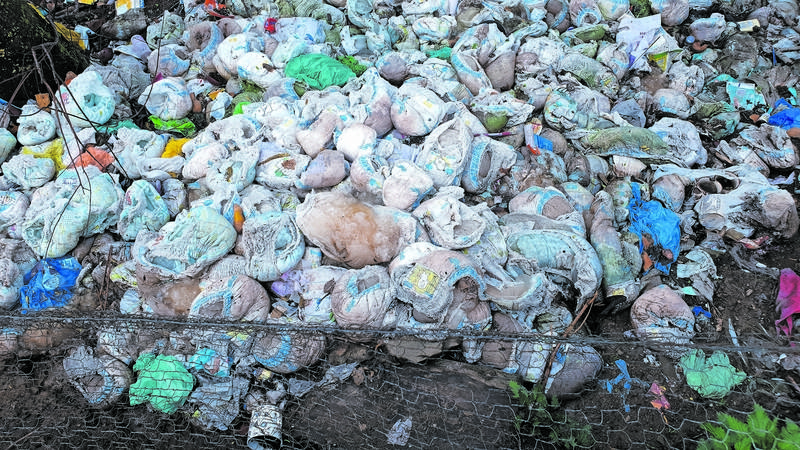
Environmental organisations and people living in rural areas are joining forces to tackle the rising problem of environmental degradation from disposable nappies which are polluting soil and finding their way into water sources.
On average, a child uses between 4?000 and 7?000 disposable nappies from birth until they are fully potty trained, which is at about the age of two, but disposing of them in an environmentally safe way is difficult, especially in rural areas where municipal services are limited.
The products, which are not biodegradable, find their way onto land space — making it difficult for any type of vegetation to grow — and worse, into water intended for household use, including drinking.
Enter Environmental and Rural Solutions (ERS) — a social enterprise NGO which works to improve ecosystem health and human well-being in the Eastern Cape.
It is spearheading an initiative to provide reusable nappies for free to young mothers in villages in the Matatiele district as an alternative to the disposable variety.
Beyond the pilot group of mothers, the ERS is also encouraging broader community use of the BiddyKins reusable nappies, which are made out of bamboo fibre and are cheaper than their disposable counterparts, while being equally effective in keeping babies comfortable and dry.
The ERS has identified young people in villages — known as ecochamps — to champion the conservation drive by helping conduct informal surveys to gain insight into the nappy-disposal practices prevalent in these communities.
Their findings revealed that 98% of disposable nappies were dumped in water-source areas and on open land, with severe consequences for the environment.
The main reason for this was the absence of municipal services in these areas.
Some people even buried used nappies, disrupting vegetation growth.
Disposable nappies have grown in popularity and few still make use of the reusable cloth ones that were widely used in the past.
This is largely because they are considered less convenient than their disposable counterparts.
When ERS initially launched the pilot programme with the young mothers, there was resistance to the concept of having to wash soiled nappies instead of just throwing them away.
However, these modern ones are easier to wash and quicker to dry than the traditional cloth ones used in the past and they come with biodegradable liners which can be disposed of safely.
Matatiele mother Nomathemba Ramotsamai recently had an upsetting dispute with her neighbour over the way she got rid of used nappies.
“I used to dig a pit where I would dispose of my baby’s nappies — until one day, my neighbour’s dog dug up the pit and pulled them out.
“My neighbour’s cow ate the nappy, got sick and died and my neighbour was very angry at me for the longest time,” she recalls.
“He would not speak to me at all.”
Part of the reason Ramotsamai was drawn to disposable diapers was the social stigma attached to using traditional cloth nappies.
“I was at the clinic, taking my baby for her shot and while we were in the waiting area, a mother was struggling with a crying baby,” she said.
“We kept telling her to change the baby’s diaper as the baby might be uncomfortable.
“She gave in and changed her baby’s nappy on the floor of the waiting area.
“We then realised why she wouldn’t change the baby’s nappy — she was using the old cloth nappy and a plastic bag as [a waterproof barrier].”
A reusable nappy could have saved the young mother from embarrassment and the baby from discomfort, Ramotsamai said.
Although the reusable nappies might seem to cost more than the disposables on the face of it, with a pack of four selling for R550, they last a long time and they are more cost-effective in the long run as mothers do not need to spend over R300 on nappies every month.
Added to that, the reusable nappies can be used from birth up to three years and beyond.
They are likely to be a game changer in South Africa, which like many other countries, faces a growing environmental challenge in the form of waste pollution.
According to the State of Waste Report, the country generates around 108 million tonnes of waste annually. Of this, there are 59 million tonnes of general waste, 1 million tonnes of hazardous waste and 48 million tonnes of unclassified waste — and only 10% is recycled.
Single-use or disposable nappies are one of the biggest contributors, according to a UN Environment Programme report, with the convenience they provide coming at a steep environmental cost.
The fact that most disposable nappies are not biodegradable means they take hundreds of years to decompose in landfills. South Africa has 826 landfills, whose capacity is already stretched.
The disposal of nappies in rivers, streams and oceans results in water pollution. The plastic components break down into microplastics over time, which are ingested by marine life and disrupt aquatic ecosystems.
The post Taking the poo-lution out of nappies appeared first on The Mail & Guardian.
Our top five cars for a road trip:

With the holidays fast approaching, our nation is preparing to mobilise and take over the coastal regions. This got us thinking about the best road trip car options.
5. Fiat 500 (the most frugal)
Holidays aren’t cheap. And when you live in landlocked Gauteng, there is always a road trip element to consider, whether you are going to Cape Town or Durban. Your choice of vehicle can make your trip a financial breeze — or a nightmare. No, the Fiat 500 isn’t the most exciting car in the world, but it’s frugal, averaging 4L/100km. Plus, you get a large dose of character in this compact package. Just don’t expect to be able to overtake in a hurry.
4. Mercedes-Benz EQS 450+ Sedan (the electric vehicle)
With the world moving towards EVs as the price of fuel continues to climb, this vehicle could be a prudent choice. The infrastructure might be questionable at this stage but in the EQS 450+ you can get up to 782km of range from its 108kWh battery. Yes, if you were travelling from Joburg to Cape Town, this would become a little tricky and you would have to carefully plan your stops along the way. At least your costs would be considerably lower than in a petrol car — not that it would be a concern, given that you purchased a not-so-cheap EQS. What I can tell you is that it will be a comfortable journey for you and your passengers.
3. BMW 320d (best of both worlds)
This entry comes purely from experience, as my first car was an E90 320d. I was immensely impressed with its ability to average around 4.4L/100km, allowing me to travel from Johannesburg to Port Elizabeth on one tank of fuel. The best part about a 320d, especially a newer model, is that it has plenty of power and agility for overtaking on mountain passes and cruising along coastal highways.
2. Mercedes-Benz S-Class (for the sheer comfort)
It’s widely agreed that the S-Class is among the most luxurious automobiles available and that’s important on long trips. Being able to stretch out your legs while driving on a cloud is an extravagance few get to experience on the N1. The S-Class makes any journey that much more enjoyable. In addition, you’ll be the envy of onlookers and the centre of attention wherever you go — if that sort of conspicuous thing is your speed. We’re not judging …
1. Aston Martin DB12 (the best GT, in our opinion)
Many believe that supercars have no business going on road trips. And, to a certain extent, they are correct. However, a Grand Tourer is a different animal altogether — a GT sings on the highway. What is the best GT is a contentious subject and under debate. What we do consider a fact, though, is that there’s not much that money can buy that sounds as good, looks as good and feels as good as the Aston Martin DB12.
The post Our top five cars for a road trip appeared first on The Mail & Guardian.
Submit and get free exposure here: Showcase Your Business | Advertise Your Special Offers.
