
The ANC’s heritage under siege:
The African National Congress’s (ANC) battle to reclaim the sacred name Umkhonto weSizwe from Jacob Zuma’s party is nothing less than a defence of its very soul and heritage. It is a fight to safeguard a revolutionary heritage, to protect a legacy forged in blood and sacrifice and to shield the identity of the liberation movement from brazen political opportunism.
In every epoch of struggle, the liberation movement must defend not only its organisational existence but also the integrity of its memory. Today, the ANC finds itself in such a moment. The symbols, history, language and martyrs of our movement – earned through blood, exile, prison and sacrifice – have become the battlefield on which rival political parties seek moral legitimacy.
As a result, the ANC has been forced into a position where it must protect through the courts, if necessary, its hard-won heritage of the freedom struggle against a range of political opportunists who try, openly or subtly, to clothe themselves in the garments of the ANC’s moral authority.
In post-apartheid South Africa, the ANC remains the party most closely associated with the liberation struggle. Its names, symbols, heroes and history are deeply embedded in the national consciousness. This is why, across our political landscape, we see parties that did not live the struggle, that did not carry the pain or the scars of apartheid, attempting to wrap themselves in the cloth of the ANC’s history.
Some do so through speeches. Some do so through imagery. Others go as far as attempting to steal the very names and symbols that belong to the ANC and its fallen heroes. From the Democratic Alliance (DA) to the Economic Freedom Fighters (EFF), the Congress of the People (COPE), the African Independent Congress (AIC) and most dramatically, uMkhonto weSizwe (MK) Party, the symbols and names have become a prized commodity.
The most recent and brazen example is the attempt by MK Party to steal from uMkhonto weSizwe, the armed wing of the ANC. The MK name represents fallen heroes, a history written in blood and sacrifice, not a political shortcut for opportunists seeking electoral power. The Zuma Party’s warrior logo and name are calculated to confuse voters into believing that they are a continuation of the historic MK, the glorious army of the liberation movement.
When a political formation that played no role in the armed struggle adopts the MK name and symbols, it is more than confusion. It is an assault on historical truth and on the collective memory of the liberation movement. It disrespects the dignity of the cadres who faced torture, exile and death under the banner of MK. It seeks to mislead voters by dressing in military uniforms they did not earn.
The irrefutable truth is that even those who have broken away from the movement cannot escape the gravitational pull of ANC history. This is made evident in the case of COPE. The latter’s very formation was rooted in a calculated political manoeuvre to appropriate the ANC’s historic identity. By naming itself the Congress of the People, it shamelessly sought to steal one of the most significant parts of ANC’s history – the 1955 Congress of the People in Kliptown, where democrats, workers, peasants, intellectuals and freedom-loving people from all corners of our land united to adopt the Freedom Charter. It was the moment the oppressed declared, in one united voice, the vision of a future South Africa. The Freedom Charter remains the ANC’s lodestar and a compass that articulates the people’s aspirations and outlines the architecture of a just, equal and democratic society.
For COPE to steal this sacred name for political opportunism was nothing short of a deliberate attempt to confuse the masses and wrap itself in the garments of a history it never built and never defended. The theft of this historic identity was therefore an attack on the revolutionary memory of our people. The ANC fought this identity theft in every available space, for it understood that names, symbols and history are not ornaments but the lifeblood of the struggle.
COPE continued to vulgarise a sacred chapter of our liberation heritage. Their actions confirmed what Vladimir Lenin taught us – that counter-revolutionaries seek appropriate revolutionary symbols only to drain them of meaning and mislead the oppressed. But the masses know the truth. Today, the real Congress of the People lives not in the name of a breakaway faction but in the revolutionary traditions of the ANC, while the fake COPE is now lying in ruins, ready to be consigned to the dustbin of history.
This tendency does not stop there. Even the EFF’s revolutionary rhetoric is built on ANC foundations. It continues to rely on the names of ANC struggle icons such as Winnie Madikizela-Mandela for its political identity while launching constant attacks on the organisation she served with loyalty.
Perhaps the clearest example of conscious symbolic mimicry, short of the Zuma Party, is the African Independent Congress (AIC). The AIC adopted colours and a logo strikingly similar to the ANC’s black, green and gold with a circular emblem. Objective election observers have repeatedly noted that the AIC gained parliamentary seats largely because confused voters thought they were voting for the ANC.
The AIC’s political survival has depended solely on this confusion, making it a textbook case of heritage parasitism. It benefits from the liberation movement’s brand without sharing in its historic responsibilities. A party that survives through confusion born of mimicked colours and stolen identity cannot claim any form of legitimacy.
The Democtaric Alliance, which is rooted in rightwing liberal opposition politics, has also made repeated attempts to attach itself to the ANC struggle’s history and symbols. We remember Helen Zille standing at Solomon Mahlangu Square in Mamelodi during the 2014 election campaign, invoking the name of a young MK soldier executed for his role in the armed struggle led by the very organisation the DA (or its earlier iterations) opposed.
This appropriation of ANC heroes, however subtle, reflects an understanding that without the legacy of struggle, with the ANC at the centre, South African politics is morally bankrupt. We also remember the DA claiming the legacy of Mandela while opposing many of the policies and values he cherished.
This phenomenon is not new. Lenin once warned us of this tendency.
He wrote that during the lifetime of great revolutionaries, the oppressing classes “hounded them with the most savage malice, the most furious hatred and the most unscrupulous campaigns of lies and slander”. But after their deaths, “attempts are made to convert them into harmless icons… to hallow their names… while robbing the revolutionary theory of its substance, blunting its revolutionary edge and vulgarising it”.
The likes of Zille have been at the forefront of this project. They seek to appropriate the towering icons of our struggle, dressing them in the DA’s liberal garments so they may be paraded as docile figures whose worldviews supposedly mirror their own. In doing so, they attempt to strip our leaders of the militant, revolutionary traditions that defined their lives.
Their method is calculated: they selectively and opportunistically quote isolated lines from historic speeches of our leaders, carefully severed from their political context, in order to manufacture the illusion of ideological alignment. The ultimate objective is to erase from our collective consciousness and memory the uncompromising revolutionary record of these giants.
In their retelling, we are permitted to remember only the reconciliatory Madiba who donned the Springbok jersey at a moment of national triumph, but not the Madiba who served as Commander-in-Chief of Umkhonto we Sizwe, nor the internationalist who counted Fidel Castro and Yasser Arafat as comrades-in-arms in the global struggle against oppression.
This leads us to a fundamental question: Why is the ANC the only victim of identity theft and identity manipulation? Why do almost all parties desperately want a piece of the ANC legacy? The answer lies in the organisation’s historic and moral stature.
For more than a century, the ANC has been the custodian of a nation’s hopes and aspirations and the architect of our liberation. All parties know that the story of our liberation – the story of Mandela, Tambo and many others – is the heartbeat of our nation’s identity. The ANC’s legacy is a national asset, and thus a target.
Just ask the fellow from Nkandla why he is clinging so desperately to ANC membership while presiding over his own family stokvel masquerading as a political formation. The explanation is simple: even he cannot escape the gravitational pull of the ANC’s historic brand – an identity forged in struggle, not assembled in some God-forsaken homestead.
Parties want to associate with the ANC’s history, heroes and symbols. They know that fighting the ANC head-on is difficult, but stealing its history is easier. Even its harshest critics, including breakaway formations, want a portion of the ANC heritage.
They continue to define themselves in relation to the ANC, not independently. For them, a legacy is a way to compete with the ANC on its own turf. Theirs are not attempts to honour our struggle, but merely to borrow its moral authority.
The battles raging in the courts and in the public domain are not mere legal or political contests. They are about protecting the heritage of a people’s struggle.
The ANC’s resistance to this political identity theft is an act of safeguarding history – protecting the dignity of the fallen, the legacy of the real uMkhonto we Sizwe, and the integrity of South Africa’s liberation narrative.
In defending its symbols, the ANC is defending the memory of a nation. The people of South Africa carry a moral duty to join the ANC in its quest to preserve the country’s proper history from being distorted at the altar of political opportunism.
Cornelius Monama is a member of the King Nyabela Mahlangu branch and former national communication manager of the ANC and writes in his personal capacity.
Year-end blues of hits and misses:
It’s 14:45pm. I’m at Clicks in West Street. I get a call from a private number. A call that will jolt my withering dreams back to life. “You are one of the people we are taking for the internship programme.”
A million emotions flooded me at once, excitement and tears fought for the number one spot. After the call, I thought about the Lamborghini and mansion I was going to buy in Sandton because at that moment, nothing seemed impossible. The many months of job seeking after university vanished immediately.
One phone call changed everything. But what do you do, when you don’t get the call? When you have applied, submitted the business proposal; asked for the raise and didn’t get a yes.
What do you do when rejection seems to lock you in a cage and you feel stuck and stagnant? You have done all you could possibly do with the little that you have and still get “We regret to inform you”.
For many of us, 2025 has been just that, it has been a season of complete disappointments.
A season of receiving so many nos, that you wonder if your name and the word congratulations can ever be neighbours. This 2025 season brought with it frustration, doubt and tears.
The business ran at a loss; lost a job. It was just bad. On top of everything, the economy is not kind, food and life in general is getting more and more expensive.
Having an Instagram account during this time is extremely dangerous because it will give you a first-class ticket to depression. The level of flaunting and showing off on that App is higher than the GDP of most countries. Open with caution.
Yes, life in 2025 for some of us has been life(ing). Plans did not go according to plan and we are not okay.
Noel Jones once said “don’t lose your mind over the car that you lost, because you are going to need your mind to drive the next one”.
The loss of the car does not take away your ability to drive. You have a chance to get a new, even better car. One of the main things when life seems hard, is to continue to try.
Going against the flow of a heavy current takes so much strength but you develop the muscle. Some people present life as this glamorous, fabulous experience that some of us question ‘what is wrong with me?’
Why do I keep experiencing setbacks and never seem to catch a break?
Thanks to the Madlanga Commission and the parliamentary ad hoc committee on the allegations made by the KZN Commissioner we now see that not all that glitters is gold. You are actually doing better than you think.
Aaliyah in her album, Romeo Must Die has a song that says if at first you don’t succeed, dust yourself off and try again. If, as 2025 ends, you are one of the millions of people who did not enjoy the year, know that all is not lost.
New opportunities are ahead. Don’t dwell on this year’s setbacks. Don’t delete the old proposal yet. Before you accept defeat, take one last look and polish it.
It is time to add new potential clients on the list. Press the refresh button and get ready for 2026. But for now, take a chill pill, pack your bags, book a flight, drive or take a taxi home to be with family. ‘Tis the season to be jolly.
Scorpion Kings set to headline Piano People’s debut in South Africa
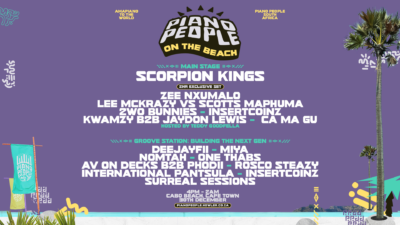
After hosting massive sold-out shows in global cities like London and New York, the famous Piano People festival is finally coming home to South Africa for its local debut. On 30 December, the “Amapiano to the World” movement takes over Cabo Beach Club in Cape Town for an unforgettable day-to-night celebration right by the ocean.
The lineup features the undisputed kings of the genre, Scorpion Kings (Kabza De Small and DJ Maphorisa), along with fan favourites like Zee Nxumalo, 2wo Bunnies, and Lee McKrazy. This event marks a major milestone for the local music scene, bringing world-class production and high energy to the heart of the Mother City.
Doors open at 16:00 and the music continues until 02:00 the following morning.
Tickets are currently available for purchase on Howler.
DJ Kent & Shekhinah to headline Made In Jozi NYE Festival
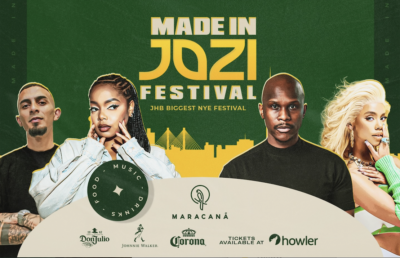
Johannesburg is ready to come alive this New Year’s Eve with the return of the Made In Jozi NYE Festival. This popular event is a celebration of the city’s unique energy, offering a premium daytime-to-night experience. On 31 December, the Maracanã in Sandton will be transformed into a world-class festival space with impressive staging and great production.
The lineup includes some of South Africa’s favourite artists, such as the soulful singer Shekhinah and popular DJs like DJ Kent, DJ Clint L and DJ Chowmein. Guests can look forward to a mix of Amapiano, Afro-house, hip-hop, and deep house music, along with gourmet food and a great atmosphere to welcome 2026.
The festival starts at 14:00 and continues until 02:00 the next morning.
Tickets are available for purchase online through the Howler website.
WAV Festival redefining R&B and Soul in the Mother City
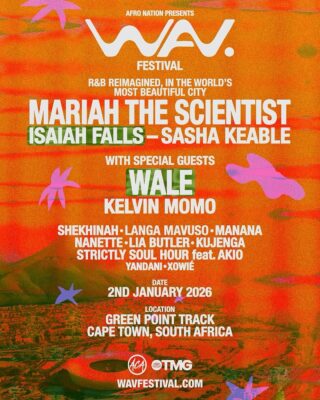
Cape Town is getting an exciting new music event this summer with the launch of the WAV Festival. Created by the team behind the famous Afro Nation, this festival focuses on the best of R&B, soul, and alternative music. On 2 January 2026, the Green Point Track will become a stylish outdoor space where music and culture come together.
The lineup features international stars like Mariah The Scientist, Sasha Keable and Wale, along with local favourites like Kelvin Momo, Shekhinah, and Langa Mavuso. It is the perfect way to keep the festive mood going after New Year’s, offering world-class music and a great atmosphere right in the heart of the city.
The festival will start at 12:00 and is open to guests aged 18 and older.
Tickets and VIP options can be found on the official WAV Festival website.
Gunna and Majid Jordan return to SA for the Milk + Cookies Festival
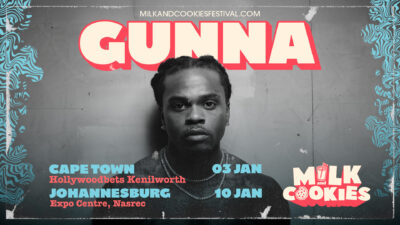
The Milk + Cookies Festival is back in South Africa this summer for two big shows. This event celebrates music, food, and culture by bringing global stars together with local talent. American rapper Gunna will headline both shows, along with the popular Canadian-Bahraini R&B duo Majid Jordan.
The lineup has just been expanded to include UK soul singer Odeal (performing in Cape Town) and US singer Elmiene (making his debut in Johannesburg). They join local favourites like Nasty C, A-Reece, Blxckie, and the legendary DJ Kent for an unforgettable experience.
The Cape Town show will take place at Kenilworth Racecourse on Saturday, 3 January 2026. The Johannesburg show follows at the Nasrec Expo Centre on Saturday, 10 January 2026.
Both shows start at 14:00 and are strictly for people aged 18 and older.
You can buy your tickets online through the Howler website.
Submit and get free exposure here: Showcase Your Business | Advertise Your Special Offers.
