The complex history of Addis Ababa’s Piassa is being erased:
Bulldozers have knocked much of the Piassa area of Addis Ababa, erasing centuries of history that Ethiopians built there, starting with Menelik II in the late 1800s. It is now nearly unrecognisable.
This was, for decades, the beating, bustling heart of the capital city. Its streets were lined with artisans and tradesmen, and crowded with people haggling over gold and silver, while sampling macchiatos from its old Italian era cafes.
Many of Piassa’s buildings were classic examples of the modernist architecture that was, until recently, Addis Ababa’s signature style. Then came the bulldozers.
Gates and fences have been torn down, and old buildings have been turned to dust. Blue corrugated iron sheeting disguises the wreckage as excavators load the rubble on red lorries, which dump it — along with great chunks of the city’s history — in far away rubbish tips.
The Addis Ababa Corridor Development project calls for wider streets, cycle lanes and modern buildings.
The Piassa’s narrow cobbled streets and historic buildings must give way to Prime Minister Abiy Ahmed’s ambition to make the capital an East African Dubai. Abiy intends to transform the capital into a smart, modern city that can deliver a reasonable quality of life for its estimated 5.7 million residents.
“The plan has in mind accommodations for a growing metropolis, including projects for the construction of bicycle routes, spacious pedestrian walkways, better roads, parks, libraries, and additional housing. To improve the quality of life in the city, the project aims to upgrade the outdated drainage systems, upgrade utility networks such as power and the internet,” reported Abren, a diaspora group.
For some in Piassa the changes have come too fast, and without adequate warning. Some home and business owners have been evicted from their premises, sometimes with just a few days’ notice.
Others have been told to modernise their own buildings, at enormous cost. Renters in one Piassa building were told last month to replace their old, shuttered windows with tinted glass and aluminium frames, at a cost of about $ 750 a window.
There are as many as 20 windows in some apartment blocks, where the average rent is less than $ 120 a month. After residents protested, the order was suspended.
One of the area’s most iconic buildings, Hager Fikir — the first theatre in Addis — has been spared. But its historic front gate and an outbuilding, used as a torture chamber by the Italian occupiers, have been razed.
“We pushed back, asking for formal letters communicating the decision,” said theatre director Abdulkarim Jemal. “It bought us a few days. But they demolished it anyway.”
In response to residents’ concerns, the Ethiopian Heritage Authority said that buildings in Piassa do not automatically qualify for protection because of their age. With many buildings already destroyed, that heritage must be preserved in other ways.
“We have photos and videos, and we must use these options to pass on the history to the next generation,” said Jemal.
This article first appeared in The Continent, the pan-African weekly newspaper produced in partnership with the Mail & Guardian. It’s designed to be read and shared on WhatsApp. Download your free copy at thecontinent.org
Israel, Hamas reject bid before ICC to arrest leaders for war crimes:
Israel and Hamas, engaged in heavy fighting in the Gaza Strip, both angrily rejected on Monday moves to arrest their leaders for war crimes made before an international court.
The International Criminal Court’s prosecutor Karim Khan said he had applied for arrest warrants for top Israeli and Hamas leaders over the conflict.
Israel slammed as a “historical disgrace” the demand targeting Prime Minister Benjamin Netanyahu and Defence Minister Yoav Gallant, while the Palestinian militant group Hamas said it “strongly condemns” the move.
Israel’s top ally the United States joined the condemnation, while France said it supported the court’s independence and its “fight against impunity”.
Netanyahu said he rejected “with disgust The Hague prosecutor’s comparison between democratic Israel and the mass murderers of Hamas”.
Khan said in a statement that he was seeking warrants against the Israeli leaders for crimes including “wilful killing”, “extermination and/or murder”, and “starvation”.
He said Israel had committed “crimes against humanity” during the war, started by Hamas’s unprecedented October 7 attack, as part “of a widespread and systematic attack against the Palestinian civilian population”.
Khan also said the leaders of Hamas, including Qatar-based Ismail Haniyeh and Gaza chief Yahya Sinwar, “bear criminal responsibility” for actions committed during the October 7 attack.
These included “taking hostages”, “rape and other acts of sexual violence”, and “torture”, he said.
“International law and the laws of armed conflict apply to all,” Khan said. “No foot soldier, no commander, no civilian leader –- no one -– can act with impunity.”
The warrants, if granted by the ICC judges, would mean that any of the 124 ICC member states would technically be obliged to arrest Netanyahu and the others if they travelled there, a point noted by EU foreign policy chief Josep Borrell.
However, the court has no mechanism to enforce its warrants.
US President Joe Biden denounced the ICC bid as “outrageous” and said “there is no equivalence — none — between Israel and Hamas”.
Germany agreed, with a foreign ministry spokesman saying the warrants gave “a false impression of equivalence”.
Biden also rejected accusations in a separate tribunal, the UN International Court of Justice, where South Africa has alleged that Israel’s war in Gaza is genocidal.
“What’s happening is not genocide,” Biden told a Jewish American Heritage Month event at the White House on Monday.
South Africa welcomed the move at the ICC.
‘Where will we go?’
The war ground on unabated, with Israeli forces battling Hamas in Gaza’s far-southern city of Rafah, as well as in other flashpoints in central and northern areas.
Israel defied international opposition almost two weeks ago when it sent troops into Rafah, which is crowded with civilians and which the military has described as the last Hamas stronghold.
Netanyahu has vowed to keep fighting Hamas in Gaza until the Iran-backed Islamist group is defeated and all remaining hostages are released.
The United Nations said more than 812,000 Palestinians had fled Rafah, near the Egyptian border.
“The question that haunts us is: where will we go?” said Sarhan Abu al-Saeed, 46, a desperate Palestinian resident. “Certain death is chasing us from all directions.”
Witnesses told AFP that Israeli naval forces had also struck Rafah, and medics reported an air strike on a residential building in the city’s west.
The military said Israeli troops were “conducting targeted raids on terrorist infrastructure” in eastern Rafah, where they had found “dozens of tunnel shafts” and “eliminated over 130 terrorists”.
‘On verge of collapse’
The war broke out after Hamas’s October 7 attack on Israel, which resulted in the deaths of more than 1,170 people, mostly civilians, according to an AFP tally based on Israeli official figures.
Hamas also took about 250 hostages during the attack, of whom 124 remain in Gaza including 37 the army says are dead.
Israel’s retaliatory offensive against Hamas has killed at least 35,562 people in Gaza, also mostly civilians, according to the Hamas-run territory’s health ministry.
The Israeli military said on Monday the bodies of four hostages retrieved from Gaza last week had been found in tunnels under Jabalia in the north.
Israeli forces have been fighting in northern and central areas previously declared largely cleared of militants, with the military saying its troops had killed 200 militants in Jabalia.
Israel has imposed a siege on the long-blockaded Gaza Strip, depriving its 2.4 million people of normal access to clean water, food, medicines and fuel.
The suffering has been eased only by sporadic aid shipments by land, air and sea, but truck arrivals have slowed to a trickle amid the Rafah operation.
The European Union warned that 31 of Gaza’s 36 hospitals are no longer functioning and that the rest are “on the verge of collapse, with more than 9,000 severely injured people at risk of dying”.
Air strikes continued across Gaza, including on Gaza City in the north, the military said.
Gaza’s civil defence said the bodies of eight dead, along with several wounded, were retrieved after an air strike on the Sheikh Radwan neighbourhood of Gaza City.
US National Security Advisor Jake Sullivan met Netanyahu on Sunday and told him Israel must link the military operation against Hamas with a “political strategy” for Gaza’s future.
Washington has pushed for a post-war plan for Gaza involving Palestinians and supported by regional powers, as well as for a broader diplomatic deal under which Israel and Saudi Arabia would normalise relations.
© Agence France-Presse
Author’s views on student activism is sloppy and ignorant:
Since the publication of her debut novel White Teeth (2000), Zadie Smith has been a darling of tastemakers across the Atlantic.
Much of her ensuing work feels like a love letter to the forces who anointed her into literary stardom. Twenty-four years on, she continues to repay the favour.
Her reflections on student activism in The New Yorker on 5 May represent a milestone in the venerable genre of Self-Important Liberal Novelist Giving Unwanted Advice To Wayward Youth And Uncouth Radicals.
Most entries in the genre are merely obtuse and sanctimonious; Smith manages to also be sloppy and misinformed. Give her credit. She’s mastered the trick for which the haut monde sent her off into the world.
While positioning herself as a Deep Thinker detached from primitive loyalties, Smith painstakingly tethers expressions of ambiguity to the status quo, the most primal loyalty of all.
Let’s examine the essay’s most egregious failures one by one.
In the first line, Smith writes, “A philosophy without a politics is common enough.” It’s not at all common. In fact, a philosophy without a politics is impossible. Only a mind afflicted by upper-class rot could think otherwise.
Smith speaks of activism that can lead to arrest or other forms of punishment, concluding that it “represent[s] a level of personal sacrifice unimaginable to many of us”.
This royal “us” betrays Smith’s position as outsider and poseur. In reality, sacrifice is eminently imaginable to the countless people who have chosen to act on their consciences and subsequently languished in prison, lost jobs and careers, suffered exile and ostracism.
It is eminently imaginable to the very students on whom Smith lavishes so much scorn. They are being punished in horrible ways and yet they keep going.
Sacrifice isn’t unimaginable to “many of us”. It is unimaginable to Smith and her cohort of frivolous lickspittles.
This she confirms a few sentences later with what is supposed to be a droll anecdote about her inability to give up travel to New York for the sake of the environment.
“What pitiful ethical creatures we are (I am)!” she laments. This singular (and parenthetical) flash of self-awareness, meant to be ironic and thus venial, is the only aspect of the essay worth the reader’s attention.
“The more than seven million Jewish human beings who live in the gap between the river and the sea will not simply vanish because you think that they should.”
Who has called for seven million Jews to vanish? It is not a demand of any Palestinian political party; the Boycott, Divestment and Sanctions movement; pro-Palestine student organisations; the vast Palestinian intellectual tradition or of the Palestine solidarity community around the world.
Not a single spokesperson in any of the student encampments has even hinted at replacing or eliminating Israeli Jews. To interpret Palestinian demands for freedom as inherently malicious is crude racism dressed in humanistic affectations.
Smith, like too many of her Western contemporaries, believes herself capable of discussing Palestine without apparently having read a single Palestinian writer.
Regarding the encampment at Columbia University in New York: “It may well be that a Jewish student walking past the tents, who finds herself referred to as a Zionist, and then is warned to keep her distance, is, in that moment, the weakest participant in the zone.”
Yes, and it may well be that an elephant wakes up one morning with a trunk attached to its arse. The only Jewish students facing recrimination are those who have joined with their Palestinian classmates. The ones agitating for genocide are supported by the entire corporate and political establishment.
“To send the police in to arrest young people peacefully insisting upon a ceasefire represents a moral injury to us all. To do it with violence is a scandal. How could they do less than protest, in this moment? They are putting their own bodies into the machine. They deserve our support and praise.”
Here’s the point at which a competent editor would have asked Smith if she planned on including any support and praise or if she just wants to keep bombarding college students with passive-aggressive bromides.
(The same editor might have explained that in 2024 pretensions of neutrality have become incredibly trite and boring.)
Smith tut-tuts protestors and their antagonists for simplifying “unbelievably labyrinthine histories”.
There are three reasons why a person would describe the history of Zionist colonisation as labyrinthine: ignorance, cynicism, racism.
Ignorance is self-explanatory and the least troublesome of the options. Cynicism might result from careerism or bootlicking or simple contempt for the downtrodden.
And racism, of course, arises from any form of Zionism, in this case the notion that Palestinians don’t deserve freedom because it would muck up the good times for everyone else.
“But it is in the nature of the political that we cannot even attend to such ethical imperatives unless we first know the political position of whoever is speaking.”
Finally, a moment where the term “labyrinthine” is applicable.
I’m having trouble figuring out what Smith wants to say. She’s probably confused too, but, being a long-standing member of the cultural elite, understands that clarity is less important than satisfying the right audience.
Anyway, students are saying exactly what their position is, as Smith acknowledges elsewhere in the essay. She just doesn’t accept it. Perhaps she’s upset that the approval of Zadie Smith was never part of their calculation.
I could explain why the essay also fails rhetorically, stylistically and creatively or go on about how it is thoughtless, ungenerous, superficial, but what’s the point?
It was doomed the moment that Smith decided she could philosophise without politics. It only got worse when she changed her mind and then found 10 ways to butcher the word “political”.
At one point, Smith seems to almost recognise she’s talking a whole lot of bullshit and tries to pre-empt the inevitable backlash.
“The objection may be raised at this point that I am behaving like a novelist, expressing a philosophy without a politics, or making some rarefied point about language and rhetoric while people commit bloody murder.”
Incorrect yet again. The objection is that you’re abetting genocide.
Steve Salaita is an academic and a writer.
‘Just say that you are a coward and move on’
The pro-Palestine protests that ignited on campuses across the globe since late last month have also spread across opinion pages and social media.
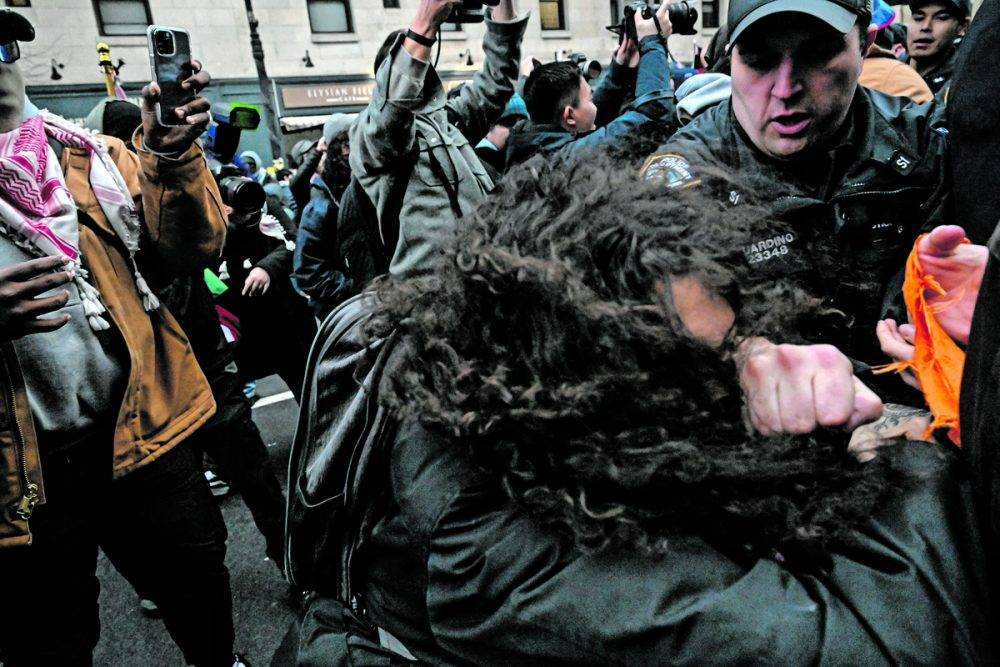
The protests escalated after mass arrests by police on the campus of Columbia University in New York. Nearly 2?900 students on almost 100 campuses have been arrested across the US in recent weeks, Associated Press reports. The students were protesting Israel’s devastation of Gaza in which they have killed more than 34?000 civilians.
Many Gaza solidarity encampments were taken down recently after university authorities agreed to consider severing financial and academic links with Israel, according to Al Jazeera.
Last weekend saw many protests during graduation ceremonies in the US, including at Duke University North Carolina where pro-Israel comedian Jerry Seinfeld received an honorary doctorate. Some protestors waved Palestinian flags and chanted “Free Palestine!”
The violent suppression of the protests on many campuses was reminiscent of the demonstrations against the Vietnam War.
It brought the conflict in Gaza home to many Americans — and the great and the good weighed in on their foremost comment pages.
One of the most controversial opinion pieces was an essay by English writer Zadie Smith in The New Yorker on 5 May, in which she wrote: “But, when I open newspapers and see students dismissing the idea that some of their fellow-students feel, at this particular moment, unsafe on campus, or arguing that such a feeling is simply not worth attending to, given the magnitude of what is occurring in Gaza, I find such sentiments cynical and unworthy of this movement.”
The backlash on X was swift and angry.
Palestinian writer Mohammed El-Kurd responded: “Zadie Smith argues that protest slogans are ‘weapons of mass destruction’ in a new pretentious and navel-gazing article and she does it while a literal genocide ravages Gaza. I am sick of ignorant and tone-deaf writers who feel like they can lecture us from their lavish homes.”
American writer Camonghne Felix, who identifies as “Black & Jew” on X, tweeted: “No, I’m sorry, I don’t understand what Zadie Smith is saying. Maybe I’m not smart enough, I’m still learning, but I don’t understand an essay that suggests ‘Zionist imperialist state’ is a misnomer when Israel is, by all definitions of these words, a Zionist imperialist state.”
Arnesa Buljusmic-Kustura, a genocide researcher originally from Bosnia and Herzegovina, reacted: “Honestly it has become exhausting having to listen to liberal writers yap about ‘it’s complicated’ and ‘both sides’. Just say that you are a coward and move on.”
American academic and novelist Steve Salaita responded in kind to Smith with an essay of his own. — Charles Leonard
Submit and get free exposure here: Showcase Your Business | Advertise Your Special Offers.