
The forces that shaped ‘faith healer’ TB Joshua and made him untouchable:

TB Joshua was a world famous Nigerian televangelist, faith healer and Pentecostal pastor who established The Synagogue Church of All Nations. Three years after his death a BBC investigation alleges Joshua raped, tortured and abused several of his followers over a period of 20 years. There are allegations of child abuse at his Lagos compound and that he faked his miracles. Nimi Wariboko is a leading theologian and social ethics expert who wrote the book Nigerian Pentecostalism. We asked him about the forces that shape a ministry like Joshua’s and what might have allowed him to abuse his power in this way.
What is Pentecostalism and why is it so popular in Africa?
Pentecostalism is a movement in Christianity that accents the charismatic gifts of the Holy Spirit in the lives and communities of its members. It traces its origin to the birth of the church on the Day of Pentecost in Acts 2 of the Bible. Pentecostals believe that the gifts of the Holy Spirit poured out to Christ’s followers on that day, and that the miracles the apostles did in the first century still continue. Most Pentecostals believe that miracles are possible today. A good number go to church expecting to receive them.
Pentecostalism centres on the Bible as the true word of God. This does not mean interpretations of the Bible are static. Pentecostals often adjust interpretations to suit their contexts and circumstances.
Many Pentecostal churches are led by “big men” or “big women” – authoritarian leaders who dominate their organisations and are rarely accountable to any human power. Their authority is almost unlimited and they teach or discipline their members not to question them, relying on Psalm 105:15: “Touch not mine anointed, and do my prophets no harm.”
Pentecostals also preach prosperity gospel, a belief that God is in the business of materially enriching believers.
These are some of the ingredients that have made the movement popular in Africa.
What forces shaped the rise of TB Joshua?
When Joshua started out in 1987, he focused on the spiritual and economic needs of Nigerians. He combined the belief systems, practices and doctrines of Christianity, Islam and African traditional religion. He later embraced Christianity fully.
The widespread poverty in the country, the precarity of life and the brutal oppression of ordinary citizens were in sharp relief to his efforts to cater to the economic needs of the poor (which he often televised), his attention to the spiritual empowerment of believers, and the simplicity of his lifestyle. These contrasts endeared him to millions of Nigerians and many more all over the world.
The genius of this man – and, perhaps, the majority of Pentecostal leaders – was his clear focus on the explanation, prediction and control dimension of religion. This means he set out to spiritually explain the causes of the predicaments of ordinary Nigerians. He prophesied what was ahead of them, and demonstrated the power to enact miracles to control or reverse their bad situations.
He was an early adopter of TV and the internet. In 2004, Nigeria banned TV stations from airing unverified miracles by pastors, most likely because of Joshua. This led him to launch Emmanuel TV on satellite TV and then online, out of their reach.
Why do people believe in prophecies and miracles?
First of all, Pentecostals believe in a two-tier world: physical and spiritual. They believe the spiritual controls the physical and that those with charismatic gifts can access the spiritual world to extract information to explain, predict and control outcomes in the physical world. So, there’s a quest for information from the invisible realm. I called this “the spell of the invisible” in my book Nigerian Pentecostalism.
Second, we have to look at Pentecostal epistemology – its philosophy. Nigerian Pentecostals beautifully render it as, “It does not make sense, but it makes spirit.” This means their decisions might seem irrational, but they are all good, reasonable and ethical through a spiritual lens. I address this issue in another book, The Pentecostal Hypothesis.
Finally, there is a deep belief in what I’ve named “the Pentecostal principle”: that the new can emerge amid ongoing social processes. The idea of the coming of the new, miracles that can transform the present situation of believers. We can’t ignore the role of economic hardship and poverty in heightening the vulnerability of citizens to religious charlatanism and authoritarianism.
How did he remain untouchable?
There are three points I would like to raise here.
Firstly, he started a Christian ministry, an independent denomination, which became enormously successful. He was not accountable to anyone. As they say, absolute power corrupts absolutely.
Second, the pursuit and seemingly effortless performance of miracles appeared to have excused or covered his frailties. But, in a sense, he was also enabled by the people. This is not to excuse the allegations against him but to say he was produced by a certain kind of Christian community or generation. He easily (and excessively) gave them their fantasy. His excesses were integral to the movement itself.
Finally, the allegations tell us that the Nigerian state has little or no oversight over how its citizens are maltreated, exploited or abused in the name of God. Religious leaders appear not to be accountable to the state or the demands of its laws. Joshua was a friend to many presidents in Africa.
How can Nigeria deal with future abuse by religious leaders?
The government has to hold every religious leader accountable to the laws of the land without usurping their religious freedom. Allegations of abuses must be swiftly and clearly investigated. Laws to properly regulate religious organisations are on the books but the government lacks the political will to enforce them because the churches are so popular and many politicians are also religious. The government must set the example of obeying its laws. The most important thing is for the government to work for the economic flourishing of its citizens.
This article first appeared in The Conversation.
Mlungisi Gegana: A page-turner of a career:

“With enough time and space,” says Queenstown-based bassist and composer Mlungisi Gegana, “we can make music that speaks to people. It really doesn’t matter how long it takes.”
Gegana is reflecting on the title of his just-released third album My Time, My Space and the nearly 10-year gap between it and his second album as leader, the 2014 I Am Who Am I, as well as on a four-decade career marked by moves between many South African performance spaces.
“I call it ‘turning the page’,” the self-taught musician says of these moves. At 11, in Queenstown, Eastern Cape, he was experimenting with a homemade oilcan guitar, and getting hooked on music, though he initially played percussion.
“And then, one day in 1986, I was helping my grandmother in her garden, and I told her:
“I have to do something with this music thing!’”
With family in Cape Town, the Mother City was an obvious destination. There, he encountered established musicians and one, Godfrey Ntsila, invited him into the outfit where he played bass.
The guitarist was the late musician and music organiser Christian Syren. They formed an instant bond, and when the latter mooted turning some of his rented home into a jazz club, Gegana became co-founder of the city’s legendary Jazz Den.
He wasn’t yet playing bass but living beside the performance space, where instruments were left overnight: “I used to look at that bass standing in the corner and wonder.”
He hungrily borrowed jazz LPs from a library and a Stanley Clarke bass solo was his first transcription.
The late bassist Spencer Mbadu became a mentor and stellar club guests, including saxophonists Robbie Jansen and Basil Coetzee, and bands Peto, Sakhile, Bayete and more expanded his musical circle.
“Then I needed to turn the page,” Gegana says. It was around the year 2000, he now really was a bassist — and it was time for Joburg.
Friends such as saxophonist McCoy Mrubata had arrived there before him. Reedman Kaya Mahlangu invited him into the house band for the sadly short-lived TV music show Bejazzled.
That brought work with more stellar names, including trombonist Jonas Gwangwa and multi-instrumentalist Pops Mohamed, “but it was nerve-wracking, my first time playing at that level”.
Gegana stayed in Gauteng for 17 years, working across multiple contexts, and releasing his 2004 debut One Step Forward and later I Am Who Am I.
Time to turn the page again.
Gegana considered America, where fellow bassist Bakithi Khumalo had offered hospitality, or France, “Or perhaps I should go home and help with development?” he wondered. The last option won.
Now back living in Queenstown, Gegana continues performing and composing, working with the International Library of African Music (ILAM), and teaching at his eMlungisi Music Academy (named after its township, not him).
And out of all those experiences has emerged My Time, My Space, which launched in Cape Town over the holiday season, with Joburg launch events scheduled for March.
The 10-track album features an eight-piece band, the largest instrumental ensemble he has worked with across a whole album (although some tracks on his debut used as many musicians, counting vocalists).
That’s not the only innovation. It’s the first album for which Gegana has composed from the piano, rather than simply on his bass.
“That made a lot of changes to my composing,” he says. “Before, I’d work outwards from a bass line. Now, I could play and hear both harmony and melody at the same time.”
That’s helped create bigger, more textured, arrangements and particularly a rich set of brass harmonies, using trumpet and trombone.
“That brass sound was a dominating sound in my head when I was composing,” Gegana says. “The trombone had to be there! “I hadn’t known Kyle [du Preez] but got to know his work with [saxophonist] Sisonke Xonti and met him when I played at Stirling High School, where he teaches.”
Alongside trombonist Du Preez, the band comprises trumpeter Sakhile Simani; reedmen Phumlani Mtiti and Anthony Drake; pianists Chester Summerton and Andile Yenana and drummer Ayanda Sikade.
The compositions reflect Gegana’s journeys and pay homage to his mentors. The contemplative opener East to West, for example, with its thoughtful solos from Simani and Yenana, reflects his dilemmas wondering where to move next.
He had settled in Pretoria as part of a plan to save money for a possible air ticket and the tune began to germinate “when I was moving from the east of Pretoria to the west” — a microcosm of all the other moves he had made and was considering.
The expansive brass and reed sound of Sibamba Ngazo Sozbini expresses “the respect you show by receiving something from somebody else with both hands”.
“It’s giving respect to all my mentors, Spencer, Sipho Gumede and other elders like [pianist] Pat Matshikiza and [singer] Stompie Mavi — some never moved from Queenstown, but still gave us so much.”
The closer, Introspection, where soloists including Du Preez stretch out, reflect “looking deep inside yourself to determine what you want to say … As much as we are instrumentalists, our music still carries deep messages.”
The twists and turns of Gegana’s melody and bass solo on Be Happy With What You Have, urge “in music and life, not copying or wanting what others have but drawing on who you really are”.
Those inward-looking tracks also reflect Gegana’s experience during Covid, which forced him, like many creatives, to draw on inner resources to stay motivated. “And, of course, Covid was part of the delay in creating the album — as well as organising finance to make it happen.”
Today, he says, he’s “still learning from the elders — I work a lot with [veteran singer] Retsi Pule through ILAM [Rhodes University’s International Library of African Music]” but Gegana is now also a teacher through his community music academy.
The school accepts youngsters from 12, but if younger children want to sit in, he doesn’t turn them away. He cheerfully admits to being a tough taskmaster, strictly instructing even on such matters as how to sit at a piano stool.
“I think some of them find all that intimidating,” he says. “But music is work: all your life. I’ve been learning for more than 40 years.
“You’ll never finish with this music thing until the day you die.”

This year marks the 34th anniversary of ‘Black January’ — the tragic incident that happened on 20 January 1990 in Azerbaijan
On the night of 19 January, as a result of military aggression of the units of the Soviet Army and special forces as well as contingents of internal troops against Azerbaijan, civilians, including children, women and elderly were massacred in the cities of Azerbaijan, including the capital Baku, by order of the USSR leadership.
As a result of the occupying forces’ military aggression 150 civilians were killed, 744 were seriously injured and four people went missing. The Soviet army forcefully suppressed the mass protests of the Azerbaijani people and the national independence movement. The protests were in response to the discrimination policy of the USSR leadership against the people of Azerbaijan, which included the deportation of hundreds of thousands of Azerbaijanis from their historical lands in the territory of present-day Armenia, and Armenia’s unfounded territorial claims against Karabakh. The Soviet forces committed an unprecedented massacre against the civilian population, grossly violating international law and the Constitution.
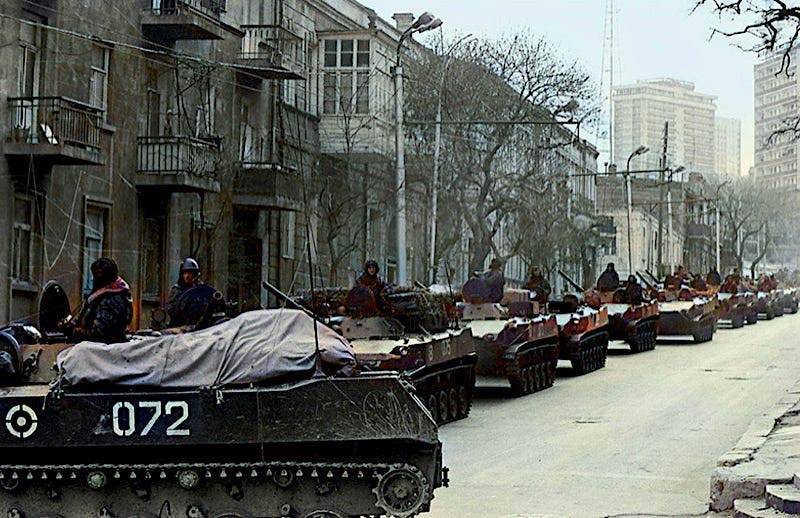
On the morning following the tragic events, National Leader Heydar Aliyev went to the permanent representative office of Azerbaijan in Moscow, where he vehemently condemned this heinous crime committed against the Azerbaijani people and demanded punishment of the guilty.
At the special session of the Milli Majlis (Parliament) held in February 1994 the brutal killing of innocent people on 20 January 1990 was qualified as military aggression and a crime, and in March 1994 a decision “On the tragic events committed in Baku on 20 January 1990” was adopted. 20 January was declared a National Mourning Day.
The tragedy had a decisive influence on the formation of the national identity of Azerbaijan and became a turning point in the restoration of its independence. Azerbaijani people, who were subjected to military, political and moral aggression of the Soviet regime 34 years ago, showed commitment to their historical traditions of struggle. The date of 20 January 1990 was marked in the history of the country as a day of tragedy, as well as of national pride, whereby the Azerbaijani people conveyed to the world that they deserve to live free, sovereign and independent.
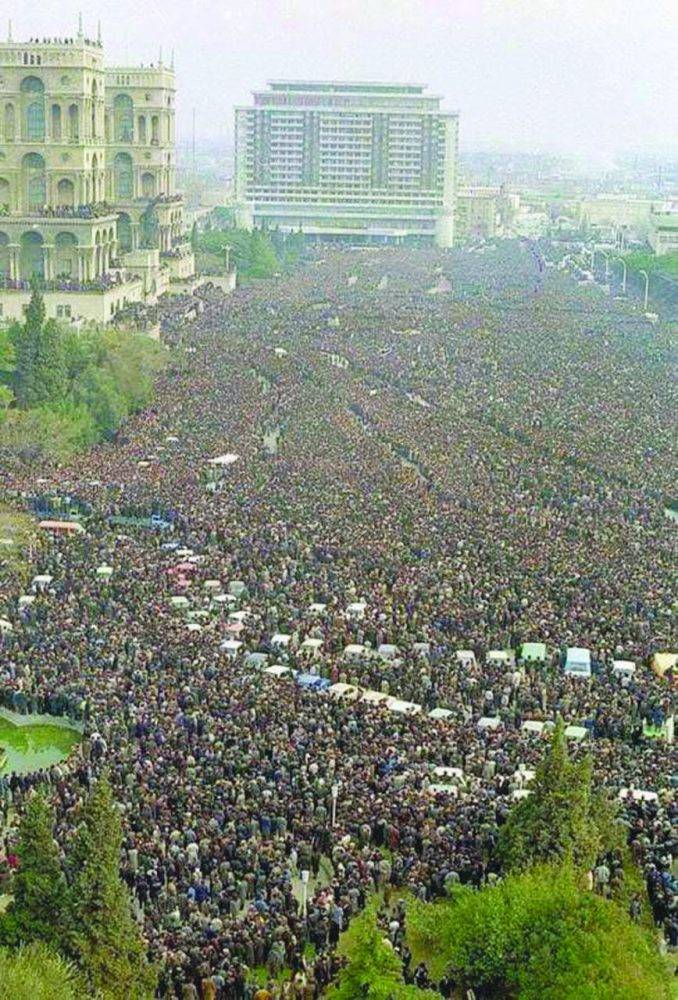
Today, the souls of heroic martyrs who gave their lives for the independence of Azerbaijan, as well as for the sovereignty and territorial integrity of the country are at peace. The courageous Azerbaijani army liberated the territories that were under occupation for 30 years, and the territorial integrity and sovereignty of Azerbaijan was restored. Actions against the independence, sovereignty and territorial integrity of Azerbaijan will continue to be adequately countered.
The Azerbaijani people buried their heroes in Mountain Park, the highest spot in Baku, and since then it has been called Martyrs’ Avenue. This is the most sacred place for every Azerbaijani. Every year on 20 January millions of Azerbaijanis visit Martyrs’ Avenue and lay carnations on the graves.
This ceremony begins in the early morning when the President of the Republic and officials lay wreaths at the eternal flame.
According to official protocol, every guest or delegation paying a visit to Azerbaijan begins their journey by visiting the Avenue and traditionally, the head of state, accompanied by guards of honor, approaches the monument erected to commemorate the martyrs and lay the wreath.
The people of Azerbaijan will never forget the martyrs who lost their lives for the independence, sovereignty and territorial integrity of the country, and they are remembered and honoured with the deepest respect and esteem by all.
Submit and get free exposure here: Showcase Your Business | Advertise Your Special Offers.
