
The forgotten women in education:
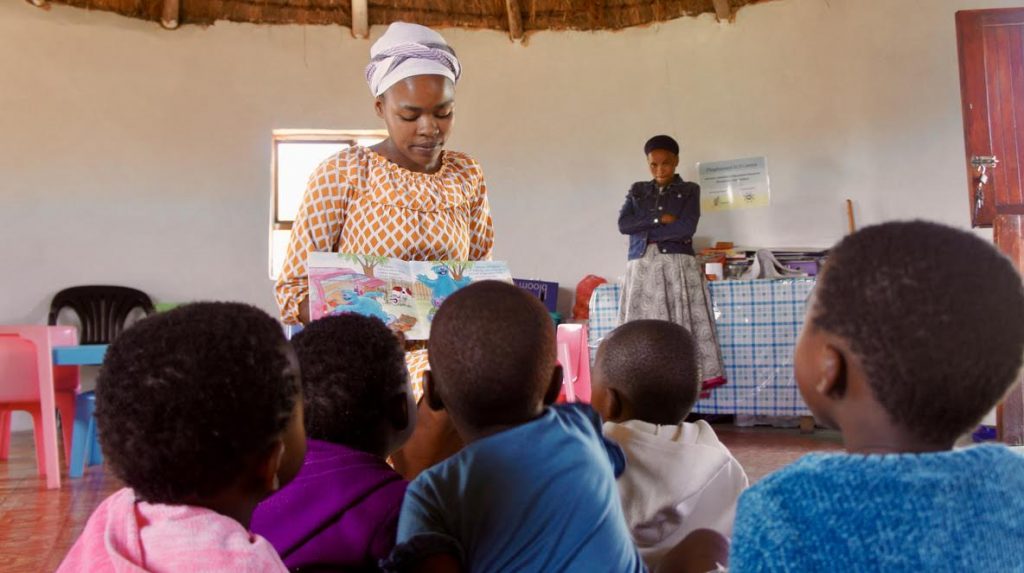
The work of early childhood development (ECD) practitioners is one of the major sources of income for black women. But, much like domestic workers, ECD practitioners constitute a forgotten generation of women who work, wait and sow endlessly on the pathways of life, yet never get an opportunity to earn, progress and reap.
The limited research on ECD practitioners and their learning pathways is testament to just how neglected these women are.
I am referring to the aunties and mamas who clean snotty noses and teach the ABCs, the 123s and whatever else keeps the children learning while we are at work.
Do you know that ECD practitioners, well qualified and well experienced, could earn as little as R1?000 a month? Sometimes they earn R2?000 a month, for starting work at 6am and knocking off at 6pm. This is generally the going rate, but they may earn anything or nothing at all, because of no policy and administrative support in this area.
ECD practitioners form the backbone of many of the poor and impoverished areas in the Western Cape and elsewhere in the country. Some practitioners set up small businesses that begin with just taking care of children whose parents work away from home. They feed and teach children, often starting out with little knowledge and experience in teaching.
Just take a drive in Khayelitsha, Philippi in Mitchells Plain or Hanover Park and you will see the signs: Funda Daycare Centre, Mandy’s Daycare; Abantawana ECD Centre. They are everywhere.
Access to higher education is crucial for poor black women who choose this pathway to step out of poverty and widen their life chances and choices. Research in South Africa shows that this is near impossible for black women working as ECD practitioners.
Higher education would not only reinforce the stronghold of black women against poverty but also empower them as members of marginalised neighbourhoods. Black, adult women seek higher education for empowerment, progress, and potential upward mobility.
They do it not only for themselves but for their families, neighbourhoods —and the children.
I first learned about the valuable role ECD practitioners play in poor and marginalised areas during a six-year period where I worked and earned a living as an ECD facilitator. I met and taught women who were participating in ECD Level 1, ECD Level 4 and ECD Level 5 programmes at Technical Vocational Education and Training (TVET) colleges to enhance their work as practitioners.
As black, adult women, they had been bruised by the inequalities that permeate our country’s social and economic landscape. They had been marginalised from social and economic growth.
But they had a fire burning within them, which ignited a deep desire to gain an education. These women wanted to study toward a Bachelor of Education degree to teach in primary schools.
As ECD practitioners, they are overworked and underpaid. For them, access to higher education to get a degree meant acquiring permanent positions in schools. I wanted to help the practitioners in my reach grow in their own learning and knowledge, to ensure deeper stimulation and more effective change at the levels of teaching and learning in their neighbourhoods. I also wanted to help them go to university.
As such, I supported them as a mentor to research points of entry into universities where they could study towards a degree in education, especially because they were working toward ECD qualifications obtained at TVET college.
What we found in the research was astonishing. Universities do not accept ECD qualifications successfully completed at TVET colleges.
There is only one route into higher education for ECD practitioners. This is through the Recognition of Prior Learning (RPL) programme. The way this programme functions varies across higher education institutions and only one institution in the Western Cape clearly stipulated the requirements for acceptance into the BEd degree through the RPL. Information regarding the RPL is hard to come by and is often shared only through word of mouth.
Take Surreya, for example, a 46-year-old mother and breadwinner in her home. After completing her schooling and ECD Level 4 certificate, she applied for university entrance for four years without any response or feedback from the institution.
It was the same story with Jenna, a 44-year-old mother, who is primarily responsible for her children’s education. Jenna applied at three universities over a period of three years, with no feedback from any of them.
Both practitioners heard about the RPL after applying for undergraduate studies.
Surreya was accepted after a battle within the RPL application process, and Jenna is continuing her RPL application process. What a long, long road to acceptance.
International research on adult women shows that as students, they are determined to succeed and achieve their goals to obtain degrees and pursue their careers. They are career-orientated and are more determined than other participants in higher education.
They are self-confident and often succeed against the risks that participating in higher education bring. Some of these risks are not fitting in to student life, not being able to work and provide for their families during studying and the risk of failure.
With this mind, why would ECD practitioners have such limited access to higher education? Why prevent them from accessing a route out of poverty?
On a global scale, and specifically in Africa, poverty is feminised. ECD practitioners most assuredly fall into this group. Many of them lead female-headed homes, provide for children and extended families and are located in the marginalised group of minimum-wage or unpaid workers. Surely, accessing higher education could change this.
Why limit their access to one route of the RPL?
During the Covid-19 pandemic, ECD practitioners were refused access to consistent employment and remuneration. Although guidance was given to teachers at schools on what to do during the lockdown periods and teachers in basic education continued to be remunerated, ECD practitioners received no initial direction on what to do to continue operating during business hours, nor was it communicated to them how processes could be followed.
They also received no remuneration during this period. Come vaccination time, teachers at schools were once again given first preference. ECD practitioners were given none.
No wonder they strive for higher education to obtain degrees and to teach at schools.
This article was a finalist of Canon Collins Trust’s annual Lead with Your Mind: Troubling Power essay competition. Kaylianne Aploon
Kaylianne Aploon-Zokufa is a lecturer in the Institute for Post-School Studies at the University of the Western Cape in the faculty of education.
The views expressed are those of the author and do not necessarily reflect the official policy or position of the Mail & Guardian.
– The forgotten women in education | The Mail & Guardian
‘World watching’ as Djokovic, Alcaraz clash for Wimbledon title:

Novak Djokovic says the “world of sport” will be watching when he faces Carlos Alcaraz in a Wimbledon final where history and a generational shift are at stake.
Djokovic is attempting to equal Roger Federer’s record of eight titles at the All England Club and match Margaret Court’s all-time mark of 24 Grand Slam crowns.
Having already pocketed the Australian Open and French Open in 2023, victory on Sunday will put the 36-year-old just one major away from completing the first men’s calendar Grand Slam since 1969.
“It’s the ultimate showdown,” said Djokovic, who will be playing in a record 35th Grand Slam final.
“Everything comes down to one match. All eyes of the tennis and sports world will be directed on this Sunday’s Wimbledon final. It’s probably the most watched tennis match globally.”
At 20, Alcaraz is Djokovic’s junior by 16 years.
When Djokovic captured the first of his 23 majors at the 2008 Australian Open, the Spaniard was still three months shy of his fifth birthday.
Djokovic can become Wimbledon’s oldest champion while Alcaraz is bidding to be its third youngest after Boris Becker and Bjorn Borg.
“I obviously have more experience. It can help a little bit in some important moments, beginning the match, managing the nerves, managing the occasion, circumstances,” said Djokovic.
“But it’s not going to be the deciding factor really. Whoever, on a given day, is in a better state, mentally and physically, will be the winner.”
Djokovic won the mind games when the pair clashed in the French Open semi-finals in June.
Alcaraz suffered body cramping, a physical ailment brought on, he freely admitted, just by the sight of Djokovic on the other side of the net.
“If you think how big he is, you struggle,” admitted Italy’s Jannik Sinner who was blown off court by Djokovic in Friday’s semi-final.
The memory of his Paris collapse is still raw for Alcaraz who plans a series of mental exercises to counter the tension on Sunday.
“I’ll try to forget that I’m going to play a final against Novak,” he said.
‘Best moment of my life’
Sunday will be Alcaraz’s first Wimbledon final in just his fourth grass-court event.
Djokovic is in his ninth championship match at the All England Club.
The Serb has won 34 successive matches at the tournament and has not been beaten on Centre Court since losing the 2013 final to Andy Murray.
“He’s in great shape,” Djokovic said of Alcaraz. “He’s very motivated. He’s young. He’s hungry. I’m hungry, too, so let’s have a feast.”
Their progress to the final has been similar.
Both have only lost two sets. They have spent virtually the same amount of time on court.
“This is going to be the best moment of my life,” said Alcaraz who aims to become the third Spanish men’s champion after Manuel Santana in 1966 and Rafael Nadal, who won the title in 2008 and 2010.
“Playing a final here in Wimbledon is something that I dream about when I start playing tennis.
“It’s even better playing against Novak. It’s going to be a really emotional moment for me. For Novak is one more day, one more moment,” added Alcaraz who described Djokovic as a “legend” of tennis.
Alcaraz will likely enjoy most of the crowd support as All England Club fans, in common with most around the world, remain stoically ambivalent of Djokovic despite his status in the game.
There were wild cheers when Alcaraz told a courtside TV interviewer after his semi-final demolition of Daniil Medvedev that he believed he could beat Djokovic and that it was “no time to be afraid”.
Just hours earlier, Djokovic had feigned mock tears and cupped his ear in response to his pro-Sinner supporters.
“All love. It’s all love. All love and acceptance,” he told reporters.
© Agence France-Presse
– The forgotten women in education | The Mail & Guardian
The VW Amarok: When motoring titans come together:

Online forums were set ablaze in 2020 when the news broke that Ford would be building not only its next-generation Ranger at its plant in Silverton, Pretoria, but also the next Volkswagen Amarok.
Memes, some of which were, um, typically South African, nearly broke the internet. The bakkie world went mad.
But, in case you didn’t know, badge engineering is nothing new. The biggest local exponent of this is undoubtedly Toyota, with its fondness for Suzuki’s designs. In the bakkie world, though? Well, it’s pretty much sacrilegious. The only thing worse is a “jou ma” joke.
The thing is, this collaboration works. Sure, the world was waiting with bated breath for the second act of the overall brilliant, but dated, (original) VW Amarok 3.0-litre V6.
And, yes, the VW purists have raised their eyebrows and given their 10 cents’ worth on the notion that it is no more a VW than Eskom is a functional entity.
And yet, on the exterior detail front which, for many bakkie pundits, is a deciding factor, it’s largely VW. Those IQ light LEDs upfront, the horizontally focused lines … You get the idea.
Interior
Then there’s the interior trim — plenty of Ford to be found here but also VW’s unique approach.
Front and centre in the trim of the PanAmericana test vehicle is the identical tablet-style 12-inch infotainment screen found in the Ranger Wildtrak and Raptor which, unfortunately, has the same annoyances, the layered interface and tiny integrated click points for external functions, such as Android Auto, for one.
It is not bad when you are parked but interacting with it on the move is like trying to thread a needle on a roller coaster.
Another example is the Easter egg hunt to find and optimise the climate options. This definitely reminds me of VW products, such as the Golf R. It’s clearly meant for sophisticated, tech-savvy individuals, not some flip-flops and sweatpants-wearing oke.
As for the 12-inch digital instrument cluster layout, well, that’s more VW than many VWs. Driving info is readily available, it’s easy to configure, and the graphics are crisp. There are buttons on the steering wheel to control functions such as volume — no digital sliders to be found here.
The overall fit and finish? The PanAmericana derivative boasts a sophisticated approach. This is in contrast to the more utilitarian-with-niceties finish found in its American cousin, the Ranger Wildtrak.
In fact, I’m trying to think of a plush interior execution from VW Commercial Vehicles and I’m coming up seriously short.
Yes, yes, it’s a Ford, I know. But it’s also VW at its very best.
The black leather upholstery, with brown adornments, is called “Cricket”. The brown tastefully extends to the armrests, seatbacks and centre storage bin. While I’m not fond of brown inserts, for this off-road-focused luxury bakkie, it works a charm.

Driving
The Amarok PanAmericana walks the walk — and then some.
Under the bonnet beats a creamy Ford-donated heart in the form of a 3.0-litre V6 turbodiesel oil burner that produces a mighty 184kW and 600Nm of torque. In layman’s terms, that’s enough to tow the moon into a different gravitational orbit. Probably. We’re pretty sure.
How about the 10-speed automatic gearbox? There are no qualms here as it covertly distributes drive to the wheels. The plentiful torque figure helps extract the maximum potential from the box that, 99% of the time, accurately predicts and adjusts according to throttle inputs.
The other 1%? Well, the vehicle did, on occasion, get a tad over-excited when modulating the throttle before a planned overtake and, as a result, knocked down a few cogs in the 10-speed. This is hardly necessary since there is plenty of grunt on tap for just that.
The refined ride quality and bump absorption remind me of the first-gen Amarok. It won over buyers with its sturdy and unruffled nature over pimply roads and the tranquil cabin was another feather in its cap.
In fact, I’m willing to say, once again, VW has one of the most comfortable contenders in its direct segment. No VW-ness in this dinner jacket-wearing Ranger, opine the naysayers — I’ll just trail off here for dramatic effect …
Ownership
This is a bit awkward but the Volkswagen Amarok 3.0TDI V6 PanAmericana 4Motion, as tested, costs a sturdy R1?084?600 — and it is not even the range-topping derivative. That is R60?000 more than its near-comparatively-specced Ranger Wildtrak cousin and R100?000 less than the mad-as-a-hatter Ranger Raptor.
While the Amarok PanAmericana is a superb bakkie, with more than enough redeemable qualities to easily forgive the badge-related bloated elephant in the room, that price leans on the side of over-steep.
Isn’t the point of joint venturing to make the bean counters happy? To eliminate the need for costly platform developments and refinements to keep asking prices down? Then again, I’m hardly qualified to speculate what goes on behind closed doors when pricing matters are discussed.
I am, though, in a position to comment on matters of fuel consumption. During the test tenure, the Amarok PanAmericana registered 9.2 litres/100km during suburban driving and dipped to a respectable 8.5 litres/100 km on highway jaunts. Not bad. It certainly doesn’t have the wayward drinking habit of its V6 petrol-powered Ranger Raptor cousin.
Conclusion
The VW Amarok PanAmericana is an astoundingly good bakkie. That Ford brawn, the VW finesse …
Instead of lamenting this strange-on-all-accounts joint effort, shouldn’t we applaud what these brands have achieved together?
In fact, the locally built Amarok makes a fitting analogy for South Africa — with the kaleidoscope of cultures and backgrounds that call our country home, we can still, on occasion, and despite our differences, come together and do something extraordinary. And then complain about the price.
– The forgotten women in education | The Mail & Guardian
Submit and get free exposure here: Showcase Your Business | Advertise Your Special Offers.
