The Haval H6 HEV is a stand-out in the SUV market:
The Haval H6 is increasingly popping up in car parks around South Africa, often seen next to what used to be the local mainstay brands.
The striking design of the H6 gives it pride of place and commands more presence than many of the products with which it competes. Such is the strength of Phil Simmonds’s design that brand-conscious and historically loyal consumers are choosing to spend their money on a relatively new brand, despite the woeful performance of Chinese brands and products in the past.
We’re into a new era now. Haval is chomping away at market share and exceeding even our lofty expectations.
But design isn’t all there is to it. Haval has made significant progress in South Africa, launching commendable products with inarguable value for money. The H6 is one such product, offered with a full house of tech and features within a very attractive package and price point.
Initial criticisms in the past have centred around the engine choices on offer being uneconomical … enter the H6 HEV, launched late last year, to fill that gap.
The new HEV is a noteworthy testament to Haval’s ability to make strategic calls and quickly land new or improved products on our shores.
We spent significant time with the Haval H6 HEV, covering just under 4?000km in the car over four weeks.
The H6 HEV is a head-turner and conversation-starter. Its futuristic design has hints of sportiness, elegance and intelligence, it is more handsome than the non-hybridised versions and certainly one of the standout designs in its class.
It’s an approachable car too and that’s no metaphor. It provoked others to not just look but to enquire more about what it is, where it’s from, how much it is, and so on.
The conversation continues as you get inside the H6 HEV. Much like the exterior, the interior is a fresh impression of Haval’s design architecture. It’s not unlike the other H6s, but consider it an ultra-luxury spec model.
Its cabin includes just about everything technology- and feature-related you can imagine and it feels as if Haval has done this in a bid to win customers, yes, but to also justify the price … more on that later.
The floating console design prioritises space and practicality, partly freed up by the rotary drive dial.
Above this, a 12.3-inch infotainment screen looms, within which you’ll find plenty of functions. Directly in front of the driver is a 10.25-inch screen and beyond that, projected onto the windscreen, is a high-resolution heads-up display that is configurable and dynamic.
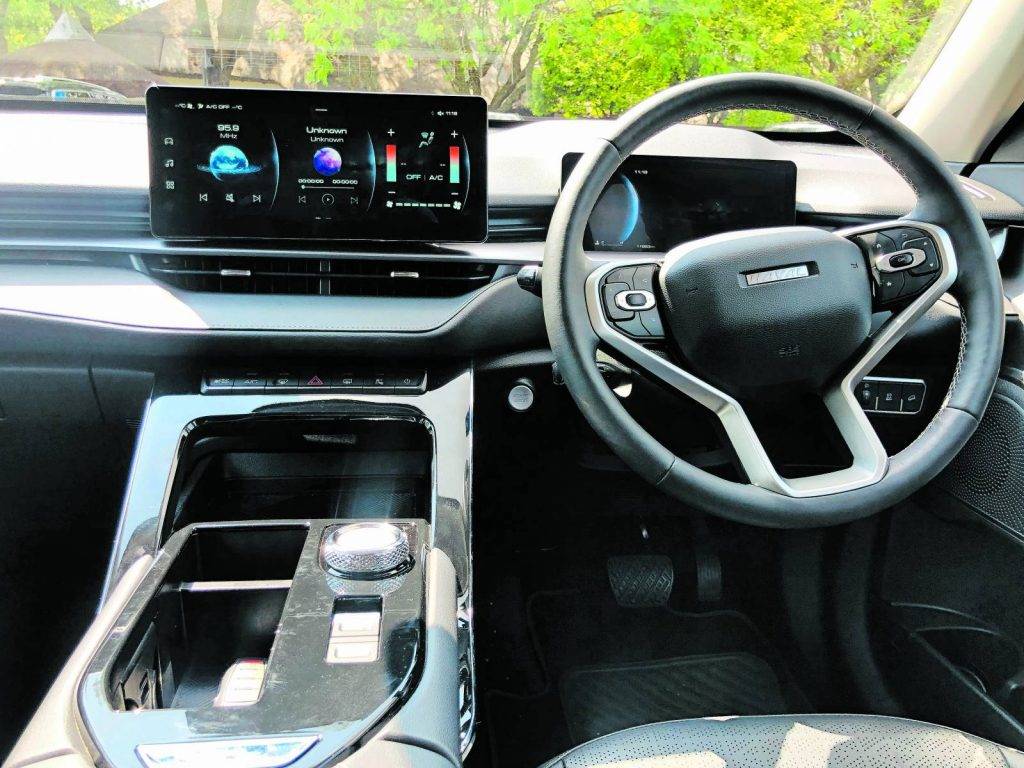
We’re talking full marks here — the 360-camera resolution is top-notch in the segment, as is the heads-up display and the sheer number of functions in this car.
Technology, such as phone mirroring, is a given. Add a myriad driving and steering weight modes and you have a car that, in many ways, can be tailored to your preferences.
A panoramic roof adds to the ambience and electronically adjustable leather pews make the driving position almost perfect … almost.
Within this accumulation of tech, there are a few oddities. The user experience is decidedly odd. There are far too many sub-menus to access certain features and it takes a while to figure them all out. However, that can be overcome.
After that, certain functions are overly complicated or hidden under a sub-menu only to be layered underneath yet another one. Something as simple as the volume control isn’t so simple unless you’re the driver and you control it from the multi-function wheel. Similarly, the ability to access the climate
control menu to adjust the temperature isn’t nearly fast or straightforward enough.
These are just a few functions that, while they aren’t hard to employ, are just not where they should be.

This brings me to the drive itself. Let’s start with the good stuff. Hybrid drive makes sense in our country. It allows you to travel vast distances while conserving fuel in urban and extra-urban environments.
The H6 HEV pairs a 1.5-litre turbo-petrol motor with an electric motor. The system, though somewhat complex, isn’t all that complex from behind the wheel.
The powertrain provides small-car economy with exciting performance. The H6 HEV is the most powerful H6 you can buy, dishing out 79kW of combined grunt. Command it from your right foot, and it’s delivered in front-wheel-driven spades.
It is exciting for what it is — a family-friendly SUV for the urban buyer.
On gravel surfaces, a suspension on the firm side shows up but, for the most part, it is what you’d expect from this type of vehicle.
On the open road, the ride is good, with acceptable NVH levels and a comfortable ride.
Consumption can be very impressive, provided you’re in a suitable driving mode, and your battery regeneration is set to “as much as possible”. Braking regeneration charges the battery as soon as your foot comes off the pedal, while coasting or when you’re on the brakes, and this can extend battery life so you can go further in electric mode.
Our best consumption around the city was 5.9l/100km, and we managed a respectable 6.9l/100km over the entire test. That is impressive for a car that was called in to haul a family of five, and all their luggage, across all sorts of roads. That’s the point of SUVs, though.
So where’s the rub? There are two big ones in the full-spec H6 HEV.
The first has to do with the Adaptive Cruise Control technology. On paper, this is an intelligent system but my concern lies in the execution of the braking control. The H6 will slow down when needed, but it does so by depressing the brake pedal at your feet. This is an old technology decision that disturbs your sense of driving and changes the pedal feel if, for instance, you need to apply more pressure to the brake.
The second is a sensor-ranging issue where the system applies the brakes when not required. On the highway, without any obstructions in front of the car, the H6 will just randomly hit the brakes. Or perhaps while cruising around a slight bend in the road, the car seems to brake as it senses an upcoming curve, no matter how slight, and the application, in most cases, is harsh.
The other big issue has to do with braking regeneration. No matter what regen setting you’re in, the H6 charges the battery when coasting, especially down a hill. As I mentioned above, it does this by depressing the brake pedal, in essence, riding the brakes. It gets most concerning on extended downhills, such as mountain passes, where the vehicle seems to ride the brakes to a point where the pedal feel is lost, and the entire car shudders when you take braking action yourself.
Imagine driving a car with warped discs? That’s what it feels like. To make matters worse, the braking efficiency is compromised. This becomes unnerving for the driver, not to mention the passengers, who can feel the discomfort and shudder.
These problems aren’t unsolvable and the fact that Haval has loaded this car with so much is something to be celebrated. My suggestion to Haval is to offer the H6 HEV in a slightly lower spec, as it has done with the Jolion Luxury model — a spec that does away with all the fancy self-driving tech and just gives you standard cruise control.
That would revise the price too, which, for what it is on paper, doesn’t seem ridiculous, given the H6’s competition with the Toyota RAV4. But when considering the H6 HEV at R669 950 costs about R90?000 more than the Super Luxury 4WD model, one has to weigh whether the saving in fuel economy is worth it. Over the cost of ownership, this may be enough of a swing to the HEV.
The H6 HEV is a smart addition to the crowded SUV field and will find homes nationwide. Were it not for those flawed bits of tech, it would score much higher in our rating, but we can’t forget about those, as they are fundamental to a confident driving and ownership experience.
The HEV is sold with a 5-year/60?000km service plan,
a 5-year/100?000km warranty and
a hybrid-battery warranty of
8 years/150?000km.
Arsenal fans are ready to party like its 1989:
Arsenal fans old enough to remember that far back are preparing to party like it’s 1989.
Eight points ahead of Manchester City, who have a game in hand, at the top of the English Premier League, The Arsenal are – hesitatingly – beginning to dream.
It’s been nineteen years since the North London club’s last league title – the 2004 triumph of Arsene Wenger’s peerless ‘Invincibles’, who went the whole season undefeated – an unprecedented and unrepeated feat.
The first of Arsenal’s nine game run in is at Anfield on Sunday against Liverpool, who have suffered a curiously erratic season. Regardless, Anfield always presents a challenge.
But Arsenal will no doubt draw on the spirit of the Anfield night in late May 1989, when George Graham’s team won the league for the first time in eighteen years.
For those of us who were lucky enough to be there on that balmy early summer night, it has always felt that nothing could ever match the drama and ecstacy of Micheal Thomas’s winner.
It came several minutes into stoppage time. One up at the time, Arsenal had to win by two clear goals to snatch the trophy from under Liverpool’s noses.
It was an emotional evening all round. When the players entered the arena half an hour late due to motorway traffic jams that had delayed the arrival of many supporters, the Arsenal players ran to all corners of the ground to hand out large bouquets of flowers – a token of sympathy and respect for the Hillsborough tragedy the month before, when 96 Liverpool fans shockingly died at the FA Cup semi-final against Nottingham Forest.
The home game against Arsenal was originally scheduled for late April, but was re-arranged as the Merseyside club mourned. This set the stage for the most extraordinary finale for any league season, anywhere.
In those days, the fans were relatively stolid; now the mood, especially on social media, is febrile. Many grew up during the glorious early phase of Wenger-ball, in the late 1990s and early 2000s, when Arsenal won the league three times, with two doubles.

Since then, it’s been a rollercoaster ride – always the bridesmaid but never the bride. So this time, angst-ridden Arsenal fans are hoping it can be wrapped up long before the final game of the season.
But those of us old enough to remember the run-in in 1989 will be fearing the worst.
Four points ahead of Liverpool with three games to play in 1989, Arsenal contrived to first lose at home to Derby County in a nervy encounter and then four days later drew 2-2 at home to Wimbledon.
This twitchy draw was only achieved in the dying minutes. The scorer was a player so left-footed that it was clear that his right leg was simply there to stop him toppling over. So when Arsenal left-back Nigel Winterburn smashed a speculative long-range effort into the top corner with his right foot it seemed truly miraculous.
Similar potholes in the road lie ahead – Anfield on Sunday; the Etihad Stadium for an obviously crucial match away to City on 26 April; Brighton away in mid-May, before the final game at home to Wolves on 28 May – a game for which tickets can now be bought on the black market for around 20,000. Sterling.
The wheel of fortune in sport usually turns and eventually comes around, but never fast enough for the impatient sense of entitlement of the modern Emirates stadium-era.
For older fathers and mothers who have imposed their fidelity for the Gunners onto their offspring there will considerable relief.
Previous Arsenal title triumphs have rarely if ever been universally celebrated. Other fans love to hate The Arsenal. But this is a very likeable Arsenal side; the strength of the collective is obvious. And they play delightful football.
That sense of cohesion and purpose will be sorely tested over the next seven weeks, starting on Sunday at Anfield.
It’s the hope what kills you.
Why should beginners use a pip calculator in trading?:
It helps you make informed decisions about where to enter and exit trades, and how much to risk on each trade
A pip is a unit of measurement for a currency pair’s value change in the foreign exchange market. Traders use pips to calculate their gains or losses. It is the smallest change in the exchange rate, usually the last decimal point. The value of a pip depends on the exchange rate and the trade amount. For instance, if a trader makes 10 pips on a trade, the cash amount gained will depend on the pip value, which can be calculated by dividing the trade amount by the exchange rate and multiplying it by the number of pips gained.
Using a pip calculator, you can quickly and easily determine the value of a pip in your account currency, which can help you make informed decisions about where to enter and exit trades and how much to risk on each trade. This information is critical if you are trading with leverage, as it can help you manage your risk and avoid potential losses.
Benefits of a pip calculator
Pip calculators have wide-ranging benefits for beginners. Let us go through each as follows.
Accurate pip calculations
You can accurately calculate the value of a pip for a currency pair, which is important for calculating profits and losses and making informed trading decisions.
Time saving
A pip calculator can quickly and easily calculate the value of a pip, saving traders time that they would otherwise spend on manual calculations.
Risk management
It can help traders manage their risk by determining the appropriate position size and stop loss for a trade.
Decisions
You can make more informed trading decisions, such as where to enter and exit trades.
Multi-currency support
Pip calculators can be customised to support different account currencies, making it easier for traders to calculate pip values in their preferred currency.
Compatibility
Pip calculators can be used with different trading platforms and are available as standalone tools, making them accessible to traders regardless of their trading setup.
Free Usage
Many pip calculators are free to use and can be found online, making them a cost-effective tool for traders.
How can I find the pip value for a specific currency?
To calculate the pip value, simply multiply/divide the found pip value by the exchange rate of your account currency and the currency being traded. If the currency being converted to is the counter currency of the exchange rate, divide the found pip value by the corresponding exchange rate ratio. If it’s the base currency, multiply the found pip value by the conversion exchange rate ratio. Most forex brokers will do this calculation automatically, but knowing how it works is still beneficial.
Currency pairs and pip value
Here are some famous currency pairs and their value in pip:
- The exchange rate between USD and CAD is 1 USD to 1.0500 CAD. The value of a pip (in terms of the base currency) is calculated by multiplying the value change in the counter currency by the exchange rate ratio. In this case, the value change is .0001 CAD, which, when divided by the exchange rate of 1.0500 CAD, gives a pip value of 0.000952381 USD per unit traded.
- A one-pip move in GBPJPY would be 0.01 JPY. By plugging this value into the formula [(0.01 JPY) / (150.00 JPY)] x 1 GBP, you get a pip value of 0.0000666 GBP. Therefore, for a trade of 10,000 units of GBP/JPY, each pip change in value would be equivalent to approximately 0.666 GBP.
- The EUR/USD currency pair can experience a movement of one pip when it increases from 1.1700 to 1.1701. If you had opened a long position on EUR/USD and the market went up to 1.1740, you would have earned 40 pips and made a profit. However, if the market moved in the opposite direction, dropping from 1.1600 to 1.1560, your position would have suffered a loss due to a decline of 40 pips.
Summing up
A pip calculator is a useful tool for beginners in trading as it helps calculate the value of a pip in a currency pair, which is important for managing risk, making informed trading decisions, and calculating profits and losses. Pip calculators save time and can be customised to support different account currencies. Different currency pairs have different pip values, and knowing the value of a pip can help traders make better trading decisions.
Submit and get free exposure here: Showcase Your Business | Advertise Your Special Offers.