The slow and satisfying life of a snail farmer:

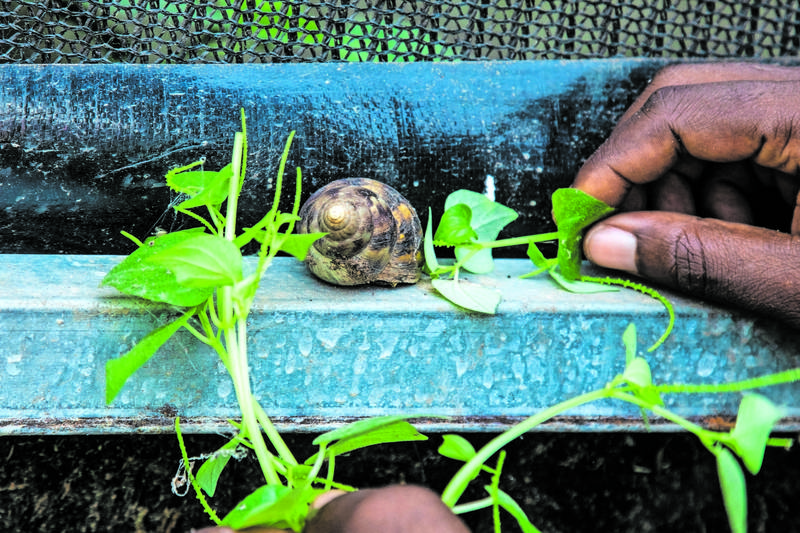
Ama Serwaa Ennin squats in a greenhouse, proudly showing off her farming produce, her hands full. What she’s holding is her source of pride and future income. But this is not grain or legumes of the sort usually proffered up in tales of African farming success. Instead, her hands are holding two snails — giant African snails, to be exact.
“Snail farming is a good business but it takes time before you can harvest, so you need patience if you really want to venture into [it]. People often encourage me on social media but some are unintentionally funny; one asked me why I do this when my peers are leaving for Canada to practise nursing,” Ennin said.
Snails are a delicacy and source of protein for Ghanaians. Popular dishes such as jollof rice with snails, banku with snail stew, yam chips with peppered snails, snail meat pies, and snail meat kebab can be found in eateries in most urban areas. They’re also a huge opportunity for farmers.
“They are the most profitable animals per square metre,” explained Felix Appiah Nyarko, co-founder of Trisolace, an enterprise that helps smallholder farmers like Ennin grow snails organically in urban and rural areas.
Over the past eight years, Nyarko has helped build Trisolace into a company that is fast becoming a household name in Ghana, having established more than 200 large greenhouses dedicated to growing snails.
“The greenhouse package costs between 36?000 cedis (about $ 3??000) to 200??000 cedis (about $ 17??000) and the small boxes start from 700 cedis (about $ 58) whereas a pack of snails is 150 cedis (about $ 12.5),” Nyarko said.
Snail farming was about as far from Ennin’s initial plans for a career as one could get. But after qualifying for her dream job in nursing, she waited in vain to be placed in one of the country’s medical centres.
“I realised that I wouldn’t be posted anytime soon after national service because our predecessors [were] still at home and I decided to do something and the opportunity I had here was land, so I started farming,” she said.
In 2022, Ennin’s father told her about snail farming. Soon after that, she travelled for training at the Trisolace Snail Farm in Accra, then started her project on her parents’ land in Mampong municipality in the Ashanti region.
“I market the snails online and buy from local pickers and sell to the open market while waiting for those in the greenhouse to fully mature,” she said.
Ennin’s parents helped her with the purchase of her first greenhouse, which cost some 24??000 cedi ($ 2??000). There, she grows vegetables like carrots, cabbage, lettuce, and cucumber. She sells some of her harvest, but most is used to feed about 1??700 edible giant African snails, or Lissachatina fulica.
“You need to have patience because it’s a long-term investment,” Ennin said. “Snail farming does not need much space. You can go through the training and start small, not necessarily the greenhouse method.”
The idea of commercialised snail farming came to Nyarko during his job hunt when he met other friends and civil engineering colleagues who were also looking for jobs but were unsuccessful. Nyarko participated in different start-ups and entrepreneurship programmes and saw the huge potential the snail industry presents in terms of job creation.
“We started with small boxes filled with snails and gave them out to friends and colleagues where they reported on what they like and don’t like, as well as the mortality rates, so that was how we got our research,” Nyarko said.
With savings from Nyarko’s national service allowance and support from his co-founder, they raised 5??000 cedi to start rearing the snails on a commercial scale, using boxes.
“In 2018, we started on a larger scale doing the greenhouses. This was after I completed intensive training at a state-owned institution, the Council for Scientific and Industrial Research, Forest Research Institute of Ghana on snail farming technology.”
Their snail rearing was catching on and, in 2019, Nyarko was awarded a $ 5??000 grant by the United Nations Development Programme and the National Youth Authority under Ghana’s Youth Connekt Platform.
Trisolace has grown over the past seven years to now have 22 full-time staff members, thanks in part to the application of different innovative methods such as using greenhouses and sprinklers.
“We saw that there were a lot of prospects in agriculture. But we didn’t have a place of our own. I was still with my parents so you couldn’t do anything like poultry or anything that smelled or made noise. That is when we started to research snails,” Nyarko said.
Snail farming still has its difficulties and risks, including a relatively high mortality rate during hatching if conditions are not closely monitored.
But retired Ghanaian technician Elvis E Nkrumah, who previously specialised in snail farming technology, advises young people to have patience and ensure best practices to become profitable over time.
“We advise that you don’t sell your first generation but the second generation so that you have a sequence of ranges where you can sell the subsequent years and that will make them big enough to earn you higher prices so that you get a lot of profit. Your first generation will get you a lot of snail population.
“They lay a lot — on average 400 to 500 eggs annually — and hatchability is between 95 to 100 percent,” he said.
Another under-explored area in the value chain is the rising demand for snail slime by the cosmetic industry globally.
“A lot of people are developing interest in the sector not because of the flesh but because of the cosmetic industry,” Nkrumah said. “Few people in Ghana extract snail slime and export but a lot of them sell fresh meat. The profitability [of meat] is quite high, especially in the dry season when the snails are scarce
“We can meet only 18 percent of the total market demand, hence the reason we’re offering free training in order to get more people to invest in the sector,” said Nyarko.Ennin hopes to start selling her snails in 2025. — bird story agency
Pebofatso Mokoena’s: Getting a sense of the artist:
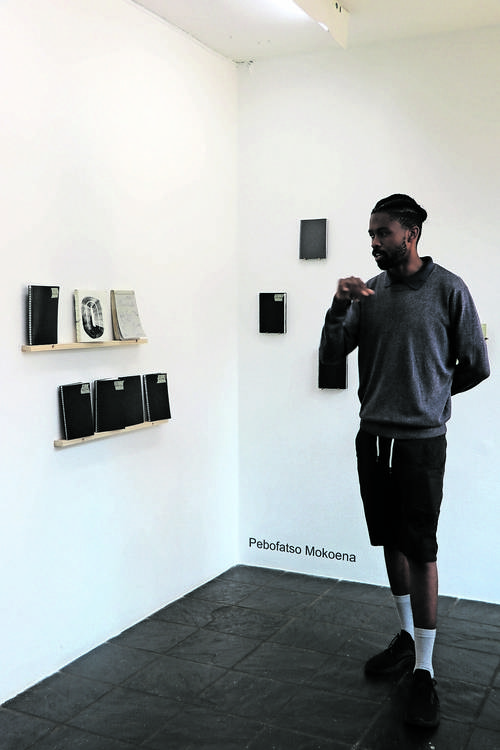
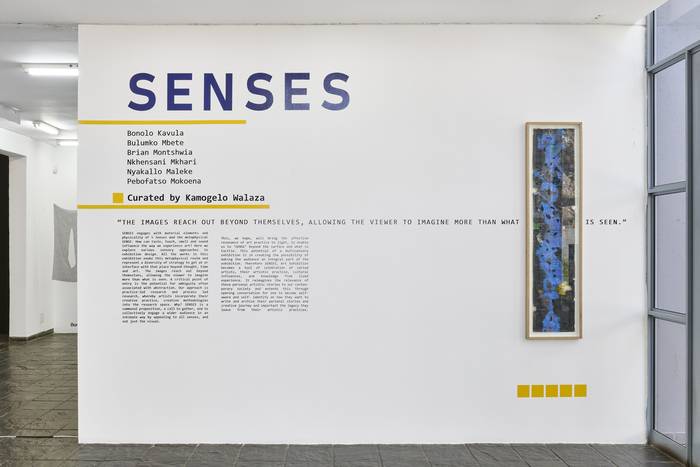
The moment you walk into the gallery space at the Goethe-Institut in Johannesburg, you are met by the Senses exhibition, which captures the mind, heart and, of course, the senses.
The exhibition is presented as part of the Young Curators Incubator programme — an initiative conceived by the Goethe-Institut in collaboration with the University of Cape Town’s Michaelis School of Fine Art. It is curated by Kamogelo Walaza.
During a private walkabout, Walaza explains some of her curatorial choices for the exhibition, which displays the work of six multidisciplinary artists, carefully chosen to tell their stories. They are Bonolo Kavula, Brian Montshiwa, Bulumko Mbete, Nkhensani Mkhari, Nyakallo Maleke and Pebofatso Mokoena.
Some background. Senses is a group exhibition that engages with the material elements and physicality of the five senses — how taste, touch, smell, vision and hearing influence the way we experience art.
The exhibition does awaken the senses as you make your way through each of the artists’ contributions.
I am moved to touch Mbete’s work, which is what you encounter as you walk in. They are contemporary works made of materials such as denim and itshali (a type of blanket worn by brides on their wedding day).
Walaza quickly cautions that this work cannot be touched, just admired with the eyes: “There are works that people can come into contact with, while others can be admired by just looking at them.”
She emphasises the importance of the relationship between the curator and the artist and says there should be open lines of communication at all times. That, ultimately, creates an environment where the work is showcased with the utmost respect.
The importance of this back-and-forth surfaced when she wanted to suspend one of Montshiwa’s installations to display it on the exhibition.
“I felt that it would have been stronger,” she says. However, the artist explained that hanging referenced a past experience with a loved one. Walaza knew that she had to listen and respect Montshiwa, regardless of her curatorial desires.
“These are the types of angles you look at as a curator when you negotiate with an artist. That’s why I say social practice is important, in as much as this is the work coming into the space and, now, I take a level of ownership of the work.
“It is very important to have those interactions with artists to make sure that they are okay and they trust that their work is there with you.”
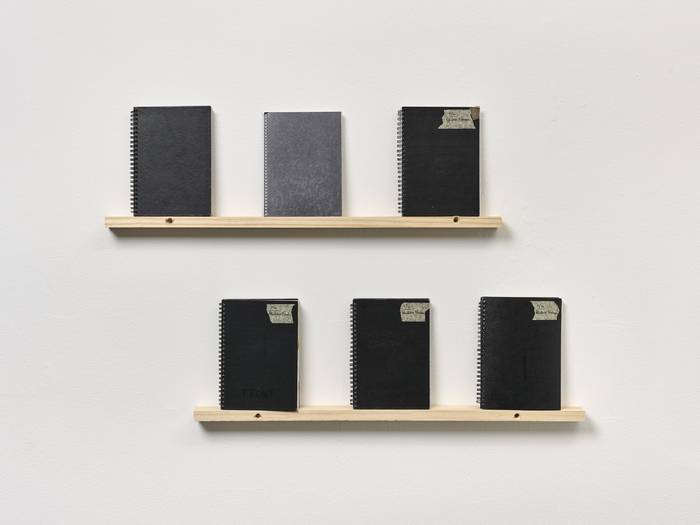
The exhibition ends with an interesting piece of work. For it, notebooks are carefully and skilfully placed. They are simply displayed. Some stand neatly on a block of wood, while others are strategically placed against the wall. They are calling to one of my senses.
“Can I touch this?” I ask. “Absolutely,” replies Walaza.
I open one of the notebooks, dated 2016. Every page is filled with abstract illustrations.
She tells me, “This work belongs to Pebofatso Mokoena.”
Walaza explains that Mokoena has been travelling between his hometown of Alberton and Johannesburg for years, using public transport. A lot of the illustrations are about how he experienced the city.
“Every day I come here, open a notebook and find something new. I am always amazed at what I find in these books,” says Walaza.
I drop a notebook by mistake and panic. But Walaza tells me: “Don’t worry — this is a curatorial choice.”
My next mission is to track down the man behind the notebooks to paint an image for us, to place us where he was, tell us what he was feeling, at the time of making them.
On a hot Tuesday afternoon, Mokoena and I sat for almost an hour at the Salvation Cafe in Milpark, talking about his process and work. He is soft-spoken and I started to regret the choice of venue because we made it to the café just in time for the lunchtime rush.
The 30-year-old tells me he was born eight months before South Africa’s first democratic elections in April 1994 and shares his first memorable encounter with the arts.
“I used to watch quite a bit of TV and draw. Other kids would draw cars and houses; I would just draw lines but I never really knew what those lines were,” he says.
Mokoena says his love of drawing was so evident to his family that they bought him a 72-page book in which he would draw figures and lines.
“That meant everything to me. There was something about having a book and a pen where I could just do whatever I want on a page. That was one of the best things ever — it was not the ultimate freedom but a licence to build what I wanted and no one could tell me it’s wrong,” he says.
He matriculated at Alberton’s Bracken High School in 2011 with a distinction in visual art and the Design School Art Trophy.
Mokoena would go on to study visual art at the University of Johannesburg and got his bachelor degree from the University of the Witwatersrand with distinction. He is studying towards a master’s degree in fine art.
According to his page on the Latitudes Centre for the Arts’ website, his work “orbits in between critical discourses across the spheres of visual art architecture, global culture and aesthetics”.
“These interests at times open and bridge gaps in his own understanding of the importance of being alive in a world that, in theory, in becoming smaller and smaller.”
Mokoena’s work also taps into why people move from one space to another and the way they move.
Although he uses many media, he says pen and paper is his favourite because they are limitless.
What we see in the notebooks on Senses is him trying to make sense of where he was, to figure things out, as he felt he was operating in a very complex space, being the city.
“I could not articulate what capitalism, communism or socialism was, but I could articulate the movement of people from one space to the next, or the movement of taxis.
“I did not know I was mapping those things out and that I was creating diagrams,” he says.
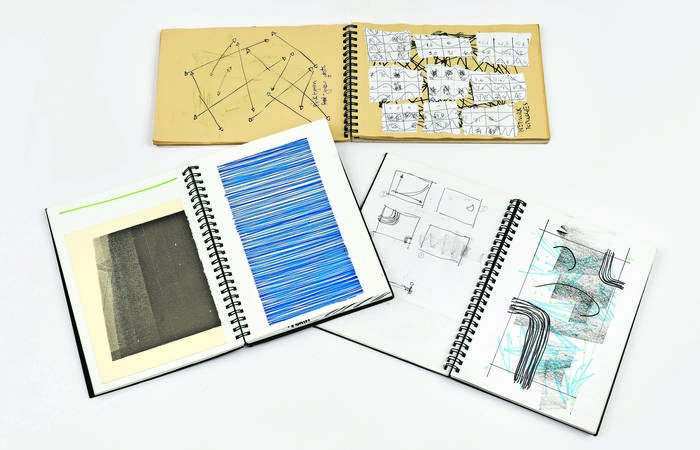
The notebooks grew over time as he navigated the city, and when Walaza approached him about an interactive show she was working on, he started thinking about how to put a collection of works together.
“The books were the initial idea but Kamo [Walaza] wanted us to take it even further. We pushed it further until the final week but we did not have anything to show.
“We knew we needed to get it together very quickly and we knew we had to go back to the original idea — the books,” he says.
The exhibition’s works flow well into each other. If you did not know it was a group show, you might think the work was by one artist — showcasing Walaza’s curatorial prowess.
“When you encounter art, drop all your baggage at the door. Get into the work with the least amount of assumption,” Mokoena says.
His notebooks, a highlight of the show, invite viewers to connect with his personal reflections on the movement and space of the city, providing a unique and intimate experience for all who engage with this captivating showcase of sensory exploration.
The exhibition runs until 29 February at the Goethe-Institut Johannesburg in Parkwood.
Guide dog association to sue Uber over ‘discrimination’:

The South African Guide Dogs Association for the Blind (Sagda) said it will take Uber SA to court after multiple cases of discrimination were reported by people with disabilities wanting to use the e-hailing service.
Shepstone & Wylie Attorneys, who will be taking the case to the Equality Court on behalf of Sagda, said they had made attempts to communicate with Uber to highlight various incidents of discrimination that had been reported but they had been ignored.
“Unfortunately, we received no meaningful responses or undertakings from Uber that it would take action to eliminate the ongoing discrimination faced by Sagda’s members.
“Sagda has been left with no alternative but to approach the Equality Court for relief on behalf of its members,” senior associate Sirhaan Che’ Khan told the Mail & Guardian.
The law firm highlighted instances where Uber drivers had refused to allow service dogs into their vehicles, even when an Uber Assist ride had been requested.
Uber SA has also been accused of failing to respond to alleged discriminatory incidents reported by users of the app and to ensure that action was taken.
“There were too many complaints by our members and we thought it was best to handle the discrimination legally,” said Sagda’s Pieter van Niekerk.
The non-profit organisation, which has been operating for 70 years, provides services for people with disabilities, who have visual, physical or developmental needs, with trained guide dogs, service dogs and autism support dogs.
Some Sagda members say their disabilities, such as blindness, have opened them to discrimination from the e-hailing industry.
“Being blind, it is always difficult for me to get an Uber or a Lyft.
“It is either the app or the driver that makes me very aware that my needs cannot be facilitated,” said a 32-year-old female Sagda member, who asked to remain anonymous.
The alleged discrimination against people with disabilities was brought into the spotlight after a change.org petition by Hanif Kruger, who is a manager at the South African National Council for the Blind’s assistive technology centre, in which he shared his experiences of using Uber as a blind person.
Kruger, who made use of Uber to attend the Africa Conference and Career Expo in Johannesburg last year, said he had a traumatic experience after his Uber driver refused to allow his guide dog into the car with him, claiming the dog was “a threat to his life”.
“Even though I explained my dog’s role and training, he stubbornly refused to understand or accommodate us. It was an unsettling experience that left me alone in a dangerous location, where I was robbed just last year,” Kruger told the Mail & Guardian.
He added that the driver had refused to cancel the trip so that he could request another ride, even though he begged.
After some time, the driver did cancel the trip, claiming that Kruger had not been on time, and charged him R25.
But what followed is what Kruger found most upsetting.
“Uber emailed me stating that the driver complained about a verbal altercation and I was warned that my Uber account would be suspended if I continued with this behaviour. I immediately responded to this email.
“Uber then replied, stating that they were not interested in my report and that, if I genuinely wanted to log a case, I should write a separate email,” Kruger said.
“They concluded by stating that no further response was needed from me.”
According to Kruger, Uber drivers have been “difficult towards people with disabilities, while Bolt has not made its app disability friendly”.
Although Uber did not respond to the Mail & Guardian’s requests for comment, in its response to News24 after Kruger’s petition, the company’s spokesperson Mpho Mutuwa said Uber SA had guidelines against discrimination.
Mutuwa said that Uber had encouraged people with disabilities to make use of Uber Assist when requesting a trip to make the process easier.
“Uber Assist, a first in the market, was developed with the purpose of ensuring that riders with disabilities can get to where they need, hassle-free,” she told News24.
Mutuwa added: “Should there be any issues with the trip, like cancellations due to the presence of a guide dog, it’s important that riders report this using the Help button on the app. This feature has a built-in voice-over function for the visually impaired.”
However, many Sagda members told the M&G there were problems with Uber Assist, including that the app had few rides available and that drivers still refused to accommodate guide dogs.
“It takes me double the time to get an Uber Assist and, even when there is an available driver, he or she will refuse to let me bring my guide dog along and will give excuses that they either have a phobia or that the dog will litter the car,” said an 41-year-old blind man who tried to make use of Uber Assist, as stipulated by the company.
In its application to the equality court, Shepstone & Wylie say that Uber Assist has not proven to be a viable option for people with disabilities.
“[T]he Uber Assist option is discriminatory in itself in that the Uber Assist option is more expensive than an Uber Go option and is not available in certain areas or at certain times of the day — thus the Uber Assist option is not a reasonable alternative for persons living with disabilities,” said Shepstone & Wylie partner Deirdre Venter.
The E-Hailing Partners Council (EPCO) said there was an information gap when it comes to how drivers should assist those with disabilities.
“There is no specialised training and unfortunately there is an information gap about such provisions for e-hailing drivers, given the fragmentation of the industry,” the council’s spokesperson, Kenny Moretsele, told the M&G.
According to EPCO, it has been pushing in the past years for the industry to be regulated so that issues such as “people with special needs can be properly taken care of”.
January 14 is the deadline for the council and other industry stakeholders to make their final submissions to the e-hailing draft regulation.
Submit and get free exposure here: Showcase Your Business | Advertise Your Special Offers.